Tag Archives: Power Stroke

Polaris Industries Inc.,  announced its entry into the Indian market on 24th August 2011, through Polaris India Pvt. Ltd, a wholly owned subsidiary with a wide range of their products on offer bought in as completely built units from the USA.

Mr. Pankaj Dubey, Managing Director – Polaris India Pvt. Ltd., speaking about the market scenario, said “The specialized automobile market is at a very nascent stage in India at this time. Our principal aim is to sensitize the consumers and create a new market for the possible options available in recreational vehicles such as ATVs, off-road jeeps (Polaris RANGER RZR Side-by-Side vehicle) and snowmobiles, and to generate more interest in these activities. We will focus on the utility application of our vehicles in areas of construction, forest, military, police and Para military forces”

As part of its strategy to sensitize consumers, Polaris India intends to travel to a number of cities in the country with their products in tow and let consumers sample some of their offerings. After Delhi and Ahmedabad experienced the slush, muck, the smell of gasoline and good quality riding gear, it was Chennai’s turn.

Polaris’ offerings in India include Polaris Sportsman® ATVs, Polaris RANGER RZR® Side by Side Off-Road Jeeps and Snowmobiles.

MPL Adventure Sports Vehicles Pvt. Ltd., will be Polaris’ dealer in Chennai. MPL is a big name in Chennai having established their credentials with their Ford, Mahindra dealerships. Riot Engine spoke to Mr.S.Ashok, the Director.

We were pleasantly surprised when we realized that this gentleman at the event doing the running around, interacting with prospective clients & members of the media, under the merciless Chennai sun was the Director himself. Ashok believes you do not normally get into this business without having the passion for automobiles.

Ashok introduced us to the ATV range starts from Rs. 2.85 Lakhs and goes all the way upto Rs. 12.5 Lakhs. The Side By Side jeeps start from 10L and go upto Rs. 20L. The off-road vehicles from Polaris are niche market products and Polaris is using targeted advertising methods to reach the clientele that would be willing to fork out the money for the leisure and luxury products from Polaris.

Ashok believes there has never been a better time for Polaris to expand into India, with the rising purchasing power of the Indian. Spares have been stocked, and service will usually be provided on-site with the help of a service van equipped for this purpose in addition to the small workshop that the dealer will have.

Krishnapatnam Port in Nellore already has some imported Polaris’ vehicles doing duty. Ashok says these vehicles can find application in the forests, in mining and construction operations, and in leisure activities like adventure sports.

Polaris branded riding gear will also be available at the dealers. The RANGER® is also available as a Diesel and an electric. A 30 HP/48V AC electric motor powers the EV. It plugs into a 110V AC outlet to charge, in the USA, we assume necessary changes will be made to plug it straight into 240V sockets.The EV retains Polaris’ On-Demand True AWD which maximizes traction.

Business Standard has also reported that Polaris India also has plans to introduce low speed electric vehicles in India. Pankaj Dubey, managing director of Polaris India, said, “We have a good line-up of passenger and goods carriers in GEM. We will soon start a market study to assess the potential for these vehicles in India.”

Dubey said, “ORVs can be used in farms and forests for mining and construction work and also by defence forces. We intend to achieve sales of a minimum of $100 million by 2016.” Polaris records majority of its sales from North America, Europe and Australia. It had a turnover of $1.99 billion in 2010.

Polaris Sportsman ATV

How deceitful and hypocritical can people get?  If you want to know the answer for it, we suggest you take a look at the MotoGP paddock.  It is now very well documented that in the March of this year Japan was rocked by an earthquake and a resultant tsunami that destroyed not just the physical infrastructure of Japan but also the lives of millions.  Even today there are videos being posted on You Tube and these were made by those who were caught in the devastation and died but the cameras (only some) survived to tell the tale of what happened in Japan.  If you have not already seen those scary videos we suggest that you head over to You Tube and do a search for these videos.  Even those who survived the tsunami and the earthquake have been rendered homeless and though alive, have lost everything, including families.  There are heart rending and gut wrenching tales that can bring tears to even those who are insensitive to others’ suffering.  One of the results of this tsunami and earthquake was the over heating of the Daichi Fukushima nuclear reactor and this threatened to become a full fledged melt down bringing fears of radiation that would be worse than those that happened after an accident in Chernobyl in the erstwhile Soviet Union.  The other development which will be of interest to you and me is the postponement of the Japanese MotoGP race from its scheduled date in April, 2011.  The postponement was indefinite and it was said that after seeing how things progress in Japan if possible another date would be chosen for the MotoGP race.  The MotoGP paddock was not one to left out.  Every race in May and June saw several riders, team members and officials carrying placards that said “Japan, We are with you”.  Even the fans carried banners while some of the riders also pasted stickers proclaiming the same on their steeds.  We all prayed 1) for the recovery of the Japanese people and as racing enthusiasts 2) for an alternate date to hold the Japanese MotoGP race.  Needless to say the second was only an add on, the first being the priority.

It is well known that the Japanese are assiduous and diligent people who know their region and themselves better than anyone else.  They are always in some state of preparation for natural disasters given the fact they are in an earthquake prone region and that volcanoes exist pretty to all the Japanese isles and that most of these volcanoes are active.  It only needs a volcano to erupt for earthquakes and tsunamis to follow.  They have risen from many tragedies in the past and are a very resilient people who strive to bring everything to normalcy at the fastest speed possible.  Let us say this, the Japanese are better at handling natural disasters than any other country.  The Daichi Fukushima reactor too was worked on and still being worked on and the levels of atmospheric radiation have been brought down drastically even as per the International Atomic Energy Agency.

The Twin ring Motegi circuit is approximately 130 kilometres from Daichi where the Fukushima reactor is.  Initially the radiation levels at the twin ring circuit were high.  The circuit is called twin ring because it has two kinds of tracks.  The first is usual twisty track that is used for MotoGP and Formula1 racing and the second is an oval track with a banking (the sort that are used in America, Indianapolis being a prime example, for Indy Racing and NASCAR Racing).  The track is owned entirely by Honda, who use both circuits for extensive testing of their products before they are released into the market.  This just one of the two tracks that Honda owns, the other being the famed Suzuka that still hosts the Japanese Formula1 GP.  We have just said that the Japanese are a disciplined and resilient people and proof of that came when an announcement was made in June that atmospheric radiation was coming down.  Honda to instill confidence in the world actually started repairing the track in June itself and after that test riders regularly rode/drove Honda vehicles at Motegi.

By August it seemed that Japan had recovered sufficiently to put the tragedy behind it and look to rebuilding its future.  The Japanese have since then been doing exactly that.  In the meanwhile they received great support from other countries in the form of charitable aid, but most importantly there were people working in certain organizations such as the Red Cross who went into areas where radiation levels were pretty high.  They stayed in Japan, worked with the local communities and ate the same food that ravaged people were eating. Other technical people even went to the core of Fukushima reactor to help in solving the problem.  They had the necessary clothes and gear to protect themselves from the extremely high levels of radiation but nevertheless they were likely to be and were exposed to some atmospheric radiation near the site of the nuclear reactor.  These people did not hold placards or banners that said “Japan we are with you”.  They were actually in Japan, with the Japanese people and they played an important part in Japan’s recovery process.

When it was obvious that things were settling down the FIM announced in conjunction with Dorna that the MotoGP race would be held in Japan on the 2nd of October, 2011 if there were no problems.  For some time there was silence in the paddock and as the date started drawing closer, the rumblings began.  The first of the lot who started talking about exposure to radiation and safety was defending MotoGP champion J-Lo (no, not her) or Jorge Lorenzo.  He kept saying that it would not be safe and he did not want to go there since he wanted to live for a long time etc.  Then came Casey Stoner, who in his brusque and forthright Australian style, declared that nothing and really nothing could take him to Japan.  He said “How will it help the Japanese people if I go there?  What good will it do to them?  Therefore, I am not going, that is it”.  Here one must wonder how the banners, placards and all the other such things were helping Japan.  If this is not hypocrisy than what is? The other people in the paddock were supposed to have expressed their dislike for the idea of going to Motegi and parleys between riders and Dorna and FIM started.  It is to be considered that three out of the four manufacturers in MotoGP are Japanese and in Moto2 all engines are supplied by a Japanese company called Honda and that next year when the 125cc class will be scrapped in favour of a four stroke 250cc class called Moto3, the European manufacturers will cease to exist on the grid.

Another quality of the Japanese that we have not talked about is their pride.  They are noble people who are proud of their achievements and the Japanese manufacturers wanted to show how well they have recovered.  They were not going to take it kindly if the event was cancelled.  Dorna and the FIM had no option but to go around.  The Japanese in all fairness asked Dorna to commission an independent agency to tell the teams whether it was safe or not to go to Motegi.  ARPA was commissioned and in its report it said that there was no danger of radiation and therefore it was safe to go to Japan.  In all this the one thing that has come to the fore is not just the plain stupidity of Lorenzo and Stoner but the wiliness of  Rossi. Rossi was waiting in the shadows hoping that Lorenzo and Stoner would succeed in getting the Japanese round cancelled.  Soon he realized that was not to be because Lorenzo (under pressure from Yamaha) and Stoner (under pressure from Honda and also from each other since if one did not go the other went he could clinch very valuable points that could make the difference to their championship campaign) began to make conciliatory noises.  Stoner said “I said what I said because it was that very day I came to know my wife was pregnant and I was concerned that she and the foetus could be affected by radiation but now I am a little more settled because of all the reports coming out of Japan”.  (A paddock insider told us exclusively that Lorenzo wanted to say that his friend’s wife was pregnant and it would be bad for the friend, the wife and the foetus if Lorenzo went to Japan and so he said what he said in the heat of that moment and that it took very severe persuasion from the Yamaha PR personnel to get him to drop this idea).

So Rossi found that the two objects that were creating the shadows in which he was hiding had suddenly moved on and so he stood exposed.  After having called Lorenzo and Stoner pussies (not what you are thinking, it was his idea of sissies) in the past, Valentino Rossi demonstrated that he was the biggest pussy of them all (not that meaning, we are a family safe website).  Rossi does not give up easily, we know that.  It takes something like the Ducati Desmosedici to tame him.  He first suggested that Ducati should pull out completely since they were not a Japanese company and so need not have their arms twisted.  Dorna and Carmelo Ezpeleta are not what they are for nothing and they found something else in contracts to twist collectively all the arms that were there in Ducati’s MotoGP team and also in its satellite teams.  The result Ducati said they will go.  Rossi still did not want to go and suggested that the venue be moved to Suzuka which is relatively less affected due to a greater distance from the reactor.  Honda simply said that Suzuka was no longer homologated as per FIM and MotoGP norms and there was no question of shifting venues. So a kicking and screaming Valentino Rossi has decided to land in Motegi.  Looks like a happy ending to a very sad story, right?  Wrong.

We Indians know how to make noises of the wrong variety.  Mahindra that runs a 125cc racing team under its own name has gone and offended not just the Japanese but also every self respecting Indian.  After buying out Engines Engineering of Italy which had previously supplied 125cc motorcycles to the Chinese manufacturer Loncin and later till last year to an Italian consortium who raced under the Lambretta name, Mahindra decided to announce itself globally.  To their credit the effort of Engines Engineering  has improved tremendously once they started racing as Mahindra and their bikes have been scoring points which they never did when they were Loncin or Lambretta.  Now Mahindra has undone all the good work and the good will by allowing the lily livered lot in their team to stay back in the comfort of their homes, while they were going to hire “local” people to do the work in the team. Team Manager Mufaddal Choonia has this to say. “It was difficult, but we felt it right to offer the choice to our team members and we have to respect their decisions,” said team manager Mufaddal Choonia. “While the information that Dorna has circulated has been very reassuring, it did not seem fair for us to force the guys to head out there if they had their own personal concerns.  Of course, it will not make the weekend particularly easy. Mahindra Racing is a slick operation. Each man has his role and they all know the bike inside out. With the temporary staff members we shall do the best we can and hope to carry on the great progress we have made this season”.  We hope that Mahindra in fairness to all will leave their motorcycles in Japan so that the radiation from them does not contaminate the sterile Europeans.  As if this is not enough, Team JiR in Moto2 has also decided that they will allow their team to stay behind and that they will use the services of technicians from their chassis (TSR) and engine (Honda) makers both of whom are Japanese.

It is obvious that MotoGP comprises of stupid people who do not know that the frequent MRI scans that they go through are far more lethal in radiation terms. than what is now the level of radiation at Motegi.  Only a few days ago the Indy Racing series staged its race despite small tremors (after shocks) being felt during the weekend and when cars were on the grid.  Motorcycle sport carries the shadow of deadly risk, injury and death in its wake.  One assumes that the riders are aware of that.  Then why all this rubbish?  It is perhaps a demonstration of the lack of feeling.   Roger Waters (ex Pink Floyd) was given a small paragraph written by a prisoner undergoing torture in one of the South American countries and he made that the basis of his song “Each Small Candle”.  It would not be out of place to quote the lines written by the unknown prisoner.


“Not the torturer shall scare me,

Nor the body’s final fall,

Not the barrels of death’s rifle,

Nor the shadows on the wall,

Not the night when to the ground, the last dim star of pain is hurled,

But the blind indifference of this merciless unfeeling world”.


All New Ford Fiesta in India

All New Ford FiestaAll New Ford Fiesta : Integrated IndicatorsAll New Ford Fiesta : Rear 3/4All New Ford Fiesta : kinetic Design headlamps

On the East Coast Road

It was a sultry afternoon in Chennai. And a roadside with no trees on either side of the road, was not a good place to be in at this temperature. I waited as sweat beads slowly trickled down my forehead.

The sighting of a car painted in Ford’s signature shade and the ringing of my mobile happened simultaneously. It was my colleagues checking to make sure I was where I was supposed to be – waiting for them at the roadside.

The new Ford Fiesta rolled to a stop next to me. Maybe we should give it a name similar to the new Verna which is called the ‘fluidic’ Verna, I thought. I began to wonder how ‘kinetic’ Fiesta would sound.

The kinetic energy exuberated by the Fiesta was not convincing enough to challenge the powerful thermal energy from the Sun, which meant we decided to do all the talking after we were inside the car and into realm of the air conditioner.

There was only one place where we could get a feel of this car in Chennai at this time of the day. The three of us headed to ECR against the backdrop of the setting sun.

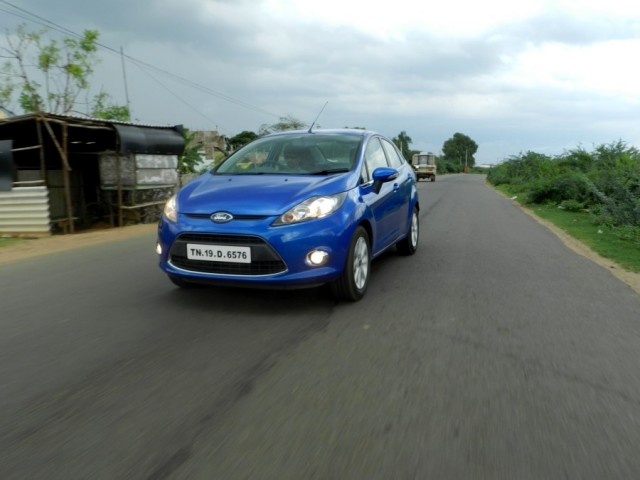
All New Ford Fiesta on the ECRAll New Ford Fiesta on the ECR

We reached ECR and decided it was time to evaluate the physical traits of the car. A good long look at the car and I felt the design was striking at the front, with the striking-ness withering as you walk towards the rear of the car. Something which makes you ask the question if this was a hatchback first. Which incidentally, is true. But it is not like the Dzire and Manza where the boot feels as if it was welded on as an afterthought. It is just that the same design fizziness is missing at the rear when compared to the front.

If you are interested in knowing more about the design language and the engine of the Fiesta, please do check out our dedicated sections on Engineering and Design on pages 3 and 4 of this article.

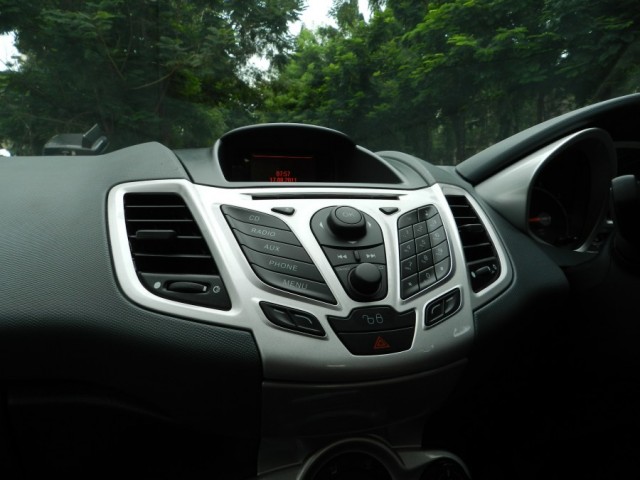
All New Ford Fiesta : Dash

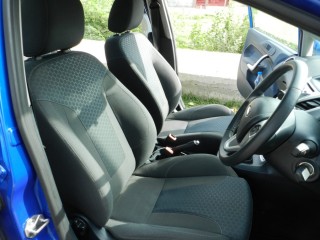
Initial feel inside the car– well laid out controls, chunky steering wheel with the controls for audio and cruise control (as we had got the Titanium variant). Hop on to the driver’s seat and one can feel the bolstered seats almost immediately. I then tried the height and length adjustments of the driver’s seat. The height adjustment was an amusing experience as you have to pump a lever as the height steadily rises. This felt like a massage to the back and the pumping was a good exercise to the arms.

The central console, designed after gadgets these times, has panels painted silver, not unlike how the rest of the body panels are painted. Quality of the other plastics though – disappointing, in one word. The glovebox felt flimsy, the plastics were too, err… ‘plasticky’. Not that it was bad but we don’t expect this in a car in this segment. One look at the interiors of the Vento and you know what we mean.

All New Ford Fiesta Interior ViewAll New Ford Fiesta Interior: Climate Control

We then tried playing around with the by now famous voice activation system. We were able to set the temperature on the climate controlled AC without much of a vocal effort. We will have more on this and the sound system later.

One of my colleagues was already not happy where he was – at the back bench, saying it was not as good as his second generation Honda City. We decided to check it out and understood what the complaining was about. Even though Ford’s are known to be ‘driver’s cars’ their treatment of the rear benchers has always been questioned. Both the Ikon and Fiesta did not have great rear leg room. The Figo was the car which helped their case by being more generous to large families. But things haven’t remained the same with the new Fiesta. The rear leg room is still just adequate.

All New Ford Fiesta Interior Space : RearAll New Ford Fiesta Interior Space : Front

As we moved on ECR, we came across a side road which led to the sea. This road looked like it was going to be a good test for the ride of the car. We turned into it and were amazed at how well mannered the car was on the undulated road. The high ground clearance gives you the confidence to let the car run over the potholes at pretty decent speeds.

Coming to what’s under the hood, the Fiesta now comes with an all new 1.5 litre petrol engine which generates around 110PS. So the engine is smaller than the previous Fiesta but makes more power. Wow… That might translate into more fun on the road, I had said aloud. We couldn’t wait to find out.

We let the car sprint the moment we encountered an empty stretch of the road. And sprint it did. But in a controlled, less aggressive manner. This is in spite if this being the petrol car and of course this is not what the previous generation Fiesta was known for. No necks pinned to the headrest, no adrenalin pumping surge…

That is when we got the feeling that the look of this car does not complement the engine that it has. It is evident that Ford has played it safe when it came to the pricier fuel. It has tried to find the balance between outright performance and fuel efficiency, two parameters which are almost mutually exclusive. Not that this is a bad thing considering the current prices of petrol. But fans of the previous generation Fiesta might feel slightly disappointed. With these thoughts in mind, we watched the sun set and decided to head back to the city and into thick traffic.

The traffic meant we could test another facet of the car – how it behaved in choke block situations. The first thing that you realise is that even though the low range grunt is not mind blowing, it is more than adequate to keep the car rolling along in second and third gears. Fuel efficiency was shown as 10.5 to 11.5 while navigating through traffic which was appreciable for a petrol car.

My colleagues then dropped me home, after we having decided that tomorrow was the highway day where we would test high speeds and handling among others.

Cruising the by lanes of Chennai

All New Ford Fiesta in Nungambakkam

At dawn the next day, as we were traversing some of Chennai’s posh localities towards the highway, a thought struck us.

It actually hit us while we were taking pictures of the car at various places. The kinetic design seemed to complement certain backgrounds better than others. Parked in a dusty road, next to old buildings, it seems futuristic. Seemingly out of place. But parked next to a snazzy new mall or shopping complex with geometrical shapes and lots of glass panes and windows, it seems to be perfectly at home. Take a look at some of the images let us know if you agree!
All New Ford Fiesta

All New Ford Fiesta : No Mustangs hereAll New Ford Fiesta : That's evolution!All New Ford FiestaAll New Ford Fiesta

The question above is becoming more and more inconvenient if you are either a Valentino Rossi fan or an Italian motorsport journalist.  When Valentino Rossi went to Ducati amid the celebratory sounds of bugles and the blaring of klaxons it was thought that Italy’s favourite son was going to decimate opposition on an Italian motorcycle icon.  Then the first test after the last round of the 2010 championship happened.  Rossi went very slowly on the Ducati to finish 15th on the timing sheets, as good as slowest and last.  Casey Stoner who got off the Ducati and hopped on to a Honda went fastest, straight out of the box, exactly like he did in 2007 when against all expectations he went super fast on the Ducati and took victory in the first race and finally the championship itself.  In that process he made Valentino Rossi look very ordinary and that ruffled Rossi so much that he threatened to quit Yamaha if Masao Furusawa did not take greater interest in matters.  He also asked for Bridgestone tyres which Stoner was using and got his way.  In the process Michelin was so demoralized that after a couple of years they quit MotoGP.

The devotion that Yamaha showed to Rossi and the hard work that Rossi and Jeremy Burgess his crew chief meant that the following year Rossi could wrest the initiative back from Stoner and went on to claim the championship in 2008 and 2009.  Even while Rossi was winning championships a threat to his supremacy was brewing across the Yamaha pit garage on the other side of the wall.  Jorge Lorenzo, young, ruthless and ambitious (some would also say disgusting but that is another story) was making his intentions of wanting to be MotoGP world champion very clear and that meant that he would not play second fiddle to Rossi.  Rossi and Burgess were insisting at every possible juncture that Lorenzo was reaping the fruits of the plants whose seeds were sowed  and nurtured by Rossi.

Meanwhile at Ducati things were not exactly quiet.  Two things were happening there.  One was that Casey Stoner’s victories were becoming more sporadic and he was crashing a lot more just like when he started racing in MotoGP on a 990cc Honda (with LCR).  But he was still winning and finishing on the podium quite regularly.  The second thing was that Loris Capirossi was out of Ducati after being Stoner’s teammate for a year.  Loris Capirossi won the odd race but his record on the Ducati of whatever cubic capacity was no match for what Stoner had done in 2007.  So Loris Capirossi leaves Ducati to go to a non performing Suzuki team where he continued a few more barren years in MotoGP.  Loris Capirossi was replaced by another Italian Marco Melandri.  Marco Melandri appeared pathetic on the Ducati with just one decent top five finish in China but otherwise ending up at the tail end of the field, much like Toni Elias this year.  Melandri was so embarrassed by his non-performance that he hung his head in shame and voluntarily left Ducati and was replaced by Nicky Hayden.

Nicky Hayden was the world champion in 2006 on the 990cc Honda, though many would argue that he became one only because of the lack of reliability of the Yamaha.  Whatever maybe the case, Hayden was a world champion.  When Nicky Hayden was announced as Melandri’s replacement there was a lot of talk about how Hayden’s style was more like Stoner’s and how they would make a super duper team.  Unfortunately for Hayden no such thing happened, even though it must be said that he managed to acquit himself a little better than Melandri had.  But on the whole he too was spectacular in not getting to grips with the Ducati.  By the time Hayden had gone to Ducati in Melandri’s place, one big change took place technologically on the Ducati Desmosedici.  Till 2008 Ducati had raced a motorcycle with a conventional frame, but unlike the Japanese motorcycles which used an aluminium twin spar or Delta box frame, Ducati was using a steel trellis frame.

For a moment just let us get a wee bit technical here.  We Indians have grown on antediluvian motorcycles of capacities of 250cc or 350cc or on 100cc pocket rockets such as the RX 100 from Yamaha and to some extent the KB100 and KB125 two stroke motorcycles from Kawasaki-Bajaj.  The antediluvian motorcycles such as the Yezdi and the Enfield Bullet had handling characters that could make Tata and Leyland trucks feel like they were Formula1 cars.  But the Japanese motorcycles handled quite well and one of the key reasons for that was a frame that was flex free.  Flex free frames are rigid and actually give confidence to the rider but only if they are tiddlers like the Indo-Jap 100cc bikes.  But bigger bikes that put out 150 bhp to 200 bhp would spit the riders off if they were completely rigid.  Enter Japanese ingenuity.  Instead of using steel for the frame the Japanese started using aluminium that is more friendly to building flex at the right places so that the rider is not thrown of the bike.  Over a period of time the Japanese had perfected the art of building Delta box aluminium frames that could be tuned as per the necessities of the riders and their different styles.

Ducati’s steel trellis frame was trying to do what the Delta box frame was trying to do i.e build flex to make the motorcycle handle better.  The philosophy of the trellis frame is that it is built in a way where the vertical steel pieces are welded at different angles to build flex and this is actually imprecise.  Filippo Preziosi the builder of the Desmosedici believes that it was the trellis frame that was ultimately the undoing of Melandri.  He therefore experimented with carbon fibre and built a monocoque chassis of sorts wherein the engine was used as a stressed member.  Preziosi argued that carbon fibre lent itself to dialling in flex the best from all available methods.  He was actually trying to overcome the problems of the trellis frame without doing what the Japanese were doing for that would only give them an advantage.

So when Rossi sat on the Ducati for the first time he was sitting on a motorcycle of this variety that found limited success in Stoner’s hands.  In fact, when an even firing order was used in the Ducati engine (screamer engine) and when this was mated to the monocoque it seemed to give Stoner better feed back than it was doing when Ducati shifted to the uneven firing order or Big Bang or growler engine and mated it to the monocoque.  Stoner only won three GPs and all of them after the Motorland Aragon GP (including it).  When Rossi rode this motorcycle to 15th on the timing sheets, most people thought it was just a small thing.  Rossi too simply said that the “Ducati should be ridden differently, in a more dirty sort of way”.  Then the 2011 season began and Rossi has looked far from being a winner.  His detractors were overjoyed and one among them was Casey Stoner.  Stoner had been vexed by criticisms by Rossi fans and their booing every time he won a race.  He was also put off by the sympathy that journalists had for Rossi.

Rossi is not only a very skillful rider but one who knows how to keep journalists happy.  He could hold press conferences where he would pull a chair and sit in their midst and with great charm and grace field their questions.  He knew most by name and made it a point to use their names while answering questions.  The same journalists fraternity has now started defending Rossi.  They say that Rossi looks ill at ease with the Ducati and after months of investigation have declared that it is the bike that is a dud and not the rider.  It also helps immensely that Loris Capirossi who returned to the Ducati fold found himself more on the asphalt than on the bike as did his teammate at Pramac Ducati, Randy De Puniet.  Nicky Hayden too has not been going very well and so the popular verdict was that it is the bike and not the rider.  Stoner however has been queering the pitch by questioning Rossi’s inability to ride the bike even after truck loads of Marlboro and Ducati money are being thrown.  Those questions have become very inconvenient with all of Rossi’s experiments with the Ducati in terms of various designs of chassis and different materials being used, all leading to no improvement of any kind.

So is Stoner the better rider?  In the face of the overwhelming evidence that is available to us today, the answer has to a yes, however inconvenient that maybe to the Rossi fan.  Italian journalists are at a wit’s end to deny this.  If you deny then you vilify an Italian marque’s motorcycle and if you don’t then you damn an Italian great who is a nine times world champion, seven of those in the premier class and five in the four stroke class and four on the Yamaha to make it the most successful marque in the 800cc era.  Rossi humbled the might of Honda and resurrected Yamaha by making it rise from the ashes.  Dani Pedrosa, Andrea Dovizioso, Marco Simoncelli and before them Nicky Hayden could not bring the world championship in the 800cc era to Honda.  That may well have been the case this year too if it wasn’t for Casey Stoner who is riding the wheels of the RC212V and looks certain to take his second world championship and the first for Honda in the final year of the 800cc era.  This at a time when Rossi is languishing at the back of the field and generally making up the numbers. So it does appear as if Stoner is a better rider especially since both he and Rossi rode the same bike from last year and where Stoner won and Rossi looked like anything but a winner.  But then life’s mysteries are seldom so easy to resolve.  So let us consider a few things.

When Casey Stoner jumped on to the Ducati in 2007 he was all of 21 yrs old and eager to prove his mettle as a rider.  He was fearless and took risks to establish himself.  Remember he won the championship on a trellis framed bike.  Rossi got on to the Ducati when he was 31 years old.  It is well known that advancing age makes people more aware of their mortality and therefore fewer risks are taken.  Rossi also went as one of the greatest champions of all time.  So the determination to explore the outer limits of a bike could be missing.  In fact, the ego of the nine time world champion must have felt that it was up to Ducati to give him a winning bike and not up to him to make the bike win.  He also thinks he is this great development rider and so has taken on the onerous responsibility to developing the Ducati into a rider friendly bike.  In doing so he has found that he is just a rider and Ducati did not have the wherewithal to build an aluminium space frame or delta box. So everyone is struggling.  Perhaps what Guy Coulon of Tech3 had to say when it comes to riders is very important here.  Coulon is the person who designs the Moto2 frames for Tech3 apart from being Colin Edwards’ crew chief.  In an interview with David Emmett a renowned journalist when questioned about the lack of innovation in frames, Coulon said that innovation in MotoGP is limited by the fact that rider’s want what they are used to.  He believed that conventional delta boxes delivered a certain kind of feedback that a rider to could process but if the nature of the feedback changed then the rider does not know how to process it.  That is perhaps where the answer to Rossi’s problems lies.  After years of riding Japanese machinery and with advancing age Rossi could be finding it difficult to process the information that he needs to.  A younger, eager and needing to prove himself Stoner had perhaps been able to do that.  No wonder then that Preziosi said that he would once like to have Stoner ride the Ducati to see where they really are.  Good thought but in the complex world of MotoGP contracts that is never going to happen.  And so we will never really know for sure as to who is better, Stoner or Rossi.

When was it that you last saw a MotoGP grid packed with many riders.  Can’t remember right?  And you are not to be blamed for that.  It has been aeons since the premier class in MotoGP (which is most unimaginatively titled MotoGP since the advent of the four stroke era) has seen any respectable number of motorcycles and riders on the grid.  The last few years have been a joke, with grid sizes refusing to go beyond seventeen, despite the increased involvement of Ducati which along with two factory bikes also has four other bikes two run by the Pramac team and one each by Team Aspar and Team Cardion AB. For its part Honda also supports six motorcycles.  This year three of those have been under the umbrella of the factory Repsol Honda team and two under the San Carlo Gresini team and one with Team LCR.  One of the two Gresini bikes ridden by Marco Simoncelli is again factory spec.  Yamaha has four, two for the factory team and two for the Monster Tech3 team.  And Suzuki this year has run one motorcycle.  Last year it had two, but there was one Ducati less on the grid.  The year before there was one Kawasaki that went as Hayate and while in 2008 Kawasaki had two bikes there were two Ducatis less, with Team Aspar also not having a bike.  So what does this tell you?  For as long as you can remember there have been only seventeen motorcycles on the MotoGP premier class grid.  And what about the system of points?  Any motorcycle that finished even in fifteenth place scored a point for the team and rider.  With the advent of the 800cc MotoGP machines and increased involvement of electronics lap times came tumbling down in the process taking some riders down as well.  The increased number of falls suffered by riders has meant that at any given point someone or the other has been injured and so there have been instances in the past two years when the races started with only 15 riders on the grid.  So it meant that if you just started a race, you were assured of points; and this in the premier class of two wheeled racing.

Now let us turn our attention to the year 2010.  The year saw the introduction of a new category and new system of racing.  This is the now familiar Moto2 class which replaced the 250cc class one year ahead of the original schedule.  The Moto2 class is a significant experiment.  Let us look at what prompted this experiment.  The 250cc grids were also beginning to dwindle and for all practical purposes had three manufacturers only out of which Honda and KTM were contributing only four motorcycles between them.  The rest of the grid was made up of Aprilia motorcycles some of which were branded as Derbi, some as Gilera and the rest as Aprilia.  Aprilia, Derbi and Gilera are all Piaggio group companies and Piaggio used the opportunity of a grid full of their bikes to brand them differently for purposes of advertisement.  Honda had said that it had stopped development of its 250cc machine because they did not see any relevance that two stroke technology had for road use.  KTM was too small a factory to take on the might of the Piaggio group and Dorna the promoters of the MotoGP series came under pressure from Honda to wind up the 250cc two stroke category and replace it with a four stroke category just as the two stroke 500cc class was replaced first by the four stroke 990cc class and then the four stroke 800cc class.

The timing of introducing Moto2 had everything to do with global recession which crippled the economies of the developed countries such as the USA, countries of Western Europe and Japan.  Aprilia’s two stroke motorcycles cost millions of Euros something that most teams could not afford and the rising costs were reducing grid sizes even in the 250cc class.  Honda ever the opportunistic company used this situation to press through with its demand to introduce four stroke racing bikes instead of the 250cc bikes.  Honda decided that the motorcycles should be powered by 600cc engines and in collusion with Dorna came up with a deviously brilliant plan.  Tenders were called for a single supplier of engines for the entire grid, a practice that is common in Indy car racing (Honda is the sole supplier there as well) and the least expensive quote would be picked up.  It is a no brainer that nobody can match Honda’s cost effectiveness and so the contract went to Honda.  Now what is devious about this?

The world wide motorcycle racing world (not including country specific series) is divided into two categories.  The Grand Prix racing series which will allow only prototype machinery and the Superbike+Supersport+Superstock series that allows only souped up versions of road going motorcycles of 1000cc for Superbike and Superstock (1200cc for twin engined bikes) and 600cc for Supersport categories.  The agreement between the two series is that one will not infringe on the other’s turf.  It was with respect to this alone that the original four stroke category was kept down to 990cc and later to 800cc.  But costs had to be kept down which means that Honda needed to put out a 600cc engine.  Now when Honda is the sole supplier of engines and when intellectual property considerations come into being no one knows what spec 600cc engines that Honda is supplying.  There were protests from the organizers of the Superbike series but they had no case as no one knew the nature of the 600cc Honda engine and Dorna smartly asked teams to get themselves custom chassis from specialized chassis manufacturers.  So for all practical purposes this is prototype racing at least according to Dorna anyway.  In the first year there were as many as a dozen chassis manufacturers; ADV, BQR, FTR, Kalex, Motobi, Moriwaki, MZ, Pons, Suter, Speed Up, Tech3 etc and this year they have come down to half a dozen; FTR, Kalex, Motobi, Moriwaki, MZ, Suter and Tech3 but all the teams are still there.  In 2010 the grid size was 42 motorcycles – nearly double the 250cc grid and this year there are 38 with Dorna saying that they will limit entries to 36 from next year.

Another new category of four stroke racing will come into being from 2012; Moto3.  Moto3 will replace the oldest and still surviving two stroke 125cc motorcycles with 250cc four stroke motorcycles.  And there will not be only one engine supplier.  How come you may ask?  There is no 250cc class in the production Superbike series.  So why not 200cc or 300cc?  The Moto Cross series uses engines of 250cc capacity.  All manufacturers compete in the World Moto Cross series.  The issue is now straight forward.  Tune the 250cc engines to suit road racing.  No extensive chassis work is required since the chassis used for 125cc motorcycles can be tweaked and used for the 250cc engines since the power out put will be roughly the same.  Simple cost effective solution.  Break the back of the Piaggio group that monopolizes the grid with Aprilia and Derbi bikes (both are the same) and the two Mahindra machines plus the lone KTM.  Honda will dominate again.  Yamaha may join the grid at a later stage in 2013 perhaps but most motorcycles will be Hondas with some KTMs thrown in for good measure along with the Mahindra motorcycles maybe.  ADV is supposedly working on its own engine, but it may take time.  Dorna is so confident of the grid swelling up that it has already stated that it will limit the size of the grid to 36 motorcycles for the Moto3 category as well. One more problem solved.  But the biggest one remains.

The premier class has the strangle hold of motorcycle manufacturers association and if costs have to be brought down then something like a Moto2 has to be done.  But there is a problem.  Since it is the premier class one cannot possibly call for tenders and give the supply of engines to one manufacturer alone.  That strategy is alright for a supporting class but a big no no for the main class.  Dorna decided to take the horn by the bull and talked of a new class within the premier class.  The premier class would have three categories of machines; the factory spec motorcycles, the satellite spec motorcycles supplied by the manufacturers to teams of their choice and the new category called the claiming rules teams or CRTs (do not confuse this with cathode ray tubes).  But for this to happen there is a glitch.  No motorcycle manufacturer makes 800cc engines that can be bought and fit into custom chassis.  So the solution was to make it 1000cc engines.  Here Dorna was boxed from two sides; on the one side the motorcycle manufacturers and on the other side promoters of the World Superbike series.  To keep costs down Dorna said that CRTs could use modified production based engines of 1000cc capacity and this raised the hackles of the promoters of World Superbikes who claimed that Dorna was breaking an agreement.  The claiming rules mean that if one team suspects the other of cheating it can deposit a certain amount of money with Dorna and claim the engine of the competing team (this rule exists in Moto2 as well).  Dorna to encourage teams to become CRTs decided that while factory and satellite spec machines will be allowed only 21 litres of fuel per race and 6 engines per season the CRTs would be allowed 24 litres of fuel per race and double the number of engines.  This sent the manufacturers into a tizzy.  Why? Read on.

The present premier class category has four manufacturers with Suzuki threatening to quit at the end of 2011.  The other three are Honda, Yamaha and Ducati.  All of these, especially Ducati with their amazing ability to create unrideable bikes (apparently only Casey Stoner can ride them), have one big fear; what if CRTs using engines from Aprilia, BMW and Kawasaki beat the factory and satellite teams?  Disgrace, right?  So they amend the rules and say that factories can claim CRT machinery but not the other way round.  But to Dorna’s credit it must be said that they have persisted with their plan of introducing CRTs from 2012 onward.  It is a big help that Dorna owner Bridgepoint has purchased the Infront group which owns the Superbike series.  With both under one umbrella the possibilities of an amicable rapproachment have become very real.  It is this that seems to have given the Dorna Chief Carmelo Ezpeleta the courage to take on the manufacturers.  On Friday at Misano he said that the way forward for the premier class was CRTs.  He did not stop there.  He went on to say that in two years he expected half the grid to be CRTs and in another couple more the full grid would comprise of CRTs alone.  Well done Dorna.

If one looks at Formula1 at a time when the engine suppliers and chassis constructors were two separate entities, one sees that the series was stable.  Costs were in check.  Then came the deluge of manufacturers wanting to manufacture both engine and chassis.  Ferrari was the only team to do this but the first decade of the 21st century saw Toyota, Honda, BMW and Mercedes all coming into F1 as engine and chassis constructors.  When the recession hit the world all of them with the exception of Mercedes have disappeared from F1.  Erstwhile independent teams like Williams which were for a decade forerunners have been reduced making up numbers.  Arrows, Simtek, Jordan, Ligier, Benetton, Tyrell have all disappeared. Only McLaren survives while Force India survives with a lot of help from McLaren.  The other teams can disappear anytime.  Since manufacturers have a different agenda and a different point to prove they have to spend millions of dollars in order to extract a 10th of a second more and therefore the whole process of increased costs and unviability.  The same is now happening with MotoGP.  Dorna need to maintain their courage.  Teams can always buy engines from the market and put them in custom chassis like it once was overwhelmingly in F1 and returning to the same again.  Just as there is a McLaren Mercedes or a Lotus Renault or a Sauber Ferrari there can be Suter- BMW, Moriwaki – Honda, BQR -Kawasaki, Tech3-Yamaha, FTR-Aprilia and Motobi-Ducati. Then we will have the same quality of racing at less than a quarter of a price and the grid numbers will swell.  The racing will be genuine and the points will make sense.  Let us hope that this is the future.  A brave new world of two wheeler racing.  Amen to that.


Eighteen years ago at the Misano circuit in Italy a seemingly innocuous crash took away not just racing motorcycles but also mobility of a great racer who goes by the name of Wayne Rainey.  Racers like Rainey are a different breed of people, tenacious and perhaps even pugnacious to the core and possessing a mental toughness that other ordinary people simply do not possess.  Till that fateful day eighteen years ago, Wayne Rainey’s life was mainly glory but from then on it has been one of guts and more glory but of a different nature.  Lesser mortals would have called time on racing, gone away into some corner and maybe even wallowed in large doses of self-pity.  Not so with Rainey, who was racing wheel chairs in hospital corridors when he felt well enough to do so, which was not very many days after his life wrecking crash.  But the irrepressible person that he is, Rainey was backing in the racing paddock next season, managing a Marlboro and Yamaha backed 250cc racing team comprising of riders Tetsuya Harada and the KR-Jr or Kenny Roberts Jr. while the elder Kenny Roberts was running the 500cc works Yamaha team.

Like it was till the 250cc category was alive (which is the end of the 2009 season) Aprilia were the dominant manufacturer.  Yamaha were running a team but it was Yamaha France that was running the team and sponsorship came from the Malaysian company Telkor.  Pierre Francesco Chili and Harada rode for the team when Harada actually clinched the World Championship but the team became small the next year due to the withdrawal of Telkor’s sponsorship.  Before Valentino Rossi became their favourite son, Wayne Rainey held that position in the hearts of Yamaha.  After all he had won three consecutive World Championships for them and was enroute to a fourth when the Misano crash ended his career.  After Rainey, it took Valentino Rossi to get Yamaha back to World Championship winning ways.  In the middle were the Mick Doohan years where the Australian won five world championships before Valentino Rossi on the Honda NSR 500 first and then the four stroke 990cc Honda RC211V took over the domination which he continued with Yamaha after he defected there.


The 1990s were still not all about being politically correct and therefore Marlboro was openly forking money into motor racing by supporting McLaren and Ferrari in Formula1 and Yamaha Team Roberts in 500cc for which Rainey was riding till the day of his fatal crash and for whom he had won three world titles.  Marlboro supported the physically debilitated Rainey by sponsoring the 250cc race team that went now with name of Marlboro Yamaha Team Rainey.  While Tetsuya Harada was by all means a superb rider with an incredibly smooth riding style, he was unable to match the dominant pace of Max Biaggi who had defected from the Rothmans Honda 250cc to the Chesterfield Aprilia 250cc team (see all the cigarette brands).  The reason for this was that while Yamaha used a reed valve induction system, the Aprilia used a disc valve induction system.  While the reed valve system had its advantages it was simply unable to keep up with the sudden bursts of power that the disc valve engined Aprilia was producing and helping Biaggi to escape at the front.


With Wayne Rainey out of the 500cc category, his arch rival Kevin Schwantz who rode for the Lucky Strike Suzuki team (yet another cigarette brand sponsored team) managed to win his one and only 500cc world title and retired from racing citing that with Wayne Rainey not racing he did not have the motivation to race anymore.  Concurrently with these developments was the rise of Honda in the hands of Mick Doohan and his hatchet man Jeremy Burgess.  The Honda put out more power than the Yamaha thanks to its single crank shaft design that cut down power losses while the Yamaha used a twin crank shaft design that sapped its power a little more.  Doohan under the tutelage of Burgess was setting up the Honda engine in such a way that its mid range power was boosted and this helped its driveability.  This along with the fact that Yamaha was not able to attract riders of great calibre helped Doohan and Honda runaway with world titles year after year.

At this time King Kenny the man who started the domination of Yamaha in GP racing decided that he needed another kind of challenge and decided to go into race motorcycle manufacturing rather than running the Yamaha team.  He then set up his own motorcycle factory at Banbury in England and with the help of the then tiger economy of Malaysia started a project called the KR3.  This is a no brainer; KR stood for Kenny Roberts and the 3 was for the three cylinder configuration.  The money came from Malaysia first from Modenas and then from Proton and so he ran this motorcycle either as the Modenas KR3 or the Proton KR3 (this experiment inspired multiple world superbike champion Carl Fogerty to start his own venture again with Malaysian money and went by the name of Foggy Petronas and in the process set back the career of Troy Corser temporarily).  The premise behind the KR3 was that four cylindered 500cc machines had too much power and quite a bit of it was not tractable so King Kenny thought that a 3 cylinder motorcycle would deliver more power.  His engines were built by Tom Walkinshaw Racing but his efforts only produced modest results in the hands of Jean Michel Bayle.

King Kenny’s other interests opened the door for the Marlboro Team Roberts to become Marlboro Team Rainey who wound up the 250cc operations since Yamaha preferred to focus on the premier class alone to get back to word championship winning ways.  Rainey managed the team and had a motley crew of riders ranging from Max Biaggi through Carlos Checa to Sete Gibernau.  With the world becoming politically correct increasingly and with a ban on cigarette sponsorship looming large Marlboro decided to quit sponsoring the Yamaha team since results were simply not coming in.  Rainey ran the team as the manager and tried to get the services of Mick Doohan in order to get Yamaha to winning races without success.  Finally he too threw in the towel and left the MotoGP paddock except for the occasional visit now and then.

Yamaha’s total lack of success in the period between the Rainey years and the Rossi years actually throws great light on the talent of the two men.  Prior to Rainey the Yamaha torch was carried by not only Kenny Roberts but also by Eddie Lawson who won championships both on the Honda and the Yamaha.  Kenny Roberts picked up Wayne Rainey after he saw Rainey capture the AMA Superbike Championship on an evil handling Kawasaki GPz750 that could be tamed only by Rainey while most other riders could barely finish races atop it.  Rainey joined the Lucky Strike Yamaha team (no that is not a typo, before Marlboro came on board Lucky Strike sponsored Yamaha briefly) and brought the kind of results that King Kenny wanted.  Misano was the scene of Rainey’s first triumph, a podium riding a 250cc Yamaha and unfortunately for him, his family, his fans and the world of motorcycle racing, Misano also proved to be the last time ever that Rainey would ride a motorcycle.

Now eighteen years later the man has returned to the place that holds bitter sweet memories for him.  But he spoke like the truly brave man that he is when he said that he had no regrets and that he was quite alright with the way his career ended, when he was ahead and still on the gas.  This year the return of Rainey to Misano has eclipsed everything else; Casey Stoner’s exploits aboard the Honda and Rossi’s troubles aboard the  Ducati.  Rossi had been the inheritor of Rainey’s legacy at Yamaha thanks to an unlikely coup that was pulled off by Lin Jarvis and Masao Furusawa.   Yamaha seemed again like a manufacturer who was a worthy champion.  It was Rossi’s winning ways on the Yamaha that brought Rainey back to the pit garage of the team on the odd occasion.  He was once at Mugello with a beaming smile on his face and almost every time that the series went to Laguna Seca.  Laguna Seca is actually what it is due to the efforts of Rainey, who spurred Marlboro and Yamaha to make it a venue for premier class motorcycle GP racing.  If Misano has been bitter sweet to Rainey, it has till now been mainly bitter to Rossi with the exception of that one victory on board the M1.  The circuit was of the racing calender for a long time until it made a comeback with new asphalt and a new anti clockwise direction.  The irony of Misano for Rossi is that he lives less than 15 kms from the place in Tavulia.  This is the real Rossi neighbourhood, but success has eluded Rossi consistently except for that one remarkable victory on the Yamaha M1.  His travails on board the Ducati do not suggest an end to his bitter memories anytime soon.  Maybe it is time to change the brew for Rossi.  ‘Oive had too many p(o)ints of bitter ma(y)te, how but some fresh l(o)ime and sugar eh’.

Last Sunday’s Grand Prix of the Deutschland at the Sachsenring marked the completion of the first half of the MotoGP season of 2011.  Out of the scheduled 18 races, nine have now been done and dusted but the dust instead of settling down has been rising up in ever increasing plumes.  Over the last many decades sports have been becoming more and more political in nature.  When the United States of America refused to send its Olympic contingent to the Olympic Games at Moscow in 1980, there was hue and cry about keeping politics and sport separate.  In the last thirty years the transformation of sport is such that there is more politics and other kinds of filth in it than there has ever been before.  The pressure to win has seen the increased pushing of the envelope of all things dubious with athletes like Ben Johnson having tested positive for the use of anabolic steroids and having been stripped off their records and titles.  The game of cricket once considered to be a gentleman’s game found itself embroiled in controversies of match fixing, a controversy that has dogged football for years.  With the increasing professionalizing of sport it became inevitable that commercial interests have come to the forefront.

This is situation is best symbolized by the state of motorsport which more than any other sport is directly connected to businesses.  In the last half century and more of motorsport, one sees that there has been evolution of the sport from comprising of cigarette smoking,  womanizing, swaggering and loud mouthed sportsmen to highly disciplined, focussed and almost robotic ones.  That is because motorsport has moved on from the race on Sunday and sell on Monday dictum.  It is now racing for racing’s sake and winning at all costs.  With the recent global economic meltdown leading to cutting of actual costs, other costs have assumed significance.  Manufacturers now come and go from motorsport if they are not winning.  Honda, Toyota and BMW leaving Formula1 and Kawasaki leaving MotoGP with Suzuki threatening to do the same thing next year, can all be put down to not winning and therefore not justifying participation.  Privateer teams, drivers and riders who once abounded on the grids are now an endangered lot.  No other form of motorsport has felt this phenomenon more than MotoGP where grid sizes have become wafer thin.  For the past few years the sizes of the grids have been 17 or 18 motorcycles out of which 15 are guaranteed points.  Ridiculous is the word that comes to mind.

The word ridiculous is refusing to go away from MotoGP despite the best efforts (or are they?) of Dorna who hold controlling rights over the sport.  The manufacturers are doing everything under their control to spike the introduction of the CRTs or the Claiming Rules Teams while happily cutting down their own involvement.  Honda is the latest to say that next year on there will be only four Hondas as against the present six, while Suzuki may leave the sport altogether or just continue with the existing 800cc motorcycle with one rider to keep Dorna happy.  So there is this big question mark over CRTs because the manufacturers will exercise the right to claim the engines of a CRT by paying a paltry sum of 20 million Euros while they remain immune from engine claiming.  At this rate there is a strong possibility of World Champions emerging from a grid of a dozen motorcycles and riders.  Not much of a World Champion that would be right?

Talking of World Champions, how can we ignore the plight of a nine time World Champion (Seven of those world championships have come in the premier category) who goes by the name of Valentino Rossi.  In an article series titled the “The curious case of Michael Schumacher……and of Valentino Rossi” we had said that the two legends had made ill fated moves, the former by coming out of retirement and the latter by not retiring from MotoGP this year.  We had said that both were threatening to come out looking second best in doing what they did.  But we too did not believe that Valentino Rossi could finish second last in qualifying as it happened at the Sachsenring.  Rossi performed almost as wonderfully in qualifying at Silverstone and yet the man is fourth in the MotoGP World Championship so far this season.  That is amazing isn’t it?  Not really.  Here is the explanation why.

This year there are 17 riders and bikes on the grid.  Of these Alvaro Bautista on the Rizla Suzuki could not compete in two GPs owing to a broken leg and was substituted by John Hopkins in one race only.  Dani Pedrosa has been out of three GPs after being punted out by Marco Simoncelli.  Prior to that he had to undergo an operation for arm pump inhibition problems and so was not riding at his best.  Marco Simoncelli, the great Italian hope after Rossi fell in most of the nine races so far.  Casey Stoner got taken out of a race by Rossi wherein Stoner could not remount and continue his race while Rossi could and finished fifth in a race that had something like 8 or 9 riders completing it.  Also look at the competition; Colin Edwards is definitely over the hill and continuing only because he comes for a very inexpensive price.  Cal Crutchlow is a rookie and has had his share of misfortunes by missing a couple of GPs due to injuries already.  Ben Spies has shown only flashes of brilliance and has been nowhere near consistent.  At Riot Engine there are fans of Spies but there are also old cynics who are not convinced by his talent.  Hiroshi Aoyama is on a satellite spec Honda and is coming back from a huge back injury.  Andrea Dovizioso is NOT a great talent.  After receiving equipment that is the same as Stoner and Pedrosa, Dovizioso is consistently slow and never threatening the two.  Toni Elias on the LCR Honda looks like he is learning to ride a motorcycle. That is the Suzuki, the Hondas and the Yamahas accounted for.  That now leaves the Ducatis and there are six of them.

Ducati have forked out a truck load of money to snare Rossi once Stoner had decided to move on to Honda.  It is therefore unlikely that Ducati is giving better equipment to the Pramac team or the Mappfre Aspar team or the Cardion AB team.  The latter two are single bike teams.  The Cardion AB Ducati is ridden by rookie Karel Abraham whose father happens to own the Czech Brno circuit.  The Mappfre Ducati is ridden by the mercurial Hector Barbera who never was consistent at any level of racing.  The Pramac team has a rider who is past the sell by date and goes by the name of Loris Capirossi.  He too has been injured and missed races.  Randy De Puniet is the epitome of inconsistency and has spent as much time in the kitty litter as he has on the actual circuit itself.  Anyway all of them receive inferior equipment in comparison with the works team.  Nicky Hayden’s approach to racing this season has been best summarised by Casey Stoner who said Hayden was waiting for Rossi to fix the Ducati so that he could ride it properly.  Hayden has willingly abdicated the development rider’s position to Rossi.  So given this scenario and also given the fact that Rossi has been tip toeing in races and finishing a couple of minutes behind the race leaders it is a matter of no surprise that he is fourth in the standings behind Stoner, Lorenzo and Dovizioso.

The obvious question then is what went wrong with Rossi on the Ducati?  Let us face it, the Ducati has always been flattered by the genius of Stoner.  He single handedly made a career destroying bike look really good.  Want proof?  With the exception of a couple of wins by Capirossi, Casey Stoner is responsible for the rest of the over 20 wins that Ducati has seen.  In the meanwhile Marco Melandri’s MotoGP career was destroyed by the Ducati as have been those of Capirossi and Hayden.  Rossi is probably the latest victim.  Here in order to understand things better a little bit of rewind is required.  When Ducati came into MotoGP they did so with a V4 engine mated with a trellis frame (the usual Ducati recipe). When the rules of MotoGP were rewritten to replace the 990cc engine with the 800cc engine, the Ducati in the hands of Stoner decimated the opposition in 2007.

 A few things which most people now forget  happened then.  The Japanese factories were used to doing things in a certain way and the rule change along with the rationed amount of petrol (21 litres) made them choose a conservative path of development.  Ducati which was the new kid on the bloc (though they had competed in two seasons with the 990cc engine) was more adventurous and the technical analysis during 2007 suggested that the Ducati was making more power due to its desmodromic valves (therefore the bike’s nomenclature Desmosedici or sixteen desmodromic valves)  while the Japanese were stuck with spring operated valves.  Suzuki and Kawasaki shifted to pneumatic valves and therefore they saw 2007 as their best season.  Yamaha and Honda were late to respond insisting all the while that valves had nothing to do with the Ducati domination.  But ultimately they too shifted to pneumatic valves.  Another factor was the tyres.  For aeons Michelin dominated MotoGP but Bridgestone wanted to make a name for themselves and so came into MotoGP.  They worked closely with Ducati and ultimately a very spoilt Valentino Rossi threw a tantrum and asked for Bridgestone tyres for the next year so that he could defeat Stoner (which he did).   One year on and Ducati’s advantages had all been nullified.  In the meanwhile in search of a radical solution Ducati dumped the trellis frame and went for a frameless chassis made out of carbon fibre.  In effect the Ducati became a three section bike.  The front wheel, suspension and the head stock, the engine used as a stressed member and the rear swing arm, suspension and rear wheel.  The front and the back of the bike were bolted on to the engine.  This solution generated front end chatter and caused Stoner to crash too many times every season and out of contention for a second world title.

In effect, this is what Rossi inherited this year.  Right from day one on the bike (at a test at the end of the last season) Rossi has been super slow and simply making the numbers at the rear.  Rossi is used to a delta box frame mated to the engine, the preferred method of construction used by the Japanese manufacturers.  Unlike Casey Stoner who went to Ducati when he was just about 21 and after one season in MotoGP, Rossi went to Ducati at the age of 32 and after being used to a certain style of machinery and adaptation has become difficult if not impossible.  It must be humiliating for him to hear his feisty rivals Stoner and Lorenzo making remarks about him which ooze pity.

Stoner and Lorenzo have been leading a crusade this season against going to Japan.  The Motegi circuit is a couple of hundred kilometres away from the Fukushima nuclear reactor which suffered a melt down during the earthquake and tsunami that devastated Japan and led to the postponement of the Japanese GP to 2nd October from its original date in April.  The International Atomic Energy Agency has said that it is safe enough to go to Motegi as have other agencies but this is not being agreed to by Stoner and Lorenzo.  After having targetted Rossi during the initial part of the season only to find that the man only worthy of pity Stoner and Lorenzo have needed something fresh and that is now not going to Motegi.  Lorenzo has also run out of things to say about Simoncelli who now looks all set to lose his ride with Honda.  So far the only thing of note this season is that Ben Spies has won his first ever GP.The rest is boringly Casey Stoner Vs Jorge Lorenzo, Honda Vs Yamaha.  In Moto2 and 125cc racing things are equally boring.  Seriously who is interested in a one make engine series with a few chassis manufacturers fighting it out?  Where is the variety?  Even in the 125cc category there are only two Mahindra motorcycles and one KTM to keep company to the Piaggio owned and Aprilia produced Aprilia bikes some of which are also branded Derbi.  The sad thing is next year may not be much different, probably worse.

Ducati has started testing its new Superbike with Troy Bayliss who is indicating that he wants to race in Superbikes again.  If so will Ducati also trim its involvement?  Now that would be a tragedy of epic proportions, one that MotoGP and its supporters cannot accept.

Bikers are a funny sort. They do things that only they are perhaps capable of comprehending and say things that would embarrass normal people no end.  There was this chap who just got married (and he was still in his wedding regalia with yellow sacred race on him along with garlands with his wife also still in wedding regalia and they were married for a few minutes only) and promptly introduced his new bride as his “second” wife.  There was shock and horror on the face of the poor girl and her proud father who seemed to think that they were cheated into getting into a matrimonial alliance with a feller who was already married once!!!! But his biker buddies to whom he introduced his new bride thus were not in any state of confusion; they knew perfectly what he meant.  The chap who was among the first in the group of friends to be going the marriage way was reassuring everyone else that he remained committed to his first wife which happened to be a Yamaha RX-100.  But the brand new father in law did not know and looked fairly panic stricken.

One of the chappies in the group of friends decided to up the ante by spicing up the story.  He said that before the now newly married guy acquired his first wife he had a mistress who happened to be his maternal uncle’s first wife!!!!!! Right at the time when the new bride had decided to take off the garlands and throw them to the ground for marrying into such a crooked and immoral family, good sense prevailed in the bikers gang and another offered to explain not only the fact that the first wife was an RX-100 but also the fact that his mistress who was also the uncle’s first wife was a Jawa 250 motorcycle of the 1959 vintage.  This revelation brought palpable relief to the faces and tormented souls of the new bride, her father and her family.  And now it also brings us to the main course; the content of this article which is all about the Jawa/Yezdi legend and folklore.

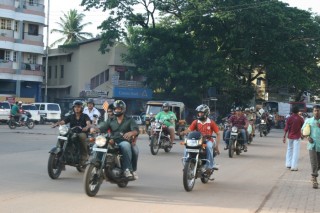
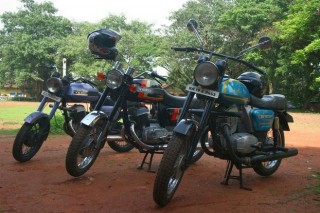
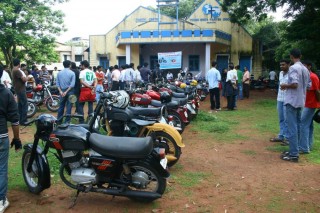
9th International Jawa Day Celebrations in Mangalore9th International Jawa Day Celebrations in Mangalore

Rewind to the time prior to the 1980s, actually the mid-point of that decade.  Owning even a two wheeler, let alone a car was not possible for everyone.  There were three scooters to choose from: the Bajaj 150, the Lambretta from Automotive Products of India and the Vijai Super (it started life as the Vijai Deluxe). (The last named was also a Lambretta; Mrs. Indira Gandhi’s government bought out the entire plant of the defunct Innocenti Scooters of Italy along with the designs that the company had.  That new entity was called Scooters India and went on to produce Vijai scooters for the victorious hockey team that had just won the World Hockey Championship in 1975 under the captaincy of Ajit Pal Singh.  The story is that the scooter was thus named to signify the victory of the Indian Hockey team at the highest level).  In the motorcycle segment too there were three to choose from; the Enfield Bullet (350cc four stroke), the Jawa (250cc two stroke with two exhaust ports in one cylinder-this bike later on became the Yezdi) and the Rajdoot (175cc two stroke) which was actually based on a DKW motorcycle from the 1920s.  The Bullet was probably a year or two younger in its vintage as was the Jawa.  The three motorcycles tell us three different stories.

9th International Jawa Day Celebrations in Mangalore9th International Jawa Day Celebrations in Mangalore

First, the Rajdoot. The Rajdoot was made in India by Escorts Ltd who then sold their business to Yamaha who then like the American forces in Abbotabad quietly took the Rajdoot to some remote corner of Uttar Pradesh and gave it a quiet and quick burial so that no one would ever remember it and pay homage to it in the future. So the Rajdoot died a death about which we have no clue.  Then, the Bullet.  While the Japs and the Chinese believe in reverse engineering, we Indians went in another direction called reverse purchasing.  What was actually Enfield India went on to assume the mantle of the original company which was a British relic and became Royal Enfield Motors and continues to produce Bullets like Godzilla its “little” off spring or the Signourney Weaver tormenting Alien that not only refuses to die but continues to procreate.  The Bullet has old faithfuls who will follow it to the depths of hell if required. The third, the Jawa/Yezdi has been retired to graze the pastures peacefully and there are those good old yeomen who continue to service and look after the heavy horse that once served them loyally, faithfully and reliably.

9th International Jawa Day Celebrations in Mangalore9th International Jawa Day Celebrations in Mangalore
One such pasture is Mangalore in Karnataka where this year the International Jawa Day was celebrated on the 10th of July, 2011. To most people Mangalore is the poor country cousin of Bangalore, but that is not true.  Mangalore has its own proud heritage and has its own community of automobile afficionados who love and look after their automobiles with the same passion and pride that automobile afficionados in other parts of the country and world do.

Mr. Sudhir Bhandarkar an enthusiast and a member of the said community had this to say about the event to Riot Engine. “International Jawa Day was celebrated at Mangalore today the 10th of July 2011.It was a fun-filled get together of 12 Jawa and 22 Yezdi bikes.Led from the front by Shawn Fernandez and Arun Shiri, the club members started assembling from 3 PM. By 4 PM, which was the starting time, there were 25 bikes.

Remainder trickled in within next hour. We went on a ride around the city starting 5:30 PM. Traffic police were of immense help;  we were escorted by two police bikes leading the way and two police jeeps following the entourage”.  He further added, “There were 12 Jawa and 22 Yezdi bikes at the show.  Oldest owner (incidentally with the oldest bike as well) was Mr A P Bhat (69 yrs of age with his 1964 Jawa). Other old model Jawas belonged to Deepak Rao (1965; inherited his father’s Jawa) and Henry, a renowned Yezdi mechanic (1967 model)”.

9th International Jawa Day Celebrations in Mangalore9th International Jawa Day Celebrations in Mangalore

Mr. Shawn Fernandez whose name you find mentioned by Mr. Bhandarkar wrote  his feelings in his blog which is titled “Enigmatic Ravings” (www.enigmaticravings.blogspot.com).

What’s in a ‘Yawa’? – The 9th International Jawa Day

“10th July, 2011 and one more year – well not for me in that way, but for something that touched a lot of people all over the world! The Jawa motorcycles! Ok, the people who ride the Jawa motorcycles? Ok ok, forget the Hondas and the Yams and the BMWs and what nots, not heard of the Czechoslovakia manufacturing unit, the biggest Eastern manufacturing unit that has a capacity of manufacturing 100,000 motorcycles annually? And hey its pronounced “Yawa”……….Rules were simple. Helmets were to be used and not just carried, stick to a respectable speed of 45 km/h and ride in staggered formation, so any traffic overtaking us or oncoming can easily pass, while each rider falls in behind the other”! He further wrote, “We rode on through town, past signals and people and traffic! Our pilot rider, a police man on a 100 cc bike, was pretty proud of towing all the large motorcycles behind him, and he did an excellent job! Cars other 2 wheelers were immediately prompted to move to the side or stop completely, stubborn buses were immediately glared down (or glared up at), hell yes, the red signal at the main junction meant nothing and we mowed through, with all policemen strategically placed, halting all onrushing traffic! The Jawas and Yezdis had won their place! This was no fast paced rally nor was it a chanting mob of alcohol fired youngsters! These were the motorcycles of yesteryear s, throbbing and roaring in unison all in formation, elderly riders with their prized possessions, younger generations with their rides, different from others! We rode serenely at a steady pace and the public gawked! We bliped our throttles and everybody in the malls turned to watch. Motorcycles – old and aged, some before we were born but still strong and steady – no wonder they called them the ‘Forever Bike’!”

What words!!! The Jawa/Yezdi is indeed a Forever Bike.  The Indian Ideal Jawa factory is closed, this model of bikes are no longer made even by the original Jawa Company but owners and their progeny ensure that the bikes remain in running condition and use them proudly.  Some of the owners are gone but the bikes are still there; a legacy cherished by the members of the family who continue to maintain the family heirloom.  This is a romance of epic proportions and love story that far exceeds the intensity of Romeo & Juliet, Laila & Majnu and any other that you can think of.

9th International Jawa Day Celebrations in Mangalore9th International Jawa Day Celebrations Mangalore

Our most sincere thanks to Mr. Sudhir Bhandarkar and to Mr. Shawn Fernandez for the information and the link to Mr. Fernandez’s blog.  Keep up the great work people, it is people like you who make the difference to an automobile that is now out of production.  You are preserving a heritage and a piece of history for posterity.  And paraphrasing AC/DC’s lyric we say “For those who really rock, we Salute You”.

Riot Engine was there when Ford finally completed the launch of the much awaited Fiesta sedan and revealed the prices.

Jump to the recently added video where Sriram Padmanabhan, General Manager-Marketing, Ford India answers some interesting questions.

New Ford Fiesta launched in India

Below are the prices according to the trim and fuel type.

Ex-Showroom New Delhi Price (In INR)

Variant

Petrol

Diesel

Style 8,23,500 9,27,200
Trend 8,77,200 9,77,200
Titanium 9,17,200 10,17,200
Titanium+ 9,42,200 10,42,200

You have seen the prices now just see the list of what comes standard in every trim.
Take a deep breath and look at the list of standard items.

ABS with EBD
Dual Airbags
Audio controls
EPAS with pull drift compensation technology
CD MP3 with aux
Outside RVMs with integrated turn indicators
Remote key


Riot Engine also managed to get Mr. Sriram Padmanabhan, General Manager – Marketing, Ford India to answer our questions about the One Ford concept, and how ‘child parts’ fit in the strategy, the possibility of a Ford SUV/Crossover embracing Kinetic Design and finally, if there are plans to bring down the automatic transmission variant of the Fiesta.

Offering his deepest condolences to the victims of the horrific blasts in Mumbai the previous day, Mr. Michael Boneham, President & Managing Director, Ford India reminded those gathered how resilient the people of Mumbai are, and in that spirit, the launch was not postponed but instead, the festivities were forgotten and a quiet launch ensued, after a respectful thirty seconds of silence.

Michael Boneham, President, Ford India at the Ford Fiesta LaunchNigel E. Wark, Executive Director (Marketing, Sales & Services) Ford India at the Ford Fiesta Launch

Michael Boneham, President, Ford India, Nigel E. Wark, Executive Director (Marketing, Sales & Services)

After being handed over the microphone by Mr. Boneham, Mr. Wark, Executive Director (Marketing, Sales and Services) ran through the various features of the Fiesta, the engine options and most importantly, the extra effort put into the Fiesta for India. Seemingly the most insignificant change, the horn circuit being beefed up highlights the time spent by Ford India in getting its game right. The brake booster characteristics have been worked on to get the modulation right, taking into account the traffic conditions in India. The suspension characteristics have been worked on to deliver a better ride, and the tyres are of a higher profile to improve robustness on impact, give the car a higher ground clearance and ultimately, better ‘water-wading’ capacity.

The Fiesta is constructed with different types of steels in different parts of the body, including the high strength ‘Boron’ steels to achieve the best possible compromise between body stiffness, energy absorption during impact, cost and weight.

Ford Fiesta Launch in IndiaFord Fiesta Launch in India

New Ford Fiesta launched in India

Right at the beginning of this article let us make one thing very clear.  The writer of the piece positively dislikes the idea of Casey Stoner winning races.  So this is not a piece written by a fan, but it is also not written from the point of view of Casey Stoner haters of which there are plenty.  The idea is to be as objective as possible in understanding Casey Stoner the rider and Casey Stoner the man.

Perhaps when one is writing articles of this nature the very best way to begin is by going to the beginning which is not always available but in this case it is, and that is a relief.  By now anyone who is interested in MotoGP knows that Casey Stoner was a prodigious talent that came out of the Gold Coast of Australia.  People also know that Stoner made his career in Europe by racing in Britain and in Spain.  Casey Stoner’s passion for two wheeled racing was such that he raced in 35 races in one day and won 32 of them.  The total number of prizes that were available were 5 and all of them went to young Casey Stoner who was barely fourteen.  He had been riding bikes from the age of four and was racing from the age of nine.  However, in Australia the legal age limit for racing is sixteen and in Britain it is fourteen.  S0 Casey Stoner was taken to Britain by his father Colin Stoner who packed up everything he had and took the entire family to Britain where Casey Stoner began his racing.  In the beginning it was in the 125cc category in local events and Stoner even went to Spain to race against better competition.

One not so well known fact about Casey Stoner is that he was mentored by Alberto Puig, the Spanish 500cc racer who also mentored Toni Elias and continues to mentor Daniel Pedrosa.  If you see the numbers that these riders use even today you will get the story.  Toni Elias uses the number twenty four while Dani Pedrosa uses twenty six and Casey Stoner uses the number twenty seven.  These numbers were chosen for his wards by Puig. Apologies to our readers for not remembering the rider who was assigned number twenty five by Alberto Puig.  While Dani Pedrosa remained with Alberto Puig till date Toni Elias and Casey Stoner went their way.  Casey Stoner entered into the Grand Prix racing world on a 125cc Aprilia with Lucio Cecchinello who himself was a 125cc rider.  Casey Stoner rode brilliantly, but did not win anything substantial for the world to talk about him.  When KTM decided to come into 125cc World Championship Grand Prix racing, they chose Stoner who brought moderate success to himself and KTM.

When Casey Stoner decided to step up to the 250cc class he again did so with Lucio Cecchinello who had retired from racing to become a full time team manager.  Cecchinello managed to get a competitive Aprilia for Stoner who challenged Dani Pedrosa for the 250cc world championship.  Pedrosa was riding a Honda and it was alleged that Honda had developed a 250cc bike keeping in view Pedrosa’s physical smallness.  Roberto Rolfo who was riding 250cc bikes for Honda complained about this since he was much bigger in size and therefore was not comfortable on the small and light Honda.  Stoner pushed Pedrosa but finally a couple of falls in races tilted the balance in Pedrosa’s favour and he went on to win the title.

The following year Dani Pedrosa stepped up to the MotoGP class on the 990cc Honda RC 211V on the Repsol sponsored bike.  Lucio Cecchinello also stepped up to the MotoGP class and formed a single man team comprising of Casey Stoner who would ride a satellite spec RC211V.  While all eyes were on Pedrosa, Stoner was riding incredibly fast on the Honda but sadly was crashing too frequently to be of any consequence in the championship.  Some simply saw him as an inconsistent rider with good speed, while some just ignored him but Livio Suppo at Ducati saw something in Stoner that no one else did and so for the year 2007 signed Stoner to ride the Ducati.  In 2007 MotoGP rules changed to bring in 800cc engines along with a rationing of petrol, 21 litres only.

Ducati had been around for a couple years in the MotoGP class with their 990cc Desmosedici and Loris Capirossi was their lead rider who impressed on a couple of occasions, but did nothing spectacular.  Kawasaki also came into MotoGP but did not perform as well as Ducati even though the latter’s performance itself was not something to feel great about.  The year 2007 turned out to be the most memorable for Ducati and for Stoner.  It was the year when Stoner arrived and brought a whole lot of controversy with him.

Casey Stoner took to the 800cc Ducati like fish to water.  He rode it like a shining knight and the Ducati looked like it had an extra 1000cc and left every other bike for dead.  The first race of 2007 people thought was a one off for Stoner and Ducati and most people said that as the season progressed, Stoner would regress.  But that wasn’t to be.  Conspiracy theories started doing the rounds.  Some said that the Ducati engine was actually running with a higher capacity and that was the reason why Stoner was winning.  The FIM and Dorna even conducted a random test to see if Ducati were cheating.  They found much to their chagrin that everything that Ducati was doing was legal.  Valentino Rossi who was the king of MotoGP did not take all this too well.  He had lost the title in 2006 to Nicky Hayden mainly because of reliability problems with his Yamaha in a couple of races and also due to crashing when he had a few points lead by pushing too hard.  Everyone had believed that Nicky Hayden’s World Championship victory was a one off and they were right in that.  Everyone also thought that 2007 would see the return of Rossi as champion but Casey Stoner was confounding not just Rossi but his fans as well.

Rossi complained that the reason why Stoner was winning was because of the tyres.  Michelin has traditionally been the company to supply tyres to the premier category while the lower categories such as the 125cc and 250cc had tyres supplied to them by Dunlop.   But Bridgestone entered MotoGP along with Dunlop to challenge the dominance of Michelin.  Dunlop never achieved anything significant while Bridgestone with Casey Stoner and Ducati were winning races comfortably.  Rossi complained about the quality of Michelin tyres and more importantly issued an ultimatum to Yamaha.  Masao Furusawa who was responsible for the teams in MotoGP had stopped coming to every race.  Rossi insisted that Furusawa come to every race.

Rossi also twisted the arms of Dorna Chief Carmelo Ezpaleta and the FIM Chief Vito Ippolito and broke a contract with Michelin for Bridgestone tyres.  The following year World 250cc champion Jorge Lorenzo was entering the MotoGP category with the factory Yamaha team.  Rossi told Yamaha that Lorenzo who would be on Michelin tyres should not get the data from Rossi’s side of the pit garage and so Rossi insisted there be a wall between his side and Lorenzo’s side.  In the year 2007 Casey Stoner won the World Championship handsomely by winning a total of ten races that season.  He rode his bike like a master, he slid it when necessary, he used rear wheel steering and made the Ducati do everything at his bidding.  Rossi for the first time was rattled and rattled like never before. He and his supporters said that Stoner was winning only because of superior machinery.  Stoner for the first time perhaps said something controversial.  He said “Why is it that when Valentino Rossi wins that people say it is due his superior riding skills and when I win it is due to a superior motorcycle or a better tyre?  The poignancy of Stoner’s statement could be seen from the results of the other Ducati rider Loris Capirossi who was not even a patch on the dominant Stoner. So a rivalry had begun and Rossi wanted to crush Stoner and prove that he was king.

Yamaha came under pressure from Rossi and Masao Furusawa and his team of engineers decided to make the growler engine or the big bang engine by using a cross plane crank shaft which facilitated an uneven firing order that gave some respite to the rear tyre and therefore better grip.  Yamaha also overcame their problems of fuel efficiency and Masao Furusawa was there through out the season at every race.  Rossi did not get off to a flier in 2008.  Casey Stoner did.  He seemed unstoppable but gradually Rossi clawed back into the championship and started playing mind games with Stoner.  That was seen most clearly at Laguna Seca when Rossi put a frightening pass on Stoner which led to Stoner crashing.  But Stoner is made of Aussie grit.  He remounted and took second place in the race.  What was rivalry till then became a war.

The war spilled over from the track to the fans.  For years, from his 125cc days to his MotoGP race years Valentino Rossi was a fun character.  He had unique ways of celebrating his wins and they all seemed good natured, unlike Jorge Lorenzo’s celebrations which initially involved simulation of guitar playing and stepping on to the podium with a lollipop in his mouth and later involved the disgusting practice of planting Lorenzo land flags.  Everybody loved Rossi and Rossi was being beaten by Stoner, a man who hardly communicated with MotoGP audiences.  He was quite happy to hang around with riders from the Red Bull Riders class and maintaining a reticent media silence.  In the pits and on the race track prior to the race it was his wife who was with him, even holding the umbrella.  This ensured that the fans took a dislike to a person who was aloof and did not show too much emotion or share anything with them.  So whenever he beat Rossi he was booed but Stoner is made of very strong stuff.  It seemed that he enjoyed the negativity of the fans and relished in making them even more angry.  Stoner was fuelling the anger of the fans and feeding of it.

Yamaha’s reclamation of the title in 2008 meant that Stoner demanded from Ducati that they too should do something to beat the Yamaha.  This lead to the creation of a carbon fibre chassis for the Ducati Desmosedici instead of the trellis frame that Ducati are famous for.  Fillipo Preziosi, the engineering genius at Ducati who built the MotoGP bikes decided that a carbon fibre chassis which would be more rigid than even aluminium would be the ideal for a racing bike.  The carbon fibre chassis idea meant that the bike would not have the traditional frame that all motorcycles have.  Preziosi came up with an idea where he connected the rear swing arm straight to the engine and the front of the bike had a complex setting where the front fork and tank were again connected to the front of the engine.  So the engine became a stressed member in the bike.  The use of carbon fibre while having advantages also had disadvantages.  The almost complete absence of flex meant that the rear was so stiff and did not allow for too many adjustments and in 2009 Stoner found the front of the Ducati a little difficult to deal with since it had a tendency to low side if there was not enough grip or friction.  Stoner started crashing but was also winning races when not crashing.  Stoner seemed like a contender for  the 2009 title before being struck by a mysterious illness that sapped him of his strength and he found it difficult to ride, but still completed races, most times on the podium.  But when he was unable to go to the podium ceremonies, he decided that he needed to take off.  At this time Mika Kallio was brought into replace Stoner and to ride alongside Nicky Hayden who replaced Loris Capirossi that same year.  Neither Hayden or Kallio looked like winners on the Ducati.  After missing some races Stoner came back and won three races on the Ducati.

In the meanwhile some interesting developments were happening at Ducati.  Ducati did not seem to have believed that Stoner was really ill and wanted to sign Jorge Lorenzo for 2010 for a very high price.  Lorenzo was sensible enough to not fall for the lucre that was offered. Stoner’s mentor and strong supporter Livio Suppo went to Honda for 2010.  Stoner was hurt with the attitude of Ducati and in the beginning of 2010 itself signed a deal with Honda thanks to Livio Suppo, to ride for the HRC Repsol Honda team in 2011.  Stoner worked hard on the Ducati that tried bringing in the growler or big bang engine to iron out the problems of the bike.  Nicky Hayden again failed miserably while Stoner had an on and off season.  He crashed a few times but won quite a few times.  Rossi broke his leg and Mugello and when he was taking rest, Ducati approached him and asked him to sign for them from 2011 onward.  Rossi’s relationship with Jorge Lorenzo hit a low point and he gave an ultimatum to Yamaha “its either me or him”.  After weighing the pros and cons Yamaha decided that it had to be “him” (Lorenzo) because he was young and showed steely determination and maturity in the races of 2010.  This meant that Rossi had no choice but to go to Ducati in 2011.

The 2011 season has been one of the most anticipated MotoGP seasons.  On the one hand was the euphoria of an all Italian team featuring the legend called Valentino Rossi on the legendary Ducati designed by Fillipo Preziosi.  All of them were Italians.  The Italians were cock a hoop.  Time to show what Italy was.  The one test that Rossi had on the Ducati at the end of the 2010 season saw him setting the fifteenth fastest time, while Casey Stoner on the Honda set the fastest bettering existing Honda riders such as Dani Pedrosa and Andrea Dovizioso.  The start of testing in 2011 showed Casey Stoner riding the wheels of the Honda while Rossi was struggling at the bottom of the time sheets.  Now a new war was brewing.

Dani Pedrosa’s cantankerous and insecure mentor Alberto Puig feared for his ward.  He went to Honda to try and get the newest developments for Pedrosa but Suppo quietly brought Stoner into the picture for the new parts.  He impressed on the HRC management that Honda had not won a single 800cc MotoGP title.  Dani Pedrosa had been there through out but did not produce the results.  Since 2011 is the last time that the 800cc bikes will be raced before being replaced by 1000cc machines in 2012, 2011 was the only time left for Honda to win the world title in that category.  He stressed upon the abilities of Stoner and Honda saw his speed which was there straight away without testing and asking for changes in the bike.  Honda’s philosophy always has been to give a bike to a rider and only make small adjustments on it, no large scale changes. It was this attitude that led to Rossi leaving Honda and going to Yamaha who did whatever he wanted them to do.

In 2011 another rivalry came out into the open, the Rossi vs Lorenzo rivalry.  Rossi and his crew chief Jeremy Burgess who was originally Mick Doohan’s crew chief claimed that Rossi and Burgess did all the development of the bike and that Jorge Lorenzo was only enjoying the fruits of that development.  It seems they were right since both Ben Spies and Lorenzo won the latest Assen TT race and the Italian GP at Mugello using the frames from 2010.  Rossi was quick to point this out by not only congratulating Spies on his first victory but also patting the bike that he was riding, the same one that Rossi rode last year.  While this maybe a small victory for Rossi the more complex game has been seeing him falling farther and farther behind Stoner.  Stoner has been toying with the Honda making it do whatever he wanted it to, while Rossi struggled with the Ducati which wasn’t improving even with his and Burgess’ inputs.  In fact, Ducati – actually Filippo Preziosi took advantage of a loop hole in the testing regulations for this season.  The regulations state that only next years 1000cc bikes can be tested during this season ten times.  Preziosi decided that he would use the chassis parts of next years Ducati this year and mate them to the 800cc engine, since Rossi had expressed happiness at the way in which next years bike was going.

But to achieve this Preziosi had to surmount a serious problem.  The mounting points of the 800cc would not be same for the chassis for next year.  He overcame this problem by destroking the 1000cc engine for next year to 800cc.  So not only is Rossi using next year’s chassis but also next year’s engine in a destroked form.  Cheating?  Some have said so, but others have said it is a clever exploitation of the loopholes in the rules.  Whatever it maybe Rossi is still as slow on the new bike as he was on the older bike.  He is usually anywhere between one second to two seconds behind Stoner.  So don’t read too much into his 4th and 5th places finishes.  Those were due to the misfortunes of others and not because his Ducati or he were fast.

This was the ideal opportunity for the Stoner to hit back at Rossi and his fans who boo Stoner.  Rossi tried to put the blame for his bad performance on the Ducati on Stoner, saying that Stoner did not know how to develop a bike.  Stoner pointed out that he won races on that bike despite it having no development while Rossi was struggling even after getting everything he asks for.  Stoner’s other opponent Dani Pedrosa has had a poor season falling of his bike and injuring himself mostly on his own but once with the help of Marco Simoncelli.  Even when Pedrosa was fit and riding he could keep up with Stoner till the half way point in a race and then would begin fading away.  He too has been second best only.

So what is Casey Stoner?  First of all he is an Australian, with the steely determination and never say die spirit that is so associated with the Aussies.  Behind his almost shy demeanour is a competitor who wants to win and nothing else.  He is irreverent and does not believe in paying respects to reputations.  He is also a private person, almost a recluse who is happy to be with Adriana his wife whom he had married in January 2007 and who is with him all the time.  Stoner is also anti technology in real life and prefers spending his time hunting with a bow and arrow on the Gold Coast of Australia and avoiding social networking sites such as Twitter (for micro blogging) and Facebook.  Even his celebrations after victory are very matter of fact and lacking in exuberance, deliberately.  After winning races, Stoner rides straight back to the paddock and just hugs his mechanics and wife.  On the podium too Stoner is restrained.

In the lower categories of Grand Prix racing Stoner was not someone who attracted attention.  It was in MotoGP with Ducati that Stoner has become a legend.  Yes a legend.  When the 800cc Ducati was introduced, he just got onto the bike rode away into the distance and won races.  Nobody heard of any talk of how he was trying to develop the bike and make rideable etc., the stuff that one has been hearing from Rossi and getting sick of it. In MotoGP, Casey Stoner is the worthy successor to Mick Doohan in the Aussie line of riders.  There have been riders like Daryl Beattie during Mick Doohan’s time from Australia and showed a lot of promise but faded away in no time.  Then there have been contemporaries of Stoner such as Chris Vermeulen  and Anthony West who did not make any significant impact on MotoGP.  Casey Stoner is now among the greatest ever Aussie riders in GP racing after riders such as Barry Sheene, Wayne Gardner and the legendary Mick Doohan.  He is not just an Aussie legend, he is a world legend who brought the great Rossi down to earth and on to his knees.  Stoner won three races towards the end of the last season on the Ducati and the same Ducati is what Valentino Rossi rode in the beginning to be at the bottom of time sheets.  Whatever changes he has made have not made too much difference.  So has Stoner put the issue beyond doubt?  Yes, he has.  Even if Rossi develops a bike that will start winning there is no disputing the raw and natural talent that Casey Stoner has.  With him it is just riding the wheels of a machine, no wasting of time developing and all that.

We started by saying that the writer of this article does not like Stoner.  That statement stands.  The writer seems to be a fan of Stoner but does not like him at all, so what is this?Is this a new kind of fan?  You tell us.