Of Ti-VCT and UHSS and a dramatic crash
The all new Fiesta is powered by all-new fuel-efficient 1.5 L Ti-VCT and 1.5 L Duratorq TDCi powertrains developed for India and built in Chennai.
Ti-VCT is Ford’s Twin Independent Variable Camshaft Timing which is yet another form of variable valve timing technology using which the camshafts can be rotated slightly relative to their initial position, allowing the cam timing to be “advanced” or “retarded.” Traditionally ( says Ford, we say, in the stone age), camshafts only have been able to open the valves at a fixed point defined during engine design and manufacturing. Variable Camshaft Timing allows extremely precise variable control of “valve overlap,” or the window of time in which both the intake and exhaust valves in the engine are open simultaneously.
Ford’s Ti-VCT also has the added benefit that this technology is applied to both the intake and exhaust camshafts of its DOHC design, using electronic solenoid valves to direct high-pressure oil to control vanes in each of the camshaft sprocket housings. By using one oil control solenoid valve per camshaft, controlled by the Electronic Control Module (ECM), the intake and exhaust camshafts can be advanced or retarded independently of the other as engine operating conditions change, providing an exceptional degree of valve timing control.
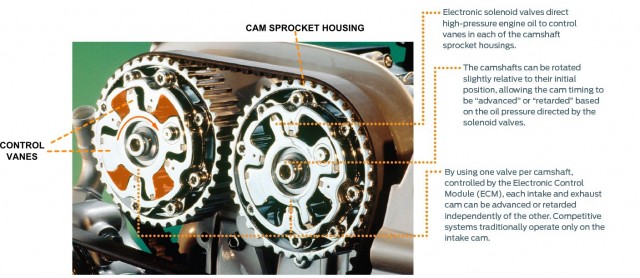
Shown in this image are the intake and exhaust camshafts. The control vanes are operated by high pressure oil regulated by a solenoid. Depending on the engine load and speed, the ECM instructs the solenoid to force oil through specific passages. The orange areas shown here indicate the pressurized oil which would rotate initially, the cam phasers clockwise and ultimately, the cam shaft to either advance or retard the valve timing.
Ford leaves no stones unturned while bragging about the benefits of Ti-VCT
- Ti-VCT can deliver up to a 5 percent improvement in low-end torque and a 7 percent improvement in peak power versus non-Ti-VCT-equipped engines.
- Up to a 4.5 percent improvement in fuel economy.
- Reduced NOx and hydrocarbon emissions without compromising idle quality.
- Optimized cold-start operation minimizing cold-start emissions.
The ride that we so loved and the handling potential that we couldn’t exploit fully are courtesy specially tuned front struts, bushings, damper stabiliser bars and a rear twist-beam axle
Much of the following material regarding the use of boron steel is derived from the press materials provided for the Fiest hatch, rest assured though, the Sedan is but an evolution of the hatch, so much of it should stand true.
Ford uses a number of ultra-high-strength steels (UHSS) in select structural areas on several of its current models, including the Mustang, the Fiesta and a number of other models we do not get to see in India. More than 55 percent of the structure of the Fiesta uses high-strength steel with ultra-strong boron steel reinforcing several key points. Boron steel happens to be one of the strongest weldable materials. The high yield and tensile strengths of these materials allow engineers to design parts that are lighter and stronger than ordinary steel, which means they help protect vehicle occupants and also improve fuel economy.
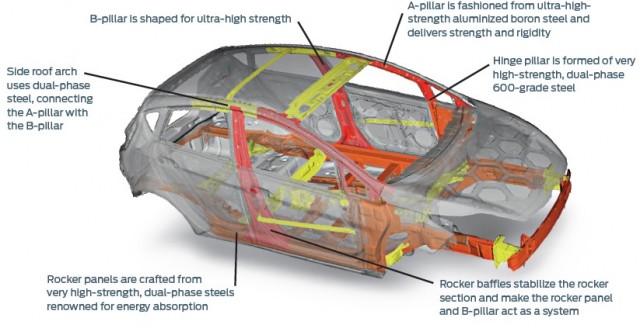
All Ford vehicles use boron steel in their door intrusion beams, which helps protect occupants in side impact collisions. The Ford Fiesta uses Boron steel in its A-Pillars, which is critical to occupant protection as is evident from the following incident reported by Natalie Neff from Autoweek who was testing the first batches of the Fiesta hatch that landed in the US.
I never saw it coming. A tire had flown off an Oldsmobile Cutlass heading in the opposite direction on the freeway, rolled past its horrified driver, skipped over the median, bounced at least 20 feet into the air and smashed through my windshield as I emerged from under an overpass.
Regardless of why the tire chose my car or why I was spared decapitation, I found myself in awe of the Fiesta’s actual performance under fire.
Used extensively in the roof structure of the Fiesta, particularly in the A- and B-pillars, boron steel is one of a variety of ultra-high-strength steels, so hard that it resists conventional cutting methods–including the Jaws of Life. The use of boron steel isn’t new; the stuff’s been around for years now. But its application in a car like the Fiesta, a B-segment, entry-level ride that will start at about $15,000 when it debuts here next year, is a first. We hope it’s not the last.
They just don’t build small cars like they used to. And thank goodness for that.


Read more: http://www.autoweek.com/article/20090610/CARNEWS/906109990
The result Ford claims, is best-in-class occupant safety: passengers are better protected in the event of a side impact. Safety is also enhanced by standard front driver and passenger airbags on all models.
Ford also claims best-in-class Noise, Vibration and Harshness (NVH) levels. The diesel version also comes with additional insulation under the hood to keep all the diesel clatter from creeping into the cabin.
First-in-segment electronic power assisted steering (EPAS) with Pull Drift Compensation technology adapts to changing road conditions. As we mentioned earlier, we weren’t able to explicitly point out when the Pull Drift Compensation intrudes, but we guess that is a compliment to the Fiesta, considering the steering never had us complaining at any moment.
Independent MacPherson Struts with coil springs & an anti-roll bar at the front working with the semi-independent twist beam with twin shock absorbers (filled with gas & oil) at the rear take credit for keeping you on the road through corners, for keeping all wheels on the road when the hooligan in you decides to ride the curb and beat the traffic ( definitely not recommeded!) and surprisingly keep the passengers in the car, reasonably comfortable.