Tag Archives: Power Stroke

From right to left: Chris Bangle, Adriano Mudri and Mate Rimac

From right to left: Chris Bangle, Adriano Mudri and Mate Rimac

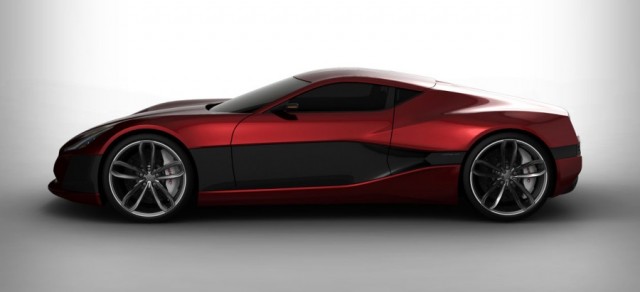
At Riot Engine, it’s as much about ‘People’ as the automobiles themselves. When we featured the Rimac Concept_One in our ‘Design’ section, we were stumped by the 23 year old who got a team together and built the stunning Concept_One. The ‘About us’ section on the Rimac website had us hooked. The story of Mate Rimac is incredible for the simple reason that as inspiring as it is, it can also be the life story of any auto enthusiast who takes the first step beyond the boundaries of being just a spectator.

Riot Engine brings you an exclusive interview with the man himself, Mate Rimac, CEO, Rimac Automobili,all the way from Croatia.

Riot Engine: Let’s start at the beginning. Can you tell our readers about your BMW E30?

Mate Rimac: I went to a technical school in Croatia where we had to make a “Matura exercise” before graduating. Usually students make simple electronics like amplifiers. I was totally into electronics so I used the opportunity to build something unique. My invention was elected to participate in a local invention exhibition where I won the first prize. After the local exhibition I participated on the national level where I also won the first place – this opened the door to the world’s biggest international exhibitions. I participated in South Korea, Switzerland, Germany, Malaysia, Czech Republic, Romania etc. On all those exhibitions I usually won gold or silver medals for my inventions which also caught the attention of European car manufacturers and suppliers. I patented my inventions and negotiated with these companies about selling off the rights to use them – quite successful. (I cannot talk about details since I have signed non disclosure agreements)

Mate Rimac drifting his e-M3, an electric BMW E30

Besides electronics, I have a big passion for cars and bikes. I owned an old BMW E30 (MY 1884) which I used for drift and circuit races. At one of these races, the gas engine blew up. Then I decided to try building an EV. The goal from the beginning was to create a very powerful car. At first I started on my own. I read a lot about other people’s projects who have already converted cars to EVs, and even some who are using EVs for racing. Then I have ordered parts and started to build the car. After one year or so the car was able to drive but I was not satisfied with the result. It was heavy, not very powerful and the range was very limited. I started to collect a team of experts to develop our own components since I believed that the electric propulsion can give much more compared to what was available on the market (at least for individuals – big companies have access to better technologies).

The old BMW has gone through five development phases. Every time we changed almost everything. The power electronics, motors and battery-packs have been replaced each time with more compact, lighter and more powerful developments. The car got faster, lighter and more reliable each time.

Riot Engine: When your BMW E30 blew its engine, what made you decide to go the electric way instead of getting another combustion engine?

Mate Rimac: I had the idea to make an electric car for a longer time. The blew-up engine was just the trigger to actually start doing it.

In which year did you start off with the development of the e-M3?

2008.

Did the same team that work on the e-M3 and the Concept_One?

I started alone in my garage. New members joined the team (and the company) year after year. Everyone who worked on the e-M3 works also on the Concept_One. We are a small company which is more like a family so everyone works on every project.

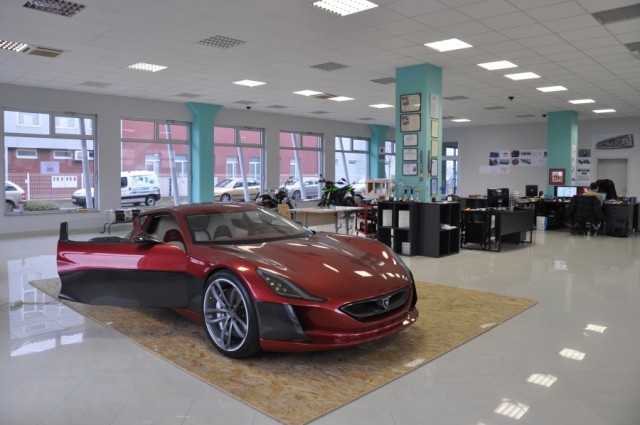
Rimac Concept_One

Have you worked on any previous projects with Adriano Mudri? How did the collaboration with Mudri as the Lead Designer for the Concept_One come about?

I have meet Adriano when I was searching for a designer for the Concept_One. He is, just like me, a perfectionist so it was not always easy to satisfy his quality standards in the production, especially with our tight schedule and budget. But on the other hand, I am now glad that the car looks perfect even in the smallest detail.

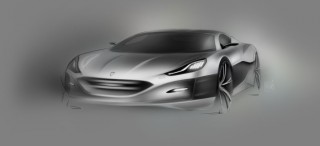
Rimac Concept_One Design Sketch 05Rimac Concept_One Design Sketch 04

I was setting the design goals, our engineering set the packaging (so the space which is used for mechanic and electric components). Adriano had to work within those parameters. As everyone knows, there are always some conflicts between the design and engineering part of the team but we have managed to find solutions and finish the car while satisfying both the look and technical part.

Can you tell us about the all wheel torque vectoring in the Concept_One? Does it mean each wheel can rotate at different rotational speeds independent of the other?

Traditional cars need to rotate the wheels at different speeds because of the different diameters while going through a corner. That is the reason why cars have differentials.

The Torque Vectoring System takes care of the speed differences (so it is a “virtual differential”). At the same time, it controls the torque of each wheel separately. The Torque Vectoring opens new possibilities in terms of controlling the vehicle dynamics. You can have a completely different handling by pressing a button. You can choose between understeer, oversteer or neutral handling.

When the Concept_One goes into production, will it continue to have the same name?

Probably not. We will release the final name next year.

Why have you fixed a limit of only 88 units this year?

People who buy such a car expect exclusivity. We are guaranteeing them the exclusivity by limiting the production.

The number 88 is chosen because the car has a power of 1088 hp.

Concept_One at Rimac Automobili

An exclusive image of the Concept_One being worked on at the Rimac R&D Facility in Zagreb, Croatia

We understand some of the big names in the automotive industry have come together to design a ‘Universal Charging System‘ for electric vehicles. Do you see Concept_One adopting such a system in the future?

We are using EU-standardized Level 2 and Level 3 charging plugs. We are also working on the implementation of the Chademo DC fast charging protocol.

We know you must have spent quite some time brainstorming about the choice of materials for various components of the Concept_One. Aluminium and Carbon fibre seem to be in abundance. Can you give us an insight into how tough that was?

I wanted to build the best car possible. If you want to build the best car, you have to use the best technology and materials.

Some of the most exotic automotive brands have finally arrived in India. When do you think we can see a Rimac on the roads in India?

I am not sure about the homologation standards in India. If the European homologation is valid in India, we will offer the car on that market also as soon as production starts.

The name Rimac is no longer just about you, the individual. Rimac is now a global brand. How does that feel?

I’m very proud. That’s everything I worked for, that’s my dream come true.

Riot Engine wishes you the very best for the Concept_One. Thank you for your time!

Thank you for the interview.

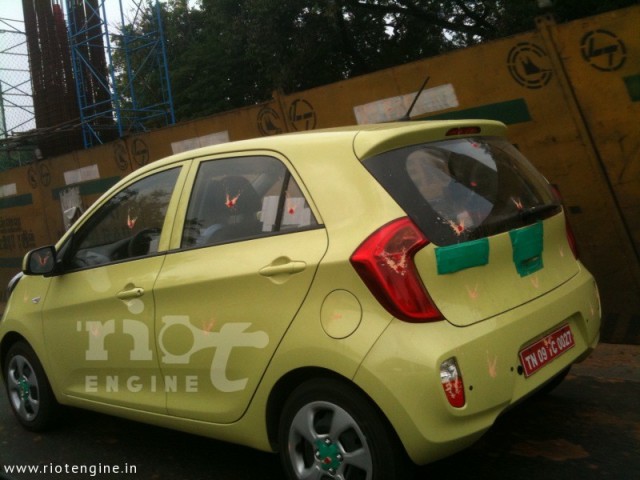
Kia Picanto testing in Chennai

One of our correspondents in Chennai caught this LHD Kia Picanto being tested. Kia has been doing a feasibility study in India since late 2010. We’ve also heard reports of Kia shelving its plan for India somewhere through the middle of 2011. India is a market that no car manufacturer can ignore, it’s no surprise that Kia continues to conduct its feasibility studies.

The Picanto should share space in the market with the i20 if launched here. As this correspondent pointed out, a left hand drive Picanto simply means that Kia’s plans for India are nowhere near fruition in the near future.

It should be interesting to see how Kia intends to position its products along with it’s Hyundai siblings.

Kia Picanto testing in Chennai

Kia, if we may make a suggestion, please do bring the fantastic looking Optima with you when you take a flight out of Seoul.

Kia Picanto testing in ChennaiKia Picanto testing in ChennaiKia Picanto testing in ChennaiKia Picanto testing in Chennai

It is no secret that MotoGP has been ill, very seriously at that, for quite sometime now.  The last many years have been seeing the pulling out of manufacturers from the sport and the number of motorcycles have been dwindling so much that in the last couple of years the situation has become ridiculous.  One has seen in the last two years that just starting a race virtually guaranteed championship points.  The number of motorcycles has been hovering around seventeen and in almost every race there have been actually fewer motorcycles due to injuries to riders.  The entire irony of things is that MotoGP has been most dangerous for riders when squillions of dollars are being spent on electronics purportedly to make the motorcycles safer for racers.

Safe is one thing that MotGP has not been.  Ask Dani Pedrosa.  The fragile and small Spaniard has been spat out by his bike so many times that in the last three years he has not been without injury.  Even Valentino Rossi who has an impeccable record of not crashing in races has been thrown of his bike and in one instance last year with a break to his leg, one that compromised his world championship challenge.  In his first year of racing in MotoGP, Jorge Lorenzo raced on will power more than on skill because his Yamaha was like an unbroken stallion that just kept throwing off its rider.  There were cartoons of Lorenzo being carried on a stretcher to his motorcycle and podium by the irrepressible Jim Bamber.  Later on Lorenzo quietly agreed that he was scared so much that he considered quitting motorcycle racing at one point.  The pressure of racing an uncompetitive and difficult to ride Ducati led to fatigue and exhaustion for Casey Stoner who would look like he was about to collapse at the end of a race.  The situation became so alarming that he had to stop racing for a while.  Doctors were mystified by what was happening to him, finally zeroing in on fatigue.  The year 2012 is perhaps the high point of MotoGP, with almost every rider having a serious enough accident to keep him away from a race or two.

This amidst manufacturers pulling out of the sport.  Aprilia was the first to go, next was Kawasaki and finally at the end of this year, Suzuki as well.  BMW was preparing to enter MotoGP but changed tack and went to World Superbike Championship instead.  Aprilia did not give any specific reason for its pull out, while Kawasaki and now Suzuki have given the weakness of the global economy and the accompanying down turn in their fortunes as the reason for their quitting.  BMW said that it made more sense for them to race in the production based series as that would be more relevant to their aspirations of selling more road going motorcycles.  It would be interesting to see what was happening in World Superbikes when all this was happening in MotoGP.  The grid in Superbikes at one point was so healthy that it boasted of seven manufacturers and almost 30 motorcycles starting a race.  That number too slowly started dwindling and reached twenty two last year and this year it has fallen below 20 in most races.  Ducati quit World Superbikes at the end of last year and the grid started becoming a place of refuge for discards from MotoGP.  Look at the number of ex GP riders on the World Superbike grid this year.  Carlos Checa, Max Biaggi, Marco Melandri and Eugene Laverty.  They were also the riders who were contenders for the championship itself.  Is that a coincidence?  The answer has to be no.

MotoGP and World Superbike Championship have been actually two battle grounds on which motorcycle manufacturers have fought their wars on.  Here is a scope for a misunderstanding.  When we say wars we are not talking about racing on the tracks.  We are talking about politics and the wars of one up man ship between manufacturers.  Now that we have cleared up the misunderstanding, let us get on with the rest of the story.  MotoGP is actually the back yard of the Honda Motor Company.  The only other company that has occasionally managed to get into that back yard is Yamaha and in one instance, and only one instance, Ducati.  Honda is the King of MotoGP.  Its bikes have been the class of the field and have converted even mediocre riders such as Alex Criville, for example, into world champions.  The situation is very much like what team Williams was in Formula1.  Even Damon Hill and Jacques Villeneuve could become World Champions; such was the car they made in the 1990s.  There is a parallel here in the story of Honda in motorcycle GP and Williams in F1 GP.  So let us draw it then.

Let us start with Williams’s case.  Whoever Williams put in their car went on to become champion.  Nigel Mansell, Damon Hill and Jacques Villeneuve.  They all came a cropper when they went to other teams and other cars.  Things changed for Williams when one Mr. Michael Schumacher arrived on the scene and spoilt the party.  (Never mind that he has been accused of cheating and wanting to be number one and all that, nobody wins 91 races by doing these things.  Also never mind that today he is struggling, he is past his prime).  In a Benetton car with a Ford V8 engine, Schumacher beat the Williams cars.  He went to a dismally performing Ferrari and won them a World Championship after 20 years of Ferrari being in the wilderness.  He won a total of five World Championships with and for Ferrari.  Nobody won a World championship with Benetton before or after Michael Schumacher.  Only Kimi Raikonnen has won one World Championship with Ferrari after Michael Schumacher and Jody Schekter had won the last one (in the year 1979) before Schumacher’s first triumph with Ferrari twenty one years later in the year 2000.

Now on to MotoGP.  What Schumacher did to Williams, Valentino Rossi did to Honda.  After a bitter falling out with Honda, Rossi switched to Yamaha and won them a World Championship in the year 2004, the first in 12 years, the last prior to this being in 1992 under the legendary Wayne Rainey.  In between in those twelve years 10 years Honda riders took victories while in 1993 and 2000 Suzuki riders Kevin Schwantz and Kenny Roberts Jr took the championship.  Rossi’s move to Yamaha changed the fortunes of the company and in his hands, it has won more championships in the 800cc era than any other manufacturer with Ducati and finally this year Honda, winning once each, both with Casey Stoner.  Michael Schumacher and Valentino Rossi are two people who proved to the world that a driver/rider could make the difference to a manufacturer in a world which otherwise was all about manufacturer domination.

The intent behind narrating the above stories is to draw your attention to the fact that except for Valentino Rossi’s Yamaha years, Honda is the undisputed leader of GP racing.  That means that it also gets to call the shots.  Changing from two stroke to four stroke,  upping or downing the capacity of engines in every category, the changes are all mainly at the behest of Honda.  For a new manufacturer to get into MotoGP it necessarily means playing the game by the rules that Honda orchestrates.  Unlike in Formula1 where the FIA (thanks mainly to Max Mosley) is relevant, in MotoGP the FIM (thanks to Vito Ippolito) is more or less absent.  The body only rubber stamps the rules and regulations written by manufacturers (read that as Honda mainly).  Dear reader, you can rest assured that the reasons of global economic turn down by Kawasaki and Suzuki are really facing mechanisms.  The real problem is their inability to fight it out with Honda politically.  That is what made Aprilia leave MotoGP and stopped BMW from coming into the category.

Those who did not want to go into MotoGP and beard Honda there, went to World Superbikes and converted it into near prototype racing, instead of it being production based motorcycle racing.  After Scott Russel, the American racing legend won the one and only World Superbike Championship for Kawasaki in 1993, Rob Muzzy who ran the Kawasaki World Superbike effort (the team was called Muzzy Kawasaki), said that all the parts on the championship winning motorcycle could be found in Kawasaki spares stores.  Now that is no longer the case.  First BMW, then Aprilia and even Kawasaki this year with the new ZX-10R have created near MotoGP type of machines and homologated them in World Superbikes.  This means that the two championships have been treading on each other’s toes and the battle came out into the open when Dorna the rights holders of MotoGP announced that MotoGP would allow production based engines in prototype chassis.

The Flammini brothers, especially, Paolo Flammini said this was in violation of the agreement between MotoGP and World Superbikes (controlled by Flammini’s Infront).  Carmelo Ezpeleta of Dorna gently reminded the Flammini brothers of what was happening in World Superbikes.  Funnily, however, the Flammini brothers found an ally in Honda (and to a lesser extent Yamaha and Ducati, the two other manufacturers left in MotoGP). When Dorna said that the new sub category in MotoGP would have claiming rules, everyone believed that teams entered as Claiming Rules Teams could claim each other’s engines.  But that was not how it was.  It was revealed that the factories could claim the engines of claiming rules teams for a paltry twenty thousand euros!!!  Apparently this was done to stop Aprilia entering MotoGP through CRT as a factory.  Now Aprilia seems to be showing that the fears of the other factories were justified, because it has announced that it will develop a new prototype chassis for teams that will use its RSV4 based engine.

But Ezpeleta and Dorna are bashing on regardless.  Ezpeleta has been giving combative interviews saying that CRT is the way forward for MotoGP and the fact that there are only three manufacturers willing to supply a total of 12 motorcycles has strengthened his case.  In the first year of CRTs there will be different rules for the CRTs and the factory prototypes but from 2013 the rules will be same for all says Ezpeleta.  What has helped Dorna become strong is that Bridgepoint the owner of Dorna has also taken over Infront, the rights holder of World Superbikes.  There are a couple of other reasons as well.  The first is the exodus of manufacturers from MotoGP and the second is the very high cost of leasing motorcycles from manufacturers.  The competition among manufacturers has reached such a fever pitch that they have driven costs to the outer edges of our solar system.  This means that grid sizes will not improve and this is great for Dorna and a good time to bring the motorcycle manufacturers to their knees.

Things in World Superbike too are not different.  In their attempt to make World Superbikes less production based and more like prototypes, the costs of running a team have also sky rocketed.  This has prompted the organizers to take drastic steps such as allowing only one motorcycle per rider in each team.  In 2010, the grid size of the World Supersport category (600cc production motorcycles) fell to just sixteen.  The numbers were boosted in 2011 by saying that each team could run only one bike per rider and that immediately doubled the number of entries.  With grid numbers slipping to 18 this year, the same is now being attempted with the Superbike category as well.  The message is clear, there is no money for extravagance.  Right now both categories are fighting for the same space and the same market.  Let us face it, World Superbikes does not enough TV exposure as does MotoGP.  The MotoGP and Superbikes run with identical 1000cc engine capacity, as do the Moto2 and Supersport with identical 600cc engines.  Both series organizers now have a single owner, namely Bridgepoint.  So why not make the whole exercise cheaper and more meaningful by clubbing the two series together.  Like in Formula1 let there be constructors who have chassis and plonk engines from various manufacturers in them.  The integration will not be easy, but it is something that one should work towards in order to save motorcycle racing from vagaries of the economy and from the ruthless ambition of motorcycle manufacturers.

That exercise will be fraught with difficulties and will require a lot of head banging before positive results start emerging.  In the meanwhile for MotoGP salvation has to come from CRTs.  It is now clear that only twelve bikes will be put on the grid by the motorcycle manufacturers and the lessees.  Mercifully, the numbers seem to be coming in from the CRTs.  There are about 8 confirmed entries and one hopes that more will come to the fore in the coming days.  Otherwise, motorsport maybe something that we will tell as a story to our grandchildren.

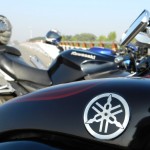
'01 Yamaha R1, Yamaha V-Max in the background

Do you really need mad bikes, awesome friends, smooth roads and good weather for the ride of a lifetime? Well, stop deluding yourself, yes you do.

Yamaha V-Max, '04 Kawasaki ZX-12R and the '01 Yamaha R1

Max, our good friend who wrote a story on the V-Max for Riot Engine, offered an invitation that this correspondent could not say no to. Keys thrust into my hands, kit and lid on, it suddenly dawns upon me that I’ll be spending the rest of the day trying to keep up with this mad Max (man?) on a very mad motorcycle, an ’04 Kawasaki ZX-12R. Ah not to worry, I realize I’m astride a motorcycle that seems very capable. A 2001 Yamaha R1, the last of the species before they plonked in the fuel injectors.

'04 Kawasaki ZX-12R and the '01 Yamaha R1 : Hello Sunday!'04 Kawasaki ZX-12R and the '01 Yamaha R1 : Hello Sunday!

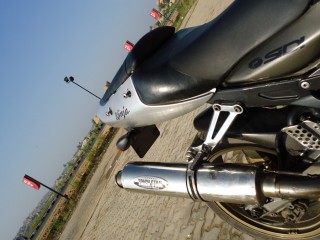
Fire up the engine and I realize this is no ordinary R1. A Micron exhaust grabs the exhaust gases from the manifold and shoves them out with all the fury of the Hulk and the drama of the action hero who plays the angry cop at your local cinema, with no catalytic convertor to play party pooper. The ZX-12R, ups the proceedings an ante with it’s as-expensive-as-your-cousin’s-R15 Trickstar exhaust. As I start off my Sunday morning with aural stimulation from the ZX-12R at the front and the R1 under me, I came up with a metaphor involving the likes of Jessica Albas and Megan Foxes. No, I’m not going to explain it here.

'04 Kawasaki Ninja ZX-12R'04 Kawasaki Ninja ZX-12R : Trickstar Exhaust'04 Kawasaki Ninja ZX-12R '01 Yamaha R1 : Micron Exhaust

Remember the last time you signed up for the gym and never got around to keeping at it for more than a week because you didn’t have a good trainer? Well that wasn’t about to happen to me. Not with Max around. The basics being the same, regardless of what bike you’re on, Max details the finer points of being on a superbike, pats my back, assures me I’m doing great and before I come to terms with reality we start rolling. What? Is that all the hype there is to this moment I’ve been waiting for half a lifetime? As I learn later, the best parts are yet to come.

04 Kawasaki ZX-12R, the '01 Yamaha R1 and Yamaha V-Max'01 Yamaha R1

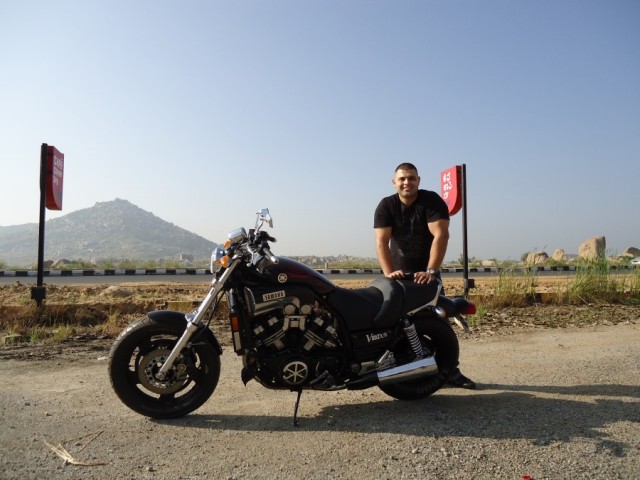
We catch up with Paul, who has been waiting for us a while now. Now Paul is the gentleman you’ll see in the pictures with the severe crew cut and biceps that could crush your windpipe if you had the balls to badmouth his V-Max. I mean it, he has Russian blood. Now that you are sufficiently intimidated by Paul and his motorcycle, let me assure you he is a really nice person. Very friendly, can go on and on about his bike, and others’ for that matter. The V-Max though, well you know the saying ‘Fear is quintessential for survival’ or something along those lines. Be afraid.

Paul on his Yamaha V-Max

I know Bangalore. I can manage to find my way around. Not so much when I’m on a superbike, I realize. Keeping my eyes peeled open for hazards, I try to orient myself, but for a couple of landmarks I recognize, I’ve no clue where we are heading and resort to sticking to the ZX-12R’s tail. If you’ve ridden your way around on a bike, you would have already expressed your disapproval by shaking your head. Trying to follow somebody, without any idea of the general direction you should be heading in, you are bound to fixate on the target, a problem that haunts not just amateurs but seasoned riders too. I’d suggest trying to keep your lead in your peripheral vision, and keep your eyes open for hazards immediately ahead, and ahead of the lead too.

What a Riot!

Paul, Me, Mahima, Arjun and Wasif. What a Riot! Oh and the random stranger behind us clicking pictures.

We are then joined by the pretty lady you’ll see in the pictures, who can, take my word for it, spar with the best of you nerdy auto enthusiasts and win a war of words. Then there’s the fact that she has an appetite for drivers who think women are bad at the wheel, or that women ‘should’ drive slow. She could probably out brake you before a sweeping turn, take you on the outside, and then mash the throttle with the other end of her pointy high heels on the way out of the corner, leaving you in the dust.

We were also joined by a couple of young guns who added flavour with a P200, a Yezdi Roadking and a Yamaha RXZ! Before you ask, yes, the fantastic Yezdi made it to the end, of course why wouldn’t it? The RXZ was bloody fast and happily screaming along at 120 odd kph.

Yamaha V-Max : DetailsYamaha V-Max : DetailsYamaha V-Max : DetailsYamaha V-Max : Details

I remember Baiyappanahalli Railway station, having seen it once on the Volvo from Bangalore to Chennai. After that it was pretty much sparse traffic. It was at that moment the ZX-12R, feared drag racing machine (and much more); the V-Max whose throttle response is a rude shove in your back; the extensively modded R1, which even when half naked catapults you effortlessly to this-is-scary-fast speeds, got going. Got going, they did. Max helpfully points out that we pretty much stick to the road and head straight.

Bangalore to Kolar

Not having to worry about getting lost and riding around in circles on a superbike, I decide to open the taps and try to understand the sinful temptations of speeds I’ve never seen on the meters of bikes I’ve owned till date. For the time since I’ve been on the R1, I steal a glance at the speedo, and I’m shocked to find triple digit numbers, when the drama, or lack of it thereof had lulled me into believing I was doing maybe a 70 or and 80kph. No, don’t get me wrong. I was not going ga-ga over how fast the R1 got there, although I did, but I do not want to admit it here, in this story – I think I just did though – well, digressing, red light, stop, back to earth. I was stumped about the fact that I was riding at those speeds, and I had yet to actually subject the throttle to calculated violence.

Yamaha V-Max : THE Engine

This image was inserted here just to give you a scare. Like you see in cheap horror flicks. Seriously though, this motorcycle is mostly engine, some chrome and then tyres. The V-Max. Perfect.

'01 Yamaha R1'04 Kawasaki Ninja ZX-12R

Rather than twist the throttle of the Yamaha R1 to the stop and kill myself, I feed in the power gradually as I’d been taught to do by the Max. Beyond what I’m guessing is the 6-8k rpm mark, the engine transforms and starts swearing at you. As is the norm with free flow exhausts ( in my experience, correct me if I’m wrong) you will hear rabid explosions when you downshift or back off the throttle momentarily. That, is fantastic. What’s even better is when you have the throttle pinned to the stop, and the engine leaves no fuel wasted, and the exhaust has  no unburnt hydrocarbons to set on fire and create those big bang explosions. You know this masterpiece of engineering is working like your typical English butler with utmost efficiency and making sure you get your petrol’s worth. Almost like it gives a damn about the rising fuel prices.

'01 Yamaha R1

Continue Reading >

It is quite likely that many of you who see the headline of this article will see this as a manifestation of paranoia. But you can rest assured that this is no paranoia; on the contrary it is a reality check.  Just a couple of days ago, Carmelo Ezpeleta, the man behind Dorna the holders of the rights of MotoGP, has said that MotoGP has to change with immediate effect.  He said otherwise come 2013 there will be only two Honda motorcycles on the MotoGP grid and none else.  Anybody who has been following MotoGP will know that in the last few years grid sizes have been simply ridiculous. Ever since MotoGP shifted to the four stroke format all motorcycles have only been factory motorcycles and the concept of the privateer team has simply vanished.  Satellite squads such as Tech3 for Yamaha and Gresini for Honda have to pay anywhere between 4 to 6 million Euros to lease bikes, which they have to return to the factories at the end of the year.  The Ducati is leased for a little less around 3 million Euros.  Adding to the woes of MotoGP are the withdrawal of Kawasaki from 2009 and now Suzuki.  Honda has decided to cut back its involvement from six to four motorcycles and same is the case with Ducati.  The reason behind these developments?  Rising costs in a global economy that is seeing crisis after crisis from the one that started due to the sub prime housing loans in the USA in 2008 to the ongoing Eurozone problems.  Last month, Shuhei Nakamoto the HRC boss said that they would not supply the latest transmission that was used on Casey Stoner’s and Daniel Pedrosa’s bikes because “it cost more money than a luxury villa”(Nakamoto’s words).

Formula1 has also been seeing turbulence.  In the year 2008, Honda withdrew from the sport citing recession and the inability to meet rising costs.  The following year saw the withdrawal of BMW and Toyota, the latter without winning a single race in nearly 10 years of involvement in Formula1.  BMW had a few sporadic wins when they were engine partners of the respected Williams F1 team.  Renault too has become an engine supplier even though there is a team that is called Renault but is owned not by Renault but by Genii Capital.  From next year on the team’s chassis will be called Lotus and Renault will just be an engine partner to it officially.  The first decade of the new Millennium saw the disappearance of many well known names from the Formula1 grid.  Arrows, Super Aguri, Jordan, Midland, Spyker, BAR apart from Honda, BMW and Toyota.  The reason for the turmoil- rising costs and dwindling budgets. Both F1 and MotoGP have been hit hard by the ban on tobacco sponsorship that was the main source of income.  When technical sponsors such as HP went away from the sport it was due to the down turn in the global economy.

So what is it that pushes up costs in GP racing?  Both F1 and MotoGP fall into the category of prototype racing, where cutting edge technology is used and experimented with before finding application (supposedly) on road going vehicles.  The intense competition in both forms of GP racing has meant that millions and millions of dollars or Euros are spent in finding an extra tenth of a second per lap.  And most times that extra tenth of a second is tantamount to nothing because in a competitive field all players are finding that extra tenth and therefore there is a maintenance of status quo.  However, the bane of F1 racing has been aerodynamics.  In the last few decades, aerodynamics has pushed costs up into the stratosphere and wrecked the spectacle of racing.  Things have reached such a pathetic stage that artificial aids such as the Drag Reduction System (DRS) have to used to make overtaking possible.  Otherwise, races are pretty much processions with positions changing not due to overtaking on the track but due to botched up pit stops.  So how did F1 arrive here?

Anyone who is familiar with the history of Formula1 will know that till the 1960s F1 was all about cars that relied on ground effect grip or mechanical grip.  Cars were front engined, had open wheels and no aerodynamics whatsoever.  What differentiated a winning car from the others was the engine and the driving skills of the racing driver.  In the initial decades of Formula1, it was the Germans who dominated the sport.  The Germans renowned for their precision and perfection were creating engines and cars that simply blew the competition away.  Mercedes Benz was the forefront of this with other makes such as the Auto Union cars and BRMs being the second line.  Ferrari were always there, they won many races, but never dominated.  Other manufacturers such as Alfa Romeo and Maserati were there for sometime but again not consistent winners.  The British Jaguar cars did run some impressive races, but ultimately were not a patch on the all conquering German Mercedes Benz cars.  But Mercedes Benz withdrew after the horrific crash at the Nurburgring that killed even spectators.

Things began to change towards the end of the 1960s.  A few months ago, the Chairman of Ferrari, Luca Montezemolo when asked about the underperforming Ferrari cars said that F1 was going in the wrong direction, one of too much reliance on aerodynamics which was a British thing.  That is hardly the answer to the question that was posed to him, for after all, Ferrari also have been using aerodynamics and won so many world titles in the Michael Schumacher era due to good aerodynamics.  But let us not bother with that; what is interesting for us is the bit about aerodynamics being a British thing.  Today everyone knows that with the exception of Ferrari, all other teams have their chassis building bases in England.  Even Mercedes Benz has its wind tunnels and chassis building factory in Brackley, Williams in Grove, McLaren in Woking, Force India at Silverstone; the list goes on.  The question then is how did Britain become the spiritual home of Formula1 constructors?

Let us now try to understand that term – constructors.  Originally F1 had car manufacturers who brought their cars to the racing tracks.  But from the 1960s on one sees the birth of the concept of the constructor.  The Brits realized that they were no match for the might of engine horse power of the Germans and to an extent the Italians.  And cleverly and very cleverly actually, they changed the way F1 cars went racing.  Here F1 shares a story with the rock bands of the 1960s (also called the swinging sixties and the Flower Power years) such as the Pink Floyd, Soft Machine, Yes, King Crimson, Jethro Tull and Emerson, Lake and Palmer.  All the bands that have been mentioned were avant garde and used not just sound but also light to enhance the experience of their music.  There were literally loads of art school graduates who had nothing to do and their talents could be used to create visuals that went with the music.  Till date bands such as Pink Floyd use those abstract art visuals to go with their genre of music which was once termed experimental but now called progressive.

What happened in Formula1 too was similar, except that instead of using Art school graduates, it used the skills of aerodynamicists who lost their jobs due to the British aircraft manufacturing industry going bust.  The services of the unemployed aerodynamicists were available for pittance.  Enter a person called Bernie Ecclestone.  He created the concept of the constructor.  An astute person who was till then languishing selling used cars and motorcycles, he saw a window of opportunity in Formula1.  He bought the Brabham team and along with him another person who goes by the name of Max Mosley entered the scene with the March F1 team.  Frank Williams of Williams F1 ran his office from a telephone booth.  Bernie Ecclestone brought all these people under the umbrella of an organization which he called FOCA or Formula1 Constructors Association.

The British constructors beat the might of the Germans and the Italians by focussing upon the chassis rather than on the engine, which was turning out to be expensive.  The aerodynamicists were used to create cars that could go faster even without having an engine that was very powerful.  The word handling now comes to mind.  The Brits created aerodynamic cars, which handled well, meaning they went faster around turns and bends even though the engines were not powerful.  F1 became the playground of disgruntled and disappointed aircraft airframe engineers who inverted the principles of lift to create aerodynamic down force and grip.  Formula1 changed its ways to become like aircraft manufacturing.

With virtually all teams adopting the aerodynamic solution, the race began in earnest to out do each other.  Wind tunnels that run 24/7 for 365 days in the year became the norm.  With aerodynamics not being a big differentiator, the search to make cars lighter also began.  Metals like aluminium and magnesium were used till carbon fibre became the de rigeur.  Engines became smaller and used exotic materials like titanium and beryllium and each new step pushed the cars costs into the stratosphere.  Racing suffered, since aerodynamic grip essentially means that being the air behind another meant loss of grip.  Overtaking became non existent.  What started off as an exercise in finding low cost solutions for high speed racing became a high cost solution for processional racing.  People like Frank Williams were firm believers in technology and pushed for the greater involvement of technology in the sport.  Active suspension, launch control, traction control, fast shifting gearboxes  and other such innovations made the Williams car of 1993 a technological tour de force.

Mercifully by this time Max Mosley became the President of the FIA.  He saw that too much technology was affecting the spectacle of racing and therefore ended up banning things such as active suspension and other driver aids.  The world is firmly divided in its opinion of Max Mosley.  Many see him as high handed and dictatorial and some see him as the person who has saved F1 a few times. Both of the perceptions are true.  F1 needed someone like him to keep the sport from going overboard.  If there are 12 teams and 24 cars on the Formula1 grid today, the credit should go to Mosley.  Measures like cutting down the number of cylinders of the engine to 8 and freezing engine development and bringing Cosworth back into racing as an engine supplier did help in maintaining the size of the grid.  Bernie Ecclestone became the Supremo of F1 and kept it alive by taking it to new destinations to protect it from economic depressions that come and go in Europe.  However, Formula1 is still horribly expensive and is very much in unstable equilibrium.  Too much technology and diminishing driver importance are still a bane of the sport.  Valentino Rossi who tested for Ferrari a few times decided that he would not race in F1 since “it was not a driver but an engineer sport” (Rossi’s words).  Launch control for example meant that the driver just sat in the car till the first turn when he pressed the brakes and then took over the throttle and the full control of the car.  Till then the car was under the control of the engineers who would launch it remotely from behind their computers when the red lights went out.  This is akin to fighter pilots taking off from aircraft carriers where engineers on the ship launch the plane with the help of a catapult and the pilot gets control of a plane only when it is airborne.  Rossi wanted things to be in his control, so turned his back on F1.

While on the face of it a rider is in control of the bike that he is riding and does not get constant inputs from his race engineer like in F1 where the engineer goes through the telemetry to rectify problems on the car and also keeps talking to the driver on radio, the spectacle of racing has diminished in the four stroke era.  The shift to four strokes was to make GP racing closer to road going motorcycles.  But the shift has proved to be anything but that.  This has been pronounced in the case of the 800cc era which has mercifully come to an end this year.  Traction control, dual clutch gearboxes for fast shifting, pneumatic valves, titanium engine casings have pushed the costs through the roof of the Hotel Burj in Dubai.  Where would all these innovations be used?  Who can afford a motorcycle that has a gearbox that costs more than a luxury villa?  So Carmelo Ezpeleta is right when he sees a crisis, one that threatens to dismantle MotoGP right now.  It is good that CRT rules and teams have been introduced.  But it may make more sense to merge World Superbikes where motorcycles such as the Aprilia RSV4F have been created like prototypes and then homologated, with MotoGP.  Both series are seeing a fall in numbers on the starting grids. Formula1 is safe for now, but continued reliance on aerodynamics will mean that costs will not fall.  Marussia Virgin’s getting rid of Nick Wirth means a return to traditional wind tunnels.  Perhaps in the interests of better racing, it may make sense to return to ground effect or mechanical grip cars.  But then we don’t change till such time that our existence is threatened.

P.S: For more on CRT motorcycles and Nick Wirth and CFD please find below the links to articles where we have discussed the merits of CFD over wind tunnels and the CRT motorcycles over the factory prototypes.  They are in two separate articles.

1954 BSA C11G
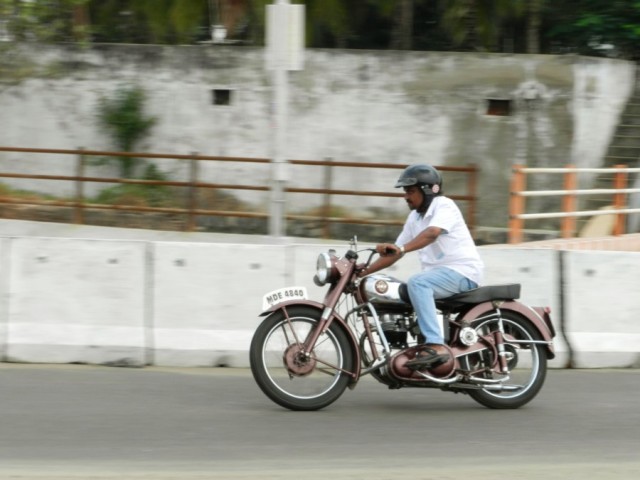
I really wanted to get this shot. Framed perfectly. I knew I would have to ask Muthukumar to take the turn again. Having already asked too much of the man when doing the Norton WD 16H photoshoot, I was slightly hesitant to ask him to do the run again. Ever the gracious host and easy going enthusiast that he is, the 1954 BSA C11G was graciously scorching, if you would forgive me for that phrase i just made up, the same patch of tarmac again, and again. I think it’s that custom paint job, ‘Rossa Mettana Effect’ he calls it. Everytime she passed me by I’d get caught up in her beauty and forget to do my job. So it was a while before I managed to get this shot.

The most popular of the BSA singles are the M20, used extensively in WW2, and the 2 stroke Bantam. These models had the magneto and dynamo setup. Relatively less known is the C range, that has always had coil ignition and until 1954 a dynamo was used to charge the battery. It was sometime in 1954 when the C10 and C11 were replaced by the C10L and C11G with alternators. The C11G also had the options of plunger or rigid frame and three or four speed gearbox.

1954 BSA C11G

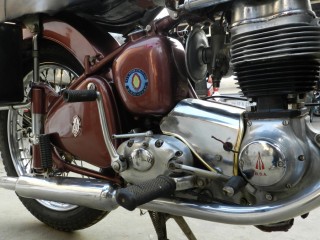
The BSA C11G is powered by a 249cc four stroke motor with a compression ratio of 6.5:1 and is an OHV unit. The C10 and C10L had the side valve engine, which were in production till 1958. The C11G was replaced by the C12 in 1956, which had the same engine, but mounted in a pivoted fork frame.

You’ve had the pleasure of acquainting yourselves with the motorcycles Muthukumar has painstakingly restored, we thought it’s time you also got to know the man himself.

It was not Motorcycles initially. It was cars, engines and motorsports involving cars ( TSD Rallys, Dirt races and track events).I still remember ( would have been 6 or 7 year kid) Formula 1 Champion Mr.Jackie Stewart came for an inaugural function of MMSC ( Madras Motor Sports Club) some 40 years back. I used to dream about becoming a NIKI Lauda. In those days even a wealthy Indian like Dr.Mallya could only dream.

I was advised that “Bikes are not safe machines for commuting”, and much more dangerous is bike racing! As far as watching races at Sholavaram was concerned, I preferred bikes ( particularly Open class) than cars.

In those days I used to lament our motorcycle tuners for their poor performance but now i understand, with the limited available facilities at that period they have done wonders. Even before doing my engineering ( Mechanical and Production) , I could understand engines and production machines a bit more than the average student who comes from a non-tech background.

My first two wheeler was a Suvega during the years ’80 or ’81. It was a gift from my Dad’s friend. Though my heart yearned for bikes,so much more than cars, consistent preaching by all and sundry made me stick to cars.

I was promised a bike though and would be allowed to participate in a TSD Rally in only a car, if I passed out with distinction in B.E. It happened and in the year 1987 my Dad bought me a Yezdi CL11 and on exactly the 8th day I crashed into a Lorry and added extra chilly to their safety advice.

1952 BSA C11G Plunger Suspension, Custom Saddlebag1954 BSA C11G Tyre Inflator

Notice the custom designed saddlebags and if you have the eye for it, the custom made badge on it. Muthukumar also has the skills to wield etching tools to get these badges done. The tyre inflator that was standard on most British bikes of that period.

1954 BSA C11G

Muthukumar about the Scissors Action Rally and his work for Enfield India:

I was back in action in 3 months, participating in the ‘Scissors Action Rally’ in a 1967 Premier Padmini FIAT (MDM 51), wearing competitor number 151. This being our (Santosh, myself and 2 other guys) first participation in a major event, we were placed 7th overall. I think that year there were nearly 60 entries including both two and four wheelers.Frad Bathena’s team won the Rally in 4 W category and Nanjappas in the 2 W ( TVS Supra SS). Mr.Karthikeyan appreciated our effort. It was a  great accomplishment to even finish a rally like that. After that, I din’t have a chance to participate, as we didn’t have funds to go on  in a professional way.

In those days, it was hard to find sponsors. Soon after that I moved to Madras, indulging in my toolroom activities, even at Madras I was not allowed to touch bikes, but it happened so. I was destined to work on tools for “Enfield India”, where some of the German Tools (DIEs) were modified or re-worked as per customer advice (based on Enfield India’s drawings). Though I was not riding bikes, I was atleast working on tools for motorcycle components.I remember working on the Fury’s timing case cover die, clutch side cover die, Explorer’s cover die etc. On several occasions I had chance of visiting all the units of Enfield, but I didn’t make any prolonged and informative visits. I do not know whether I was actually more interested in the cutting tools ( machines like the lathe, milling machines and the like) than the bikes OR if I was actually trying to heed my parents advice.

Late 1940s BSA C11 : Points housing angled into the timing case cover1954 BSA C11G : Points housed inside the timing case

Where the C11 had the points housing angled into the timing case, in 1954 the C10L and C11G adopted alternators and points were housed in the timing cover. The other difference that distinguishes the C11G from the C11 is the increased fin area which also meant that the head studs extending downward had to be longer so the fixing nut lay below the fins.

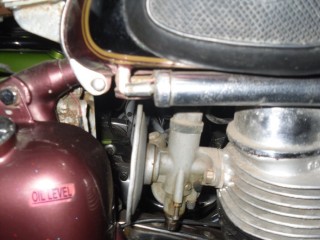
1954 BSA C11G : AMAL Carburettor

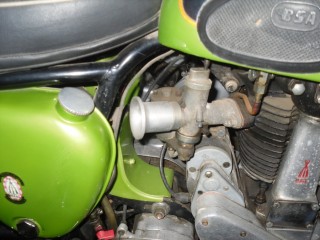
This 1954 BSA C11G has an Amal Monoblock Carburetter. Shown below are pictures of the carbs on the C11G and another BSA. You will notice the standard trumpet air filter that rams air into the carb, whereas the C11G here has a trumpet filter with a much larger surface area, but shorter length. The space available for the air filter in the C11G is much lesser and hence such a filter.

1954 BSA C11G : Trumpet Air FilterTrumpet Air Filter

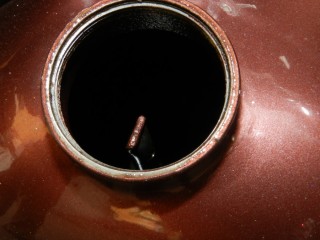
The C11G, and all four stroke BSA singles have dry sump lubrication. The oil tank is on the right side of the bike and opening the oil tank cap and making sure that oil flowed through a hole inside was one of the pre-flight checks that had to be done before rolling the bike off the stand and moving on.

1954 BSA C11G Oil Tank1954 BSA C11G : Inside the Oil Tank

Muthukumar talks about his dreams and of his father, Mr.Kanakachalam:

After ’90 I migrated to Trichy , for some offshore engineering components manufacturing and then happened marriage . In ’92 returned to Coimby to set up my dream project, which didn’t happen till now and, I think it is too late now.

I wanted to indulge in a “Steel Casting Foundry ” ( not a cast iron foundry, which is common at Coimbatore). Project cost was beyond my capacity, so was dragging the idea along till ’95 , finally compromised and indulged in ‘Tool Room’ activities in a small way! Between ’92 and ’96, was helping out a lot in my father’s garage, and apart from the regular service work, he was always busy with vintage car restoration for serious enthusiasts!

At that time we used to have cars like the Standard 10, Land Master Woody and also big cars like Austin 12, Wolsely, Hillman, Prinz, Merc 210 SE etc, but not all at the same time period, but one after other.

My Dad ( late Mr.Kanakachalam ” aka ” Ganesh) had completely restored one motorbike in his life time…it was an Ariel Square FOUR, for Narain Karthikeyan’s Family. My dad’s Car tuning skills came to the limelight, when he joined CAI, Coimbatore Auto Industries. Though my father was not highly educated, he had this ability to learn in very short time periods, and had good common sense. Initially he tuned cars for the late Mr.G.Varadraj (Narain’s grandfather) for Sulur races during the early ’60s.

Morfia

He had also made a custom car which he called ” MORFIA” with his colleagues, for Mr.G.Varadaraj , in Indian Open category who eventually went on to finish first in both the races ( a 6 lap event & a grand prix (50 laps). The Morfia had its chassis from a Morris and engine from a Fiat, a 1100cc modified with Isky cams.

1954 BSA C11G

It is only when you sit down to talk to a true blue enthusiast like Muthukumar that you realize the number of misconceptions with regard to restoration of British singles. When rigid frames were replaced with plunger frames, it was every biker’s desire to have a single piece seat for two up riding, as seen on this C11G instead of individual sprung seats. The single piece seats were in demand for the simple reason that it was a much more comfortable proposition for the pillion who was otherwise relegated to the mudguard, or any other form of a temporary seat bolted onto the mudguard. Not to forget the benefit for just the rider himself who has much more space to move around, especially on long rides. As Muthukumar pointed out, it isn’t uncommon for bikers even today to fit their motorcycles with individual sprung seats in complete disregard of the fact that the motorcycle rides on gas filled shock-absorbers mounted on a swinging arm.

You will remember the attention to detail by Muthukumar, for the seat upholstery work from the Norton WD 16H article. It wasn’t any different with the BSA C11G. It was worked on repeatedly for a number of days with Muthu wanting to achieve the perfect shape as seen in pictures of the motorcycle as it was when it rolled out of the factory. Initially the seat was out of shape, with some WFM Rajdoot’s foam. Removing all the deteriorated foam stuff Muthukumar and his trusted assistant Giri discovered ‘Made in England’ punched in the base plate. A decision was made, dents in the plate removed, fractured bits welded, then the base plate was sand blasted & powder coated. Of course, Muthukumar concedes, powder coating was not the order those days, but to preserve this beauty for years he had to adopt modern methods. Good sturdy , non textured mat black rexin was selected from Mumbai. Finally the BSA logo at the seat’s rear as shown in the image above, attached as a screen printing sticker.

1954 BSA C11G : Rider's View

Continue Reading >>

For those whose motorcycling began in the first decade of the new millennium the only kind of motorcycles known are ones that have a four stroke engine.  Also all motorcycles are either Japanese or Indian.  Honda, Yamaha, Suzuki and Kawasaki are here.  The last mentioned is a very minute niche player while Yamaha and Suzuki are struggling to gain traction in the Indian market.  Honda is the one player who has made its presence felt, thanks mainly to the successful start it had with the Activa and later on the Unicorn but still as things stand it is only the fourth biggest player in the Indian market.  Its erstwhile partner who still depends on it for technology, Hero, is the numero uno but all their motorcycles are essentially Hondas.  Bajaj and TVS have carved good positions and reasonable reputations for themselves while Royal Enfield who is the oldest manufacturer of motorcycles in India is confined to selling motorcycles of the 1940s vintage to a market that is steeped in nostalgia.  That too is a small market.  But there was a time when Royal Enfield or we should actually say Enfield India had other ambitions as well, those that did not reach fruition.  In fact, this story is about one model of motorcycle which was to have catapulted Enfield into the main stream market, but sadly did not.  But that motorcycle has a pedigree which is pretty interesting to look at and one wonders what may have been had its story been scripted otherwise.  The said motorcycle goes by the name of Fury and is a legend in its own right albeit among a small bunch of people.  To understand this story it is necessary to rewind to the 1980s and that is what we shall do.

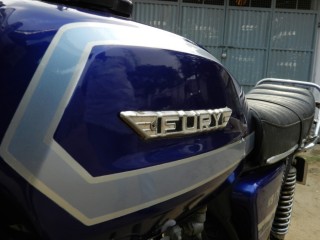
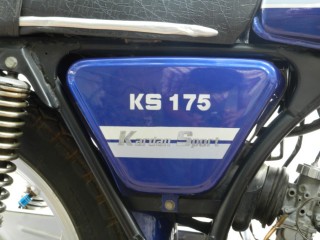
Enfield Zundapp Fury KS 175The 1980s are to Indian motorcycle buffs what the 1960s were to Europe in general.  In Europe the 1960s were all about revolution, change and great new society, a spirit well captured by Jean Luc Goddard in one of his films.  For the motorcycling enthusiasts and for the general commuters, the same was happening in India.  In Europe the societal revolution that everyone wanted never happened but fortunately in India in the 1980s a revolution swept across changing everything in its wake.  To understand the success of that revolution one has to understand what was happening in the economy of the country then.

Years of socialist rhetoric and dysfunctional industrial sector controlled by the Government had meant that the Indian economy was beginning to lose the ability to generate sufficient social wealth for the people to enjoy.  That was the time when the Prime Minister of India, Rajiv Gandhi decided to introduce a new regime that would do away with the licence Raj in some sectors and open them up for new players to emerge.  It was also the first dose of liberalization that opened up possibilities of new collaborations and allowing foreign manufacturers to have an investment as long as it did not cross a certain limit.  One of the sectors that was opened up was the two wheeler sector and initially there was a restriction on the engine capacity of the motorcycles that could be made with foreign collaboration – a restriction of 100cc.  The first player to avail of this opportunity was India Motorcycles Limited (later to become TVS Suzuki) which collaborated with society to form a company called Ind-Suzuki motorcycles and it launched the two stroke AX 100.  The next was this company called Hero Honda that made the all conquering four stroke 100cc called the CD 100 which later spawned the Splendor, the Passion and the various 100cc motorcycles that Hero still makes.  The third player was Escorts the maker of the venerable Rajdoot who tied up with Yamaha to make the Yamaha RX 100 yet another two stroke 100cc.  The story of Escorts is interesting because it first made the now famous and then infamous RD 350 under licence from Yamaha but owing to pathetic fuel efficiency the motorcycle died a very sad and premature death.  The fourth player in the market was Bajaj who brought the Kawasaki name into the market through a technical collaboration.

This meant that the old Indian bike manufacturers Enfield India and Ideal Jawa the makers of the Jawa (later changed to Yezdi) were left without any collaboration.  Of the two the position of Enfield was more precarious as the Bullet 350cc that it made was notoriously unreliable and complicated to maintain.  It was but natural that it was the first to feel insecure since the sales of the Bullet began to plunge.  Enfield then was under the control of the Viswanathan Group/family of Madras (now Chennai) and they decided to do something about it.

Enfield Zundapp Fury KS 175Enfield Zundapp Fury KS 175 Instrument Console

The Viswanathan family or the Enfield of then knew the weaknesses of its product-the Bullet.  They had therefore tried to innovate with another product which was a 200cc two stroke motorcycle which was called the Mini Bullet.  It sold in reasonable numbers but not enough to perturb any of the old players leave alone the new ones.  If you have been reading this story so far, you would have noticed that with the exception of Hero Honda nobody did anything with four stroke technology.  The reason being two strokes were more reliable and much more easier and economical to maintain since those engines had fewer moving parts. Also, a two stroke engine fires once every revolution of the crankshaft, whereas a four stroke fires every two revolutions. Also every alternate stroke in a two stroke is a power stroke unlike in the four stroke where for every four strokes you have a power stroke. This meant that two strokes were more powerful, delivered the power faster and in a heady sort of way.  The reputation of the Bullet did nothing for the cause of four strokes and therefore, wherever the Indian partner had the way, it was two stroke.  Only in the case of Hero Honda the story was different since Hero had no experience of motorcycles but more importantly were willing to listen to what Honda had to say and Honda has always favoured four strokes.

Enfield Zundapp Fury KS 175 : Instrument Console

But to come back to our story, Enfield India decided that it needed more two strokes to be able to withstand the new pressures brought by the new players.  By the time they decided to do something like that the Japanese manufacturers had been snapped up already and therefore they looked towards Europe.  In Europe, thanks to the Japanese, most motorcycle manufacturers had disappeared and that included England the original home of the Bullet. Italy had a few manufacturers left but they were teetering on the verge of collapse and they made only large capacity sports bikes.  Enfield somehow managed to locate the German manufacturer Zundapp that had shut shop and was willing to sell not only its technology and designs but also its production line itself.  And the Viswanathan group decided to acquire them all.

But in what can only be considered a “difficult to understand” strategy Enfield decided that it would take a bottom up approach and decided to start with 50cc machines, the step through Silver Plus and the motorcycle Explorer, then step up to 100cc with the Enterprise and finally to the 175cc Fury.  This was during the middle years of the decade that was the 1980s.  Amazingly for that time all the vehicles were to come with things such as alloy wheels and in the case of the Fury, even a disc brake. The company released advertisements that gave the launch scheme to the people.  Some of these models were also displayed at the first ever Auto Expo in the January of 1986 (there was a break of 6 years before the second edition of the Auto Expo happened).  Enfield had a bizarre strategy of “demonstrating” the capabilities of their motorcycles by using test riders.  But to Enfield’s credit it must be said at least people got to see the bikes turning their wheels while in the case of LML and Andhra Pradesh Scooter Ltd people only got to see pictures of their scooters before placing money for bookings (for the XE and the PL 170 respectively) and the other manufacturers of the new Ind0-Jap motorcycles only displayed their models while some generous dealers actually started the motorcycles.  The Silver Plus had a pretty good start in Southern India and it is not uncommon to see some of them on the road even today since they sold well into the 1990s. A lesser success but a success of sorts nevertheless was the Explorer and that too like the Silver Plus sold till the mid 1990s.
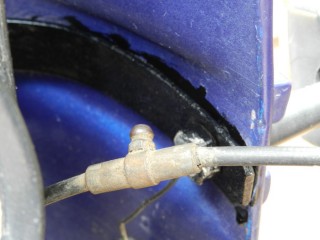
Enfield Zundapp Fury KS 175 : Grease Nipple for the Throttle Cable!Enfield Zundapp Fury KS 175 : Switchgear

Grease nipple for the throttle cable, Fury switchgear

However by the time the Silver Plus and Explorer established themselves, it was obvious that the 100cc space had become too congested thanks to the four Indo-Jap bikes, the AX 100 (TVS Suzuki), the CD 100 (Hero Honda), the RX 100 (Escorts Yamaha) and the KB100 (Kawasaki Bajaj) and in what can only be considered to be good thinking Enfield decided to postpone the launch of the 100cc Enterprise and advance the launch of the 175cc Fury.  When it entered the market the Fury was an extremely interesting motorcycle.  There were certain things that set it apart from others.  Its engine capacity was different (previously only the Rajdoot had an engine capacity of 175cc among motorcycles apart from the Lambretta Mac scooter which also had that capacity).  It was only much later that Ideal Jawa launched the 175cc single exhaust model with the Kawasaki Bajaj KB 100 parts bin providing the turn indicators and certain rubber bushes.  The Fury was also (with the exception of the Bullet 350cc) the most powerful motorcycle with a power out put of 14 PS.

The way its engine was mounted was also interesting.  It was in a traditional double cradle frame but rubber bushes were used in between the engine and the frame.  This was done apparently to minimize vibrations from being transmitted to the frame and the rider and what is interesting is that due to the rubber mounts the engine used to appear to sway a little bit during idling, something that would disappear once the engine picked up speed.  This led to some really wild stories about how the rubber bushes were not simply rubber bushes but that they also had a viscous fluid contained in them.  Another interesting feature of the Fury was the exposed frame that served as a design detail. The people’s response to the Fury was not exactly lukewarm.  It was after all the only second bike after the Explorer, its own stable mate, to sport a bikini fairing, a tachometer (the first was the Explorer but it was only optional, the KB 100 being the only motorcycle to come with a tachometer as standard), alloy wheels, and it was the first bike to sport a disc brake on the front wheel. It sold pretty well initially before traditional Enfield gremlins came to the fore.

Enfield Zundapp Fury KS 175 : Disc Brake

The biggest problem was the gear box and inconsistent build quality accounted for other problems such as front fairing rattles.  Perhaps the gear box of the Fury tells a story, one about why most European manufacturers disappeared once the real onslaught of the Japanese began in right earnest.  It was obvious that the Europeans just did not bother to strengthen their motorcycle engineering since after the World War II, the motorcycle was no longer seen as mode of transport.  It became a tool of recreation and the car took over as the mode of transport.  The electricals of the Fury (and those of the Explorer) were considered to be not as good as say those of the KB100.  The Fury though a reasonable handling motorcycle, could not capture the market due to its unreliability and expensive maintenance which were highlighted by its awful gear box.  Gear selection was more about providence rather than riding skill and this along with a dealer network that was not properly trained to handle the problems and also competition from other manufacturers meant that the numbers of the Fury began to dwindle quite alarmingly.

Enfield Zundapp Fury KS 175

What did not help was the unfortunate tinkering with the already troublesome gear box by Enfield.  Even in the case of the Explorer, Enfield reduced the number of gears from four to three (due to the preconceived notion that Indian riders of small capacity bikes did not like too many gears) and therefore reaching second and third gears was more due to prayer than due to intent.  Enfield’s tinkering with the Fury’s gearbox was also typically a case of the cure being worse than the disease.  When this tremendously negative feedback hit Enfield they went to IIT Madras (the mechanical engineering department there actually) for support.  The mechanical engineering department at the IIT Madras worked diligently for sometime on the gearbox but could not do something radically different and the problems did not entirely disappear (could we say that teaching is one thing and actually doing something is another?).  Enfield then decided to revamp the model and achieved another first.  They launched the motorcycle with a two tone colour scheme.

Enfield Zundapp Fury KS 175 : EngineEnfield Zundapp FuryKS 175

That motorcycle was called the Fury GP or Grand Prix.  The two tone colour scheme used two very contrasting colours such as black and silver or deep red and silver.  The other company that used such a scheme was TVS Suzuki on its Supra model.  Enfield also tried to take a leaf out of the Ind0-Jap motorcycles by offering a heel and toe shifting mechanism to shift gears, this to alleviate the problems of riders.  Sadly however, the gear box was not entirely cured even though the heel-toe mechanism offered greater convenience while locating the gears.  The people however had gotten used to the bullet proof reliability of the Indo-Jap motorcycles and anything lesser was increasingly becoming unacceptable.

Enfield Zundapp Fury KS 175 : Carburettor

Enfield for the first time in their history took to advertising very strongly.  They advertised the Fury as the machine with “Guts For Glory”.  Then they also asked people to choose from bike that would serve for years or pack up soon.  By doing this they were trying to build on a popular misconception that existed in the market then, that the Indo-Jap bikes were flimsy and would not last long.  Their advertising went “The quick pick up or the quick pack up” and asked the customer to choose.  Suddenly it also dawned on them that they had a disc brake on their motorcycle and decided to harp on that.  While the usual advertising in those days harped on the time taken to reach 60 km/h from zero, Enfield decided to advertise the stopping power by saying 60-0 in certain number of metres.  Try as they may, the Fury GP simply did not sell.  Examples of that are very rare, but those who have them like to keep them, since that means that they are keeping a certain piece of Indian Motorcycle history with them.  Some others which are shabby, if found, are rescued by the likes of Mr. Muthu Kumar Kanakachalam, who has done this glorious restoration of the Fury that you see in these pictures.  No matter what, the Fury is an important player in the chequered history of Enfield in India and also in the history of the Indian motorcycle market.  Its story tells us why the Indian motorcycle market went in the direction that it did.  For those fortunate people such as this author, the Fury is reminder of a rush of power and pretty good handling despite the troublesome gearbox.  If you ever find a Fury ask for a ride, it will be something different and something worth remembering.
ZundappEnfield Zundapp Fury KS 175
P.S: Now this bit is like the thing that you see in films when the credit are being shown.  What happened to the characters in the movie is also shown.  So imagine that you are seeing the credits, even though in this case the credits will show only the name of Mr. Muthu Kumar Kanakachalam.

In the 1990s the Viswanathan family sold Enfield to the Eicher Group.

Somebody in Enfield India realized that since the parent British Company, Royal Enfield Motors was dead, the rights to that name could be bought by Enfield India.

The Eicher group decided that there was no point in flogging the Zundapp range of motorcycles in the market.

The Enterprise was never launched and it was last seen in the second edition of the Auto Expo at New Delhi.

The Explorer was the second motorcycle, after the Fury, to breath its last.

The Silver Plus continued for a while before it too went to the grave silently and without ceremony.

Under Eicher, Royal Enfield Motors decided to become a niche player and cater only to those who loved the Bullet.

Consultancies such as AVL were used to make the Bullet a little more Bullet proof.

The 500cc was launched.

The Bullet spawned various versions such as the Electra and Machismo

Most recently Royal Enfield created a new Unit Construction Engine of 500cc and 350cc.

The Classic 500 and the Classic 350 were launched to resounding success (by Enfield standards).

If you want to know more, Mr. Muthu Kumar is the man for you.

The story is over, now what are you waiting for.

If you read this far, it means that you really love motorcycling history and failure means nothing to you.

And if you have read properly you will see that the article has not been proof read.

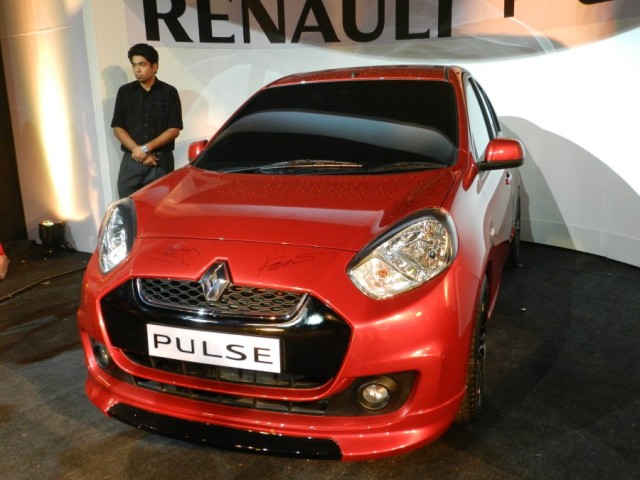
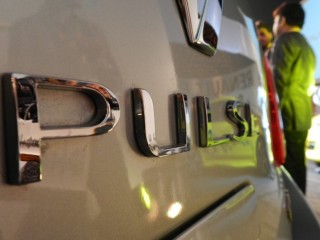
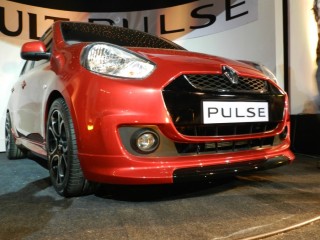
Renault Pulse Unveiled in India

Renault unveiled the Pulse today in the vicinity of the Buddh International Circuit with the dust yet to settle from the qualifying. The Pulse, will feature the K9K family of engines, developed by the Renault Nissan Alliance and better known to us as the 1.5-litre dCi turbocharged common rail diesel, that does duty in Nissan’s Micra, Note, Tiida , Qashqai,  NP200 and also the Renault Kangoo/Nissan Kubistar van range. The Pulse is part of Renault’s plans in India to deliver five products by the end of 2012.

The Renault Pulse has a 2+2 Year Extended Warranty, color schemes differentiating it from the Micra and in the opinion of this correspondent, a better looking front end. We do wonder though, did Renault miss the opportunity to give us what could have been a diesel hatch with universal appeal? Maybe, but that isn’t the point. The Pulse seems to be the next logical step, taking into consideration how the Renault-Nissan Alliance works. Reduced lead times, reduced development costs and the ticket into what seems to the most promising segment of the car market in India, that of the diesel hatch.

Renault Pulse India Unveiled

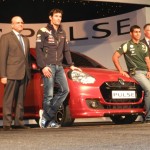
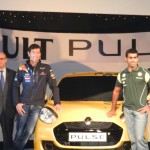
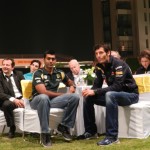
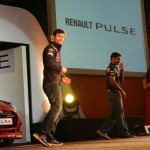
Red Bull Racing’s Mark Webber and Karun Chandhok were the surprise guests of the evening, fielding questions from the media and signing on the hoods of the special editions of the Pulse on display.

Mark Webber and Karun Chandhok at the unveiling of the Renault Pulse in India

Mark Webber, Karun Chandhok at the Renault Pulse UnveilingMark Webber, Karun Chandhok at the Renault Pulse UnveilingMark Webber, Karun Chandhok at the Renault Pulse UnveilingMark Webber, Karun Chandhok at the Renault Pulse Unveiling

The hatch goes on sale in January 2012 and will be launched at the AutoExpo. The pricing has not yet been revealed. Renault was not willing to comment on whether the Pulse will be more expensive than the Micra, but we believe it would be on the higher side. Renault also confirmed that the Pulse is not for the export market. A petrol engine for the Pulse is not out of question, said Marc Nassif, MD Renault India. The dynamics of the market are obvious, and diesel seems to be the customer’s preference.

The Pulse was designed by Renault’s Design Center in Mumbai and will be manufactured in the Alliance’s plant in Chennai, which will also manufacture the engine.

Renault Pulse India : RearRenault Pulse India : Rear
Renault Pulse India : HeadlampRenault Pulse India

Keyless entry, power windows at the front and the rear, electrically adjustable and auto folding ORVMs seem to be the highlights. The alloys on the sporty editions of the car were stunning.

Renault Pulse India : AlloysRenault Pulse India : Badging
Renault Pulse : Special EditionRenault Pulse : Special Edition

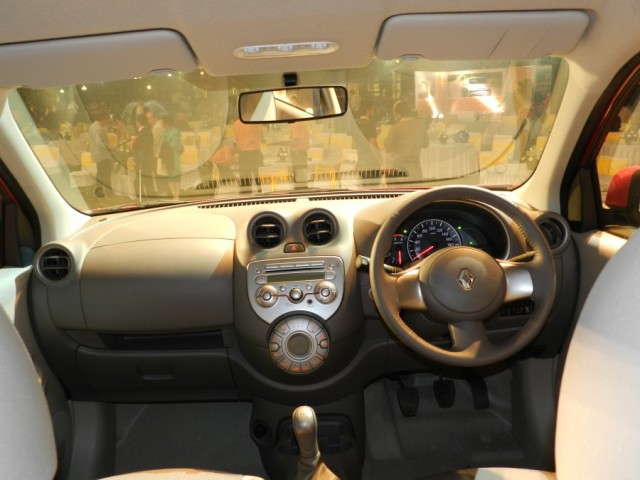
Interiors

Renault Pulse : Interiors
Renault Pulse : InteriorsRenault Pulse : Seat Fabric

Renault Pulse, the special edition : Interiors
Renault Pulse, the special edition : Interiors Renault Pulse, the special edition : Interiors

Eight years after Daijiro Kato died riding a Gresini Honda MotoGP motorcycle, Marco Simoncelli met with the same fate on a Gresini Honda MotoGP motorcycle.  Both were works spec machines; the difference lay in the cubic capacity.  Kato died riding a 990cc Honda while Simoncelli died riding an 800cc Honda.  Both suffered head, neck and chest injuries but Kato lived for two weeks in a coma before finally succumbing while Simoncelli died almost instantaneously.  After the death of Kato, Suzuka the racing circuit on which he died, did not host motorcycle racing anymore.  But Honda in conjunction with other manufacturers felt that in order to slow motorcycles down, they had to bring down the capacity of the engines of the MotoGP class to 800cc from 990cc.  It also helped that around the same time Formula1 was bringing down engine capacity to 2400cc from 3000cc and the number of cylinders from ten to eight.

If the intention of the manufacturers, Dorna (the rights holders of MotoGP) and the FIM (the governing body) was to slow the pace of the motorcycles, then they failed right from the word go.  In testing it was found that the 800cc motorcycles were much faster around turns and chicanes than the preceding 990cc motorcycles were.  Lap times in races started coming down right from the word go and even today the highest speed of a MotoGP motorcycle stands against the Honda RC212V (800cc) ridden by Dani Pedrosa (at 218 MPH) and not against a 990cc machine.  Progressively over the years the 800cc motorcycles though disliked by all were going faster than ever and in the wake of increasing speeds and decreasing lap times leaving behind more and more riders with all kinds of injuries.  MotoGP fans can scan their memories to see if in the past few years there was one year where some rider or the other had not been injured sufficiently to be out of a few Grands Prix.  None will be found.

The afore mentioned Dani Pedrosa has been injured in all of the last three seasons, Valentino Rossi in two, John Hopkins, Loris Capirossi, Hector Barbera, Alvaro Bautista, Randy De Puniet, Cal Crutchlow, Colin Edwards, James Toseland and Ben Spies in at least a few races of at least one season.  Almost every rider has crashed and starting grids which were as it is very small have become smaller still with riders injuring themselves severely and requiring surgeries.  The grand finale of this history is the death of Marco Simoncelli.  We say this history with reference to the 800cc machines which will not race after the one final race this year at Valencia.  From next year on it will be thousand cc engines and who knows what that will bring.  But to come back to the 800cc machines and Simoncelli’s death.  Before progressing further, it should be clarified that work on this article was well on the way before Marco Simoncelli died and now it is being redone keeping this rather ghastly development also in view.

Marco Simoncelli had as many antagonists as he did protagonists.  His fans loved him, the mop of hair, the colourful persona and the devil may care attributes all made him attractive to fandom.  His detractors however were many.  After his crash that saw him take Dani Pedrosa out of a race with a fractured clavicle, Pedrosa’s disreputable manager Alberto Puig called Simoncelli a person with only hair and no brains.  Pedrosa even refused the handshake the Simoncelli offered him.  While at the beginning of this season, Casey Stoner and Valentino Rossi were engaged in a wordy duel, Jorge Lorenzo started one with Simoncelli calling him a dangerous rider who was a threat to his fellow riders.  Even in the days of 250cc racing, Simoncelli had been reprimanded a couple of times for putting dangerous moves, one that remains in mind is that which he did at Jerez on Hector Barbera which saw the latter crashing into the pit wall, mercifully without serious injury.

Simoncelli has been the MotoGP equivalent of the gunslinger of the good old wild West.  He believed in the old school idea that racing should show no mercy.  Max Biaggi, after he and Luca Cadalora banged fairings and when the latter complained of bad riding, famously said “This is motorcycle racing, not classical music”.  Recently Valentino Rossi also called present day racers pussies (his idea of a sissy) and the general tenor is that people are becoming unnecessarily alarmed about things.  But apart from Simoncelli’s shock death, the unending list of injuries is necessarily a thing to be alarmed about.  And many have been injured not by coming into contact with others but simply by falling of the motorcycle all by themselves.  So where is the problem then?

To understand the source of the problem a walk down history is necessary.  Prior to MotoGP turning into a four stroke category, in the premier class which was the two stroke 500cc class, there was such a thing as a privateer entry.  People rode around on bikes such as the Patton, though invariably last on the grid, it was there for most of 500cc racing’s existence.  There were also the Elf branded 500cc motorcycles.  There was then Kenny Roberts’ Modenas and later Proton KR3 effort.  But once under pressure from Honda when MotoGP became four stroke, the category of a privateer vanished.  In effect all teams have become factory teams, while those which are called satellite outfits did not get one or two developments in electronics.  So strictly speaking all entries are factory entries and in order to protect their patented technologies, manufacturers have preferred to crush older machines rather than leasing them out or selling them to privateers.  It is this development which is most significant if we have to understand the current state of affairs.

Motorcycle factories have shown a contradictory tendency.  In the first instance they expressed an intent to slow motorcycles down by bringing down the cubic capacity of the engine but then made every possible attempts to make the 800cc motorcycles go faster and faster.  Electronics have played a very big part in this process of speeding bikes up.  But we have to explain the cause for the contradiction.  As is the case with all intentions, the intention to slow the motorcycles was well meaning, but as is the case with all competition and racing specifically to win one has to be fast and every factory wanted their motorcycles to be the winners.  One development that no one can underestimate or understate is that which pertains to Ducati and Casey Stoner emerging as top guns at the beginning of the 800cc era.  The combination stunned the Japanese manufacturers and some riders like Valentino Rossi.  Ducati and Stoner were unstoppable.  Accusations were levelled that the Ducati was more than 800cc or that it was consuming more than the 21 litres of fuel allotted per race.  All were proven wrong.

The factories realized that they had been beaten fair and square and pundits claimed that Ducati was benefitting because of its Desmodromic valves and that conventional spring valves were the undoing of the Japanese manufacturers.  First Suzuki and then Kawasaki shifted to pneumatic valves from spring valves but Yamaha and Honda, obdurately (and rightly) insisted that the issue was not with valves at all.  But the chatter about valves reached such a crescendo and included riders of Yamaha and Honda, so much so that Yamaha and finally Honda shifted to pneumatic valves.  But the improvement in performance was not going to come from there.  The Japanese as usual went the high tech way and more and more electronics came into the picture.  There were engine maps that cut out engine braking that is usually pronounced in four stroke engines, there were settings for traction control and many other such innovations to make the bike go faster.

Now add another variable to this recipe that is already primed for disaster.  The controlled tyre from Bridgestone.  Bridgestone not wanting to be accused of favouritism created tyres that could well race for twice the length of the actual races.  This meant that it usually took a while for the tyres to come into their own and offer proper grip.  But the mentality of a racer is never going to be “let me wait for the tyres to warm up properly and provide me with good grip”.  It is always going to be “that guy at the front is getting away, let me catch up with him”.  And compounding this situation are riders like Casey Stoner who seemed to be able to take off on tyres that do not offer optimum grip.  Not all are as talented as Casey Stoner and usually pushing early meant crashing.  Marco Simoncelli was the prime example of this.  This year he crashed so many times because of trying to do too much on cold tyres.  And the end came for the same reason. Unfortunately, this time the motorcycle instead of going away from the track and into the gravel went straight into the path of motorcycles following it.

Even in the days of the evil handling 500cc two strokes did so many riders not get injured so frequently and so many times.  The reason for that is that it was the rider who rode by the feel that he had with the bike rather than electronics doing all that for him and cutting him off from the road.  The riders then knew where the limits were but now they do not since the feeling from the road is not fully transmitted back to the rider.  In the days of the five hundreds there were privateers.  They got their engines from Yamaha and put them in chassis made either by ROC or by Harris.  There were always back markers to slow down the leaders.  It was usual for the Patton to be lapped up to three times in a race.  Now with all factory bikes, that does not happen.

For MotoGP to slowdown and to get safer, it is essential that electronics be limited and tyre compounds that degenerate with every passing lap be used.  CRTs is the right way to go forward and more of them should be encouraged to break the strangle hold of the factories on the sport.  All these can make the sport much safer than it is today and more lives need not be lost and injuries can also be minimized.  Hope sense prevails.
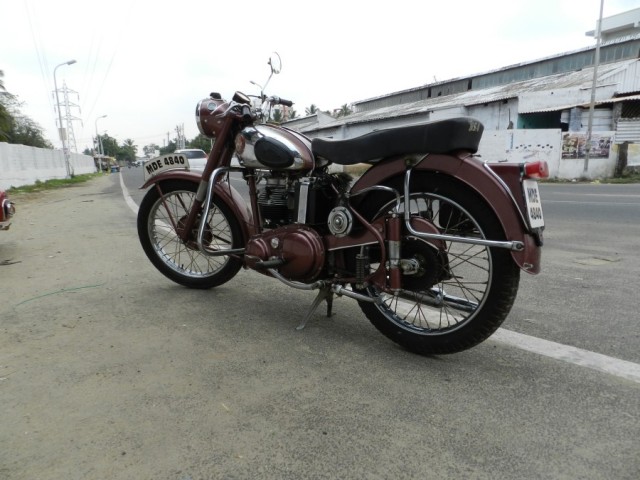
MRF- FMSCI National Motorcycle Racing Championship Round 5
Championship winners along with Chief Guest Mr. Arun Mammen, Managing Director, MRF Ltd. (5th from left), Guest of Honour Mr. Keita Muramatsu, President & CEO, Honda Motorcycle & Scooter India Pvt. Ltd. (6th from the left), Guest of Honour Mr. Jun Nakata, Director Sales & Marketing, India Yamaha Motors Pvt. Ltd. (4th from left).

Championship winners along with Chief Guest Mr. Arun Mammen, Managing Director, MRF Ltd. (5th from left), Guest of Honour Mr. Keita Muramatsu, President & CEO, Honda Motorcycle & Scooter India Pvt. Ltd. (6th from the left), Guest of Honour Mr. Jun Nakata, Director Sales & Marketing, India Yamaha Motors Pvt. Ltd. (4th from left).

The final round of the National Motorcycle Racing Championships was held at Chennai’s MMSC race track on the 1st and 2nd of October. Riot Engine was at the venue and we present to you photos and videos from the Superbike and R15 categories.

MRF-FMSCI National Motorcycle Racing Championship : Round 5 Superbikes

MRF-FMSCI National Motorcycle Racing Championship : Round 5 Superbikes

What happened next is something you can never tire of. All those middleweight engines screaming in unison, raging to break free of their reins.

MRF-FMSCI National Motorcycle Racing Championship : Round 5 Superbikes

Some more pictures for you to feast on.

MRF- FMSCI National Motorcycle Racing Championship : Round 5MRF- FMSCI National Motorcycle Racing Championship : Round 5

Yamaha R15 One Make Race

MRF- FMSCI National Motorcycle Racing Championship : Round 5 - Yamaha R-15 One Make RaceMRF- FMSCI National Motorcycle Racing Championship : Round 5 - Yamaha R-15 One Make RaceMRF- FMSCI National Motorcycle Racing Championship : Round 5 - Yamaha R-15 One Make Race

MRF- FMSCI National Motorcycle Racing Championship : Round 5 - Yamaha R-15 One Make Race: Chequered Flag!

We have also uploaded a  PDF File listing the final championship points tally.