Tag Archives: Power Stroke

It was going to be my last weekend in the United States. I was going back to India after a year’s gap. Of course, I was excited as one usually is when going back to family after a long gap. Upcoming events like my parents’ wedding anniversary and my cousin’s wedding also added to the excitement points.

Amidst all this, I was also feeling sad about leaving the US. Not for leaving one of the most developed countries of the world and the financial benefits that come along with working out of there. But because I would not be able to drive the kind of cars that I drove here in the US, back in India.

Right from the time I took my first rental car in the US, I had made a decision that I will try out all the different types of cars that I could possibly lay my hands on. And that I did. From Chryslers to Mazdas and humongous GMCs. But now, when I had just one weekend left, I was feeling sad at not being able to drive a car that had always tingled my sensation whenever I had heard or read about it. After having been in the land of the muscle cars, I had not been able to lay my hands on one of the greatest of them. I had not yet driven the Ford Mustang.

Mustangs were always rare in a car rental agency. Rental cars are not usually meant for performance oriented people. A car like the Mustang does not necessarily make much sense there. That was the answer that I got whenever I had asked for Mustangs in such agencies earlier. My roommate consoled me saying that I could buy one if I am here next time. I too had resigned to that fact.

Being the last weekend, I had to do lots of shopping. I believe I do not need to delve into the details regarding the kind of shopping one has to do when you have an extended circle of family and friends back home. It was chaotic and fun at the same time, needing to think and think again regarding the justification behind buying a particular stuff for an individual. Backup plans to accommodate any final goof ups will also have to be thought out. I had made the list ready and was just waiting for the weekend to arrive.

It was Friday morning and I had just entered my office. The phone rings and it was my roommate at the other end. He says, “I am at the car rentals now to pick up the car we had booked for the weekend. But they don’t seem to have any right now”. We had booked a midsize sedan category car and it was usual for the rental agency not to have a car in the category that we have booked.

“So what? Ask them for something else. That is what they always do”, I replied.

“Ahem… That they have offered. They only have two cars right now. One is a brand new Jetta and the other is a Mustang. I was planning on the Jetta. What do you propose?” I could feel my friend’s smirk when he said that.

I spent the next few minutes explaining to him the need to get the Mustang, in a language which is inappropriate to put in here. Coming to think of it, that wasn’t entirely necessary as he, after having listened to me lots of times, had this feeling that Mustang was not an ordinary car.

In the evening, the parking lot was the first place I headed to after I got down from the bus. There it was, the two door coupe, jet black in colour, gleaming in the afternoon sun looking just as I had expected it to. Silently thanking God for having given me this opportunity, I headed towards the apartment.

My roommate had taken the car to New York on that day and he was waiting for me to let loose his commentaries about the car. He told how he was late to start but was able to make up time as he was able to zip in and out of traffic easily and effortlessly and about being stunned about the pickup at times. Even though a considerable part of his commentary was beefed up, it was easily understandable that the excitement bug had caught him too.

The next day he accepted my request to let me do all the driving. I got ready before him for the shopping exercise and went down to the car to take a look around.

I had gotten used to the practicality offered by the Japanese cars and the finesse of the Germans, that the first emotion that stumped me when I sat in the driver’s seat was that of amusement. It looked rather bleak, dull and monotonous. The dashboard and the controls didn’t cheerfully call out their names in the order of functionality. They rather yawned at me and looked indifferent. I spent the next few minutes plugging in the GPS and setting up the iPod. I had some trouble finding the seat adjustment controls and getting used to them. Once this was successfully accomplished, we set out.

There wasn’t much noise as I fired the engine which added to my list of amusements. And the cabin seemed to be decently sound proofed as well. I gingerly backed her out and headed onto the country road outside our apartment complex.

I was doing a painfully slow 20 MPH. My friend, worried about getting a honk from a car behind us asked me to speed up. But I continued at the same speed, knowing very well that I was just executing my plans.

There is an interesting part to the American road system. The highways have a speed limit ranging from 65-75 MPH and the country roads around 25-40 MPH. Which means that the ramps which connect the country roads to the highways become small drag strips where you need to speed up from country road speed to highway speed. Now with the Mustang at my disposal, I was looking forward to getting onto the highway more than in any other car.

As I entered the ramp, my speed further dropped due to the incline. I slowly covered half the distance of the ramp, not heeding to the constant high pitched rant coming out of my friend’s mouth.

And then I did it.

Just when I thought I had only a few hundred metres remaining before I joined the highway, I floored the accelerator.
And the world transformed.

The high pitched shrieks from my friend were replaced by a noise so belligerent, so fearsome, so deeply bass-ed that my friend jumped out of his skin. He turned back in time to see a grin pasted on my face.


The grin of having had your neck pinned to the headrest with a thud. The grin from the adrenaline rush which would rival the speed at which fuel is being dumped into the big engine at the front. The grin from realising that my list of earlier amusements were no match for the experience that I was having and that my theory about the sound proofing was wrong. The grin from hearing a cacophonous mayhem at its harmonious best.

I hit 80 MPH at the blink of any eye. All through my driving experience in the US, I had always maintained my speed limit. This was the first and the last car where I did not. Because I simply couldn’t. Any speed below 80 and it made me feel foolish. It made me feel like someone who would only play Super Mario on a PS3.

I drove it almost nonstop that weekend. When we were returning it on Monday morning, I felt I had found the single reason that could make me prolong my stay in the US.

The experience with the Mustang also taught me a lesson. That such pieces of machinery had the power to appeal to non enthusiasts as well. Because after another one of my country road-ramp-highway exercise, my colleague who was sitting next to me said, “You know, it feels different when this car does that. The sound… The surge… Something that I had never experienced before”.

She didn’t bother that I didn’t reply to her. Because I had the grin back on me, my eyes looking at the highway ahead, over the swooping long bonnet with the casted silvery shape of a running horse at the grill, aptly representing the feel and sense of the car.

It wants to roam free. And it wants to be fast and furious when doing that.

Our correspondent was riding around when this beautiful baby caught his eye. She was standing at the side of the road in South Bangalore, all wet from the recent showers in the city. Apparently, Bajaj is testing the KTM Duke 125 in and around Calicut and Ooty. There is a little bit of confusion regarding the cubic capacity of the engine with some reports saying that Bajaj will launch the KTM with a 200 cc engine to justify the high price tag that it will come with. The question really is, will Bajaj really get the 125 Duke or the 200 cc Duke down here? We think it may be prohibitively expensive at 2 lakhs for a 125 cc to make any serious sales figures, but we never really know, do we? We are waiting like you and hope one of the two or maybe both will make into the market place. Why not be greedy, when you can?

Beautiful looking motorcycle, no?

The average Despatch Rider route would probably be anywhere from 150 to 200 miles, sometimes much more. Because they were on tightly timed schedules, and operated 24/7 in all weathers and circumstances, they could be very exhausting, especially as we normally worked on shifts through the 24 hours.. For example, I recall one night trip I made in Derbyshire and Yorkshire in early 1940. There was heavy snow in the hills and ice on the roads everywhere else so I slid off the road so many times I was exhausted and could hardly lift the bike up again. Eventually I stopped an army truck and the bike was lifted inside and I got a restful trip to my next stop. After handing over the mail and collecting the new messages, I took a two-hour kip on a table in the mess hall then went on my way. After it was light it was much easier and I was able to complete the route. In 1940 and 41 we ran Despatch Rider routes right through central London whether or not there was an air raid in progress, making whatever detours were necessary due to damaged roads.”

Meet Mr. John Nevil Horsfall. As a Despatch Rider in Royal Signals, from enlistment in September 1939 to 1942 when he left for officer training, he rode the Norton. Still on unsteady ground after the trip to Muthukumar’s garage, I was to say the least, stumped when I came across B&W photos from the war showing Nortons & BSAs in a parade. It took me a while on the WW2 Forum to realize that I could actually have a conversation with a WW2 Veteran who had considerable experience with the Norton in the field. What followed was a flurry of emails exchanged requesting Nevil for photographs and a couple of words for Riot Engine. Thanks Nevil, for these pictures.

Please note that not all motorcycles shown here are 16Hs

Muthukumar’s garage, fondly named B&Q Rest’s Garage, is reached through Avinashi Road a couple of minutes away from Coimbatore. Riding pillion on Mr. Muthukumar’s 1985 Kinetic Honda, I was at the gates of his garage, only at that moment realizing that even though I’d gotten there from Chennai taking the ubiquitous train, had the familiar breakfast of idlis, masala dosa and finished up with the routine of slurping filter coffee,  nothing was going to be ordinary once I stepped beyond those gates.

The gates were thrown open and the memory etched in my mind right next to that of Rajnikanth throwing open the gates in Aboorva Raagangal. The presence of a beige Indica did nothing to lessen the visual glory of the garage. I’d seen enough pictures of some of the classics prior to restoration being brought in sacks, into the garage in the boot of that simpleton of a hatchback. Muthukumar showed me the custom designed saddle bags that were to be mounted on the Norton’s panniers. When I say custom, I mean custom. Muthukumar sketched out the design he wanted, sent the drawings to an upholsterer in Agra and had them shipped back.
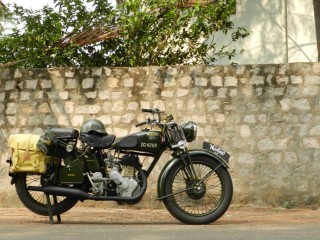
We took out the Norton for a couple of photos. She definitely got the attention she deserved. Muthukumar rightly pointed out that the biggest hazard are the gawkers who suddenly become oblivious to the fact that they are still in motion as much on the road as they were before being visually and aurally assaulted by the 16H.


The WD16H is powered by a 490 c.c. single cylinder, four stroke, side valve engine. The front suspension is of the Girder Fork type, with a central spring complemented by a set of auxiliary springs (often referred to as rebound springs) and hand adjusted shock absorbers. Norton had patented this technology and displayed the patent number on linkages on both sides. We explain the functioning of the patented system elsewhere in this article. This Norton is a hard tail, with a sprung rider seat and an unsprung pillion.

Side Mounted Lucas Horn, Girder Fork, Patent Number, Hand adjustable Shock Absorber

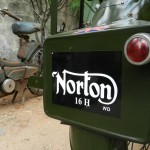
Though the internet is rife with explanations for what the WD and H stand for, Mr. Muthukumar assures me that WD is War Derived and H denotes that H-section connecting rod used in this mill.

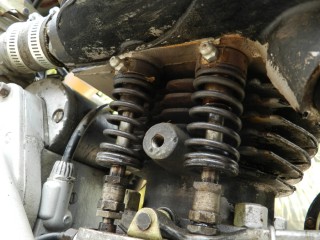
The 16H like its contemporaries has a dry sump lubrication system. A four gear pump forces oil under pressure to the bearings and the rear of the cylinder. An oil filter is incorporated in the piping. One novel feature pointed out to me by Mr. Muthukumar was that you could remove the tappet cover and grease nipples are provided to lubricate the valve guides. Having only recently been introduced to British Classics, I was stumped when I saw the Gear Indicator. Though the purpose of such a device beats me, the brass plate with the etched numbers definitely adds to the motorcycle’s charm.

The kind of abuse these motorcycles were subject to in the war, it was not uncommon to rebuild a whole motorcycle from parts recovered from various other worn/damaged motorcycles. Such a motorcycle was provided with a new Army Census number and put to work again only to end up as parts for some other motorcycle, or be repainted and sold to civilians. No wonder there are few WD16H’s left today with matching engine and frame numbers.

Those saddlebags are something aren’t they? The oil tank and the Lodge 18mm Spark Plug.

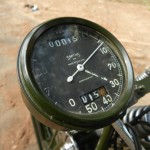
There are a number of variations of the 16H documented during the war. This variation is identified by its double bolt rear ‘civilian’ type number plate, removable rear mud guard tail piece, existence of a number plate on the front, winged “gravity” knob on the toolbox as opposed to the school bag type lock, OLH (Off, Low, High) headlamp  switch, the lack of a black out mask on the headlamp, sideways mounted horn and a lot more visible only to the discerning eye. The last two of the lot of pictures below show the Lucas Regulator and the Smiths Meter.


INTERVIEW WITH NAGARJUNA AKKINENI, TELUGU FILM STAR AND AUTO ENTHUSIAST

Nagarjuna is one of the well known names and faces of the Telugu Film industry.

He is the son of thespian actor Akkineni Nageshwara Rao who is a Padma Bhushan Award winner as also the Dada Saheb Phalke Award. Nagarjuna’s name and face are also well known to the rest of the country due to his having made films in Hindi, Tamil and Kannada apart from Telugu films. While these details about him are reasonably well known there is one side of his personality that not too many know. He is an auto enthusiast. In his home city of Hyderabad, some close to him know of his love for cars and motorcycles, a love that has been there with him for almost as long as he can remember. Riot Engine caught up with him to explore more of this lesser known facet of his.

Riot Engine: Good Morning. Thank you so much for talking to us while you have a break in your shoot.

Nagarjuna: Not a problem. I do like talking about automobiles.

RE: Is it true that you are a car and bike enthusiast?

N: Most definitely.

RE: Since when have you been an automobile enthusiast?

N: From my younger days, actually for as long as I can remember.

RE: Can you tell us the names of the vehicles that you have owned?

N: I have owned among many cars a 1969 model British Daimler, the 1974 Porsche 911 Turbo (considered by many to be the greatest 911), a Triumph 2000, a Mitsubishi Shogun/Pajero, the previous generation Mercedes S Class, a Porsche Cayenne, a previous generation BMW 7 series and now a BMW M 6.

RE: Is that an exhaustive list of all the cars you have owned?

N: Not really. I had owned a few cars and bikes while I was studying for my post-graduation in the USA. There I had a Datsun 240Z and a Datsun 260Z apart from a Saab 900 Turbo. Saab was considered to have a very good turbo technology and the Datsuns were great handlers.


RE: What is it that drives you to buying a certain car?

N: The cars will have to combine visual appeal with driving appeal.

RE: Do you prefer driving your own cars?

N: Most definitely. Good cars are meant to be driven.

RE: Apart from visual and driving appeal what is it that makes you an auto enthusiast?

N: For me cars and automobiles represent a perfect combination of art and engineering. They are the embodiment of technological brilliance coming together with artistic flair. When you see a car or a bike you know that it is a true work of great art and the fact that it is capable of locomotion is the added thrill.

RE: You have also talked of owning bikes, which are the ones that you have owned?

N: Of the cuff, I can remember a Suzuki 650 4 cylinder bike, a Kawasaki 250 dirt bike when I was in the USA, a Honda CBR 1000 RR Fireblade, a Kawasaki Ninja GPz1000 and a Yamaha R-1.

RE: Which of these did you enjoy riding most?

N: Actually all of them, each one had its own individual character and I liked all of them.

RE: Which of the two do you prefer more, driving cars or riding bikes?

N: In my very young days I preferred riding bikes. Later on as I also needed my privacy when out in the open, I moved on to cars. Also the lack of proper roads made my decision to go towards cars stronger. Some of the roads have such pot holes that biking with big bore bikes can become a problem.

RE: Which of the vehicles that you have owned are you emotionally attached to?

N: I do not get emotionally attached to any of the vehicles that I own or have owned?

RE: Why is that so?

N: I like to constantly explore new cars and bikes. If one gets emotionally tied down to a particular car then one will not explore further. For me it is important to move on and sample all the good cars and bikes that are out there.

RE: Thank you so much for speaking with us and for your time.

N: No problem. It’s my pleasure.

Our thanks also to Mrs. Amala Akkineni for coordinating and making this interview possible.


INTERVIEW WITH NAGA CHAITANYA AKKINENI

Naga Chaitanya is the latest scion of the Akkineni family to have joined the Telugu Film industry. His first film ‘Josh’ has been released a little while ago. He is the son of Nagarjuna Akkineni and like his father shares a love for all things automotive. He too is an enthusiast and probably more so than his illustrious father, if that is possible.

Riot Engine: Thank you for agreeing to speak to us about your passions with automobiles.

Naga Chaitanya: (Smiles)

RE: Can we say ‘like father, like son’?

NC: Meaning?

RE: Meaning that you take after your father, in wanting to be an actor and also in being an auto enthusiast.

NC: Yes that is very true.

RE: What do you like more, bikes or cars?

NC: It is not as if I do not like cars but bikes are what I prefer.

RE: Any specific reason for that?

NC: The reason is quite straightforward. There is a certain rush that you feel when you ride a bike and that is not there is driving cars. But like I said, it is not as if I do not like cars. They have their own ways of exciting people but the raw adrenaline rush that you get when you ride a bike is much more potent than anything else.

RE: Which bike did you start on?

NC: Like most youngsters my initiation into bikes happened on various 100 cc bikes. It was a little later that I started getting my quota of big bikes.

RE: So which was your first big bike?

NC: My first big bike was a Honda CBR 600 RR. I drove around on it for a year and then changed to a Kawasaki Ninja ZX- 636.

RE: Why Kawasaki?

NC: That is because of all the Japanese motorcycles I find Kawasaki bikes to be the most evocative emotionally. There is a certain connect between the rider and the bike that is unparalleled in other bikes. My Honda was very smooth and I loved it but Kawasaki is a little bit more.

RE: Do you still ride the Kawasaki?

NC: No not any more. I now ride a Yamaha YZF – R1.

RE: Did you change to the R1 because it is a bigger bike?

NC: Not really. I, in fact, prefer riding 600 cc bikes in the city because they are easier to handle. Their power delivery is much softer and the bikes themselves are lighter and therefore are better for the city. My problem was that I was not finding proper service for the 600 cc bikes since they are not officially sold here and since there is no service back up. When Yamaha set up shop to sell their big bore bikes and also offer service I picked up the R1, for reasons of convenience of maintenance.

RE: Are you looking forward to any other big bike launches?

NC: I know that Harley-Davidson is in India and that they will start selling their bikes shortly but I am not into cruisers and therefore I am waiting for Kawasaki big bikes to launched. Now that the Ninja 250 –R has been launched I am waiting for the ZX-10 R. When it is launched I would like to buy that.

RE: So you are a sports bike person?

NC: Most definitely. The thrill of riding a sports bike is unparalleled.

RE: Is your liking only for Japanese sports bikes then?

NC: Let me put it this way. Among all the bike makers and car makers I prefer the Japanese but I certainly do like other bikes and cars as well.

RE: Which are the other models and makes of bikes that you have ridden?

NC: I have ridden quite a few other bikes but the most memorable ones are the Ducati 1098 and the fabulous MV Augusta F4 1000. In fact, I would like to say that the MV Augusta F4 1000 Ayrton Senna limited edition is my all time favourite.

RE: Why so?

NC: There is a mystique to this bike. It is aurally reassuring because of the deep sound and visually enthralling like all of, if not most of Massimo Tamburini’s designs. And when you add a great racer like Senna’s name, what a combination.

RE: Do you like watching racing, now that you mention Senna?

NC: Yes, I like to watch racing. I also like to race myself.

RE: What kind of racing have you done?

NC: Drag racing of cars mainly.

RE: Not bikes?

NC: I have used bikes for weekend getaways with friends but I have mainly raced cars in drag racing.

RE: What cars have you raced?

NC: Most recently I have driven a Ferrari F 430 for timing at a drag race event at Hyderabad. But while I was based in Chennai, I used a Lancer.

RE: Was it a standard car or a souped up version?

NC: It was for track at Sriperumbudur. It was not a standard car. It had a MIVEC engine of the Lancer Evo which I had imported from Malaysia. The car was built up, tuned and prepared by friends at Chennai. I had this car for a while and then changed it when I came to Hyderabad.

RE: Why so?

NC: In Hyderabad there is no real track that I can use a car like that. At that time I also wanted something more practical for daily commute as well.

RE: Which car did you use for that?

NC: I used a Swift that was modified. I incorporated a stock Garret turbo along with high lift cams. The engine itself was ported for deriving greater performance. I also had the suspension of the car stiffened for better handling.

RE: What are the top speeds that you have done with your cars and bikes?

NC: Actually top speed is not too important to me. Better overall times are achieved on the race track with good suspension settings and good midrange power in the engine. Look at various races. You will see the car or bike with the maximum top speed is not necessarily the winner. It is the one that goes around better in the corners, turns and communicates better with the driver or rider that always wins. Handling and nature of power delivery are more important than top speed which is more academic than anything else.

RE: Do you still use this Swift?

NC: No I have sold it because I was finding it difficult to find help for its maintenance in Hyderabad. I now have a Honda V6 Accord.

RE: Is it modified?

NC: Not much other than a Magna Flow exhaust and a cold air intake. I don’t prefer using the car too much. I like riding my R1.

RE: Have you modified your R1?

NC: Other than putting an Akrapovic exhaust system I have not done much else to it. It has way too much power for city roads as it is.

RE: Don’t you find it a problem to ride in the city when you are an upcoming film star and the son a famous film star?

NC: I always believed that one should ride responsibly, which means that one should wear adequate protective gear such as helmets, gloves, shoes etc. Now this is where anonymity also comes in. Since I never ride without protective gear it means that no one knows what is inside the helmet et al. That is what makes it possible to pursue my passion of biking.

RE: Do you like biking alone or in a group?

NC: I like biking in a group. Fortunately I have group of good friends who share my passion for motorcycles and have wonderful motorcycles too. Except while commuting we all go biking together.

RE: Thank you so much for speaking to us. We hope to stay in touch with you in the future.

NC: Sure anytime, that is not a problem.

Thanks to Mrs. Amala Akkineni for coordinating for the interview. Thanks to Mr. V. Vijay Mohan for his involvement in the interview and photo shoot.


My green Ninja 250 R will be completing one year this month. In the initial period of purchase I could not ride it as much as I wanted to, since I have a bad back which keeps reminding me of its existence. When it raises its head, the doctors are the first to say “no biking”. This has meant that for the first six months of its existence it was not ridden too much. There were many who wanted to ride it, but I made sure that no one rode it for more than a couple of kilometres since I am very possessive about it. Right from my childhood (and I am now firmly ensconced in middle age) I have had a passion for Kawasaki bikes. I remember my friends surreptitiously looking at female nudes in a very difficultly procured copy of Playboy and I would be quite happy and content with looking at the “Kawabunga” ads that featured Kawasaki bikes.

With age my passion for biking and for Kawasaki bikes increased exponentially and my first Kawasaki was the KB -100, which I loved very much, even when everybody was writing it off. I could beat many RX-100 riders with it. Those were the follies of youth. I would not recommend that to anyone now, the racing on streets that is. Later I pretty much bought all the bikes that Bajaj launched in collaboration with Kawasaki; the 4S, the Caliber etc. Please don’t let this make you believe that I will be biased in my reportage of all things Kawasaki. Far from it, I can give you a pretty accurate picture of what the Ninja is, objectively.

The last few months, I have been riding the Ninja almost every day though not over very long distances. The first thing to understand about the Ninja is that it can even be used as a commuter, provided you are not going to be stuck in traffic over long periods. Let me explain that. The Ninja is a parallel twin, liquid cooled, double overhead camshaft engine motorcycle. This means that it has a radiator but no fan to cool it. So it needs oncoming air to cool the radiator and the engine. If you are stuck in traffic there is no oncoming air and you can see the engine heat climbing slowly. In such instances the best thing to do would be to turn the engine off and wait for the traffic to move before cranking it on again. It comes only with a self starter and no kick starter option is provided. This means that the battery will have to be taken care of properly. Another reason why the battery will have to be looked after is that the headlight of the bike in the low beam configuration is always switched on and the rider cannot switch it off. This is because the bike is built to European safety regulations which insist on the lights being switched on all the time. So now you know the philosophy behind the LED lights on the Audi’s and more recently Mercedes Benz cars. However, in India this feature is a nuisance since everybody on the road tells you that your light is on.

Now coming to the engine characteristics. It develops 33 PS of power as per the manufacturer’s specifications mentioned in the manual and is mated to a six speed one down-five up pattern gearbox that only lets you shift gears with your toes. While on the subject of the manual I would like to mention that Kawasaki unfortunately uses bad American spelling in many instances, one being that the mention of “curb” weight of the bike instead of “kerb” weight. The bike is 149 Kilograms heavy but not at all difficult to ride. On paper 33PS of power looks formidable. I have grown up with the now iconic Rajdoot Yamaha RD 350 in its 30+ bhp guise and also in its 26 bhp guise. The RD 350 always kept you on your toes and trying to act funny with it meant that one could have serious injury. So when I saw 33PS I thought wow, this is going to be good fun. When I took delivery of the bike, I gingerly engaged gear one and very gently released the clutch hoping that the bike would not pop a wheelie. No such thing happened. The bike was a like a docile little lamb. My thoughts at that time ranged from ‘did Kawasaki lie about the power or is that what I paid so much money for’ etc. The first few days of riding the machine were a huge disappointment to say the least. I was actually thinking that this is probably the reason why Kawasaki wins the wooden spoon in World Superbikes and also in MotoGP when it competed there. But I told myself that one day, I should break the rules of running a bike in and try riding it at higher speeds. So one Sunday morning, with my riding gear in place, I went to one of the empty and straight roads of Hyderabad, near the new Airport and opened the throttle fully. The surge of power from six thousand rpm was incredible and all the way upto twelve thousand the power just kept coming. I touched a top whack of 130 kmph when I finally ran out nerve and road. I later on checked with another friend who said he touched a top speed of 160 kmph. He is much lighter than I am and his bike was also fully run in.


The frame which is diamond type can cope up with the power of the engine and also with the undulations that the road has to throw up. It is not very easy to unsettle the bike and the suspension of the bike is more than adequate. The telescopic front forks and the single rear shock absorber in conjunction with the Kawasaki Unitrack system, is pretty good even on rough roads. I have not noticed any chain slack so far. The riding position is not fully forward but still does place some weight on the wrists over long distances. That can cause a bit of aching of wrists. The bike does change direction willingly and can be flipped from one side to another quite comfortably. The tyres which are made of soft compound (by IRC) need to be brought to temperature before they start holding the road properly. Cold tyres do not offer a wonderful grip. The instrument console is old school, but I like it like that. The rider’s perch is comfortable and this bike is best ridden solo. The pillion seat has one problem and that is that it does not offer anything to hold on to. The absence of a rear grab rail means that sometimes maneuvering the bike out of tight spaces can be a problem. One good feature though is the existence of a lockable storage space beneath the rear seat, where basic documents can be kept. The rear view mirrors are wonderful and give a good view of what is behind the bike. The grips on the clip on handle bars are also good with weights at the ends to iron out vibrations. Fuel efficiency vacillates between 25 and 28 kmpl, depending on traffic and style of riding. All in all the Ninja 250R is a good bike, though very pricey and with the Honda CBR 250 R debuting at half the price, it remains to be seen which way this will go. What may queer the pitch even more is the fact that a Yamaha Fazer 250 and a Pulsar 250 are rumoured to be coming. And that is not counting the Suzuki GW 250 that has been confirmed for the year end.


The first and last 2 months of the year are the dullest phase in any racing enthusiast’s calendar, which marks the longest spell of racing inactivity in any perceivable form. This intentional lull looms large for as long as 4 harrowing months thanks to ridiculously low amount of testing being imposed, which grinds the usually speed filled weekend to almost a screeching halt.

Everything is forgiven when March turns the red lights green, with the prototypes machineries taking to the tracks with a monstrous roar that just wouldn’t wane for the next 8 months. Point at any ensuing weekend and you could see yourself mostly glued to the TV seats witnessing MotoGP Aliens slugging it out and showcasing some serious aggression with fever pitch sometimes reaching fairing bashing levels.

There cannot be a single racing fan, regardless of the no. of wheels he’s obsessed with, without predicting how the season would pan out once it gets underway. Rooting for their track idol, betting on his victory chances, weighing in his strengths and weaknesses against their adversaries, locking horns with like-minded folks at numerous racing sites and automotive fora identify a racing enthusiast in unmistakable fashion. This is the very reason I beat around the bush till now only to start my rant on this season that’s piping hot, yearning to be served before it turns cold.

Ignite the MotoGP discussion with any fanatic and the subject on Aliens barges in with brute force, thanks to Colin “Texas Tornado” Edwards for coining such a term, which would get used a zillion times in a million sites by a gazillion people as if it’s a technical term that has been existing in the MotoGP lexicon since time immemorial.

Even though the concept of “Aliens” had gained unrivalled popularity in an incredibly short span of time, the meaning seems to have been redefined this time courtesy riders switching teams that either boosts or mars their chances of having a shot at the title. This year, though, the preseason testing and the subsequent 2 rounds have vouched for 3 young guns that can fight head-and-shoulders above the rest for the ultimate laurels. The names Stoner, Lorenzo and Pedrosa should not come as a surprise for anyone who’d kept regular tabs on pre-season happenings and the opening 2 races.

2011 witnessed one of the major revamps in recent past as regards rider line-up, with the shuffling of pack hitting the crest when 2 Italian giants tied the contractual knot. Ever since the fallout between the Italian legend and Spanish upstart came to the fore in the Yamaha garage, it was only a matter of when Rossi would make the switch. With Stoner defecting to Honda, the MotoGP field only evened out in terms of rider presence across factories with The Doctor filling in Stoner’s boots. Spies’ graduation to factory colours was a no-brainer and everyone is counting on Spies to reap success aboard factory machinery thanks to his storming ride to WSBK title in his first ever effort and his rookie exploits on a supposedly second-rate satellite machine shaming some factory riders in the process.


Even though Rossi’s Ducati deal was greeted with rapturous applause, his lingering shoulder woes and limited testing convinced people not to expect Rossi to re-enact his 2004 Welkom victory. But knowing the pedigree of the man in question, people never dared to rule him out. But come race day under the Qatar flood lights, his modest 7th place proved he wasn’t sandbagging during testing, something which remained Rossi’s trait. He needs time to renew his Alien license, but he’s obviously going to do it. With the genius Burgess around, he can certainly get his Desmosedici in front of the M1s and RCVs this season. Wish his shoulder comes back to 100% or something close sooner than we expect.


On paper, it is Lorenzo, who’ll, again, be the cynosure of all eyes. Having waved Rossi goodbye, he’s now assumed the no.1 role and looks promising to handle it with aplomb. After seeing what happened in preseason, the sheer pace of the Hondas were all set to lock the podium, but that Sunday night, Lorenzo displayed what “riding at the limit” was. His convention defying ride to 2nd position was treated as more than a win by the man himself. Let’s also not forget his imposing win in Jerez by not losing out to rain at all. With the hunger for wins remaining unabated, he’s sure to give the Hondas a run for their money this season.
The fact that Stoner notched a win in both his debut races aboard Ducati and Honda speaks volumes about his raw speed and talent, which Rossi himself acknowledged by giving a 10/10. Even though Lorenzo sports no.1 plate on the M1 and Pedrosa looking equally menacing, it’s Stoner who is strongly being touted to win the 800cc crown for Honda. And everyone seems to be unanimously in consensus with this. Gone are the days when he used to muscle the Ducati around the track; now he’s in possession of one of the quickest accelerating machines, which handles far better with smoothness being the hallmark. He’s cool and composed astride the Honda and most importantly, happiness personified.

The man supposedly mounted by maximum pressure to perform is undoubtedly Dani Pedrosa. Honda had long pinned its hopes on this diminutive Spaniard to bring the trophy back home; rather it was won convincingly by his arch-rival and compatriot Lorenzo who’s 2 full seasons younger to him.  He’s already been relegated from being a clear no. 1 at Repsol Honda thanks to Stoner’s riotous entry into the same team. Honda explicitly states it has hired Stoner to accomplish one mission – to win the trophy for Honda. Need we say who Repsol and Honda treat the no. 1 as? However, it’s a shame the arm issue resurfaced in both Qatar and Jerez that ruled him out of victory contention without which he could’ve gone hammer and tongs with Stoner and Lorenzo taking the action down to the wire. Wish he parts ways with the arm issue soon.

Along with Aliens, Spies is one rider who’s closely watched by fans and critics alike. He might not be tagged as an Alien right away. He has shown he has what it takes to break into the aliens’ territory, but has yet to prove it convincingly. But it’d take a brave man to bet against Spies’ prospects this year, after all, he was comfortably the top rookie last year getting the better of a patrol of 250 superstars, who had an upper hand in terms of track knowledge – one of the fundamental elements to run up front. He also holds the psychological edge by being the only rookie and satellite rider to claim a pole and climb on to the podium more than once last season. His MotoGP success is also paramount in shattering the conventional wisdom of “Superbike riders just can’t stamp their authority in MotoGP”.

Dovizioso has been an epitome of consistency, always coming tantalizingly close to podium and at times to win but stopping short due to some reason every single time. This kid has talent but lacks power to thrust into Aliens’ turf. It’s an open secret that Dovi’s donning Repsol colours only because of the contractual clause with HRC. If he ain’t riding like a Repsol Honda guy this season, he’s sure to be relegated to Satellite colours next season, with or without Honda.
Simoncelli has showed flashes of front running pace and if consistency mates with speed, he’d, for sure, be a force to reckon with. But I love the maniacal passes he makes on others at positions you’d least expect, which might not be in the right all the time, but good enough to inject us with doses of thrill. His prime targets would be Spies and Dovizioso, who are in the run along with him for the Alien tag.

Just like riders raring to make their mark, manufacturers, too, want to show who the boss is and their pride are equally at stake. Just like Pedrosa, it is Honda under maximum pressure to win the 800cc crown. I wouldn’t have believed if someone had told 800cc crown would elude them till the very last season. Honda might not have a wall like the Yam did, but the situation is a lot more grim that it seems with none of the riders having a good rapport with one another. Add the Suppo-Puig cold war that’s been silently running at the backdrop. They have the bike to beat and the RCV is a rocket in a straight line. 2 insanely fast riders pilot them and have every chance of trouncing their opposition on race day. But still, would they succeed in realizing Honda’s evasive dream still remains a mystery.

Yamaha is, undoubtedly, the most successful manufacturer in the 800cc history with no less than 3 consecutive triple crowns to their credit. They might not be the fastest, but are the sweetest around the corners with stability and adaptability to different tracks being their main forte. In Jorge and Ben they have 2 calculating geniuses, who have the wherewithal to find a solution to issues beleaguering them.  They are equally fast and have the potential to exploit what the bike has on offer to the fullest. While riding is one side of the equation, developing the steed to keep pace with opponents’ development is another. Having lost master developer Rossi to rivals, they have their work cut out. Jorge has proved last season amid the Yamaha wall, he’s got the sleight of hand in not just riding but also in setting the bike up and fine tuning to suit different tracks, of course by capitalizing on the already excellent base architected by Rossi and Burgess. Tech 3 boss Herve Poncharal has indeed vouched for Spies and certified his ability in tuning and setting as first rate. While these guys may not be Rossi of development, they sure got the proficiency in doing the task at hand.

Ducati is under no illusions about their immediate prospects and will be under the watchful eyes of everyone for a simple reason – no. 46 is adorned in one of their bikes.  Having lost their talisman rider Stoner to Honda, Ducati are under immense pressure to deliver the goods. Ditto for Rossi as Stoner has already shown the Ducati’s a race winning bike. Now, it’s up to Rossi and co. to design a victory plot and make the bike more ride able so even the satellite Ducatis, that’d been perennially running as back-markers, could reap some benefit. One thing is for sure; Rossi-Ducati duo will not be a debacle.

Suzuki has had a torrid season and global recession has only opened Pandora’s Box for them. Having gotten closer to pulling out completely from the series, Suzuki is fielding a one-rider team with minimal development only due to contractual obligations. Bautista’s potential is universally known from his 250cc days but every possible thing has contrived to blight Suzuki’s fortunes with Bautista’s injury dealing a severe blow. MotoGP exile Hopkins has been roped in to stand in for Bautista but how much of an impact can he make on the leagues-behind Suzuki that too after 2 year GP absence remains a puzzle, but his Jerez show portrays him in decent light.

Not so long ago did the riders opine the euphoric ambience, Spanish sun and the deafening  cheer of the fans made Jerez feel more like a curtain raiser. But rain gods stole the characteristic sunshine and sprayed shower instead. What should have been a sun-splashed race day was drenched with rain eventually throwing 2 days of tyre choice and bike settings out of order. All the riders had at their disposal was 20 minutes of warm up to jump to haphazard yet educated conclusions.
Again, Honda wasted no time in proving their RCV was no one hit wonder with the HRC riders residing at the pointy end of Jerez timesheets all through practice. Surprisingly, Simoncelli ran with both Stoner and Pedrosa with Dovizioso struggling to make an impression.

Stoner, Pedrosa and Lorenzo were, as usual, the men to watch out as they swept the first row in qualifying and also ran competitive lap times throughout the practice. Rossi’s race pace looked decent and was tad better than at Qatar.
When the lights went out almost all of them got off to a good start. But Pedrosa, who usually gets a rocket start, lost pace and started fading towards the mid-pack. Stoner and Lorenzo still remained in the lead group, looking on course to providing another spectacular scrap for first place.

Rossi made full use of the erratic nature of the weekend by making inroads into the lead group and dispatching people as if they were standstill. His electric pace ensured he was already in the hunt for the lead in as early as the 3rd lap. His rhythm looked strong. With a string of Rossi-esque passes, he had already pasted ear-to-ear grin on every folk’s face at the Ducati garage. Not known for committing amateurish mistakes, this time he fell prey to the slippery conditions. In what could be named as an over-optimistic move by any standards, Rossi dived inside Stoner, lost his front, and hit the deck abducting Stoner along committing one of the costliest mistakes one could think of. Perhaps this move on a completely sorted and mastered machine on a dry track would have been successful but not on the Ducati that too when the track’s just as slippery.

Having made a not-so-good start, Pedrosa started making amends by shaving few tenths in almost every intermediate thereby breathing down Lorenzo’s neck. But the arm issue again overpowered Pedrosa from mounting a serious challenge to his countryman. He also fell into the clutches of a charging Ben Spies who would later out-accelerate the Honda to take 2nd. Ben Spies’ costly error would mean Pedrosa would hold on to 2nd position just like he did in Qatar.

Jerez, traditionally known for dishing out sensational racing action, did the same this time around too, but in a slightly different way. The already painful situation of running fewer bikes just got aggravated with attrition running very high as majority of the field lost control and slid off to gravel. But some did manage to remount their steeds and come home fetching valuable points.
Simoncelli, too, looked set to repay HRC’s faith by clinching his first ever after he breathtakingly overtook Stoner and started leading the race. Blame it on the inexperience in top class or the treacherous conditions, his lead didn’t last long as the conditions sent him down spiraling into gravel.

In the midst of all this drama, one person kept his head down and rode like a man possessed for achieving one goal – stand atop the podium in front of home fans. He thoroughly deserved the win especially given how others fell victim to the wet conditions. He, again, took a plunge into the track-side pool to mark his Jerez acquisition, something he did last year too after romping to victory. This result records his first ever wet race win till date and also positions him on par with Alex Criville for maximum number of victories possessed by any Spaniard.

At the end of the day, it was lost opportunities for many. Simoncelli blew this opportunity of taking his maiden win albeit under abnormal conditions and retired early when leading. Crutchlow could have climbed on to the podium in only his 2nd appearance had he remained aboard the M1. Rossi could have joined hands with Stoner in becoming the 2nd rider to win 800cc races with 2 different manufacturers. Spies’ deliberate measure to shed some speed and take the race a little easier cost Yamaha’s chance to record first 1-2 finish without Rossi. Stoner could have dropped Jerez from his minimal list of bogey circuits had he stormed to a win just like in Qatar. But in any wet race, it’s hard to expect one’s desired outcome translate into reality.

Hopkins, riding a GP machine after 2 long years, already expressed his awe seeing the quantum leap made by Suzuki in terms of electronics. Praise need to heaped on Hopkins, too, as he steered the GSV-R home in one piece opening Suzuki’s account with 6 points.

With this win, Lorenzo has leapt to the top of the c’ship standings with Pedrosa further 9 points adrift. With Lorenzo’s new found consistency still intact, Stoner’s DNF could potentially cost him the c’ship, which will not at all be good news for Honda.
After the race ended, Rossi, still with the helmet donned, stepped into Repsol garage to apologise to Stoner for bringing his race to a premature end. Stoner did accept Rossi’s apologies and shrugged it off as a racing incident, but could not hide his disappointment and blasted the marshals for not lending required support to help him remount the RCV at the time of need.
Having said everything I said, all we can see is this season is unprecedented in terms of intensity of competition and is one of the highly unpredictable seasons. Honda looks strong and has pulled out at all stops to etch their name in the annals of 800cc. It’s now or never for them. Yamaha wants to cling onto the winner tag like it did in this class and they look extremely balanced in terms of bike and rider lineup. Ducati’s intention could easily be felt – making the Desmosedici easier to ride and launch the 2012 990cc title offensive with The Doctor on the right foot. Qatar and Jerez might not be a clear indicator of what’s in the pipeline from others who didn’t shine. But Stoner looks immensely strong and it remains to be seen if Honda’s got a rounded package to shine in Portugal just like it did in Qatar. As always, look forward to another nail-biting round in Portugal.


I booked my Chevrolet Aveo U-VA (AP 9 BG 9107) as soon as it was launched in Hyderabad and took delivery of it on the 1st of February, 2007. Till date the vehicle has completed nearly 15,000 km and here is my report of ownership of the vehicle which is nearly 3 years old.

When people look at my car they always tell me it is handsome and ask me what make it is. That surprises me a lot since the car has been in the market for a very long time now but as yet there are so many who are unaware of its existence. Apart from that I believe in maintaining my vehicles properly so excepting the few scratches that are inevitable when driving in Indian cities the car has a coat of paint that still shines like new (colour being blazing red) and that is what maybe makes the average person believe that there is a new car in the market. Whatever it is, it is a testimony to GM’s complete failure in marketing a more than decent car.

Let me substantiate that last statement of mine. I have not been a fan of GM in India ever since they rolled out the Opel Astra. But when the U-VA was launched somehow I wanted it quite badly. Most of all what impressed me was the design which makes the car look handsome in an understated way. It looked like an expensive car, a segment above the money that I was paying for it. I also loved the things that GM had bunged into even the basic version of the car. Power steering, remote fuel flap release, remote hatch door release, parcel tray at the rear, air-conditioning, light coming on when any of the doors was open, low fuel warning light, ORVMs on both sides of the car with an internal adjustment mechanism, vanity mirror et al. Except for power windows it seemed like everything else was thrown into the base model itself. I have seen no other company do this with their base model.

Interiors


I liked the interiors of the car. Most of it is in what most people call dull grey and plasticky but then I saw that the execution was not bad at all and the touch of black and the faux carbon fibre look on the central console along with the black steering wheel looked quite good to me. I would also like to establish here that I knew that I was buying a 4.5 (on road price) lakh car and not a Mercedes or a BMW. So no complaints there. The fabric upholstery is quite good but I had a set of seat covers put over by the dealer himself. I drive the car always with the windows up and with the A/C on. That is probably the reason why the interiors of my car look still pretty new. I also make it a point to park the car in a shaded area and have a garage to park it at home and so there has been no fading of anything inside the car. In fact, the exterior paint which is red and normally likely to fade has held on quite well with very little or no fading at all. One reason that I have not mentioned for buying the car was the space that was available. I have previously owned a Maruti Van and a couple of Wagon Rs and since they conform to the Japanese Kei Jidosha regulations their track is quite narrow. The U-VA, a Giugiaro design, offers a much wider track and is therefore broader and that makes it a genuine five-seater even when a couple of 100+ kilo individuals like me are thrown in for good measure. I also liked the fact that the dash board of the car is a bit low and that makes visibility good and gives a sense of spaciousness. In the three years of ownership the interiors of the cars have held on and have given no reason for complaints. What should be understood however is that the car is used relatively sparingly, and maintained almost fanatically and therefore this experience may not be the standard torch bearer. But it is indelibly true that the car is well put together. There are few squeaks and creaks that come in during the monsoons and a service and greasing normally takes care of those irritations.

Suspension and handling

The suspension of the car is quite good. The chassis is a bit stiff and therefore contributes to reasonably good handling. Please put this in the context of everyday driving and not driving on a track or maniacal driving. The car is used in the city of Hyderabad where the average speed at which traffic moves is 14kmph (official figures) and therefore one is not looking at opportunities where one can rip the car at great speeds. There are certain roads though which allow for the occasional fast drive. The newly opened elevated express way to the new airport at Shamshabad is one such road. What makes it nice is that auto rickshaws, two wheelers and slow moving contraptions are not allowed on it. It has a series of bends and it makes it interesting to drive a little fast and see how the car handles. It handled very well when I drove at speeds of 100 km/h and then went on to drive at 145 km/h on the road to the airport. That road too has plenty of turns and twists and I found it fun driving there with the car slowing down only to 90 km/h when taking the twists. But remember that this is not advised when there is traffic. The twists are also not sharp and that is what allowed that kinds of speeds. On bad roads there is no transmission of shocks to the passengers of the car but one can hear thuds and a fair amount of road noise and tyre noise if the stereo is not switched on. A not bad at all rating in the end.

Engine and gear box

The engine is the best part of the car. It is quite noiseless and is extremely tractable. As mentioned it propelled the car to 145 km/h with a full complement of 5 passengers, 3 of whom were overweight (the overweightest being yours truly). In traffic it pulls well in all gears and obviates the necessity for frequent gear changes. It always starts on the first turn of the key and settles quickly into an idle as is wont with all MPFi engines of today. The gear box too is a delight to use, with it snicking the gears into place smoothly. But on cold mornings, engaging reverse gear for the first time can be a bit of a problem with two or three attempts required to slot it into place. Another thing that I had noticed was that if the car was not taken out for two or three days the brakes would not release even after the hand brake lever is released. Putting the car in gear and slipping the clutch slowly helps but it can be irritating. I always drive the car with the A/C on and still get a respectable 12 km/l fuel consumption figure. The roads that the car is driven on are pretty crowded and congested.

Cost of ownership

I am glad to say that the U-VA has not cost me much for ownership at all. Only two occasions that I really had to spend big amounts of money was when the car had two very minor mishaps. The first time around was when I was driving through the gate of a college and the security guard was asking me why I was there. While I was explaining to him that I was there for a guest lecture the gate on one side, pushed by a gust of wind, crashed into the driver’s side door, leaving a dent. I hate it when the car is dented and therefore went immediately to the service station to get the dent removed. It meant that I had to get the whole door repainted and that cost me about Rs. 4000/-. Another time a motorcyclist rammed into the rear of the car when I was stationary at a traffic signal and that resulted in a broken rear right light cluster, the replacement of which came to about Rs. 3000/-. Otherwise the promise that Karl Slym and GM have made about the 3year or 100000 km no spends promise is pretty good. It does bring down the money spent on the car. I have therefore not found the car heavy on my pocket. I am satisfied with the car. I can say that it is not a car that opens the flood gates of passion but it is something that should appeal to the faculty of reason. That it is a reasonably good looking and spacious car should only make it even more desirable. One last thought though. I have often wondered why this car has never figured in any comparison tests of big hatchbacks in any magazine.

Yamaha V-Max

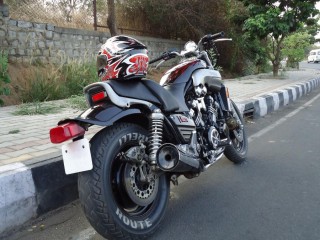
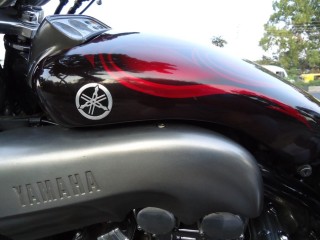
Back in the day when Mel Gibson was announcing his presence with the now cult flick, the king of the road for many a year was the Kawasaki Z1000. The 80s changed all that. Enter Yamahas V-Max. With drag racing gaining popularity, the fortuitous history of the V-Max is now part of folklore. The piano maker just went heavy metal, with a vengeance. Move over Van Halen. The other V is tapping at your doorstep.

Little did Aaraki-san (Project leader of the V-Max back in 1984, a design which underwent little changes in 20 years of production!) know that witnessing a bridge race on the Mississippi where adrenaline junkies went hell for rubber down a straight stretch that one day he would be able to not just fulfil his aim of building the ultimate straight line rocket but also see it last and outlast a lot of its competitors  and still go strong for a second coming.

Yamaha V-MaxYamaha V-Max

We visit the power cruiser that started the bruiser trend. I used to think the Z1000 handled like a dragon in heat, that notion changed after attempting a 60mph sharpish corner on the V-Max. There is something about these old missiles, point and shoot. Dont turn, just hang on and enjoy the ride. More on that later!

The design team led by Araki-san spent a month in isolation with a goal in mind. To create a machine whos only aim was to decimate anything in a straight line. To say that that goal was achieved is an understatement, just try out-accelerating one on any of the current plastic litres and watch how a 20 year old all metal, sorry, all mental muscle hauls its 300kgs alongside your plastic ass inline 4. Making you feel like a little child who’s just been taught that papa has speed, and muscle too. Cant argue much with that.

Yamaha V-Max

Yamaha at the time of The Max wasn’t setting award winning sales pitches and their Venture Royal was a capable bike but it was no Goldwing. What do you do? Take that formidable engine, tweak it to a 130hp, give it a 110 Nm of torque to go with a shorter than cruiser standard wheelbase  (1590 mm) and for good measure, add something called V-Boost.  Sounds good, V-Boost, works fine too. Little too fine. It takes a carefully practised throttle hand to both not lay down burnt rubber everywhere, or to lay it down anyway. A system which essentially opens butterfly valves in the intake manifold from 5000 rpm on to match the speeds sent by the ignition system (read by a black box which sends a computed signal to a servo motor which then pulls the wire opening the valves..) has been responsible for revolutionising the concept of motorcycling. Big, Heavy, Fast, Unsafe, much like the sports bikes of its time, but also, as comfortable as a motorcycle can get, unlike the sports bikes of its time. The only thing stopping you from a 100 mile sojourn at the drop of a hat was the crazily thirsty mill. Thank god gentlemens agreements weren’t in existence back in the 80s!

Yamaha V-MaxYamaha V-Max

So we hop on to the 1st gen V-Max, partly due to nostalgia, partly to sample how different it is from its current counterpart. The faux scoops still look the part, and the bike still has what it takes to scare someone shitless, but there is something charming about the 1st gen V-Max, perhaps its the all metal look with little plastic where needed, perhaps its that round headlight which barely lit up the road for the speeds it was capable of, perhaps it was more muscle and testosterone than the current offering, or perhaps we are taking nostalgia too far.

Turn the key and flick the kill switch and you hear the distinctive drone of the fuel pump, take note, it’s a warning sign for things to come for those unprepared or those underestimating the power of the V-Max. Thumb the starter and the giant 1200cc V-4 comes to life with a pitter patter that growls to remind you of its thirst for speed and gasoline. No potato-potato this, sample some of the many videos on youtube to hear the din it generates with the right exhaust!

Yamaha V-Max

So you plonk it to first and feel your arms ache as you turn it out onto the road because you’ve just gotten off from a much lighter sports bike and onto this behemoth.  The weight ceases to be an issue soon enough as it is rock stable with the best C of G I have experienced on a motorcycle. You accelerate, 2000rpm, 3000, 4000, ok,  this is nice, smooth, comfortable, they should make more bikes like this, then 5000, 6000, 7000, 8000..beam me up scotty! They SHOULD make more bikes like this! Gut wrenching is an often abused term which one bandies around but it fits the Max to the bill and one is thankful to the step seat which holds the now scared backside in place whilst hauling its tankish frame forward  at a rate which would send shivers down a Blackbirds spine! It also helps that the bars allow for a bit of forward movement to HOLD ON DOROTHY! Kansas and a lot of other states just went bye bye.

You shift into second and stay in the power band and release again, same result, third, same story, then you brake, and this is where we tell you a little secret. The V-Max doesn’t like to slow down (to go with hating to corner), while we can live with that, it is certainly amusing to have a motorcycle with this kind of crazy acceleration which neither stops at will, nor carves a corner. So you plan to move near a drag strip. But wait, one doesn’t have to unleash it perennially, should you choose to potter about town at a decent clip, the V-Max is a very manageable motorcycle, with tonnes of charisma (halt at a stop light and look around to know what I mean) and immense road presence. And if the ignorant point out and say “Look ma, Harley!”, just twist the throttle and play with the clutch, what happens next to go with the smoking rubber will ensure you clear any doubts that this is a devil blessed V-4, and not just a cruiser.

Yamaha V-Max

When riding a V-Max you will make a lot of friends at the fuel stations, partly because it gives you about 8 kms to the litre, and partly because you have to perform a little magicians trick to get to the fuel tank. Smile as you see the amazed looks of those around as you slide the stand, get off the bike, go around to the back unhook the lock under the seat with your thumbs to flip open the step and then get to where the fuel cap is. I  have lost count of the number of guys who peeped into the abyss(?) under the seat trying to find pandoras box where there is storage just about enough for papers, a pair of gloves, and of course the fuel tank.

All in all its a heady rush, a feeling of general bemusement, an exhilarating drama enfolding right in front of your eyes everytime you whip the throttle open yet offering one of the most comfortable rides possible when going slow. Just don’t keep it in the powerband at high speed and approach a corner wanting to slide those pegs at full lean because humans generally cannot wrestle and beat a blue whale. You may live to tell the tale, but the wet seat will tell its own story.

Yamaha V-Max Key

In todays age of motorcycles factory fitted with too much plastic, ABS, Traction control, drive modes etc, one wonders where to place the 1st gen V-Max. No where on earth fits it right because it has lived its life and done its job. If there is a motorcycle heaven out there for bikes which share these characteristics, you will find the Kawasaki Z1000 and Yamaha V-Max playing Thor and Hercules to the other also-rans.

Road test review written by Mad Max aka Mayur Mukherjee

The Tata Nano is one that has been attracting negative publicity from conception to inception and beyond.  When the Nano project was announced as the Rs. One Lakh car project, skeptics sneered, environmentalists wailed and said that there would be too many Nanos on the road and that all of them would add to greater pollution levels, good Samaritans cried hoarse about how it would add to traffic problems, competitors mulled that it would be unsafe and more such blahs.  The Nano survived all that and made it to the factory floor from the design board.  Then a fresh set of problems in the form of Mamata Banerjee and the Trinamool Congress cropped up at Singur where Tata Motors intended to manufacture the Nano.  Fights between farmers and police and the delay of the project made Tata look for other places to manufacture the Nano.  So it went from the east of the country to the west after checking out the south and settled on Sanand in Gujarat.  In the meantime to ensure that customer interest did not die down, Tata made the Nano at its Pant Nagar facility in Uttarakhand in limited numbers (it could only make it in limited numbers since there was no capacity there) and delivered cars to those who had paid the full cost of the car as booking amount.  Even though the project had shot past the original figure of One Lakh Rupees, Tata Motors under direction from Ratan Tata himself offered the Nano at Rs. One Lakh ex factory for the no frills version.

Meanwhile Tata Motors diligently constructed their plant at Sanand at great speed and towards the last quarter of 2010 were able to clear out all bookings since by then the Sanand plant had gone on stream and also because many bookings were cancelled.  But the Nanos problems were far from over and a new set cropped up.  A few Nanos began combusting spontaneously.  A couple combusted when being driven home from the showroom while others did so while being parked.  Tata carried out an audit and also investigated into the cause of the fires and determined that there was nothing wrong with the design or manufacture and this happened due to the unauthorized fitting of remote locking.  The top end Nano, the LX comes with mechanical central locking only and there is no provision for remote locking.  The Nano sales nose dived again and only started picking up towards March and April of this year before a slowing down in car buying once again brought down sales numbers.

So, all the initial fears of greater pollution, traffic jams etc have proved to be unfounded since Tata Motors has only managed to sell 10,000 units of the cars for just one month and even sold as little as 505 units for one month.  Compare that to the sales of the Alto from Maruti that comfortably sells over 25,000 units per month.  Though those fears have been put to rest (those of pollution, traffic jams), new ones about the safety of the car have emerged.  Previously people thought that the Nano would not protect its occupants in the event of a crash, but that was forgotten and new fears about being cremated alive in a Nano came to the forefront.  In all this many magazines have tested the car, some even took it to Khardungla and came back to tell a happy story, one that said that the car was reliable and wonderful to drive.

At Riot Engine, we decided to check out for ourselves what the Nano was about.  It was convenient that the wife of one of our staffers decided to go for the Nano and lo and behold we had a Nano to test and here is the road test.  We are abstaining from giving marks or stars or any other form of scoring since those things tend to be too subjective and sometimes the same tester awards different number of marks/points/stars when asked to do so after sometime.  Therefore we will only tell the story as it was experienced by us and leave out the other things to you the reader to decide.  We are of the belief that the prospective purchaser of any vehicle has to road test that vehicle before making a decision for or against and not go by what the general talk surrounding a product is.

Let us start with the looks of the car.  It is now quite old, it has been seen for more than three years, even though Nanos are only just beginning to find their way on to the roads.  We find it a cutesy car and when the owner posted pictures of the car on Facebook, her friends, especially those abroad went ooh, wow and aaww.  Everyone found it very cute.  The colour of the car is Lunar Silver and the car is an LX version that comes with all bells and whistles.  Now before you think too much let us tell you what the bells and whistles are.  Body coloured bumpers and door handles, HVAC, mechanical central locking, fog lamps –front and rear, power windows for the front doors and that is about it.  There is no power steering, and before you say, it is such a small car why does one need a power steering let us humbly submit to you that the steering is very heavy when the car is stationary and one does feel the crying need for a power assisted steering when maneuvering in small or congested spaces.

Coming to the engine of the car, it is a petrol which displaces 621 cc and produces 33 PS of power.  Now don’t snicker because we too did the same and regretted later.  The husband of the lady who owns the Nano owns a Kawasaki Ninja 250R which produces the same amount of power so the power output was a subject of banter till driving pointed to the obverse of what was thought.   But before we get to that let us put things in perspective.  The Maruti 800 in its carbureted form did not put out more than 37 PS but more importantly the diesel engine of the very heavy Ambassador only produced 35 PS and many Indians were quite satisfied with it.  When you crank the engine into starting, two things strike you.  First, the idle seems a little imbalanced and second it sounds like a diesel Piaggio Ape  or a diesel rear engine auto from Bajaj.  This has mainly to do with the location of the engine at the rear and in the interest of heat dissipation too much sound insulation has been avoided.  Also the short exhaust pipe contributes in a big way to this perception.

The gear box is quite alright and gears fall into place without too much effort and the torquey engine ensures that the Nano with a weight of upto 500kgs even starts on inclines without too much effort (the incline is upward and not downward).  Tata Motors says that the car should be driven upto speeds of 15 kph, 25 kph, 40 kph and 60 kph in first, second, third and fourth gears respectively for the first 1000 kilometres.  The Nano has four forward gears and one reverse gear.  The big and easy to read speedo meter in the centre of the car also has a digital odometer and all the other tell tale warning lights except a tachometer.  The car moves off quite smoothly and changing gears is a breeze.   The car can be driven in fourth gear with a 500kg passenger complement at speeds of 35 to 40 kmph comfortably.  In all gears the car pulls effortlessly and driving in traffic is a breeze.  The brakes though only drums all around are adequate and handle their job reasonably well.

The suspension of the car is quite alright for intra-city driving.  It is not too soft or too stiff.  The location of the engine at the rear is responsible for this.  However driving over speed breakers can be a novel experience if you are driving the Nano for the first time.  We are generally used to having weight on the front wheels, something that the Nano doesn’t have.  So one will have to change their approach to speed breakers coming in more slowly than one would in other cars and exiting a little faster than when in front engine cars.  The suspension keeps the occupants of the car happy and doesn’t  bottom out even with a full load of heavy passengers.   The steering is quite precise and the car responds well and moves in the direction that it is pointed towards.  The wheels are really small but surprisingly the Nano has huge ground clearance that is more than that of the Alto, the Santro and almost in the league of SUVs.  The high centre of gravity of the car means that adventurous driving is best avoided since the car reacts alarmingly to sudden steering inputs or sudden direction changes.  Remember the Sumo?  This is something like that.  The car has understeer and one has to be careful with approach speeds for corners; come in too fast, you probably won’t turn fully or you could topple.  The Nano is strictly for commuting and nothing else.

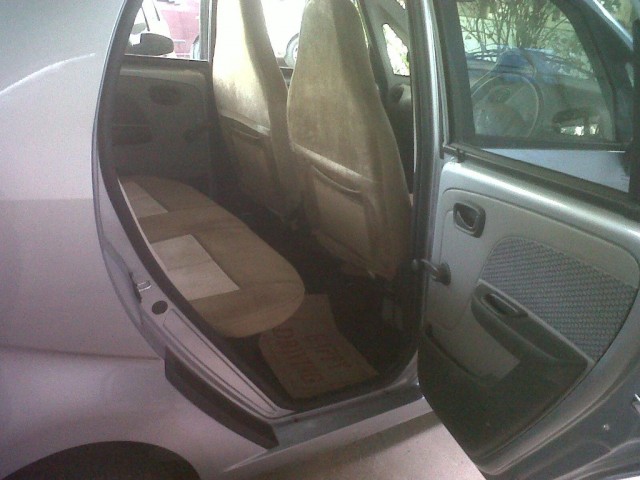
The Nano’s greatest asset has to be its space.  For a car so small it comfortably seats 4 XXL adults  and 5 typically sized Indians.  There is no doubt that the Nano is a family car.  The only thing missing is the boot space, there is none of it.  The seats are nice and high and ingress and egress is most convenient with the doors opening nicely and wide.  Great car for those who suffer from back problems, knee aches or have long legs.  Women wearing skirts can exit gracefully without wondering if something is showing. Storage space is restricted to the two scoops in the dash board on either sides of the central console, one in front of the passenger and the other in front of the driver.  There is also small little place to hold very small things next to the gear lever.  The buttons for power windows are awkwardly placed in front of the gear lever and one has to bend substantially to get to them.  The rear of the car (the hatch that is) cannot be opened at all.  The access to the engine is by removing the rear seat.  The car that was tested was also fitted with a basic JVC stereo system by the owner and despite having only two speakers, the small size of the cabin made for good acoustics.  The single wiper on the front windscreen does its job quite effectively.  But what is most surprising is the air conditioner.  The air conditioner chilled the car within minutes in the summer heat when the car was parked in the sun for more than two hours in 42 degrees Celsius heat.  Given the size of the engine the efficiency of air conditioning is nothing short of amazing.  Cars with bigger engines do not cool as well and as fast.  What is even more heartening is that the loss of power due to running the air conditioner is not very discernable in the city.  The head lights are good with a good beam spread as are the fog lamps.  But the fog lamps were only used once for testing since they can create problems for oncoming traffic in the absence of a fog.

The owner of this Nano is very proud of her car.  She says she has no regrets buying it and that she would only want a power steering on it and no other changes.   She finds it compact and says that the car draws a lot of attention, something that we found to be true while we were testing the car.  Some people even wanted to know if the stories and negative publicity around the car were true.  The car was mainly tested in the city and not too many high speed runs were attempted owing to the fact that the car is still brand new.  Just to check top speed one high speed run with a complement of three passengers was done and the clock showed the car doing 110kmh.  Needless to say there will be an error in it.  The fuel efficiency figure that we got (using the full tank to full tank method) was 14kmpl and car is still very new.  The owner also confirmed a similar figure.

All in all we found that the Nano is comfortable car even though it is inexpensive.  It does not appear to be cheap or badly put together even though the plastics inside are not top notch and the seats in the front have head restraints integrated into the seat itself for cost cutting reasons.   The Tata dealer who sold this car informed us that most of the buyers of the Nano were preferring the top end version of the car i.e is the LX variant and that most of the buyers were using this as their second or third car.  Women customers outnumber men was what the dealer said.  Now if only Tata can sell this car properly, it would be nice, for the car while not being spectacular in anything, is a competent all rounder which deserves better numbers than it is doing.