This information from Mr. Nevil gives us an insight into the rigours the motorcycle in the battlefield was put through. The simplicity and robustness of construction is what made this engine so ideal for operation in such harsh conditions.
Side Valve Engine

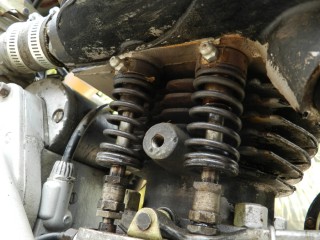
The 490 S.V. as it is usually referred to is a 490cc single cylinder engine with Side Valves. This engine is a Flat-Head engine with the valves placed in the engine block beside the piston instead of in the cylinder head. The primary advantage of such a configuration is that the need for a push rod mechanism or chain/belt/gear train to drive an overhead camshaft is eliminated. The disadvantage was that the gases had to make a roundabout turn when flowing between the block and the head which meant less efficiency and inability to function at high RPMs for sustained time periods.
Here’s a video of the functioning of the side valves. Note how the plunger rises up to indicate the flow of oil and drops down when the engine shuts down. Bulleteers might be aware of how the decompression lever functions, here’s a visual demonstration by Muthukumar as he starts the engine after decompressing it, and then shuts down the engine again by living the exhaust valve using the decompression lever. Have fun watching!
Patented Variation of the Girder Fork Front Suspension

Pivot Point Link Extension Rebound Spring
Curiosity piqued, thanks to Norton boastfully embossing the patent number on the suspension components, I tried looking up for Great Britain patents with the number 387550. Though I was unable to find the drawings usually filed along with the descriptive text, the text from the patent helped me understand, to an extent what the additional springs were for.
Norton states in its patent that these rebound springs supplement the action of the main spring by offering extra resistance. What makes the technology patent worthy is that the rebound springs offer gradually increasing resistance during compression of main spring and a sudden increase in resistance during rebound.
As denoted in the picture above, the links connect the fork pivotally with the steering stem. Extensions, denoted by the red lines have the rebound springs connected to their ends. The extensions, as you might have noticed are connected at an obtuse angle to the links. The angular disposition of the extensions of the links is so calculated as to provide for a slow gradual increase of resistance to the upward movement of the fork, and a very rapid increase of resistance to the rebound in order to check or minimise the rebound and restore normal conditions of working.
We have attached a slow motion video, a humble effort by Riot Engine to demonstrate the functioning of this suspension.
Tyre Pump Inflator

This cylindrical device is a tyre inflator pump and must have been a very handy tool for the motorcyclist on the road. Muthukumar also showed me tyre puncture repair patches.
Tyre Patches!


Pictured here is the underside and top of a tyre patch. The rider siphoned some petrol from the tank, into the underside of this patch, lit a flame, the heat loosened up the rubber strip on the top which was peeled away and stuck on the tear/hole in the tube. Then the inflator pump was put to use and the motorcyclist went on his way. A little better than having just a tubeless tire I’d say. After all you get to roll up your sleeves, bring the wrench out, get your hands dirty, shed some sweat, and then ride away with the lopsided grin.
What more can a Man ask for?
Headlamp

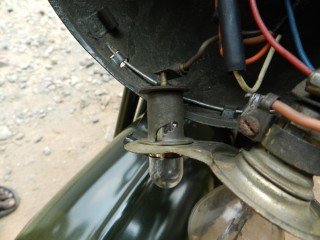
This headlamp, probably the DU142 Headlamp, with Lucas bulbs, had a main bulb and a pilot bulb. According to one user manual, “A small pilot bulb is provided for use when the machine is stationary or when driving in town”. An ammeter is incorporated in the headlamp ( Millers, in this Norton ) which would give the rider an indication of the amount of current being discharged or the current by which the battery is being charged. The ammeter, located on top the headlamp, is indirectly illuminated by two small apertures situated in the reflector. The main bulb is focused by loosening the clamping screw, adjusting the position of the bulb and bulb holder and then tightening it again.
The pilot bulb is focused by seating the bulb in one of the three position provided in the holder. These features are enamouring for their simplicity.