It is well known that when Mahindra and Mahindra opened a booking window for the second round of bookings things went even better than they did the first time around. Having received 25,000 bookings for its best seller Mahindra wants to make sure that all the prospective customers will stay with Mahindra. It is therefore enhancing production capacity of the XUV 500 to 5,000 units a month. Mahindra is aware that the launch of the Tata Safari Storme is around the corner and that Tata has not increased the cut price of the Aria. Mahindra is in a confident mood and it seems to believe that it can retain all customers who have booked the XUV500. There are also reports that Mahindra will launch a low cost SUV during Deepavali of this year. It remains to be seen if this is the shortened version of the Xylo or if it is a beefed up Bolero.
The year 2011 has been horrible for Honda. First the tsunami in Japan and later the floods in Thailand have not only set back its production objectives severely but also have caused Honda to scrap a lot of cars that were manufactured since they were submerged under water. These problems adversely impacted on its India operations as well and even the slow selling Jazz along with the newly launched Brio was not available in the Indian market. Honda is a resilient company and has managed to find a way around its difficulties by sourcing components from its other factories. Honda cars’ production is now getting back to normal with the resumption of the production of the Brio which now has a waiting list of over 7,000 customers. Honda has said that it will resume the production of the Jazz at the end of February. All customers who have booked Honda cars can now look forward to receiving deliveries of the same in the near future.
Today is the day when the fourth round of the eight round JK Tyre Max National Karting Championship will be held and you can watch it live on the Doordarshan National Channel. The time of the telecast is 6.30 PM. We seriously request you to watch the young guns, the future racers of India and encourage them. We also request you to share your ideas about what you saw with us at feedback@riotengine.in. We will send the same to the organizers. Have a nice Sunday evening.

Those familiar with the MINI lineup might be aware of the MINI Clubman, a MINI that offers slightly more space for carrying luggage relative to your Cooper and Countryman models. MINI thinks there is a market for the customer who would want much more cargo space and would be willing to pay the premium a MINI commands. MINI is so confident they have presented examples of fashion designers, people who run art galleries and photographers. Come to think of it, that does makes sense.
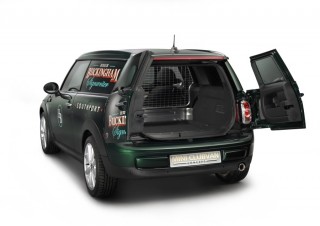
MINI helpfully points out that polycarbonate sections that form the rear side windows and heavily tinted glass for the rear doors make it difficult to see into the load compartment. The unnerving possibilities of the applications of such a car aside, the new MINI retains the signature look, painted in British Racing Green. The Clubvan Concept shares exterior dimensions with the MINI Clubman, but loses two seats, has a cleverly designed cargo space and MINI claims, is the first premium model in the small car-based van segment.


MINI says the function-led design modifications have no impact on the car’s proportions and hallmark MINI design language. The British Racing Green exterior paintwork extends to the roof, C-pillars and exterior mirror caps.

The plain canvas that is the side of the Clubvan Concept offers scope for branding, which the MINI Clubvan Concept highlights to eye-catching effect. Shown in the pictures is the Clubvan Concept with sealed side windows bearing the logo of a sign design company based in the MINI’s native Great Britain. The hand-applied graphics lend the vehicle a personal look.
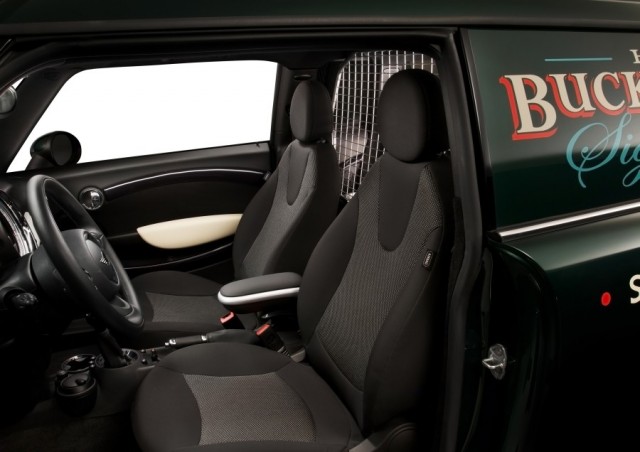
The Clubvan Concept gives customers a choice of a vehicle that combines the demands of commercial use an yet retains individual style. Unlike the Clubman which has four seats and five doors, the MINI Clubvan Concept has only two seats but the same five doors that opens up a whole new world of customisation potential. The load compartment of the MINI Clubvan Concept is designed on the principle that classic Mini’s were designed upon – of providing the maximum amount of interior space on the smallest possible footprint. The load area reaches from the split rear doors right up to the partition grille behind the two seats. The totally level floor makes full use of the interior’s depth, and that allows the concept car’s load capacity to exceed the maximum achieved by the MINI Clubman. The Clubvan Concept also has a scope for configuring the load compartment to customer requirements. For example, tools and goods can be stored neatly and securely in made-to-measure drawers or shelving units. 12-volt plug sockets in the rear area of the load compartment provide additional practicality.


Six attachment loops recessed into the load compartment floor use elasticated straps to hold items of varying lengths, heights and widths in place – without the risk of them sliding around. The partition grille, the lower section made from solid aluminium, upper section made of silver-coloured stainless steel honeycomb grating, and fixed securely to the car body, ensures that items stowed in the load compartment cannot find their way into the front seats, even under extremely heavy braking.The side walls and floor of the load compartment are trimmed in high-quality anthracite-coloured cloth. The anthracite roof liner, meanwhile, extends along the full length of the interior.

Two front doors for the driver and front passenger, two side-hinged doors at the rear and the rear-hinged Clubdoor on the right-hand side create comfortable access to the interior. The Clubdoor gives owners the option of loading or unloading smaller items from the side of the car as well as the rear.
The Clubdoor has been a subject of great debate considering it is always on the right side of a MINI, regardless of whether it is a LHD or Right Hand drive car. In right hand drive markets this meant the passengers in the rear of a Clubman had to step out into the traffic instead of onto the pavement. Spy shots of LHD MINIs being tested with a club door on the left side of the led to the speculation that MINI will resort to twin Clubdoors. Now that we’ve seen the Clubvan Concept, again with a single Clubdoor on the right side, we wonder what the future holds for other MINIs.
Of course, since the Clubdoor will be used only to access cargo in the Clubvan Concept, there is also the possibility that ONLY this model will have the Clubdoor on the right, and the other MINIs will have twin club doors.

Every once in a while there is news that Ducati is up for sale. Last year there were reports that Ducati’s owners Investindustrial were interested in selling off their stake. Investindustrial itself confirmed this. When Ducati struck a deal with AMG rumours gathered momentum but later it came out that Daimler AG was not interested. Some in the auto industry feel that Ducati would have been good for Daimler because the lower emissions from motorcycles would have offset the more polluting big engined sports cars and SUVs. Now the names of BMW, Volkswagen and Mahindra are being touted as those interested in purchasing Ducati. The Financial Times in Britain has said that the company has been valued at One Billion Euros a price that is too steep for a company that makes about forty thousand vehicles per annum. There is a necessity for the new company to understand tooling that would be required for increasing capacity to make sense of the price that they would pay for acquiring Ducati. One can discount Mahindra. Somehow the name keeps popping up every time a company is up for sale. When Saab was put up for sale Mahindra was mentioned. But we suspect that Mahindra has already spent a lot of money on acquisitions and will need capital to consolidate its acquisitions. It remains to be seen if this time around Investindustrial actually succeeds in finding a buyer. Please note that Ducati is always up for sale.
Jarno Trulli has joined Jaime Alguersuari on the sidelines of the Formula1 paddock with him being jettisoned out of the Caterham F1 team in the eleventh hour. Trulli has been driving non-stop in Formula1 from the year 1997 when he made his debut with the Minardi team and then went on to the Prost team. Trulli has been considered a natural talent but seems to have lost out to Lotus Team refugee Vitaly Petrov on grounds of not being able to bring sponsorship to the Caterham Team. With the global recession far from over, all F1 teams are feeling the pinch and have been looking for pay drivers. Trulli is the latest casualty of this.
Mercedes AMG F1 team will reveal its W03 the contender for the Formula1 2012 season on the 21st of February at the Circuit de Catalunya in Barcelona. This will be the second of the scheduled official preseason tests. Mercedes ran the old car in the first test. Adrian Newey the designer of the Red Bull Racing cars commented that Mercedes was probably delaying showing their new car so that people do not catch on to some new technology that they maybe using. However photos of the car have surfaced and it has the same ugly platypus nose. But we do not know what lies underneath that. With Mercedes having brought out their new car only the real stragglers of the Formula1 field, Marussia and HRT are yet to reveal their runners for 2012. They are not contenders and therefore we use the term runners well advisedly.
I am a motorcycle person, and generally hate cages. I do not like driving one bit, and generally rant about everything, including traffic to bad road to non existent driving sense on the streets.
Having finished saying all of the above, one cannot deny that a van has certain undeniable advantages.

You can avoid getting wet, for one. A van is “generally” more stable than a motorcycle, even if it is a mere perception, undeniably, accidents on a motorcycles, even minor ones, increase the chances of death or dismemberment, in that order.
But then again, I am a certified two wheels nut, who does not want to drive at all. However, in the interest of the Family, consisting of a Wife and two dogs, I needed a van. After I sold off the 800, where it literally broke my heart to see her go because she was such a fantastic partner in crime, and also because she was the first car I bought with my own money, I had been largely travelling around on my trusty Apache 150, until the rains decided to arrive, and the prospect of arriving in office two up with a set of wet clothes were not one of the most attractive propositions. Ergo, I needed a van.
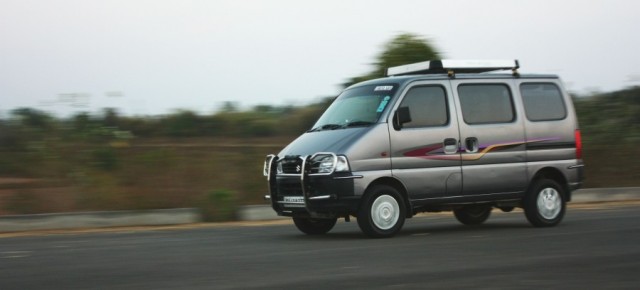
I started to scout for options. Looked everywhere for something suitable which can accommodate a truckload of my friends, my Family and then still have space for some, but will be well within the 4 lakhs range, which was my working budget. I discounted the second hand market, because although as much as I wanted a CJ3B or a Classic, I simply did not have the time which would be required to maintain the beast, and I did not want another beautiful machine to go to waste because of lack of time. I drove my friends up the wall, cribbed and cried to my folks and generally acted like an idiot and painfully resolved to buy myself the Omni, which, though is a fantastic Value For Money proposition, simply did not appeal to me because of the awkward looks and the non existent safety features. Until, that is, Maruti Suzuki decided to launch the Eeco.


The moment I saw the first snaps doing the rounds on the internet, I decided to do a reconnaissance. The first weekend after the van was launched, I queued up at the local showroom for a Test Drive. As soon as that half an hour drive was over, I came home and immediately arranged my finances. The next day saw me back at the showroom, booking her. With a waiting period of three months, I sat around twiddling my thumbs, till Maruti Suzuki, in its true blue customer dedicated fashion, decided to give me delivery a lot earlier than what it had first proposed, and a spanking new Eeco stood all ready to be delivered to me on the 30th of July 2010.

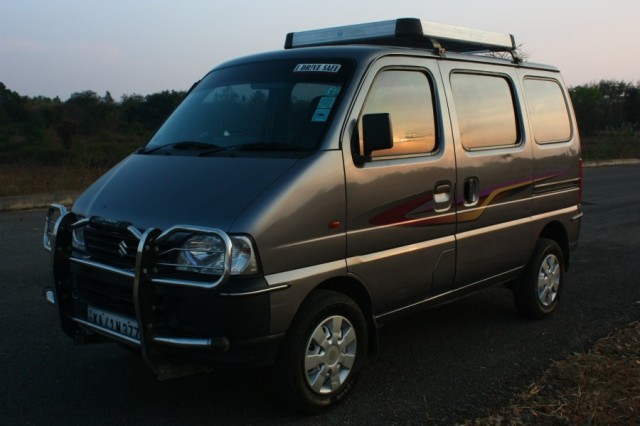
It was love at first sight. Metallic grey and shining under a gloomy sky, she looked like an awkward toddler who has just broken into adolescence. Tall and imposing, acres of room inside, the famed G13B engine, albeit in a 1.2 litre avatar to cater to the BS IV demands to boot, all of 73 horses and a 101 Nm of torque. Enough power to pull a mini truck and then some. Driving down from the showroom, I marveled at the height, at how I could acknowledge Innova and Scorpio owners with a nod of the head instead of looking into the sun, at a half of their price. I marveled at her power, which, when linear delivered to those rear wheels, had enough in them to slingshot the massive van to a ton in just under fourteen seconds.


To heck with the body roll, to heck with lack of power steering, to heck with the archaic manual ac dials, to heck with the awkward dynamics. I could not care less. I was completely smitten.
A trip to the accessories guy saw me fitting her up with gadgets which I required most, a front nudge guard, a pair of steppers for the older folks to get up without straining themselves, a luggage carrier on top to carry that extra luggage on top when fully loaded on long trips and a Bluetooth enabled head-unit which enabled me to take calls on the go without troubling my concentration on the road too much.
I started driving around. A year and a half of driving, and I have notched up close to twenty five thousand kilometres. As a friend pointed out, the van is the first (his mistake, actually, it is the second, the first being the trusty 800) tin top which I actually connected with.
Drive quality and ergonomics
She has a fantastic engine. The power delivery is very linear, with no awkward surges, and no surprise gaps in the delivery. Smooth, sensible torque spread. That being said, the engine is absolutely dead under the 3000 rpm mark, and believe me, if you are downshifting on an uphill climb, you need to climb higher up in the rev range to extract the juice prior to slipping the gear down, else, the van just starts crawling if you do the shift when the torque starts to build up.
The gearshifts are nothing spectacular, and can do their assigned work quite well. Smooth is the word. The Diagonal Shift Assistance, which allows the driver to shift gears diagonally, is quite handy, allowing smooth shifts without carrying a ruler around. The second gear though, is ridiculously tall, the van can comfortably do a 20 to 80 without shifting into 3rd, which is actually a good thing, because you need a tall second gear for city driving conditions.
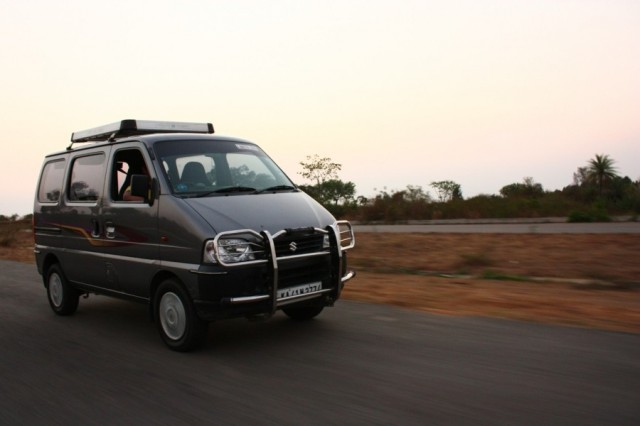
It, like the Omni, is a rearwheel drive, so you need to be careful while taking fast corners, she does a fishtail the moment you take a sharp corner above 80 and then a frantic work ensues to oversteer, correct her line and she starts to slingshot again.
The suspensions are very good, and can take quite a beating, and remain unfazed with it all. I was very worried after the van went into a gigantic pothole on the NH7on a weekend dash to Chennai from Bangalore, and jumped up around ten inches or more when coming out and landed with a thud. I showed her to the service personnel next day. Nothing! The ride quality is on the stiffer side, owing to this essentially being intended to be used as a people mover and load carrier, and this is actually an advantage, because, at the expense of ride quality, the handling of such a tall van with small wheels and awkward ergonomics improves a lot for the stiff setting and does come quite in handy when driving fast.
The steering feedback is very good, owing to lack of a power steering, and each undulation of the road and the texture is transferred well to the driver. This is a huge confidence boost when one is driving fast in slick conditions.
The ergonomics are awkward, to say the least. It is tall, and it has small, 13 inch tyres. Which lends it bucket-loads of body roll, and then some more when she is done rolling. However, it would certainly be recommended to get at least a 175/70 R13, which will lend a slightly softer ride, and will be a boon when you are driving in cities like Bangalore with very bad roads. But she is very much drivable, and fast-drivable at that. Proof? I did a Chennai Bangalore dash in just around 4 hours with an average velocity of a 90 kmph, and kept pace with an Accord for over 2 hours during that journey, till, well, the Accord stopped for the driver to take a leak!
Space

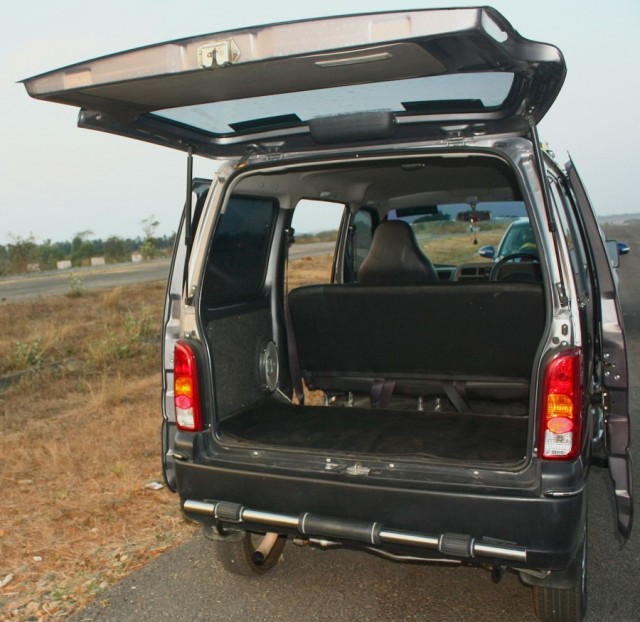
There is, quite literally, acres of space inside! Mine is a five seater air-conditioned version, ergo, there is plenty of space inside to hold five people comfortably, two dogs, and the luggage carrier does the job of carrying excess luggage, if any. And even with all that weight, it accelerates remarkably well. It is certainly no Innova, but for that price range, the amount of space it offers is well, fantastic!

Long distance capability
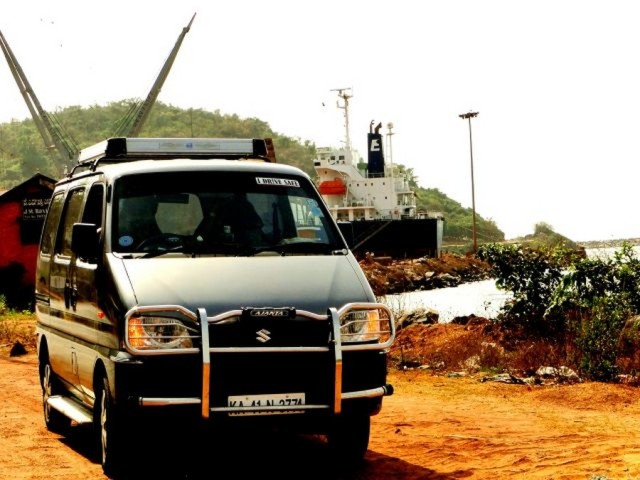
I keep reiterating that it is certainly no Scorpio or Innova when it comes to touring, but it can certainly hold its own. It does decent enough speeds (I hit almost 140 on the highway), it can run non stop for 400 odd kilometres (I am sure she can do more, I ran out of road). She does a very good job of keeping out the elements. The entire stretch from Chennai to Bangalore, it kept raining, and there was no leakage from anywhere, the sliding doors and the window reams held out. I arrived home safe and dry. The seats are comfortable and though the back can take a beating because of the stiff suspension setting and lack of a good lumbar support in the seats, such discomforts are nothing which a warm cuppa and a little walking around to get the blood flowing would not cure.
Price range
This is quite simply the sole reason why one should buy an Eeco. It screams functionality from every nook and cranny. It is not an Innova. It is not a Scorpio. But then it does not claim to be one. It offers acres of space, a very decent power-train, a decent amount of features at a fraction of the Innova or the Scorpio’s price. It does not have the upmarket image of either, but then, with both being used as taxis nowadays, I do enjoy the occasional glances at the van which nobody has seen as taxis, but is big enough and looks powerful enough to be one.

Overall impression
Quite simply, I had never hoped to pay this amount, and get a van which can carry, quite literally everything! Although she is not the best looker in the market, although she does not have a powertrain to show off, although she suffers from awkward ergonomics, I am in love with her, completely. Why? Because whatever she promises she will do, she does. And she does it quite astonishingly well. There is room for improvement. Much room, but I wonder whether it can be offered at this price. I do not think so. Then again, if it is, I would be the happiest person around!
It is an amazing hold-all van, and I am very satisfied with the purchase. In the inimitable words of a friend, I bought the van because it was good, I am not praising it because I bought it!

Photography:
Ayan Ray
Debalina Das
Porsche till the launch of the Cayenne was known for its own road vehicles such as the iconic 911, the Boxer etc. But with the launch of the Cayenne which was based on the VW Touareg platform not only did Porsche move into the off road segment but also started getting volumes from that segment. It is perhaps fitting then that the Cayenne should win the best off road vehicle award. This award came courtesy the readers of the Off Road magazine. What better endorsement than the market itself.
The readers of “OFF ROAD” trade magazine voted the Porsche Cayenne the “Off-road vehicle of the year” in the “Luxury SUV” category. The choice was between models from eleven manufacturers in this category alone. Porsche’s sporty SUV attracted more than 20 per cent of the votes, putting itself in the lead by a clear margin.

Porsche AG received the “OFF ROAD AWARD 2012” yesterday evening at a prize ceremony in Munich. Julian Baumann, Sales Project Manager for the SUV model line, accepted the prize: “This award illustrates yet again just how popular our sporty SUV is. The 100,000th Cayenne of the current generation was built only a few weeks ago in Leipzig.” The monthly trade magazine’s reader poll has been held since 1982. This year there were 143 vehicles from 40 manufacturers in twelve categories in the running and more than 57,000 readers took part in the poll.
Renault reports Automotive operational free cash flow* of €1,084 million in 2011, in line with the trajectory set in the mid-term plan, Renault 2016 – Drive the Change.
- Group revenues of €42,628 million, up 9.4% on 2010.
- Group operating margin of €1,091 million, or 2.6% of revenues, compared with €1,099 million and 2.8% in 2010.
- Group operating income of €1,244 million, compared with €635 million in 2010.
- Contribution of associated companies of €1,524 million, compared with €1,289 million in 2010.
- Net income of €2,139 million, compared with €3,490 million in 2010, which included a €2 billion capital gain from the sale of B shares in AB Volvo.
- Positive Automotive operational free cash flow of €1,084 million, including €627 million from a favorable change in the working capital requirement.
- Automotive net financial debt of €299 million, down €1,136 million on December 31, 2010.
Commenting on the results, Carlos Ghosn, Chairman and CEO of Renault, said: “Thanks to the hard work of all its employees, Renault coped with the different crises faced throughout the year, exceeding the free cash flow objective for 2011. The 19% increase in Group sales outside Europe, notably in Brazil and Russia, illustrates the Group’s international growth. In 2012 we expect international sales to be well in excess of 43% of the total, while maintaining the Renault brand leadership in France, and No. 2 position in Europe.”
Group revenues came to €42,628 million, up 9.4%. Driven by sales momentum and an improved product mix, Automotive contributed €40,679 million to revenues, an increase of 9.4% on 2010.
Group operating margin was stable at €1,091 million, or 2.6% of revenues, compared with €1,099 million and 2.8% in 2010.
Automotive reported operating margin of €330 million (0.8% of revenues), compared with €396 million, or 1.1% of revenues, in 2010. The favorable impact of sales volumes (€455 million) and the improvement in costs as part of the monozukuri plan (€500 million) did not entirely offset negative factors, mainly external to the company, such as a €509 million rise in raw materials, a €199 million unfavorable currency effect and a €245 million negative mix/price impact.
In all, the supply constraints stemming from the Japanese tsunami had an unfavorable impact on the operating margin of Automotive of an
estimated €200 million in 2011. The impacts were mainly felt in production, commercial offers and logistics.
The contribution of Sales Financing to Group operating margin reached a new high of €761 million, up €58 million, resulting from growth in loans outstanding and a historically low cost of risk.
The contribution of associated companies continued to grow, totaling €1,524 million in 2011, driven by Nissan, compared with €1,289 million in 2010.
Net income came to €2,139 million, compared with €3,490 million in 2010, which included a capital gain of €2,000 million from the sale in October 2010 of B shares in AB Volvo. Net income Group share totaled €2,092 million (€7.68 per share).
Automotive operational free cash flow exceeded the objective reaching €1,084 million, having successfully maintained operating performance despite a series of crises (supply constraints, sovereign debt) and having rigorously managed the working capital requirement and investments in an uncertain economic environment.
This performance led to a reduction in Automotive net financial debt for the third consecutive year, reaching a historically low level of €299 million on December 31, 2011, down €1,136 million. In 2011 the Group continued to reduce gross Automotive debt through early repayment of the remaining €2 billion of the loan from the French government, while maintaining the Automotive liquidity reserve at high level of €11.4 billion, compared with €12.8 billion in 2010. The net debt to shareholders’ equity ratio stood at 1.2% at end-2011, compared with 6.3% at end-2010.
In accordance with the policy announced in the mid-term plan, Renault 2016 – Drive the Change, a dividend of €1.16 per share, representing the dividends received by the Group for its interests in listed companies in 2011, will be proposed for approval of shareholders at the annual general meeting on April 27th, 2012.
2012 OUTLOOK
The global automotive market (PC + LCV) is expected to grow 4% year on year in 2012. Trends will remain contrasted, with markets outside Europe continuing to grow, especially Brazil (5%) and Russia (8%). With the economic environment remaining highly uncertain, the European market is expected to contract by 3% to 4%, including a decrease of 7% to 8% in France. Backed by the momentum of international growth, major launches (including Lodgy, Clio IV and ZOE), a new range of Energy engines and the introduction of the new design identity, Renault will continue to grow sales, in line with the objectives in the Renault 2016 – Drive the Change plan.
The Group targets positive Automotive operational free cash flow in 2012, with a ratio of capital expenditures and R&D below 9% of Group revenues.
CONSOLIDATED GROUP RESULTS
|
€ million |
2011 |
2010 |
| Revenues |
42,628 |
38,971 |
| Operating margin |
1,091 |
1,099 |
| % of revenues |
2.6% |
2.8% |
| o/w Automotive |
330 |
396 |
| % of revenues in sector |
0.8% |
1.1% |
| o/w Sales Financing (RCI Banque) |
761 |
703 |
| Operating income |
1,244 |
635 |
| Net financial income and expenses |
-121 |
-376 |
| Capital gain from sale of AB Volvo B shares |
– |
2 |
| Contribution from associated companies |
1,524 |
1,289 |
| o/w Nissan |
1,332 |
1,084 |
| o/w Volvo |
136 |
214 |
| o/w AvtoVAZ |
49 |
-21 |
| Current and deferred taxes |
-508 |
-58 |
| Net income |
2,139 |
3,49 |
| Net income Group share |
2,092 |
3,42 |
ADDITIONAL INFORMATION
The consolidated financial statements of the Renault group at December 31, 2011 were approved by the Board of Directors on February 15, 2012. The Group’s statutory auditors have conducted a limited review of these financial statements and their report will be issued shortly. The financial report, with a complete analysis of the financial results in 2011, is available for download in the Finance section of www.renault.com.
*Operational free cash flow: cash flow (excluding dividends received from listed companies) minus tangible and intangible investments +/- changes in working capital requirements.