The Grand Sport borrows the heart of the Bugatti Super Sport to transform into the Bugatti Veyron 16.4 Grand Sport Vitesse with 1200 HP and 1500 Nm of torque. The chassis of the world’s fastest open top production car has undergone engineering changes to handle the extra oomph.
This is a time to be truthful. We are dazed and confused because what happened today is akin to a slap on the face when we were actually readying ourselves for a punch in the solar plexus. Yesterday when we received an invitation to attend a press conference called by Hero MotoCorp, we were slightly flummoxed. We were wondering what this could be about. The invitation simply talked about unravelling a strategic initiative. We got into a huddle and started discussing scenarios. Nothing seemed realistic and so we went to bed waiting for everything to come out into the open. And then in the afternoon in Delhi, there was heightened anticipation. Is this going to be an announcement of a collaboration or would this be a buy out? Our minds ticked. At the venue there were no Japanese or Korean people, so obviously this was not going to be anything about a buy out of Hyosung or a strategic tie up with Kawasaki (honestly even that thought entered the head of at least one of us. Another one of us even thought of Yamaha originally since they were not getting volumes, so were they entering into a strategic tie up with Hero). But there were many people of European stock. So was this a new collaboration? But with whom?
Related Articles here
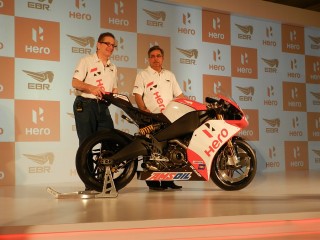
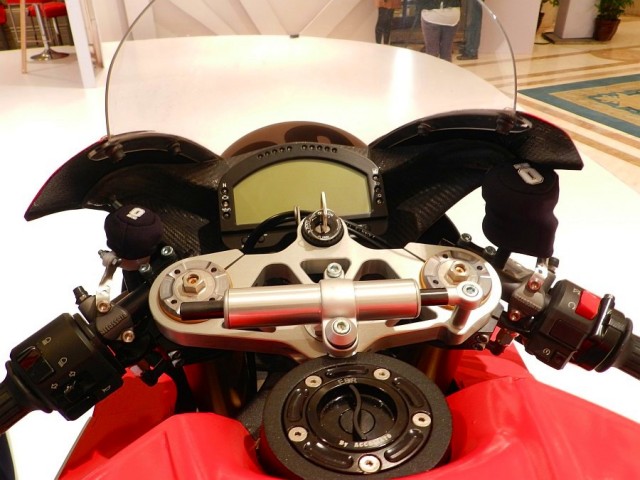
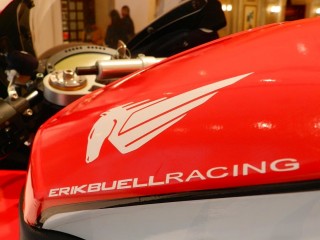
EBR 1190RS images from the Hero MotoCorp-EBR event
Hero MotoCorp announces strategic alliance with Erik Buell Racing!
Hero MotoCorp to sponsor two EBR teams in AMA Pro Racing!
Most of Europe’s surviving motorcycle makers were in the Piaggio basket and with Piaggio having just announced intention of launching products in India there was no way this was going to be, Hero-Gilera, Hero-Derbi, Hero-Aprilia, or Hero-Moto Guzzi. Laverda is resting so why would anyone wake Laverda up? Benelli is barely surviving and has no products or technologies worth collaborating or buying out.
There are two iconic Italian brands, one of them definitely struggling and the other one always up for sale. We are talking about MV Auguta and Ducati. Claudio Castiglione’s death has put MV Augusta in a bit of a spot. Harley Davidson bought MV Augusta but hit by recession they promptly handed it back to Claudio Castiglione. Post his death was his son putting up the brand for sale or was it Ducati? Only a couple of days ago we had reported that sale of Ducati rumours were yet again gaining strength. Was Hero MotoCorp buying Ducati? That was very much in the realm of possibility. Inspite of having paid huge royalties to Honda for the Impulse, Ignitor, Passion X Pro and the Maestro, Hero surely has enough capital to pick up Ducati.
But let us face it, what will Hero MotoCorp do with Ducati? Ducati sells about forty thousand motorcycles per year and it does not have small engines in its portfolio so no, it could not be Ducati. The same would be true with MV Augusta which is essentially a two model company. And the only thing distinguishing between both the models is engine capacity and that smaller engine capacity is much bigger than anything Indians can afford to buy. So MV Augusta is out. More head scratching. Is it possible that Hero is renewing ties with BMW? Remember it did sell the BMW F650 Funduro. But then the motorcycle was priced at Rs. 5 lakhs and the by the time the last one was sold, the price dipped down below the Rs. 2 lakh mark. But BMW can make small engines. In fact, Escorts when it was still making motorcycles, toyed with the idea of bringing a 125-150cc capacity scooter with a roof. It was called the C1.
While we were letting our imagination run riot, we also explored the possibility that Hero could be getting into the four wheeler space. The notorious Peugeot came to mind immediately. It pulled out of the World Endurance Championship, citing lack of funds and also rumours about its India project not taking off have been doing the rounds. Some auto journalist with an imagination as fertile as ours even said that Peugeot was scouting for Indian partners. Was Hero that? Peugeot also makes scooters with small engines. So Peugeot? Could be. The anticipation kept building up and we were wondering which of these conjectures could turn out to be true.
When the announcement came we were ready, with our abs tightened waiting for the punch. The punch did come but not into the abs but straight on to the face. Hero MotoCorp had tied up with Erik Buell Racing!!! Those of you who heard of Erik Buell and know about the Buell Motorcycle Company and subsequently Erik Buell will know why we felt the way we did. You will also understand the headline of this article, the bit that talks about strange brew. For those of you who are uninitiated into Erik Buell and his enterprises it is time to tell you a small story.
Erik Buell was an engineer working with the Milwaukee based manufacturer of the famous push rod engined and glorious exhaust sound generating, Harley Davidson. Now everyone knows Harley Davidson. It is the true American icon. At one time the equivalent of our own venerable Bullet, Harley’s were notoriously low tech. Like the Bullet, low tech did not translate into simplicity and ease of maintenance. In fact it was just the opposite. Bullets and Harley Davidsons were special children of their parents. They needed great care. In this company was this man Erik Buell, who loved racing motorcycles. And so he was able to persuade the lethargic American giant to look at least into different frames if not engines. And thus began Harley Davidson’s transformation. Erick Buell’s claim to fame is his use of the frame of the motorcycle as the fuel tank. Fuel stored in the frame meant that he could create a chassis that was nimble and relatively light. Greater centralization of mass produced better and lower centre of gravity.
Harley Davidson like Erik Buell. So they even indulged him by letting him create his own brand of motorcycles. Thus the Buell marque was born. It stayed alive till the recession hit the US of A and Harley closed down this division when it also handed MV Augusta back to Claudio Castiglione. Erik Buell was back in the wilderness. And with no disrespect meant to him we can tell you that Buell is not John Britten. The New Zealander Britten could build a whole bike in his garage. Not so with Erik Buell. Buell could not do his own engines. But he is a racer and wants to go racing. So he looks to Rotax in Austria for engines. Rotax is a well known builder of engines both four stroke and two strokes. At some point in its history it was taken over by the Bombardier Corporation of Canada. Please don’t smirk. The Canadians are good entrepreneurs. You don’t have to take our word. Ask the people at Spice Jet. They use Bombardier turbo prop aircraft for smaller towns and cities, the ones that were once serviced by Vayudoot (no relation of Rajdoot) which used tiny Dornier aircraft. The point is Rotax builds engines for some Bombardier aircraft. We talked about the F650 Funduro right? Well BMW got engines for it from Rotax. In fact Rotax built the bikes that were marketed by BMW.
So Erik Buell uses Rotax engines in his motorcycles now. Eric Buell also does not make his own suspension components. He gets them from the Swedish suspension specialists Ohlins. Don’t laugh please. Even Honda, Yamaha, Suzuki, Kawasaki, Aprilia, BMW and all those who race, get their suspensions for Ohlins. These suspensions are literally worth their weight in gold. No, no, don’t take our word. Ask Alan Cathcart who writes for Business Standard Motoring will vouch for that. Gold is used in Ohlins’ suspension components. Not by the kilograms s but in milligrams. Eric Buell makes an ECM but that cannot be customised. It has to be used in its standard settings.
By now the perspicacious among you may have got the drift of this article. What has Hero MotoCorp have to gain with this strategic tie up. I can tell you what Erik Buell Racing can gain. Money to run its teams in AMA Superbike racing. But Hero? Let us try the elimination method.
1. Hero MotoCorp will get visibility in USA because AMA is an all American racing series. The question is what will this exposure translate into? There is not market in the USA for the bikes that Hero makes. That does not seem to be the case then.
2. Hero MotoCorp will get access to cutting edge racing technology. The question then is for what? Hero does not have and more importantly does not need a racing programme. Cross this out as well.
3. Hero will get to know how to use fuel injection technologies and the like. Er, why don’t they go straight to Rotax or to Rotax’s Austrian neighbour, AVL Technologies. We are pretty sure that is a more economical and less complicated way to doing things.
4. It is not suspension technology either. Hero can go to Ohlins but for the record, Hero has its own suspension company called Munjal Showa. Therefore this is not the reason then.
5. So ladies and gentlemen, that leaves us with only one thing. Hero is going to Erik Buell Racing to get access to the technology of using the motorcycle frame as a fuel tank. Now the thing is why is this so important. We can’t figure that out.
We have scratched our heads so much that almost all of us in the team have gone bald. The editor has had a wild thought. Did Hero get conned into something that is of no use to them? That you decide or time will unravel everything. Pawan Kant Munjal has made things even more difficult by saying that the Leap scooter has some Erik Buell technology. That can only be the ECM and as far as our knowledge goes, Buell has no known expertise in electric/hybrid vehicle technology. Or is it that Erik Buell holds a key to something that nobody is telling us about at this point.
Now you understand the slap bit? Do you also understand the reason why we have generously borrowed a line from the classic rock band Cream. The line is from their song, Strange Brew. Yeah we are looking at what is inside this seemingly strange brew. And the honest answer is we cannot see a thing. But then that could be our problem not Hero MotoCorp’s.
The AMA Pro Road Racing series is the premier motorcycling road racing series in North America having played influential roles in the rise of stars like like Nicky Hayden and Ben Spies. The Series is comprised of four production-based classes: AMA Pro National Guard SuperBike, AMA Pro Daytona SportBike, AMA Pro Motorcycle-Superstore.com SuperSport and the AMA Pro Vance & Hines XR1200 Series. The AMA Pro National Guard SuperBike is the pinnacle running bikes from brands Yamaha, Suzuki, Kawasaki, Honda, BMW, Buell, EBR and KTM (for the 2011 season).
Hero MotoCorp will be backing Team Hero and AMSOIL Hero in AMA Pro Racing National Guard Superbikes Championship, two teams that run Erik Buell Racing’s EBR 1190RS.
Two time AMA Pro Daytona SportBike champion Danny Eslick for Team Hero and Geoff May for AMSOIL Hero will ride the EBR 1190RS bikes.
The Hero backed teams have their first races scheduled at the Daytona Speedway, at Daytona beach, Florida, USA between March 15th & 17th, this year.
Commenting on the tie-up, Mr. Buell said, “I deeply appreciate the support provided by Pawan and Hero MotoCorp to our two teams and this will only make Danny and Geoff perform better this season. As I kept meeting Pawan over the past several months, I realised his keen interest in moto-racing and the ‘Team Hero’ at AMA Championships is really a natural extension of our strategic collaboration. Top-class motorcycle racing is a very popular sport in the US, and the presence of the ‘Hero’ brand name is going to lend a lot of stature and excitement to all EBR fans out there.”
Unfathomable as Hero MotoCorp’s intentions and possible benefits of backing a team in the AMA Pro RR series are, Buell seems to have gotten the fairer share of the deal.
Read the main article here with more information and pictures.
Related Articles here
Hero MotoCorp announces strategic alliance with Erik Buell Racing!
Hero MotoCorp and Erik Buell Racing: Strange Brew – Looking at what is inside of you
Riot Engine has been invited to the Hero MotoCorp press conference where the biggest two wheeler manufacturer in India intends to announce its new strategic initiative.
Updates
No plans to bring in EBR bikes to India independently.
Technology from EBR to trickle down to products to be launched in THIS calendar year. Buell technologies like Fuel in frame, belt drive, centralized mass and so on, to eventually find place in Hero products.
Hero MotoCorp to enter motorcycle racing with Erik Buell Racing!
Two teams will be sponsored : Team Hero and AMSOIL Hero at the AMA Pro Racing National Guard Superbikes Championship.
Danny Eslick for Team and Geoff May for AMSOIL Hero will ride the EBR 1190RS bikes.
Unveils the EBR 1190RS to be racing for Team Hero and AMOSIL Hero.
More information to come soon.
Multiple types of collaboration.
Next generation of “HIGH-END” products to be developed by Buell and Hero MotoCorp R&D.
Leap developed in collaboration with EBR.
New strategic partnership with BUELL!
Mr. Munjal reiterates our Editor Satish Chandra statement in his recent article on Hero MotoCorp. Steady growth. While others have much to say about Hero, the numbers speak for the company.
Intent demonstrated through the hybrid scooter the Leap.
Projects ‘day dreams’ in good light. These are the dreams that you remember and take your life forward with.
We would speculate if we could, but Riot Engine has principles about not going down the much trodden wild-speculation-path, so you’ll have to hold your breath for a while longer.
Riot Engine brings you the announcement live from the venue.
The Tata Nano has already found its way into Nepal and Sri Lanka and the next country where Tata will be doing its own form of cross border diplomacy is Bangladesh. The launch in Bangladesh was delayed due to the importer and Tata Motors’ protracted negotiations on the price of the Nano. It is rumoured that the car will sell for about INR 3.2 lakhs. One presumes that this price includes all duties that the Bangladeshi government may levy on an import. We strongly believe that Tata should send the Nano to the North West Frontier, yes Pakistan as well. Who knows this car may just be the catalyst that brings the two estranged populations together again.
The news coming out of GM India is that the facelifted Captiva which comes with what is now a de riguer 2.2 litre common rail diesel engine, will be hitting showrooms in the month of March. There is however no official confirmation yet of this. The facelifted Captiva looks a little more butch thanks to the huge double decker grille and the equally big bow tie logo in the middle of it. The Captiva is a very competent vehicle, one that has always come with a diesel power mill, unlike the Honda CR-V but has only sold in small numbers. Maybe with the new changes the fortunes of the monocoque chassis using Captiva will see a rise in sales numbers.
It is worth talking about GM India because for once, it showed cars at the Auto Expo that people like you and I could feel excited about. Internationally, riding on the misfortunes of Toyota, GM has claimed back its position as the number one in sales. The story of General Motors in the last couple of years has been one that is worthy of mention and that is even more true in the case of General Motors India. After the sub prime housing loan crisis hit the USA and the economy of the country went into a tail spin, it was thought the end of GM was in sight. But GM was bailed out by the Governments of USA and Canada and it has steadied itself enough to claw its way back to the top. In this process what helped GM was that it had taken control of the erstwhile Daewoo Motors of Korea which gave it access to cars that are relevant globally and not the ill handling gas guzzlers that GM America was famous for.
In India, GM under the smart leadership of Karl Slym forged strategies that not only facilitated its staying afloat but also thriving when in other parts of the world GM was going through a crisis. GM India sold half its stake to SAIC (Shanghai Auto and Industrial Corporation) of China and this equity infusion worked for GM India. SAIC is an old partner of GM and it also has in its portfolio vehicles that are inexpensive but based on the older platforms of Opel which in themselves are pretty good. This tie up SAIC was consistent with the direction that GM decided to take at the beginning of the new century when it phased out the expensive Opel brand and decided to concentrate on volumes by introducing the Chevrolet brand. Most Indians were familiar with Chevrolet thanks to the Impala model that was a Bollywood star in its own right. While the initial introductions under the Chevrolet brand such as the Optra, the Optra Magnum, the Optra SRV, the Aveo and the Aveo U-VA, were all Daewoo cars, Chevrolet later started bringing in their cars from the global platforms. The Optra range was based on the Daewoo Nubira platform,
while the Aveo U-VA was the old Daewoo Kalos. This car came out of the Italdesign studio and was the handiwork of Giorgetto Giugiaro.
The Aveo was a brand new platform and had nothing to do with the U-VA platform and it was something on which Daewoo was working on before being taken over by GM. Its design came from Pininfarina.
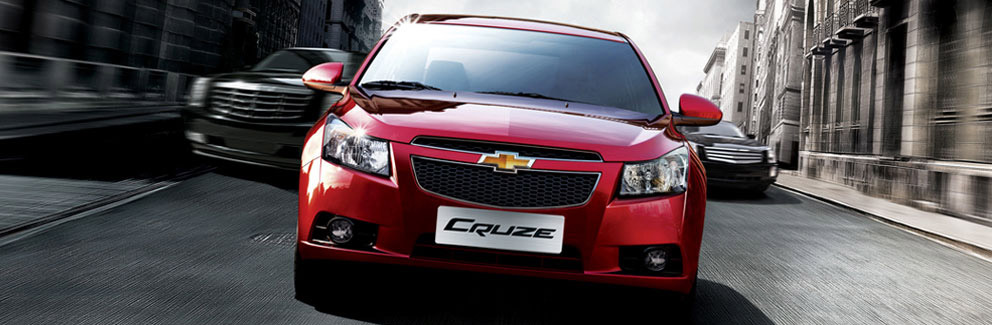
All these were competent cars but none of them had the ability to ignite passions. The Optra SRV came close but was let down by an anemic engine. It was a case of all show and very little go. But things started turning around for GM with the launch of the Cruze.
The car came with a potent diesel engine, looked like a million dollars and went like stink. It was by far the most contemporary car that GM introduced in India. Globally GM fighting to dig itself out of the economic morass that it was in also decided to replace the Spark. It took the undiluted Beat car that was shown in the movie Transformers and gave it the Spark moniker. In India, the name Beat was retained since the Spark had just started doing decent numbers for Chevrolet.
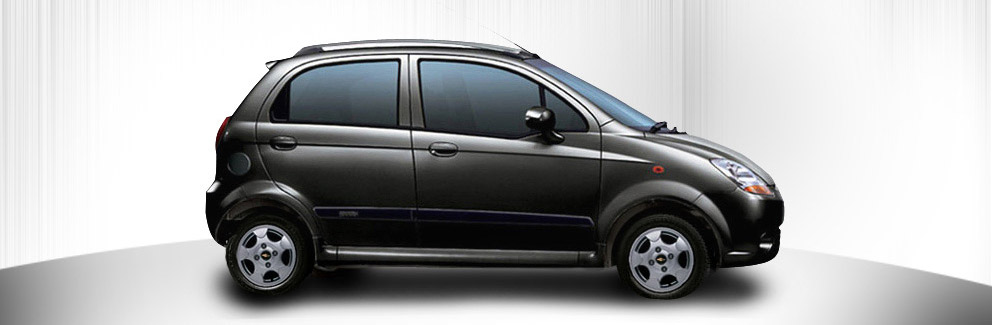
The old Spark, the one that is still sold in India is actually the last and final version of the Daewoo Matiz. The introduction of a diesel engine into the Beat has done wonders for its sale in India.
GM realised that its very competent Aveo U-VA was not selling as was the Aveo. Now when the time has come to replace them, GM has turned to SAIC. GM India is now very clear that it wants to compete with Maruti, Hyundai and Tata. It has decided to go for the volume segment and there it will be introducing new products from the SAIC stable. The first will be the Sail U-VA (U-VA is GM India speak for Yuva or youth) and this will be followed by the Sail sedan. 
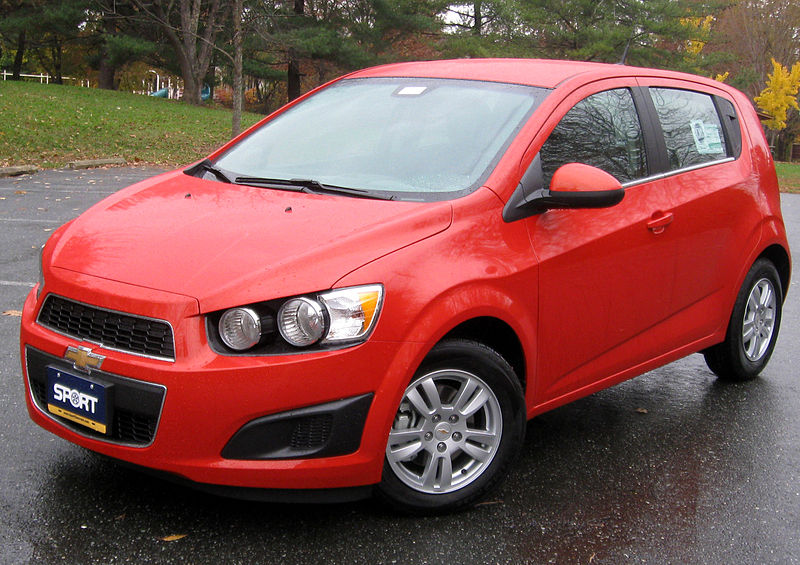
This means that the Aveo name will disappear for good. Internationally the Aveo has been replaced by the Sonic twins. The Sonic is actually taking the logic of the Beat forward but since GM India is keen on volumes it does not want to make the expensive Sonic cars, at least not yet. 
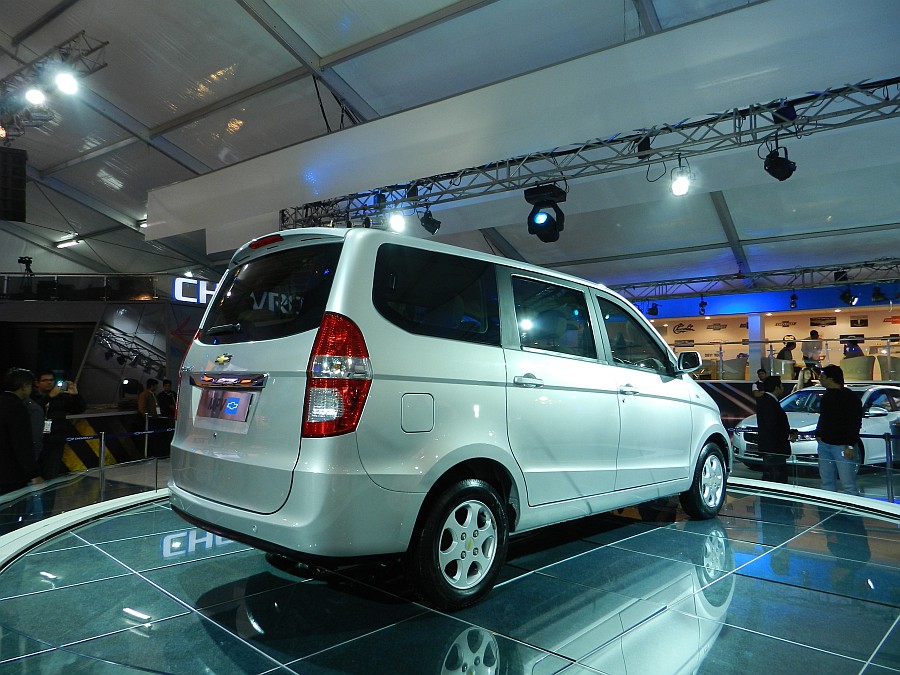
GM has also decided to enter the space of MPVs, joining a horde of manufacturers that are gunning for the Toyota Innova. At the Expo, GM showed the Sail U-VA hatchback and the SAIC- Wuling based MPV. Rumour mill has it that GM has decided on calling the MPV, Enjoy and that prices will begin at Rs. 6 lakhs.
In addition the Tavera has been resurrected by introducing a 2.0litre Common Rail Diesel Engine from ICML, the makers of the Rhino MUV. This engine is branded G.One and the Tavera that is now BSIV compliant is called the Tavera Neo3. It has also been facelifted very mildly.
These are all indications that GM India is getting its act together. It has never been this exciting before. One hopes that this enthusiasm that one is seeing in GM will last and that the company will put out products that are relevant to contemporary India.
The Suzuki Cultus, which started manufacture in 1983, the sedan version of which is better known in India as the Maruti Suzuki 1000 (for want of,*sigh*, a better name) was the first supermini to sport the name Swift in any market. It had a 1.0 litre carbureted and a 1.0 litre inline fuel injected triple cylinder turbocharged engine and such was the response from the buyers, that GM decided to exploit the alliance which they had formed with Suzuki in 1981, and started to market the Cultus in North America and Canada as the Chevrolet Sprint and the Pontiac Firefly respectively. The Cultus is still manufactured and sold only in Pakistan as of today with the famous G13B engine, putting out a 100 horsepower.
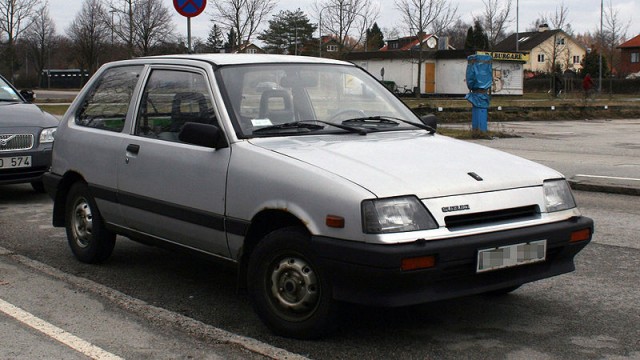
In 2000, a good seventeen years after the Cultus was released, the first generation of the Swift, with a 1.3 and a 1.5 litre iterations were released to replace the Cultus. Interestingly, GM had leveraged the alliance here as well to introduce what they then called the Chevrolet Cruze in Japan, a compact SUV which was developed on the original dimensions of the Swift.
The major alterations came along in 2004, with the introduction of the second generation of the Swift being exhibited in the Paris Motor Show in 2004. The car was made available in a 1.3 litre and a 1.5 litre manual transmission, a 1.2 litre automatic transmission and a 1.3 litre MultiJet diesel engine variant sourced from Fiat (the same engine featured in the Fiat Palio 1.3 Stile, and later the Grande Punto 1.3, and still later, as part of a technical collaboration between Tata and Fiat, the Tata Indigo and the Indica, and recently, the Premier Rio MJ D) in the international markets. In India, it was launched with the 1.3 litre manual transmission upto 2008 and from then on, a 1.2 K series all-aluminum engine.
The car was lauded after being driven around by the testers and journalists as being supremely responsive to driver inputs, being extremely friendly, carrying a superb power to weight ratio and having a “sporty” character, (a term much abused now to describe everything from car dynamics to upholstery), but at that time, being used to describe the way the car responded to being thrown around corners at high speeds and the acceleration figures. For six years, the Swift soldiered on, selling in humongous numbers and was a darling with the modifiers because of the space available in the engine bay for possible modification kits to be incorporated. Everything from body kits to piggyback systems to the ubiquitous halogen kits were developed for the Swift specifically, benefitting not just Suzuki, but the accessories manufacturers and resellers as well.
During late 2009 and early 2010, one heard persistent rumors about how the Swift was being given the complete makeover, about how the car was being redesigned ground up and how the new Swift would cater to all the shortcomings of the earlier car. Paris Motor Show 2010 saw the new Swift being launched, and it was just a matter of time before it came into India via Maruti Suzuki. As soon as it was launched in India in August 2011, it received tremendous response from the automotive fraternity, who have gone ga-ga over it’s looks and tremendous handling. So, what exactly is it about the Swift that makes it such a darling to the masses?
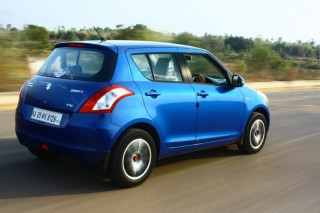
A friend of ours, Arindam, a fellow petrolhead and a rabid Swift supporter had picked up the electric blue (known as Torque Blue) in February. We got him to lend it to us for a day, and spent a Sunday throwing her around the bends and laughing maniacally while doing so. The verdict? Read on!
Looks
The new Swift retains the basic designing cues from the earlier Swift. The styling is still the double box which features in most of the newer generation hatchbacks. The bonnets look the same, but it appears that the curve from the windshield to the bumpers are slightly lesser curved than what it was with the older generation, making the bonnet slight longer than the earlier ones.
The headlights are pulled back even more into the body, making the Swift look, (for lack of a lesser politically correct description, we assure you, we are not racists at all), more slit eyed than the previous version. The taillights have also been pulled into the body, and from a side, if you look at the car, you may become confused as to which is the front and which is the rear, so similar do they look, except for the coloured plastics that the taillights use.
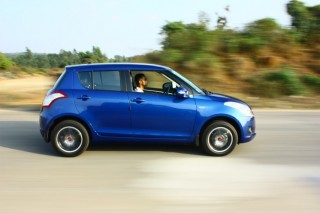
The Swift has always had a problem with having a substantial derriere and the same design concept has been carried forward into this model as well. The only difference being that the skirt is hitched a little higher on this iteration so that only half of the boot door is actually operable. There is no increase in height of the car but the wheelbase has been increased by around 40 mm, which does not create any appreciable difference in the way the car looks.
Interiors
Maruti, show some respect already! We are frustrated with the quality of plastics provided in the earlier iteration of the car, and this version simply carries forward more of the same rubbish.
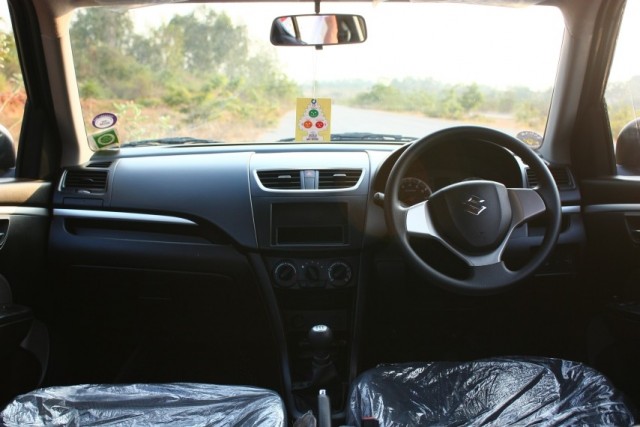
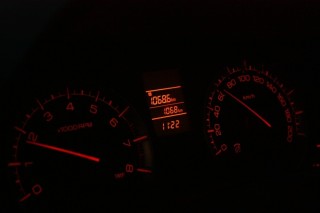
There is a hollow thud when you rap the plastics with your knuckles and the stuff actually looks cheap. The compartments which should house the music system/ AV system are poorly fitted and there is enough gaps in the panels for me to throw the kitchen sink through them and I have a hunch that it would pass through untouched. As a saving grace, the dashboard is quite large and is reasonably easy to read the numbers off it, even in sunlight. The seats are quite comfortable and large, though we would have loved a three stage lumbar support on it. For shorter city rides, it does not make much of a difference, but for long distance touring, holding the position would show.
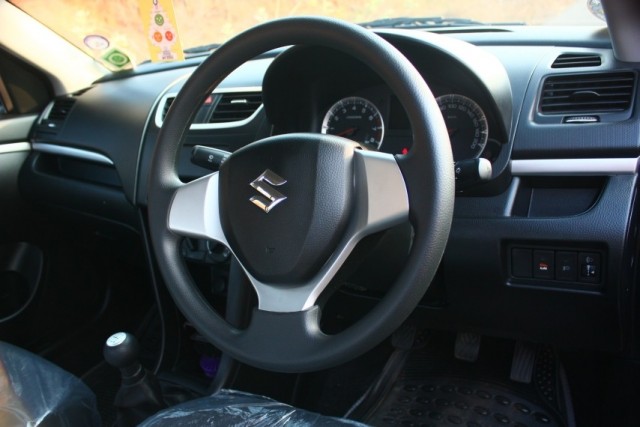
I am tired of beige and/ or grey interiors. No, seriously, what am I, a WWII veteran who has a chestful of medals and a rapidly diminishing sex drive? I would have definitely preferred a more colourful interior colour combination in keeping with the cheeky nature of the car. Chestnut wood, alongwith hints of amber, some more chrome and warmer colours like dark blue or chocolate would have made life infinitely more interesting. Maruti says that there is a (hold your breath), a Sporty steering wheel, a Sporty chrome accents on the dash and Sporty fabric seats. Much abused, right?
Verdict on the interiors in one word? Blehh, but good job on the dashboard!
Engine and Transmission
The 2011 Swift features the new 1.2 K series engine, albeit featuring Variable Valve Timing (VVT). Before going forward, let me explain why this is important. The power and torque an engine is capable of generating is a function of the duration, lift and timing of the intake and/ or exhaust valves. With set (non variable) values for all of the above, an engine would be capable of generating only the set power and torque within the specific rev range. What VVT does is it alters the maps for the duration, lift and timing mentioned above with the different revolutions at the different ranges. Essentially, if the revs are higher, the duration and lift angles would be higher, enabling more fuel/ air mixture to be pushed into the combustion chamber, which enables bigger bangs, and hence, greater power. Hence, VVT on the already high performance engine allowed it to be a high revving unit producing roughly 87 horsepower, and 114 Nm of torque.
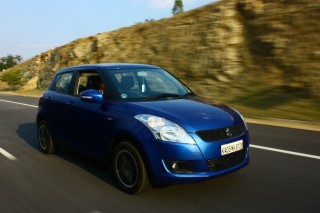
When you drive the Swift, the thing which instantly hits you is the ease with which the car listens to your commands. She is very driver friendly, as with the earlier iteration and taking quick corners and running down straights with her skirts up are very easy and the torque curve is just right, steep enough to be exciting but not scary. With the longer wheelbase, the new Swift feels more planted at the corners, with the suspensions rarely bottoming out, even when you wrench her hard (we did not try out the last part too many times, because she was an absolutely new car, but expect more when we have a long term ownership review later).
You get thrown around inside the cabin, but you can literally feel the B column pushing back to keep the position upright even during drifts. She is reasonably quick on the uptake as well, with one hundred coming up in well under ten seconds. The powertrain – chassis – driving dynamics combo works quite well together, and essentially retains most of the characteristics which was there in the older iteration.
All in all, much respect!
Final verdict
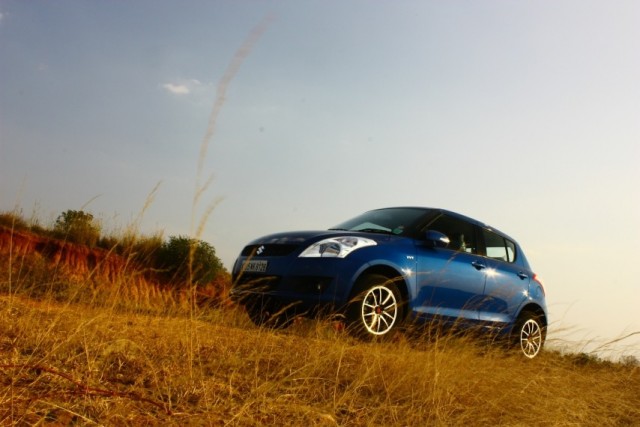
The Swift has always been a fun car to drive. The new iteration makes it even more so, albeit the diesel version, we think, would essentially feel like the older version verbatim. The petrol version, though has made the Swift even, err, Swifter!
So, if you want more comfort and bells and whistles from your ride, and who does not like too much of performance (although there should be enough to brag about it), please buy an i20 instead. But do not try doing doughnuts on her. You will just end up dead.
But if you are one of us, and like the cheeky way the car responds, alongwith the rush which the Japanese power to weight ratios are capable of, and wish to show off your driving skills to that hot chick you have been wanting to pick up without killing yourself, go ahead!
So, would it be worth it to go plonk your money on the new Swift? Absolutely! That is, unless you can get yourself the Mini. In which case, pick up both, and gift the Swift to us.
Photo Credit: Ayan Ray
The Mahindra XUV 500 will enter this year’s Desert Storm Rally, the Indian version of the famed Dakar, if you like. The XUV500 will be driven by the incredibly talented Gaurav Gill. This year Desert Storm will also feature AMW trucks for the first time as well as Polaris ATVs. The Hero Impulse will also join the Desert Storm albeit as a privateer entry.
News and pictures courtesy: Overdrive.in