Yearly Archives: 2012

Michael Schumacher posted a time of 1:35.973 in the second practice session today moving ahead of Lewis Hamilton who had posted the best time in Free Practice 1. Mercedes AMG Petronas’ technical programme focused on set-up changes, with intermediate tyres required for the early part of FP1. In FP2, the team worked on comparisons between the two dry tyre compounds on a variety of fuel loads.

Formula 1: Michael Schumacher, Mercedes AMG Petronas : 2012 Chinese GP

“It was a trouble-free day, and I am quite happy with how our car is handling so far here. The balance of the car was reasonably good, and obviously a balanced car contributes a lot to lap time. As a team, we are a lot stronger in certain areas this season, and we have a much better base to work from, although we are not quite where we want to be with this car yet but I am confident we will get there. We will now have to look deeper into the data in order to find out where we really are here, but I am looking forward to tomorrow’s qualifying.” said Michael Schumacher.

Formula 1: Michael Schumacher, Mercedes AMG Petronas : 2012 Chinese GP Photo 02Formula 1: Michael Schumacher, Mercedes AMG Petronas : 2012 Chinese GP Photo 01

Nico Rosberg who posted the second best time in FP1, moved down to 5th in FP2. He said “The conditions were so changeable today that it was difficult to take the right decisions in terms of set-up work, and we struggled a little with the front tyres. That may have been caused by the cold temperatures today, and can change very quickly between now and the race, so I am not too concerned.”

Ross Brawn explained that the programme had gone as planned, and that he was happy with the low fuel runs. The team would be concentrating on the race pace and try to understand the tyres for the optimum strategy on Sunday.

Formula 1 : Lewis Hamilton, Vodafone McLaren Mercedes : 2012 Chinese GP Photo 02

Lewis Hamilton who posted second best time after Schumacher in FP2, isn’t too concerned about the 5 place penalty bestowed upon him due to a gearbox change. He is very confident about the weekend and has said if he has to get to the podium starting from the back, then so be it. Hamilton and teammate Jenson Button (P6 in FP2) are having issues with the front brake locking up. Hamilton has said this makes the car vibrate crazily at high speeds and also affects visibility. The bumpy track isn’t helping either.

Formula 1 : Lewis Hamilton, Vodafone McLaren Mercedes : 2012 Chinese GP Photo 01Formula 1 : Lewis Hamilton, Vodafone McLaren Mercedes : 2012 Chinese GP Photo 03Formula 1 : Jenson Button, Vodafone McLaren Mercedes : 2012 Chinese GP Photo 02Formula 1 : Jenson Button, Vodafone McLaren Mercedes : 2012 Chinese GP Photo 01

Sebastian Vettel and Mark Webber posted the 3rd and 4th best times in FP2. Vettel is quite happy, and says though there is a big difference compared to the setup in Malaysia, but he cannot comment on how much of it has made a difference while driving, due to the different conditions of this track, the track temperatures are much cooler than in the previous two circuits. “It’s cooler here than at the last two races; I felt more comfortable, but we’ll see. It’s tricky to say if we look competitive. McLaren look good in all conditions.” he explained.

Lotus F1 Team reports track temperature was colder than expected meaning the car did not handle as predicted. Both cars exhibited understeer possibly symptomatic of the cool temperatures.

Sometime in Novemeber there was a render of the alleged new Linea making the rounds on the internet. While the majority of the auto journalist crowd had stamped ‘2013 Linea’ on it for all intents and purposes, some of us were not so sure. Riot Engine posted about it here arguing that the chances of this muscular and sharp design being a Fiat was really really slim. Turns out we were right. While the render was that of the Dodge Dart that was unveiled at the recent Detroit Motor Show, Fiat has now unveiled its Italian cousin, the Viaggio.

Fiat Viaggio to be unveiled at the Beijing International Auto Show, probably not the 2013 Linea for India

Fiat Viaggio to be unveiled at the Beijing International Auto Show, probably not the 2013 Linea for India : Badge

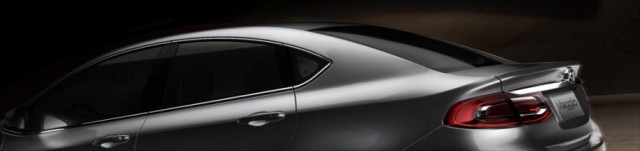
Fiat Viaggio to be unveiled at the Beijing International Auto Show, probably not the 2013 Linea for India: Fantastic looking silhouette

Come 23rd April, and the Viaggio should be unveiled in all its glory, maybe sooner taking into account the here-you-go-leaked-images-just-before-the-unveiling trend. The front face is characteristically Fiat, albeit the new Fiat and not the one we’ve seen on our Puntos and Lineas. The day light opening area is ringed with chrome, and the tail lamps are LED.

Viaggio (voyage in English and its Chinese name Fei Xiang meaning flying) is the first project worked on jointly by Fiat-Chrysler. While the Dart will work its way into the market in the USA, China’s compact sedan segment is all set to be inundated with the Viaggio. Do not read too much into the word compact, since we’re talking about China where the 3 Series, C-Class, the A4 et all have to be sold in the stretched versions!

The specs agree with that line of thought too. At 4,679mm in length, 1,850mm in overall width and with a 2,708mm wheelbase, the Viaggio is hardly a C segment car ( which it claims to be), treading on D segment territory.

The new four-door, five- passenger Fiat Viaggio as well as the Dodge Dart, are based on the CUSW (Compact US Wide) architecture which Fiat says is the most advanced within the Fiat Group. The CUSW architecture is, in turn, derived from the Compact architecture originally developed for best-selling Alfa Romeo Giulietta.

The Fiat Viaggio will be the only car in its segment (WHICH segment?) to exclusively offer sophisticated turbo-charged engines; the 1.4L T-jet in both 120 hp and 150 hp outputs matched to either a 5-speed manual transmission or the latest Dual Dry Clutch Transmission (DDTC) developed by Fiat Powertrain.

The new Fiat sedan will be the first car to be produced in the new Gac-Fiat World Class Manufacturing plant in Changsha, Hunan province. The first cars will be produced from July and will go on sale in the third quarter of this year.

Maybe Fiat should pull up its socks and bring this baby to India and of course, price it well too.

Dodge Dart

Dodge Dart 01Dodge Dart 02

Gullwing doors on a Mercedes-Benz. The 300 SL got them first, the SLS AMG was the next car to get gullwing doors, right? Until my little brother stumbled across the C 111, I thought so too. Without getting into nerdy details of series production and concept cars, let’s just say, the first Merc after the 300 SL to have those artfully crafted doors would be the C 111. That isn’t the end of it though. The C 111 also had glass-fiber-reinforced plastics as bodywork material, riveted and bolted to the steel frame/floor unit. Did I mention the C 111 was powered by a Wankel engine? The C 111 was one of Mercedes-Benz’s ‘Research Cars’ and hence the overload of experimental technologies.

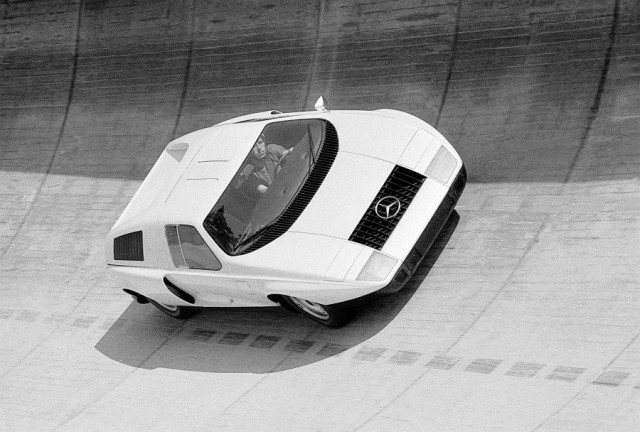
Mercedes-Benz C 111/I with a three-rotor Wankel-engine, on the test track at Untertürkheim, 1969

Felix Wankel’s unconventional propulsion system had been something of intrigue for a number of automakers in the 1960s and Mercedes-Benz was no exception. Mercedes-Benz, too, had been experimenting with Wankel engines since 1962. The C 111 was first displayed by Mercedes-Benz in September 1969 at the Frankfurt International Motor Show (IAA) with a three-rotor Wankel engine that developed 280 hp from 600 cubic centimeters of chamber volume per rotary piston and gave the car a top speed of 260 km/h. The C 111 clocked 0 to 100 km/h in five seconds.

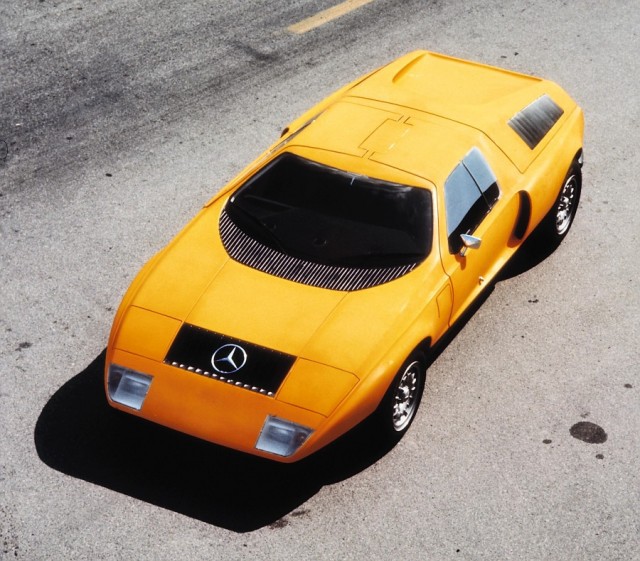
Mercedes-Benz C 111-I with a three-rotor Wankel-engine, 1969 (Photo 01)

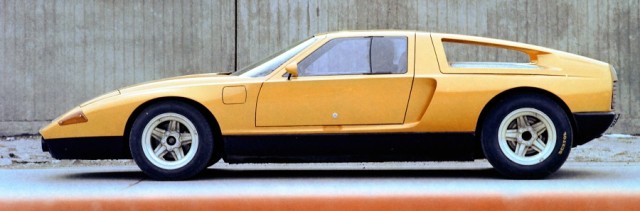
The wedge shaped body, the shade in which the C111 was clothed – ‘Weißherbst’ or ‘rosé wine’ and the gullwing doors helped cement the C 111 as an object of desire for every auto enthusiast who had the privilege of getting to know this automobile. Now remember this was the period when youngsters had their retinas seared with images of sensational cars like the Miura, the Ferrari Daytona, Mangusta and a whole horde of American muscle cars. To dislodge some of these images from the enthusiasts’ mind and then take its place, the C 111 must have been THAT spectacular.

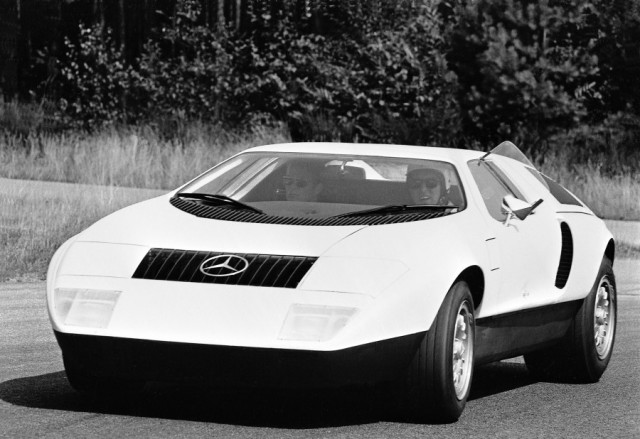
Test drive on the Hockenheim race track: Mercedes-Benz C 111/I with a three-rotor Wankel-engine, 1969 (Photo 05)Gullwing doors on the Mercedes-Benz C 111/I with a three-rotor Wankel-engine, 1969

 In late 1969, “Auto Motor & Sport” wrote: “The quiet running of the Wankel engine and the virtually complete absence of wind noise will initially deceive you into wrongly assessing the actual speed. When you think you’re doing 150 or 160 km/h, a glance at the speedometer will quickly tell you that you are in fact doing 240 km/h. Incidentally, 7000 rpm in fourth gear correspond to 226 km/h.”


Mercedes-Benz C 111/I with a three-rotor Wankel-engine, 1969 (Photo 04)

Mercedes-Benz C 111-II

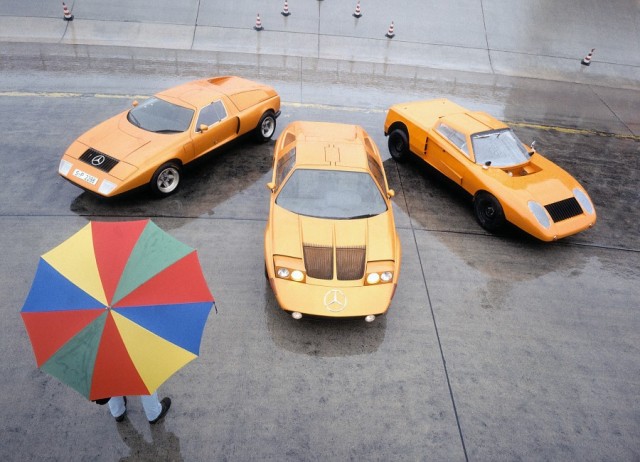
Three generations of the Mercedes-Benz research car C 111: C 111-II, 1970 (in the middle), C 111-I, 1969 (on the left), the first prototyper version of the C 111-I (on the right)

If that wasn’t enough, Mercedes-Benz, in just a few months showcased the C 111-II at the Geneva Motor Show. The three rotor Wankel engine was swapped for a four-rotor Wankel engine with an output of 350 hp.The engine, a DB M950 KE409 model, also had 600 cubic centimetres of volume per rotary piston and was the most advanced of the rotary piston engines developed at Mercedes-Benz. The engine transmitted its power to the rear wheels via a five-speed transmission, accelerated the C 111-II from a standing start to 100 km/h in 4.8 seconds and gave a top speed of 300 km/h.

Mercedes-Benz research car C 111-II with four-rotor Wankel enigne, 1970

Mercedes-Benz research car C 111-II with four-rotor Wankel engine, 1970 : Design Sketch Front 3/4Mercedes-Benz research car C 111-II with four-rotor Wankel engine, 1970 : Design Sketch Rear

While some of the engines in the C 111-I cars had dual ignition systems which was difficult to adjust, the four-rotor engine was equipped with single ignition only. Both engines were direct-injection units.

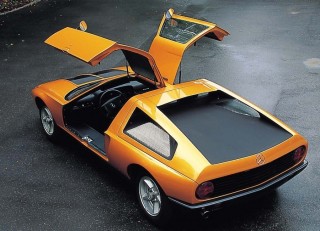
Mercedes-Benz research car C 111-II with four-rotor Wankel engine, 1970 : Gullwing Door, from topMercedes-Benz research car C 111-II with four-rotor Wankel engine, 1970 : Gullwing Door

The C 111-II also had a modified body that had better aerodynamic efficiency with a drag coefficient of Cd of 0.325 which was exceptionally low for the period. Driver visibility was also improved. Mercedes-Benz proudly claims that with the modified body and new Wankel engine, which now developed torque of 392 Nm, no other road-going supersports car was a match for the C 111-II.

Mercedes-Benz research car C 111-II with four-rotor Wankel engine on the Untertürkheim test track, 1970

While the Wankel engine had the advantages of being compact design and very quiet, the Wankel engine’s inherent problems – poor degree of efficiency, due to the elongated, variable combustion chambers of the rotary-piston principle could not be overcome by any degree of engineering ingenuity. This problem was simply inherent in the design: in a Wankel engine, the fuel burns within the space between the convex side of the rotary piston and the concave wall of the piston housing rather than the cylindrical combustion chamber of a reciprocating-piston engine. The variable combustion chambers of the Wankel engine were responsible for poor thermodynamic fuel economy as compared to a reciprocating-piston engine, resulting in significantly higher fuel consumption for the same output says Mercedes-Benz.

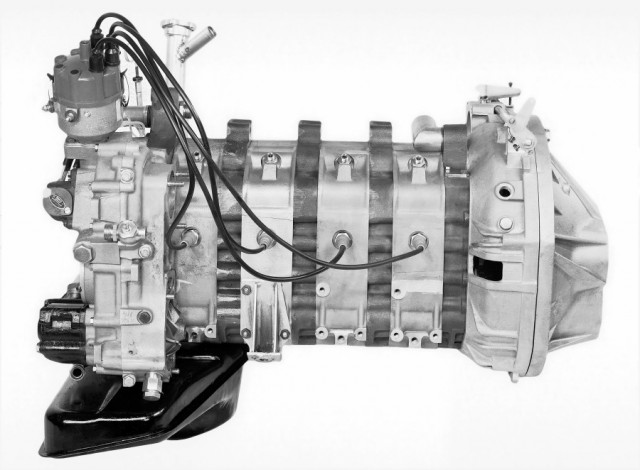
The four-rotor Wankel enigne of the Mercedes-Benz research car C 111-II , 1970

Now this is something that has us flummoxed. While Mercedes-Benz does mention that both variants of the Wankel engine on the C 111 were gas-guzzlers, the magazine auto motor und sport dated 11 April 1970 mentions that the Mercedes wankel engines delivered ‘an average of 20 litres/100 km’ which was typical for cars of that period. Nervertheless, if not for reasons of fuel efficiency, the Wankel engines had to be shelved for reasons of high emissions.

Mercedes-Benz C 111-II research vehicle with a four-disc rotary engine, 1970. It was to this 1:1-scale model that the finishing touches were made before approval of the second-version Mercedes-Benz

“The Wankel engine was not yet mature enough to be handed over to customers in line with company standards,” said Dr. Hans Liebold, Head of the C 111 Projects in the year 2000, from the first Wankel study right up to the later record-breaking cars with reciprocating piston engine. He also drove the cars his team built on a number of occasions while setting records!Record run in Nardo over 5000 kilometres (13 to 21 August 1983): Hans Werner, Hans Liebold, Kurt Obländer and Erich Waxenberger (from left to right)

In retrospect, Dr. Kurt Obländer, head of engine testing in the C 111 project, described the Wankel engine as follows: “Our four-rotor engine with gasoline injection represented the optimum of what could be reached with this engine concept. The multi-rotor design called for peripheral ports for the intake-air and exhaust-gas ducts. We were able to solve the difficult problems in engine cooling and engine mechanics by technical means. But the main problem of the concept, its low thermodynamic degree of efficiency, remained. Due to the elongated, not exactly compact combustion chambers, fuel economy was poor, resulting in high fuel consumption and unacceptably high pollutant emissions. These drawbacks were inherent in the design principle.”

Mercedes-Benz discontinued work on the Wankel engine in 1971 and went back to reciprocating engines.

Mercedes-Benz research car C 111-II with four-rotor Wankel engine 1970 : Front ( Photo 10)

Mercedes-Benz research car C 111-II with four-rotor Wankel enigne on the Untertürkheim test track, 1970 ( Photo 10)

Mercedes-Benz research car C 111-II with four-rotor Wankel engine, 1970 : Gullwings open Photo 01

Mercedes-Benz research car C 111-II with four-rotor Wankel engine, 1970 : Photo 06

Click on the link below to the Diesel engine era to continue reading.

Last year, I had written a piece titled “The peculiar case of Michael Schumacher and of Valentino Rossi.  The piece was basically questioning the rationale of Schumacher returning to Formula1 racing after a three year hiatus and Valentino Rossi not gracefully retiring from MotoGP and pursuing some other form of racing such as rallying.  My point was that both of them proved sufficiently that they were greats and legends even while they were racing and the only thing that they could prove (one by returning to racing and the other by continuing to race and that too on a career destroying motorcycle) with their actions was that they were no legends but simply ordinary mortals.

In this piece I shall leave Michael Schumacher out (I will write another piece on him soon) and only concentrate on Valentino Rossi.  By signing with Ducati and that too immediately after Casey Stoner vacated the seat there, Rossi shot himself in his feet, hands and whatever else you can think of.  Rossi has been in the MotoGP paddock since he was sixteen and at thirty two he had spent exactly half of his life in MotoGP (in its various categories such as 125cc, 250cc, 500cc, 990cc four stroke, 800cc four stroke) and in the process killed the reputations of Max Biaggi, Sete Gibernau and had he quit at the end of 2010 even Casey Stoner.  But Rossi decided to rub Casey Stoner’s nose into the ground along with that of Jorge Lorenzo’s before saying an imperious bye bye to MotoGP.  The Emperor leaving with his laurel wreath firmly on his head.  Unfortunately for Rossi fate had another script, one that would see the hero of 16 years turned into rubbish in one year and more.  In the process Rossi also destroyed the very formidable reputation of Jeremy Burgess, the man who trained under the watchful eye of legendary engine man Erv Kanemoto and then went onto produce great champions like Wayne Gardner, Mick Doohan and finally Valentino Rossi himself.

Rossi’s leaving of Honda and going to Yamaha was in itself an audacious move.  By making this move Rossi became only the second rider after Eddie Lawson to change manufacturers and still win World Championships.  He did one better than fast Eddie though, he won two consecutive races on two different motorcycles (even now the only one to do it) and two back to back world championships with two different manufacturers.  Yamaha that was reduced to an also ran for years when Biaggi and Carlos Checa rode for them, returned to glory days that it saw with King Kenny Roberts and the legendary Wayne Rainey.  In 2007 when rules were changed to bring 800cc engines in the place of 990cc engines, Ducati and the new signing Casey Stoner took risks that the Japanese factories did not take and therefore produced a new world champion in Stoner and also in Ducati.  There was then the issue of tyres.  Bridgestone were competing with Michelin and they favoured Ducati since all the big manufacturers such as Honda and Yamaha were firmly with Michelin.  The Ducati-Stoner-Bridgestone combination took risks and managed to become an unstoppable juggernaut that steam rolled all competition into submission.

Casey Stoner Ducati Team

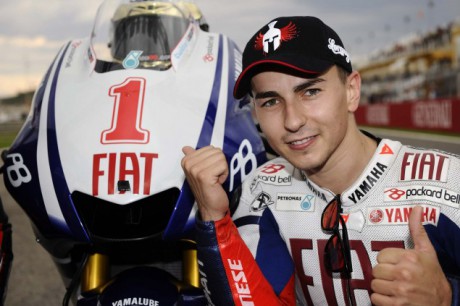
Then Rossi started kicking and crying and asked for Bridgestone tyres so that he could fight Stoner on equal tyres and though contractual obligations should have prevented this from happening, promoters Dorna ensured that Rossi had his way simply because Rossi brought more colour and popularity to the MotoGP paddock than did the rest of the paddock and all the previous generations put together.  After getting the Bridgestone tyres and issuing an ultimatum to Yamaha and Masao Furusawa and getting Yamaha to do his bidding, Rossi took the title right back from Casey Stoner and convincingly at that.  But worryingly for him his new teammate Jorge Lorenzo was proving to be a pain in the posterior just like Alex Criville proved to be for Mick Doohan.  The global economic recession and the control tyre that was introduced by Dorna, the promoters kept bringing the Spanish matador closer and closer to Rossi’s heels.  So the year 2010 was another occasion for Valentino Rossi to issue another ultimatum to Yamaha.  “Me or Him” choose.  Yamaha chose and wisely as time has proved.  Lorenzo is a gritty rider who refuses to give up, the Jim Courier of MotoGP so to speak.  He is nearly ten years younger than Rossi and for Yamaha it made sense to invest in the future rather than in the past.

Jorge Lorenzo Yamaha 460x306

Yamaha had called Rossi’s bluff and left him stranded.  Sense should have told him to quit MotoGP but the red mist descended and clouded Rossi’s judgement.  Stoner complaining of improper treatment at Ducati had already signed for Honda, a deal facilitated by his mentor at Ducati, Livio Suppo who himself moved to Honda in a managerial capacity one year earlier.  With Suzuki deciding to run only one motorcycle for 2011 and Kawasaki having runaway from MotoGP with its tail tucked firmly between its legs and with its head held low, there was only one possibility left, other than retirement and that was Ducati.  The antics of Rossi at Ducati are too well known for me to repeat them here.  But we shall touch upon some salient points which are necessary for this story.  What most people do not know and even those who know have forgotten is that Rossi’s crew chief Jeremy Burgess and the rest of the crew who are Australians did not commit to moving to Ducati with Rossi.  In fact, Burgess and co who were the team that Rossi inherited from Mick Doohan, were very reluctant to switch to Ducati.

Adesivi Valentino Rossi DottoreThe Doctor seems to have become the patient

Jeremy Burgess made all kinds of vague noises and some of those noises included a possibility of retirement.  At the same time Valentino Rossi also made noises and one heard clearly his saying that he would want to have Jerry Burgess and the crew to join him at Ducati but if necessary he would go it alone.  Stoner in turn took the Ducati crew chief Christian Gabbarini and his team to Honda.  At the end of the 2010 season, Stoner got off the Ducati and got on a Honda and went like a bullet, topping the timing sheets, one day after the season was over.  Rossi got off the Yamaha and onto the Stoner’s Ducati and went like a slug.  He finished fifteenth in a field of fifteen.  Casey Stoner had won three races towards the end of the 2010 season on the same motorcycle.  And thus began Rossi’s travails.

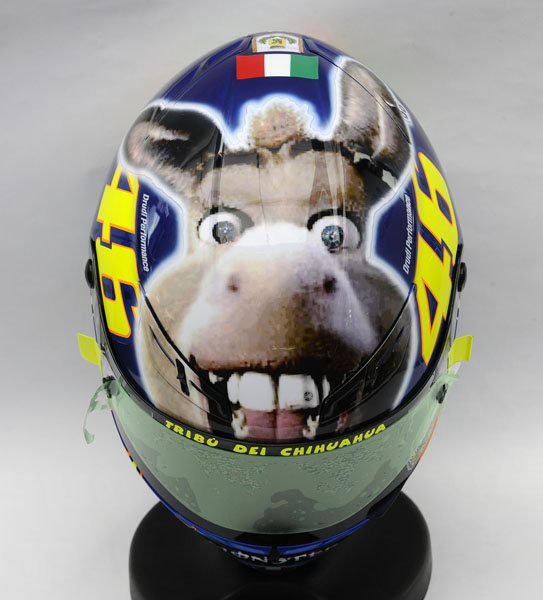
Rossi Donkey

Ahem, the picture says it all, doesn’t it?


He complained about the lack of front end feel on the Ducati.  He said the lack of a chassis and the use of the engine as a stressed member was depriving him of front and feel.  He also said that the swing arm of the Ducati was not to his liking leading to rear end chatter. So he tested the for 2012 Ducati with a revised swing arm and immediately pronounced that this bike was “his” and that the 2011 bike suffered from total lack of development under Stoner.  The complexity of the situation was that since Ducati’s 2012 bike was of 1000cc and since its mounting points for the rear swing arm were different, the engine had to be destroked to 800cc aided by the 81mm air intake restriction.  But it also meant that Rossi was using new engines and with a cap on the number of engines in a season this was a problem for Ducati.

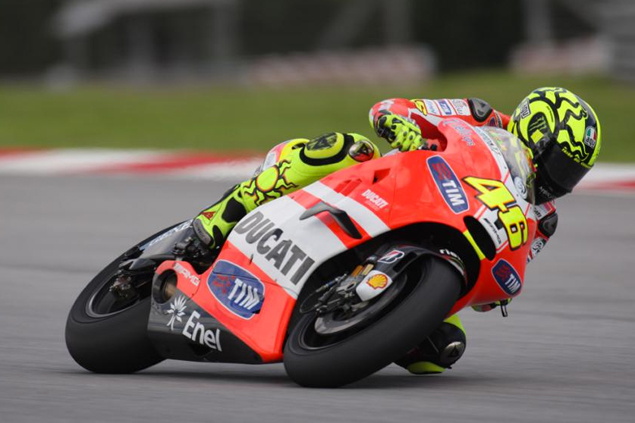
ValentinoRossi Ducati3

But Ducati obliged and Rossi still went like a slug.  Then the experiments with a front aluminium end and then a full fledged aluminium twin spar delta box frame.  The 2012 season has been underway and after Rossi still complained about lack of front end feel.  For Rossi Ducati rotated the engine head backwards to move the weight to the front.  At the tests at Sepang and Jerez and also in the season opener at Qatar Rossi tiptoed like a maiden in high heels on a slushy ground.  In most practice sessions even Hector Barbera and Karel Abraham on the customer Ducati GP Zero were going faster than Rossi, and that is not to talk of Nicky Hayden who sat out most of the preseason testing due to injury but once on the bike went consistently faster than Rossi.  After the race was over, Rossi said he cannot ride the Ducati and placed the blame at Filippo Preziosi’s door saying that I do not get what I ask for.

Vrbike1

Er, should Rossi return to this?

Through all this Casey Stoner has been laughing inside his helmet and even when he does not have it on.  He has been pushing one insult after another at both Rossi and Burgess saying that he Stoner won a championship and races on the Ducati when it was operating at a quarter of a budget.  Rossi and Ducati have run out of excuses.  What remains now is a question.  How much more humiliation will Rossi take before he finally hangs up his helmet, in shame, I may add.

Valentino+Rossi+Middle+Finger Uh oh Valentino have you checked your own posterior?  You know what Casey has been doing to you right?

The prices are introductory, meaning it might change at a later point of time. Maruti Suzuki has also started exporting CKD kits to Indonesia.

All prices are exshowroom Delhi

Petrol

LXi Rs. 5.89 Lakhs
VXi Rs. 6.60 Lakhs
ZXi Rs. 7.30 Lakhs

Diesel

LDi Rs. 7.30 Lakhs
VDi Rs. 7.90 Lakhs
ZDi Rs. 8.45 Lakhs

Six variants have been announced three for petrol, three for the diesel.

While the base variant (LXi/LDi) gets power steering and air conditioning, the mid variant (VXi/VDi) gets the audio system, twin AC ducts for the rear and ultimately the (ZXi/ZDi) fully loaded gets the bells and whistles like the rear wiper, defogger, 15 inch alloys and more.

Seven colors have been announced of which Serene Blue will be the characteristic Ertiga colour.

Six variants have been announced three for petrol, three for the diesel.

While the base variant (LXi/LDi) gets power steering and air conditioning, the mid variant (VXi/VDi) gets the audio system, twin AC ducts for the rear and ultimately the (ZXi/ZDi) fully loaded gets the bells and whistles like the rear wiper, defogger, 15 inch alloys and more.

Seven colors have been announced of which Serene Blue will be the characteristic Ertiga colour.

Prices announced!

Petrol

LXi Rs. 5.89 Lakhs
VXi Rs. 6.60 Lakhs
ZXi Rs. 7.30 Lakhs

Diesel

LDi Rs. 7.30 Lakhs
VDi Rs. 7.90 Lakhs
ZDi Rs. 8.45 Lakhs

With the kind of interest the Ertiga is generating, Maruti definitely couldn’t deny prospective customers a live webcast. Are you watching?

Webcast on Facebook

Webcast on marutisuzukiertiga.com

Maruti Suzuki Ertiga live webcast

The compact multi purpose vehicle from Maruti was unveiled at the Auto Expo. The Ertiga is built on the the Swift platform, extended by 310mm. The middle and third row of passengers have air vents in the roof above the front row.

Maruti Suzuki Ertiga unveiled at the 11th AutoExpo in New Delhi

The interiors feature a 3-spoke, tilt adjustable electric steering, twin AC, audio system (USB Compatible, 4+2 speakers), steering mounted audio controls, central door locking and keyless entry, multi information display, power windows with auto down and electrically adjustable mirror.

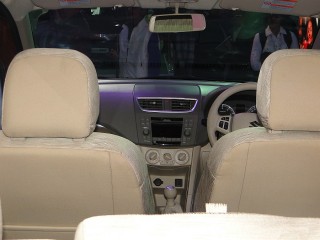
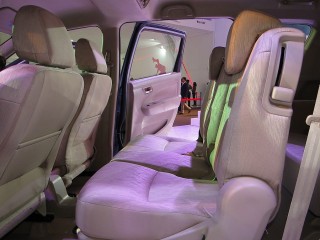
Maruti Suzuki Ertiga InteriorsMaruti Suzuki Ertiga Interiors Rear

The all new powerful and light weight K-14 VVT petrol engine, generating peak power of 95PS will debut on Ertiga. The Ertiga’s 90PS diesel variant will be powered by the 1.3 litre DDiS Variable Geometry Turbo (VGT) Turbo diesel engine.

Maruti Suzuki Ertiga  : Side ViewMaruti Suzuki Ertiga  : Rear 3/4

While the petrol is claimed to deliver around 16 kpl, while the diesel engine in India will deliver 20.77 kpl (CMW Rule 155, India Cycle).

The Ertiga offers a three-row flexi-seating options for 7 passengers (2x3x2). Each row of the car has been designed keeping in mind the occupants seating requirements says Maruti.

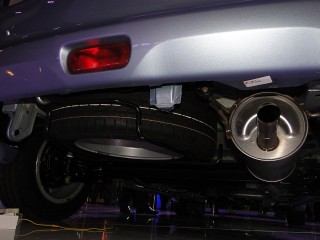
Maruti Suzuki Ertiga  : Rear Maruti Suzuki Ertiga : Exhaust and spare wheel

In 2012, Susie will contest her seventh season in DTM driving a AMG Mercedes C-Coupé for Mercedes-Benz. In addition, Wolff ( you might have also known her as Stoddart) will also work for Frank Williams as Development Driver for Williams F1 Team.

Susie Wolff, now Williams-F1 Development Driver

Frank Williams, Team Principal of the Williams F1 Team, said, “Susie is a talented, successful and highly professional racing driver who competes in one of the world’s most fiercely-contested racing series. Susie will join Williams as a Development Driver, in which capacity she will assist us with the development of our simulator and other technical challenges. Susie will also undertake some aerodynamic testing of the FW34 and a full track test in the coming months. Susie will also attend a number of races with us. I should add that, as Susie is married to Toto Wolff, a Director of Williams, her appointment was carefully considered and then approved by the Board, with Toto recusing himself from the process.”

Susie Wolff said, “I would like to thank Sir Frank for giving me this opportunity both on and off the track. I must also thank Mercedes Benz AMG and HWA for supporting me to take up this new experience with Williams. Formula One is the ultimate challenge for any racing driver and it offers me the chance both to apply and to improve the skills I have developed racing in DTM. In return I shall be offering some of my own technical insight and experience – coming from a different discipline – and helping the team engage with its partners. I hope also to demonstrate that women can play a role at the highest levels of motorsport and I shall be working closely with the team on its social responsibility programme in the areas of education and road safety.”

Bernie Ecclestone, Chief Executive of Formula One, welcomed the announcement: “If Susie is as quick in a car as she looks good out of a car then she will be a massive asset to any team and on top of that she is very intelligent. I am really looking forward to having her in Formula One.”

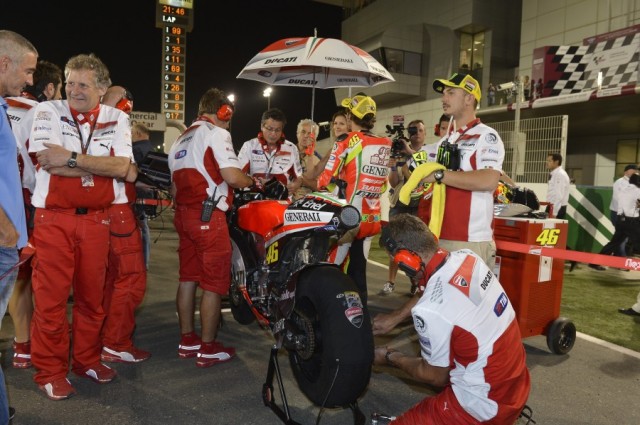
2012 MotoGP : Commercial Grand Prix of Qatar, Mick Doohan, Jeremy Burgess, Valentino Rossi

Bridgestone will introduce this latest specification front tyre featuring a revised construction that further enhances rider feel and warm-up performance. It was developed following analysis of performance data and rider feedback acquired in pre-season testing.

Bridgestone says, riders have been overwhelmingly positive about the new front tyre and after consultation with Dorna, the FIM and IRTA, has agreed to replace the current front tyre with the new 2012 specification front tyre from the Silverstone round.
In the meantime a limited number of the new front tyres will be made available for the Jerez, Estoril, Le Mans and Catalunya rounds.

Starting from Jerez, riders will be allocated two of the new specification front tyres to increase their total allocation for the race weekend to eleven front tyres. The new specification tyre will only be made available in the harder compound option,since the greater durability provided makes it better suited for race use. At Silverstone, when the new specification front tyre becomes the standard, the front tyre allocation will return to nine tyres.

Following a request from the Safety Commission, Bridgestone has proposed a revision to the wet tyre allocation for each race. Riders are currently allocated four rear and four front wet tyres in a single compound option, or in the case of all practice sessions being wet, five front and rear wet tyres.

Currently, riders have access to only one compound option of wet tyre per race. Under the new proposal, after the first wet practice session, Bridgestone, in consultation with the Safety Commission and organisers may agree to provide wet tyres with an alternative compound option to ensure rider safety in wet conditions. In this case, each rider may choose to replace a maximum of two of their front and/or rear wet tyres with the alternative compound.

Hiroshi Yamada – Manager, Bridgestone Motorsport Department:

“Last year we set out with a clear set of technical objectives for our 2012 specification tyres and since they were first tested, we received very good feedback on our path of development. Though rider comments on our original 2012 specification front tyre were positive, we haven’t rested on our laurels and brought new specification front tyres to the pre-season tests as part of our ongoing tyre development programme. One of these new front tyres was met with such an encouraging appraisal from the riders that we proposed to make it available as soon as possible. Due to logistical constraints, we are unable to supply a full allocation of this new specification front tyre until Silverstone, but we have changed our production schedule and made every effort to provide a limited allocation of the new front tyre to riders from the next race.

“I would like to thank all the riders and teams for their commitment to evaluating during pre-season testing and also Safety Advisor to Dorna Loris Capirossi for his ongoing efforts in collating feedback from the riders. I look forward to Jerez with great interest as not only will riders be using our latest specification front tyre in a race setting for the first time, they will also be showcasing the very latest in Bridgestone tyre technology to the world.”

Carmelo Ezpeleta – CEO, Dorna Sports:
“Dorna is pleased that Bridgestone will make their new specification front tyre available to riders from the second round of the season at Jerez. During the regular meetings during pre-season testing between Bridgestone and Safety Advisor to Dorna Loris Capirossi, it became apparent that this new specification tyre provided even greater levels of front-end feel to the riders and so we welcome the decision to make the tyre available as soon as possible.

“I would like to thank Bridgestone for continuing to equip MotoGP riders with their latest tyre technology and sharing in Dorna’s commitment to continually improve rider safety.”

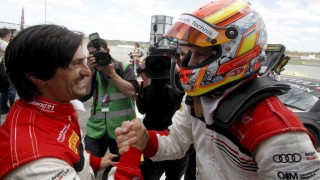
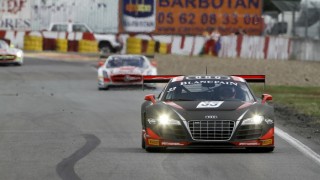
Enthusiasts eyes were on the WRT Team, for its strong driver line up, and they did not disappoint. Stephane Ortelli and Laurens Vanthoor driving the Audi R8 LMS ultra No.32 for the Belgian Audi Club Team WRT, won the Qualifying race on Sunday which gave them 8 points and 25 points again on Monday, they took the first position in the Championship Race at Nogaro, France for the opening round of the FIA GT1 World Championship.

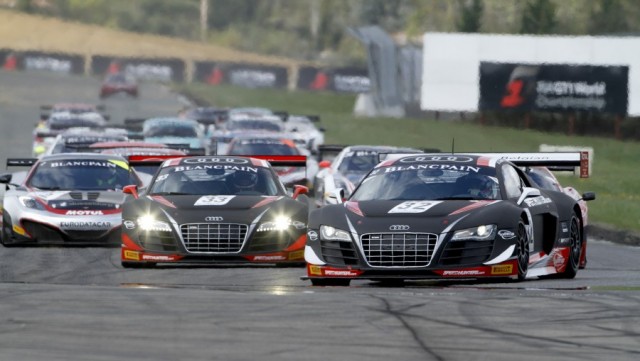
Podium, FIA GT1 World Championship Round 1 : Norago France

 FIA GT1 World Championship at Norago : Leading WRT Audi R8 LMS ultras

Stephane Ortelli and Lauens Vanthoor : Belgian Audi Club Team WRT Frank Stippler And Oliver Jarvis : Belgian Audi Club Team WRT, No. 33

The second WRT car, the No.33 of Frank Stippler and Oliver Jarvis finished second as they had done on Sunday. The Belgian Audi Club Team WRT has established its capacity for dominating the entire series, and as per GT1 regulations will carry ballast in the next race in Zolder, Belgium on the 20-22 April to make the race more competitive.

All-inkl.com Muennich Motorsport Mercedes SLS AMG GT3 - Marc Basseng / Markus
Markus Winkelhock And Marc Basseng, All-inkl.com Muennich Motorsport , FIA GT1 World Championship

Third was the ALL-INKL.COM Münnich Motorsport Mercedes SLS AMG of Marc Basseng and Markus Winkelhock, from sixth on the grid, just ahead of their team-mates Nicky Pastorelli and Thomas Jager.

FIA GT1 World Championship : AF Corse Mondiale GT1 Toni Vilander And Filip Salaquarda : 5th in the QR and 6th in the Championship Race at NoragoFIA GT1 World Championship : AF Corse Mondiale GT1 Toni Vilander And Filip Salaquarda : Pole Position in Qualifying

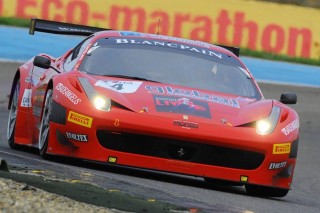
Ferrari’s debut with the revised Mondiale GT1 looked promising on Saturday with the AF Corse car driven by Toni Vilander taking pole for the qualifying race. However, things turned south for Ferrari thereon. The two AF Corse cars were not competitive enough in the race, partly because of the difficult weather conditions which meant the very damp track limited the cars’ potential. The Toni Vilander-Filip Salaquarda duo managed fifth in the Qualifying race and and sixth in the Championship Race. The Enzo Ide- Francesco Castellacci duo finished 10th in the Qualifying Race and  fifth in the Championship Race.

FIA GT1 World Championship : AF Corse Mondiale GT1, Enzo Ide And Francesco Castellacci : 10th in QR and 5th in Championship Race at Paul Armagnac circuit, NoragoFIA GT1 World Championship : AF Corse Mondiale GT1, Enzo Ide And Francesco Castellacci at Paul Armagnac circuit, Norago

The No.3 Ferrari 458 Italia of Toni Vilander and Filip Salaquarda was also given a drive-through penalty after a false start.

Peter Kox and Darryl O’Young were seventh in the Reiter Engineering Lamborghini LP600 No.25. Peter Kox also set the fastest lap of the race – 1:27.881 and is also reported to be at least two seconds faster than the competition midway through the race.

FIA GT1 World Championship : Reiter Engineering Lamborghini Gallardo LP600 Albert Von Thurn Und Taxis And Tomas Enge at Norago

The No.24 Gallardo LP600 for Albert von Thurn und Taxis and Tomas Enge. Von Thurn und Taxis was swamped at the start dropping from third to 15th but fought back to finish eighth.

FIA GT1 World Championship : Exim Bank Team China Porsche 911  GT3 R : Benjamin Lariche / Ren Wei at Norago

Mike Parisy, driving the No. 9 Porsche 911 GT3 R for Exim Bank Team China, was given a drive through penalty for a false start, but with co-driver Matt Halliday the team eventually finished ninth. The No.8 of Benjamim Lariche and Ren Wei was 15th.The Vita4One BMWs finished 10th and 11th just ahead of the Valmon Racing Team Russia Aston Martins while the Sunred Ford GT was 14th.

FIA GT1 World Championship : Vita4One BMW E89 Z4

We’ve written a separate news article for the MP4-12C GT3s fielded by Hexis Racing, read it here.

Laurens Vanthoor (BEL) Belgian Audi Club Team WRT Audi R8 LMS No.32 (1st)
“I never expected, even in my best dreams, that we would achieve this result at the first race. I am still quite speechless, but I think it is because we did a great job, we worked hard together, and we did a lot of testing. Audi have put a lot of effort into it, as well as Belgian Audi Club WRT, and then the co-operation with Stephane (Ortelli), everything is going the perfect way at the moment. I am really happy, this is one of the most beautiful victories I have had, so I hope we can continue in this direction.”

Stephane Ortelli (MON) Belgian Audi Club Team WRT Audi R8 LMS No.32 (1st)
“For Sure it is great to win, but Frank (Stippler) and Oliver (Jarvis) did a great job as well. All the week we have been testing, sharing the information, we are looking strong because we know how to share the job. We have really experienced drivers, I really like the team, and for the rest of the season I think it is looking very good, it is very special.”

Oliver Jarvis (GBR) Belgian Audi Club Team WRT Audi R8 LMS No.33 (2nd)
“First of all the team did a fantastic job, two fantastic pit stops. Its not easy down there, a lot of action going on, but the guys did fantastic. It was very close to Laurens (Vanthoor) for a few laps, where he’d been out already for a couple of laps his tyres were a little bit warmer, but we had a great fight.

“In the end Laurens was just a bit too quick for us, but we’ve had a good weekend, with two second places so we’ll go away very happy and remember that it is a long season. Hopefully we can beat them in the future, it is going to be a great fight throughout the year.”

Frank Stippler (DEU) Belgian Audi Club Team WRT Audi R8 LMS No.33 (2nd)
“For the first race it was quite a nice weekend and a nice Birthday present. Congratulations to Laurens (Vanthoor) and Stephane (Ortelli). It was a nice fight, and it was good for the team, they have worked hard, and work over in other series as well, such as the Blancpain Endurance Series, and it would be good for them to get some rest now, as they have worked extremely hard.”

Marc Basseng (DEU) ALL-INKL.COM Münnich Motorsport Mercedes-Benz SLS AMG No. 38 (3rd)
“At the end the pace was quite good, especially at the very end of the race the performace of the car was good. I treated the tyres softly most of the time, and I think that may have helped at the end.
“In testing at the start of the week we were struggling a bit, but we improved the car quite a lot over the week and we are getting more and more competitive. Markus did a good job today, we started in a similar way last season, so hopefully we can push for a win in Zolder.”

Markus Winkelhock (DEU) ALL-INKL.COM Münnich Motorsport Mercedes-Benz SLS AMG No.38 (3rd)
“We slowly improved the car step-by-step but the weather yesterday did not help us at all, but today the car was great and the Mercedes-Benz SLS AMG is known to be good to the tyres over a long stint, so that helps us as well.

“My stint was good, I had to wait to pass the Ferrari for a while but next time, at Zolder, there are some faster corners and that will maybe help us. We know that Belgian Audi Club Team WRT will make it hard for us to win at their home track.”

Ferrari celebrates 20 Years In China with a Limited Edition 458 Italia : Top View

20 years ago, the first Ferari was ordered from Beijing, a 348 TS. Ferrari is celebrating this milestone by inaugurating for the first time ever, a permanent brand exhibition outside of Maranello. Covering 900 square metres of the Italia Center of Shanghai World Expo Park, the Ferrari Exhibition will last for three years and will feature some of the best collections from the Maranello Museum.

A 458 Italia special edition of only 20 cars dedicated exclusively to the China market is planned. The car’s livery is characterized by unique Chinese elements and is finished in a brand new colour called Marco Polo Red specially developed for this exclusive car which will be presented at the inauguration of the Ferrari Exhibition at the Shanghai Expo Park’s Italian Center.

The most eye-catching element of the car’s exterior is the golden dragon on the front bonnet, which is offset by gold and black livery stripes symbolizing a racing track.

The inspiration behind the livery came from the longma theme which is an old Chinese idiom which means “the vigor and spirit of the legendary dragon-horse”. Dragon is a symbol of Chinese culture, standing for courage, passion and success, whilst Ferrari’s prancing horse logo is one of the most recognized symbols in the world representing Italian cultural identity and its unrivalled achievements in the design and engineering fields. Ferrari also points out that there couldn’t be a vehicle that could more perfectly encapsulates the passion and vitality of the longma spirit, than the 458 Italia.

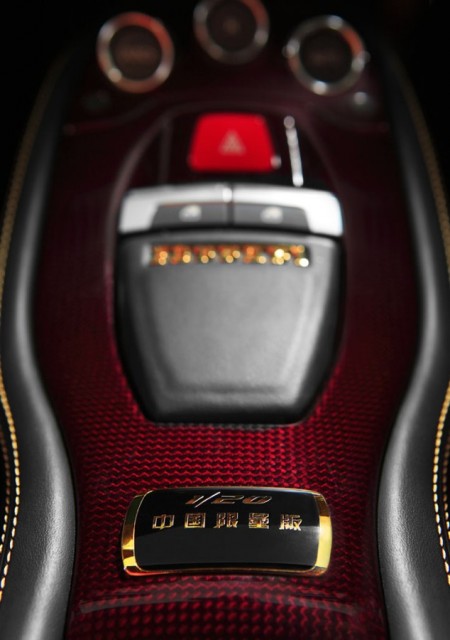
Ferrari celebrates 20 Years In China with the Special Edition of the 458 Italia : Interior shown, with the plaque reading '20th Anniversary Special Edition' in simplified Chinese

This unique design is enhanced by gold finish to the rims and the aeroelastic winglets. The interior also reflects the unique longma spirit and the celebration of Chinese culture with gold embroidery on the car’s head rests, while the engine start button on each of the 20 cars is inscribed with the simplified Chinese characters for ‘start’, and a ‘20th Anniversary Special Edition’ plaque is set into the dash.

20th Anniversary Special Edition Ferrari 458 Italia for China

Well, what can we say, a Ferrari doesn’t get any more bling than this!