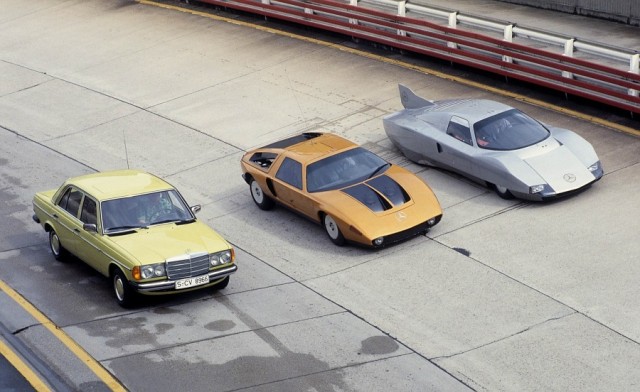
Then came the oil crisis of 1973. The focus shifted to new engines that would have much better fuel efficiency. Diesel was the most obvious solution, but compression-ignition units were thought to be sluggish and noisy. Mercedes-Benz points out that, there had certainly been examples of sluggish and noisy diesels in automotive history but the diesel engine had long since been developed into a refined power unit, perfectly capable of driving sporty passenger cars. Come to think of it, the perception of diesels in India didn’t change until the arrival of the CRDi units!
C 111-IID
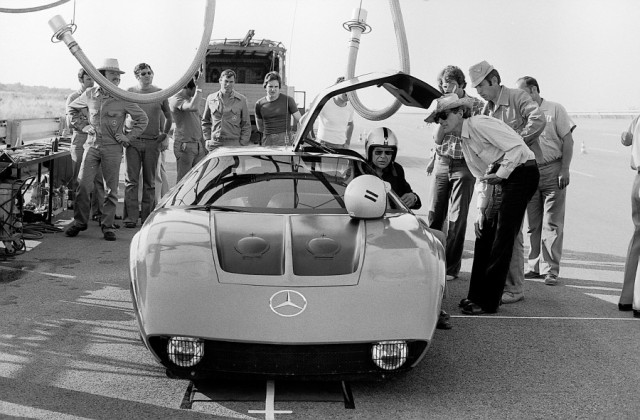
In 1976, Mercedes-Benz decided to power the C 111 with a diesel engine! The engineers installed a 3.0 L naturally-aspirated compression-ignition engine with five cylinders in the C 111-II for the first tests. The car was now called the C 111-IID. The diesel engine codenamed OM 617 LA developed as much as 190 hp, thanks to turbocharging ( a Garret turbocharger) and intercooling, as opposed to the 80 hp output of the production engine which powered the Mercedes-Benz 240 D 3.0 (W 115, Stroke Eight) and the 300 D.
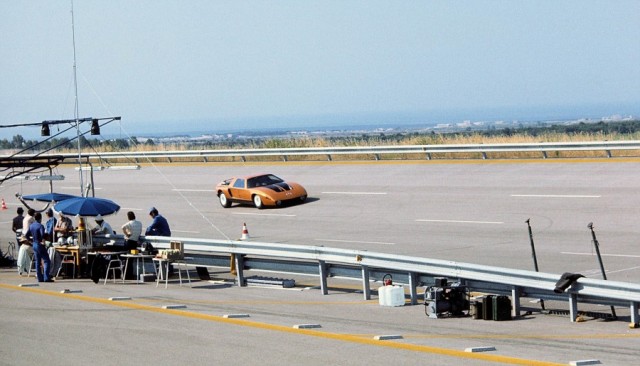
In June 1976, the C 111-IID reached spectacular speeds on the test track at Nardo near Lecce in Italy. In the course of 60 hours, four drivers, who took turns at two-and-a-half hour intervals, established a total of 16 world records – thirteen of these applying to diesel-engined cars and three absolute records, that is independent of the type of engine : 5,000 miles, 10,000 kilometers and 10,000 miles. During the tests, an average speed of 252 km/h was recorded, and Mercedes-Benz proved impressively that diesel aren’t necessarily dull. The body of the C 111-IID was unchanged. The C 111-IID could do 0 to 100 km/h in just 6.8 seconds.
C 111-III
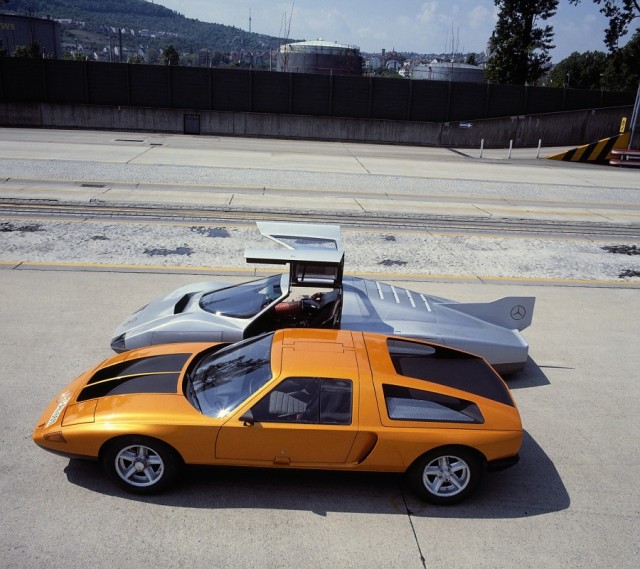
The success of the C 111-IID shifted the focus of the C 111 team. They now wanted to build a thoroughbred racing car for the sole purpose of establishing speed records: the C 111-III. The car had a longer wheelbase than the C 111-II, a narrower track, concealed wheels, a very low front end with recessed, powerful headlamps and a very long and tapering rear end with a central fin that was to enhance the car’s straightline stability under side wind conditions. The drag coefficient was down to a Cd value of 0.183.
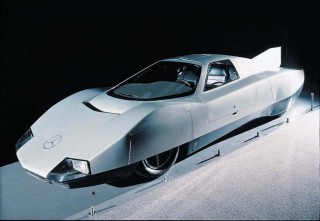
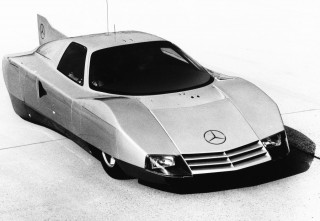
The long and narrow driver’s compartment featured a single seat: the front passenger’s space was occupied by a fat pipe conducting air into the intercooler. And there was also room for the telemetry system, specially developed by Mercedes-Benz for automatic data transmission during the record runs, as well as for radio equipment, enabling the driver to communicate with the team on the move.
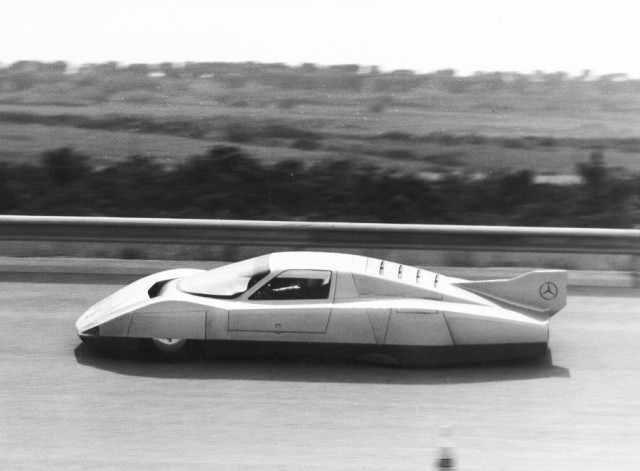
On April 30, 1978, the C 111-III lined up at the start in Nardo. A production diesel engine was again tuned, but to develop 230 hp. This gave the streamlined car a top speed well over 300 km/h. The time had come for the diesel-engined record car to drive lap after lap at constant speed on the Nardo track – anti-clockwise because this meant that the track-defining crash barriers were on the right-hand side, providing the drivers of the LHD cars with a greater safety margin in case of a crash. Mercedes-Benz remembers how a hedgehog was saved thanks to radio communication! It was rescued in time before crossing the racing car’s lane. During the third driver’s stint at night time the right hand side rear tire burst , damaging the bodywork. The recovery truck arrived on the scene quickly to pick up the damaged car and its uninjured driver, while the mechanics prepared the identical reserve car. After this incident, clocks were reset to zero and the hunt for records began again. Talk about the spirit of racing.
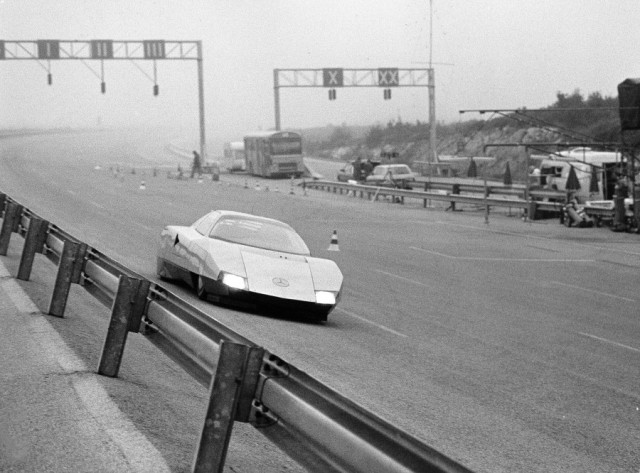
Mercedes-Benz points out that the reserve car was slightly faster than the original car, and also a little more economical, extending the refueling intervals from 62 to 67 laps! The three drivers were soon joined and relieved by their extremely fast project manager, Dr. Hans Liebold, who you’ve been introduced to in the previous page of this story.
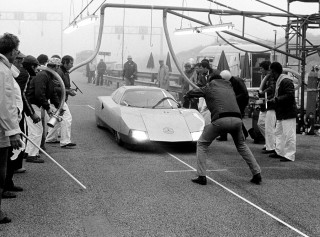
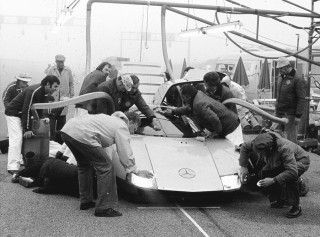
Now the faster reserve car went onto break the records just set by the other car whose rear tire had burst! Another hedgehog disrupted proceedings by entering the track, but this one could not be saved. The record car’s front spoiler was damaged and had to be repaired, something that was done under two minutes. The pit stops, incidentally, lasted between 15 and 20 seconds and this included the refueling, driver changes, tire checks and topping up of oil. A perfect view is a prime requisite for achieving high continuous speeds. The Mercedes-Benz service team therefore cleaned the windows and headlamp fairings every time the car came in for refueling with 140 liters of diesel, a change of driver and a check on the Dunlop tires.
After 12 hours of otherwise problem-free driving, the Mercedes-Benz brand had established nine absolute world records independent of engine type and displacement – achieved with a near-production three-liter diesel engine. At the end of the day, the engine in the record car had an efficiency of around 6.25 kpl, another outstanding record given an average speed of over 300 km/h!
C 111-IV
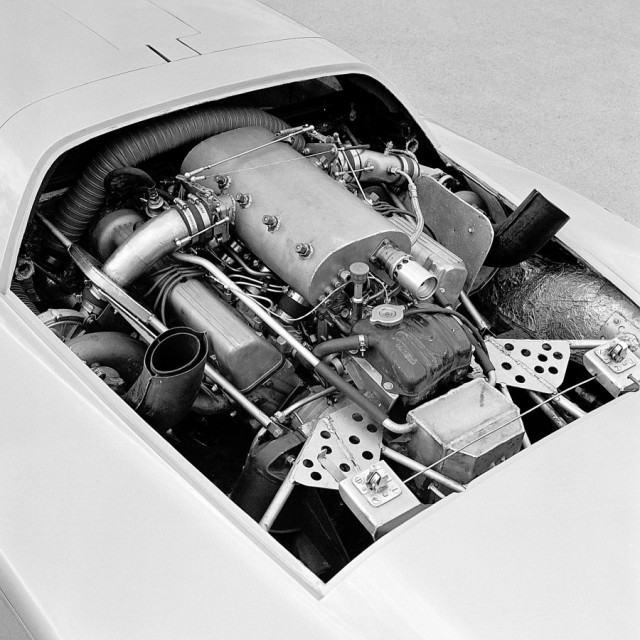
The C 111 story doesn’t end there. A world circuit record of 355.854 km/h had been in existence since 1975, set by a 1,000 hp racing car from the American Can-Am series. Having set nine absolute world records with the diesel, the engineers were looking for a new challenge. Though this unofficial record was not recognized by FIA, the Mercedes-Benz engineers felt they should give it a shot. They realized if they had another 100hp they could do just that, but the required horsepower could no longer be squeezed out of the diesel. So the team opted for the 4.5 liter V8 gasoline engine from large-scale production, bored it out to displace 4.8 liters and replaced conventional valves with sodium-cooled valves, two KKK turbochargers and a triple-plate clutch that was capable of coping with 600 Nm of torque.
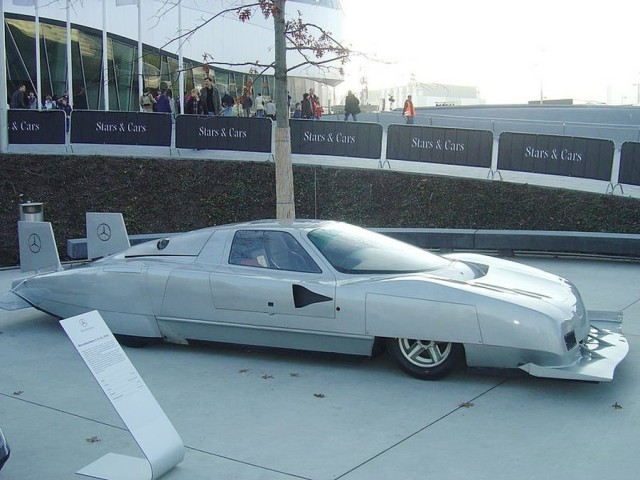
With more than 500 hp under the hood, achieved at relatively low expense, the C 111-IV was almost a racing car. The shape of the bodywork was crafted with the sole intention of breaking that speed record. It was a slim, elongated rocket with two airfoils (tailfins)and massive spoilers in a silvery livery. The C 111-IV set out in Nardo on May 5, 1979 to have a go at the world circuit record. After a smooth run, a new record of 403.978 km/h had been established.
Of course, there never was a production version of the C 111, ever. We have to wonder, if that may be a good thing after all, to let the legend live on, without diluting the awe it inspires even after close to four decades.