Royal Enfield Classic 350 and a 2002 Bullet Electra trippin'

Where does one find contentment? On a Royal Enfield, of course. Before we delve into the specifics of how and where, it seems prudent to ride the time machine back to a distant past and witness the genesis of this hallowed marque. The ‘Townsend Cycle’ manufactured by Givry Works in the early 1880s, reputed for its sturdy frame is what spawned the first seeds for motorcycles ‘Made Like a Gun’. After a financially tumultuous phase the company changed hands to become the ‘Eadie Manufacturing Company Limited’. Fortunately, the owners Albert Eadie and R W Smith were good businessmen who won a contract to supply precision rifle components for the Royal Small Arms factory in –cue the drum roll– Enfield, Middlesex. To commemorate this contract, in 1892, they designed a new bicycle to be manufactured and sold by the ‘The Enfield Manufacturing Company Limited’ which then became ‘Royal Enfield’ the next year. It was in 1893 the trademark ‘Made Like a Gun’ appeared first.

MADE LIKE A GUN : Royal Enfield Classic 350

In 1901 the first Royal Enfield motorcycle, a belt driven machine with the engine mounted over the front wheel was born. After more experiments with quadricycles, tricycles and four wheelers Royal Enfield found its calling when it put on display a small 214 hp V-Twin powered small motorcycle, at an international motorcycle show. The company survived the war, and the depression to give the world the first ‘Bullet’ in 1932. It was finally in 1949, after the II World War, Enfield arrived in India, through the Madras Motor Company.

It was in 1994 the Royal Enfield name was purchased by the Eicher group, who still own the brand. You can read more about Royal Enfield’s progress through the years in this article the Ed penned a while back. We have to head straight to August 2001 when Royal Enfield launched the Electra.

2002 Royal Enfield Bullet Electra

The Bullet Electra, was one of the first Royal Enfields to have coil ignition, technically CDI (Capacitor Discharge Ignition). This made the motorcycle far more reliable than previous Bullets that had to rely on contact breaker points (point Bullet saar!) ignition. The Electra has a four-stroke engine that delivered 18 bhp when it rolled out of the assembly line. How many horses the bike’s powertrain is capable of now, is anybody’s guess. It was available in three colors when launched,  Silver Ash, Riviera Red and Amazon Blue. While the Bullet Electra was launched at Rs. 56,931 ex-showroom, Chennai, a second hand Electra in today’s market is anywhere between twenty to thirty thousand more expensive!

Saurabh on his Royal Enfield Bullet Electra

Royal Enfield had tie-ups with Criterion Engineers,UK for gear box design and AVL, Austria for engine design. The Electra owes much if its engineering to these firms. Engineering, a word that sounds extremely delicious and inviting while we’re on the topic of Bullets. The Electra squashes notions of a heavy, lumbering, unreliable, usually unstoppable mass of metal AND metal and probably stakes claim to being the first Bullet that started the phase of putting the Bulleteer’s ear to ear grin on a larger number of motorcyclist faces. Who can say no a Bullet that doesn’t compromise too much on the ‘thump’ and still manages to start up perfectly when fully drenched?

Selva by his Royal Enfield Classic 350 and Saurabh by his '02 Bullet Electra

That question brings us to the Classic. We had the Royal Enfield Classic 350 with us for a day, thanks to our movie star doppelganger friend Selva. Saurabh, the man ( he probably prefers boy! ) with the 2002 Bullet Electra was only too willing to join us for the ride.

The Classic 350 is powered by the 19.8 bhp, 28 Nm torque Unit Construction Engine ( UCE ) with a 29mm, CV Carburettor while the Classic 500 is of course, fuel injected. The Classic 350 definitely scores lower on the characteristic ( uh-oh) thump, but for somebody who started learning to ride on his brother’s ye old Bullet, Selva seems to not mind. Saurabh though, will sit you through hour long classroom sessions on how the mechanical clatter ( not that I noticed any ) of the Classic’s engine makes more noise than the exhaust, the combined effect being a thump that cannot be compared to the full lunged bellow of the cast iron engines.

Bah. Flintstones-ish we say. As Bassee will mention somewhere else in this article, the appeal of a Bullet is that you can sit back comfortably, let the revs rise up slowly thanks to the long stroke engine with all the torque in the world and allow yourself to be transported to your intended or preferably unintended destination while astride the magnificence that is a Royal Enfield accompanied by the sonorous thump. When a Bullet can take you from Kanyakumari to Leh like no other motorcycle can, and not break down in the process of doing it, I’m sure you can find it in your hearts to forgive the perceived loss of the thump. Can you Saurabh?

Royal Enfield Classic 350

The four speed gearbox on the right hand side of the Bullet Electra needs a bit of coaxing to slot it in the cogs properly. If the 5 speed gearbox on the Classic 350 is any improvement, let’s just say, there is scope for perfection. Ride quality on both motorcycles was stunningly fantastic and gave new meaning to Evo’s off hand comment that I’d be so much more comfortable touring on a Bullet than on my 220. Getting off the Classic 350 was as hard as trying to wake up in the middle of the night and getting to the loo, afraid that when you do wake up the fantastic dream would vanish leaving no trace in your memory.

Royal Enfield Bullet Electra outpacing the  Classic 350 ?

The 19 inch rims on both motorcycles coupled with working front discs make either Royal Enfields a breeze to ride in the city and also bravely attempt to take the few long winding curves on the ECR at a clip reserved for sportier motorcycles. This 2002 Electra was modded to have a front disc setup and if we aren’t wrong, it was only in 2005 that the Electra got the disc brakes as standard. The tyres on the Classic 350 may not be very Royal Enfield, but they sure do make an appreciable difference compared to the ribbed ones on the Electra. Again the Bulleteer will argue that an Enfield can have only ribbed tyres and anything else will ruin the character (uh-oh).

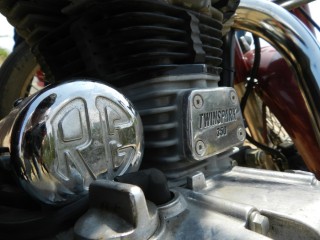
Royal Enfield Classic 350 : Oval toolboxRoyal Enfield Classic 350 : RE Badging

Before we wrap up the first half of this article, we should mention Mark Wells and Ian Wride from Xenophya Design, the firm that worked with the industrial designers from Royal Enfield and brought back the oval toolbox, the sprung seat, the unique tail lamp and the fantastic winged RE emblems stamped on the crankcase, back from the 1950s to the motorcycles that have defined the future of Royal Enfield, the Classic range, now including the Classic 500 & 350, the Classic Desert Storm, Chrome and the Battle Green. It would be an understatement to say the Royal Enfield revival was primarily brought about by the desirability factor of the Classic range. Thousands of lads ( and some lasses) across the country lost their soul to the Classic 500 that was unveiled in Teal Blue and oodles of chrome, and went on to buy one.

Does the Cramster Breezer go with the Royal Enfield Classic 350 ?

I was feeling extremely out of place astride either Royal Enfield in my Cramster Breezer mesh riding jacket with armour. Royal Enfield, when can we get one of those scuffed leather jackets? Thanking Bassee for graciously allowing me to kick start his article, allow me to ask you dear reader to click on the link to Page 2 below to continue reading the article for Bassee’s perspective on a day well spent and some more fantastic photographs!

Only yesterday we brought you reports of a rumour that Garware Motors is likely to launch the Hyosung Comet GT 250R in its fully faired and in its naked forms.  Now news has trickled in that it is not just this but also a cruiser of 250cc capacity to be called the GV250 will find its way to the Indian market sometime later this year.  But before this happens Garware is likely to launch the GV650 cruiser motorcycle that features a V twin liquid cooled engine with upside down front forks that are kicked out.  This will be in addition to the ST7 cruiser that the company currently sells in the Indian market.  There is no official confirmation of any of this.

The Business Standard newspaper has quoted Yamaha’s Roy Kurian as saying that a 250cc motorcycle for India is definitely on the cards from Yamaha.  He has even said that instead of importing the motorcycle either as a CBU or in CKD form, Yamaha will manufacture the whole motorcycle in India to keep its price competitive.  Yamaha seems to be encouraged by the response that the Honda CBR250R has garnered over the last one year in the country.  The CKD kit import, the Kawasaki Ninja 250R is priced in the stratosphere and therefore has few takers other than hard core Kawasaki fans.  The CBR250R on the other hand comes for just about half the price of the Ninja 250R (though it has one cylinder less and is down by about 8PS on power) and has been selling in decent numbers and this seems to have encouraged Yamaha to go for the 250cc category.  However, it could also be the launch of the sporty CBR150R by Honda, pitting it against the Yamaha R15 which may have given Yamaha something to think about.  Kurian however has not set any time frame for the launch of the 250cc motorcycle.  It seems this year will be the year of the scooter for Yamaha which is likely to launch a definitive version of the Ray scooter concept that it displayed at the Auto Expo 2012.

170hp Chevrolet Optra  and 96hp Fiat Punto

It was, quite literally, end of the road. The highway we were in had successfully gotten itself mired in deep legal wrangles, and halfway through, the contractors had erected a stone wall, which suited us perfectly. Not many can lay claim to have witnessed a standoff between Brahma Bull on steroids and Catwoman on acid. It was a mouthwatering prospect to have them inside one ring and an orgasmic proposition to shoot them in one frame. Pure, simple and white. Sex on wheels.

Fiat Punto, Chevrolet Optra Magnum

One was a proper redneck, been bent over years toiling away, developing a massive set of arms and calves. Not satisfied with what she is endowed with, she pumps up on anabolic steroids and works out like a devil possessed. But all that pill popping has it’s effects. She can move in only one direction, straight, but when she does, she goes like a rocket. And when I say rocket, I mean it. She seems destined to teach Newton’s first law of motion to kids and if handled without care, promises to break your neck in two. She is happiest on a straight line, and hates taking corners. Pure American muscle then, ooh yeah!

The fiery Italian and the Redneck

The other one was a fiery Italian with a slightly quirky sense of style and a pompous nose. She would do powerslides as easily as she would show off those lightning quick reflexes. She would hold her line, and inspire the driver to push her to the brink of her capabilities. And yet, when you shake your head in sheer disbelief at what she is capable of doing, she would pull out new tricks from her sleeve. She is happiest at being thrown around the corners, all of which she handles with élan and then when you step out and look at her, she would exhibit that strange mix of emotions, impassive and snooty. A thoroughbred Italian, then.

Making the dough

It all started when I met Vyshak, the owner of a popular auto service and spare parts station. Vyshak is one of us, an auto enthusiast to the core who is living out his dreams, that of staying and working with machines. A humble chap otherwise, his eyes gleam with immense pride when the conversation drifts around to his own automobiles. There is a 1986 Omni, a chocolate coloured beauty, whose engine has NEVER been opened and whose gearbox has only been overhauled once in the twenty four odd years and the four lakh odd kilometers that she has traversed. There is his 1988 RD 350, painted in a rather curious red body, black chassis combo, gleaming under the hot workshop lights. Then there is the restored Suzuki Shaolin, in a gleaming red colour. When you finish with all of this, there is his Yamaha R6, in the trademark white and blue, gawked at by clients and fawned upon by the loyal troop of technicians dotting his garage.

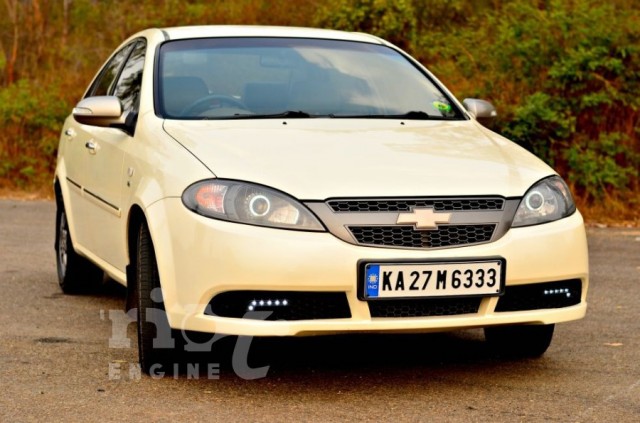
Turbocharged  170hp Chevrolet Optra Magnum 2.0 LT

And amongst all this, stands his 2006 Chevrolet Optra 2.0 LT. Pearl white, beautiful, as pristine as a lamb, not a single scratch on her. There is only one decal, stating in bold red, “TURBO”, on her rear which should give an idea to the beholder of what a beast she can transform into. No jingbangs, no screaming LED stickers, no loud music system. Simple, evocative and powerful.

The Optra, which first started off as the Korean carmaker GM Daewoo’s Lacetti in 2002 has undergone a multiple number of iterations and rebadging, including being sold as Buick Excelles in China and the Suzuki Forenza in other parts of the world to become the Chevrolet Optra as we know it today in India. The sedan had been designed by the legendary Italian design firm Pininfarina (yes, the same guys who gave you Maserati Quattroporte and Ferrari 360 Spider, not to mention countless other breathtaking beauties!).

Turbocharged  170hp Chevrolet Optra Magnum 2.0 LT  : Rear

This one, however, was special. The ECU had been remapped to boost the torque and the power, and if the dynos were to be believed, the car was spewing out, at 3,500 rpm, an astonishing one hundred and seventy horsepower (up roughly forty from stock trim) and a jaw-bending four hundred Nm of torque between 1600 ~ 2000 rpm (up roughly ninety five from stock trim). No clowning matter, this, then, eh?

Garnishing, meat or veggies?

We needed to contrast this Thing (I know not whether there is any other character other than the chap from Fantastic Four whose name and persona can be thrust upon this beast so befittingly) with Twinkle Toes. We needed some sanity to offset the madness, some curve gobbling power to offset the straight line brutality. So we turned (where else) to the Italians. A good friend, Soumya had a Grande Punto, a 1.3 MultiJet version, (incidentally, the first Grande Punto to be delivered in Bangalore), onto which, he had slapped on a Diesel Express box, and which now churned out a healthy ninety six horsepower and two hundred and thirty five Nm of torque.

Tuned 96 hp Fiat Punto 1.3L MJD

The Grande Punto is a third generation Fiat supermini to bear the name Punto. The Grande Punto was unveiled at the 2005 Frankfurt Motor Show. Designed by the legendary Giorgetto Giugiaro, (who, incidentally, also styled the Optra Station Wagon), the Grande Punto is based on the Fiat-GM Small platform, and in India, is available in a number of avatars, the 1.2 litre and the 1.4 litre petrol and the 1.3 litre MultiJet engine. The Punto has largely garnered very positive reviews about her superb handling and the frugal yet powerful 1.3 MultiJet engines. Because of her enormous weight, a full 1.2 tonnes, the Punto’s acceleration, especially the earlier ones, were on the sluggish side, but there were very few cars which could hold a candle to it in the ergonomics department.

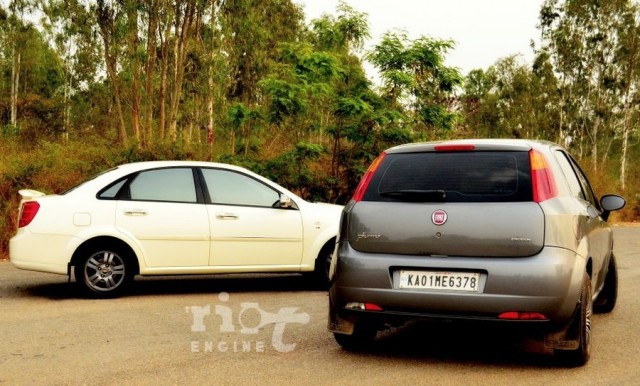
Pearl White Chevrolet Optra Magnum 2.0 LT and Medium Grey Fiat Punto 1.3 MJD

Would you like some fries with that?

The potential standoff had all the trappings of a redneck pasta, smooth and hot, gut wrenchingly powerful and surprisingly creamy. Which one will be the car of choice then? Read on to find out!

Turbocharged Optra vs Tuned Fiat Punto


The Optra, as expected, could pull away with such command on the straights, it would be a feat to outrun her even with a Mondeo. Yes, she is THAT fast. The turbo kicks in around the 1500 ~ 1600 mark, and between that and the 4500 rpm that it redlines at, the curve is sharp uphill, no breaks in between. I saw her doing a 210 flat out, with the curve showing the first signs of tapering off. When Vyshak floored the accelerator at a 140, in the fourth gear, my butt slid into the seat, the neck snapped back and I could feel my cheeks being pulled back. It was that oh-sh!t moment when the scenes become a blur, when cars doing upwards of 150 appear to be at standstill and when you can see nothing else other than the lane dividers and the road melting into the horizon. A proper take off machine, this was.

Nose to Nose : Chevy Optra and Fiat Punto

The Punto was surprisingly quick on the straights as well. It was nowhere near the gut wrenching, butt-sliding-off feeling that the Optra was capable of, but you could feel the perceptible difference that the tuning box had made. There was a healthy and smooth torque spread available at all gears, the lowdown torque was available by the truckloads, and the point and shoot capabilities of the car had improved by a considerable deal. She would comfortably cruise at a 160 all day long. Given the bulk of the car, it was no surprise that the 100 came up real fast and the power went flat out after the 165 mark. On the straights, there was no comparison. The Optra was a much faster car.

Up close with a 170hp Chevrolet OptraCaution : 170 hp Chevrolet Optra Magnum  2.0 LT TCDi

When it came to the curves, however, it was a completely different story. The Optra in a stock trim had a very soft suspension, owing to this being used primarily as a city sedan, and as such, is completely useless for high speed corner-carving. For a car capable of doing upwards of 220 kmph, the Optra was easily unsettled when a sharp curve was thrown at her above the 130 mark. It is a scary feeling, yes? The opposite suspensions bottomed out, the rear spinning like Abhimanyu himself had some role to play in it, you can literally feel the control on the car diminishing, and you know that if you brake and for some reason the ABS does not kick in, it could result in a spectacular powerslide which would result in you flying over that hedge and in all probability, landing butterside down. So, you do the sane thing and understeer, all the while gently touching the brakes to allow the ABS to do their work and steer you clear off the greenery and keep the rubber side down. Whew, that was a close one!

No time like dusk : Chevy Optra and Fiat Punto

The Punto, on the other hand, was born to take the curves on. She took them on with such ferocity and a sure, planted feel that much before I could get out of one, I found that she was in line and ready for the next one, much ahead of my preparation. Not once, not even at a 150, did I find the Punto not towing the line that I had asked her to. She threw me around inside the car, sure, but she had a surefootedness about her which was extremely comforting. Even when I was taking curves while accelerating, I could feel the tyres groaning in protest, but never going off the intended route. Most of all, the ability to transmit all of what the car was going through when taking a corner back to the driver through the responsive steering had a very reassuring effect. We did not actually time the cars, or race them across the block, but had we done that, I am sure that the Punto would have actually held it’s own against the bigger, powerful Optra, because of the sheer delight that it takes in gobbling up the curved tarmac.

Our verdict on the speeds? On a highway, there is no question. The Optra would be the pick anyday, especially with long straight roads and when you have those minimal curves, you can always slow down and take them at a pace the car is comfortable with. Our recommendation is to change the shockers pronto, and get a stiffer set slapped on. It would make a world of difference to the handling.

Inside a city, especially overburdened cities like Bangalore, the Optra does not stand a chance, however. The Punto, because of it’s size and quick and agile engine and a shorter footprint, would be able to get in between the gaps far quicker and overtaking other cars and motorcycles would be an absolute breeze. The Optra, with it’s bulk and footprint, would be a labour to drive inside the city, and I have a hunch you would end up drumming your fingers out of frustration more often than not.

Farfalle, anyone?

Now to some of us, a pasta is a pasta is a pasta. But then there are some who love the excitement which fine dining provides. Making a dough into a butterfly shaped pasta involves some amount of work and making it look even more beautiful when cooked involves a certain amount of dedication. So then, who will the fine diner please?

Redneck Pasta : 170hp Chevrolet Optra

The Optra interiors are plush and feel premium, both to touch and visually. The seats have good lumbar support and a decent thigh support. The pedals were easy to reach, and visibility over the long bonnet was very good. The large windows and well placed mirrors provide excellent overall visibility. The backseat looks pretty cramped, but it is only an illusion, helped on generally by the recessed honeycomb-like structure of the seats. The knees had a good amount of travel before touching the back of the front seats and there was a general feel of wellness when you sat inside because of the premium feel.

Giorgetto Giugiaro designed Fiat Punto

The Punto, on the other hand, has a relatively demure interior. Which is kind of surprising, given her Italian heritage and the flair which Italians have for style. The dashboard is bright and reading the information off it was quite easy. What was once fun and premium gadgets, Bluetooth and steering mounted volume controls and message reading capabilities have become commonplace now. When you are paying almost eight lakhs for the top-end trim, you may as well expect a hot hatch with premium feel. This is where we think the Punto in the present crop of hatches, loses a bit of the sheen. We recommend getting some quality interior work, (nice handcrafted seat-covers, perhaps some leather for the ceilings and a dash of hazelnut wood for the dashboard, or would that be asking too much) done for the Punto right out of the showroom to match the go that the car is capable of.

Ready in 2?

You must be joking, Sir. Modifying a car such as these take perseverance, patience, dedication, knowledge and deep pockets. Maintenance of these cars take even more time. The wear and tear is much faster and checkups need to be more and with lesser space in between each.

So, do we recommend either? YES! We recommend both, in fact. Both cars are found relatively cheap in the second hand market, and both have brilliant mills which are capable of being tinkered around with to a reasonable extent. You need to be careful to find a decent quality piece, tune it well and then run her around like nobody’s watching.

Just remember to give us some credit when you execute said idea. After all, where would the plant be if the seeds did not germinate?

Photography: Soumya Paul, Ayan Ray

YES! We recommend both!

That there is a new S class in the offing is now pretty well known.  Mercedes-fans.de has posted pictures of the new S class with minimal camouflage undergoing testing.  It is believed that it will debut soon in international markets while it may take a while to make the RHD version of the car which will then come to India.  Apart from the S Class, Mercedes is also testing a newer version of its Viano van.  No surprise then that later in the year, Force Motors will be bringing in the previous generation Viano as an MPV.  The new Viano looks bigger than the present generation and its front is still very heavily disguised.

New Mercedes S Class

Pictures courtesy: www.mercedes-fans.de

New Mercedes Viano Van

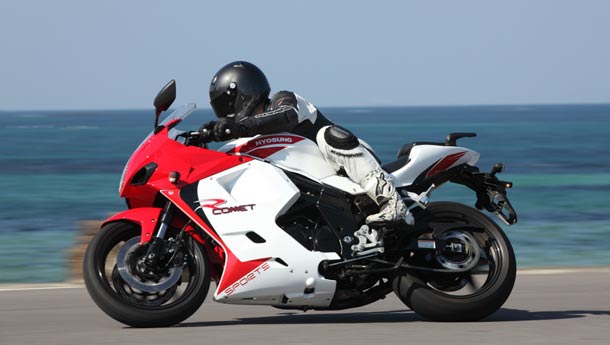
Hyosung Comet 250

The rumour mills are turning.  Sometime ago Garware Motors had announced the intention of bringing the Hyosung Comet GT 250 to India sometime during this year.  Some motoring websites have started saying that this time around the Comet will come fully dressed up (read that as fully faired) as against the last time when it came as a naked bike when Kinetic brought it into India.  Since these are still rumours we would like to ask Garware to bring in both the versions the clothed and the naked that is, just as it did with the bigger GT650.


Tata Communications has bagged the prestigious contract of being the official connectivity provider to Formula1.  In a multi year deal, Tata Communications will provide connectivity to all the twenty venues that will be hosting the Formula1 races.  It also means that it will now be the job of Tata Communications to host the official F1 website and provide content on it.  In the past Tata has been involved with Ferrari as Tata Consultancy Services and with Jordan F1 team as Tata Racing when it sponsored Narain Karthikeyan.  It also supported Narain Karthikeyan’s efforts in some races at the HRT team last year and will be doing so again this year.

After having crashed out of the first race of World Superbikes while leading, Carlos Checa, the defending champion made sure that no such mistakes were repeated again.  Riding the Althea Ducati which is a semi-works team of Ducati, Checa finished ahead of first race winner Max Biaggi who took the second place on his Aprilia while Tom Sykes of Britain riding the official Kawasaki racing bike took some consolation by clinching the third and final place on the podium.  Marco Melandri who finished second in the first race, went to claim a disappointing sixth place behind BMW Motorrad teammate Leon Haslam.  It was even more disappointing for Sylvain Guintoli who finished third in the first race, since he could not complete the second race which for him only lasted nine laps.  While Tom Sykes has gone well, his teammate finished the first race in a distant 15th position and did not finish the second race at all.

Kenan Sofuoglu made an impressive return to World Supersport racing aboard the DeltaFin Lorenzini Kawasaki by claiming victory in the race in Australia.  Second place also went to a Kawasaki rider but not from the same team.  Veteran racer Fabien Foret on board the Intermoto Step Kawasaki clinched the second place while Australian Broc Parkes riding a Ten Kate Honda claimed the final position on the podium.  This has been a good start for Kawasaki to the season with pole position also going to its rider.

Tom Sykes who started on pole position in the first race of 2012 WSBK led for one lap before he was overhauled by defending Champion Carlos Checa who after three laps in the front slid out of the race. Max Biaggi on his Aprilia who was just behind the Ducati riding Checa, utilized this opportunity to claim the win in the first of the two races.  Marco Melandri made an impressive debut for BMW by taking the second position in the race and Effenbert Liberty Ducati’s Sylvain Guintoli took the final position on the podium.  Tom Sykes and his Kawasaki had to be content with a disappointing fourth place in the race after having started so well. Hiroshi Aoyama making his WSBK debut finished in eighth position on board a Honda.