'01 Yamaha R1, Yamaha V-Max in the background

Do you really need mad bikes, awesome friends, smooth roads and good weather for the ride of a lifetime? Well, stop deluding yourself, yes you do.

Yamaha V-Max, '04 Kawasaki ZX-12R and the '01 Yamaha R1

Max, our good friend who wrote a story on the V-Max for Riot Engine, offered an invitation that this correspondent could not say no to. Keys thrust into my hands, kit and lid on, it suddenly dawns upon me that I’ll be spending the rest of the day trying to keep up with this mad Max (man?) on a very mad motorcycle, an ’04 Kawasaki ZX-12R. Ah not to worry, I realize I’m astride a motorcycle that seems very capable. A 2001 Yamaha R1, the last of the species before they plonked in the fuel injectors.

'04 Kawasaki ZX-12R and the '01 Yamaha R1 : Hello Sunday!'04 Kawasaki ZX-12R and the '01 Yamaha R1 : Hello Sunday!

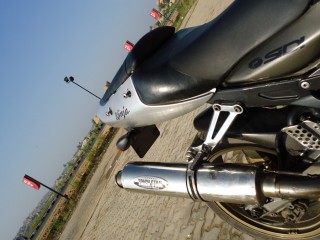
Fire up the engine and I realize this is no ordinary R1. A Micron exhaust grabs the exhaust gases from the manifold and shoves them out with all the fury of the Hulk and the drama of the action hero who plays the angry cop at your local cinema, with no catalytic convertor to play party pooper. The ZX-12R, ups the proceedings an ante with it’s as-expensive-as-your-cousin’s-R15 Trickstar exhaust. As I start off my Sunday morning with aural stimulation from the ZX-12R at the front and the R1 under me, I came up with a metaphor involving the likes of Jessica Albas and Megan Foxes. No, I’m not going to explain it here.

'04 Kawasaki Ninja ZX-12R'04 Kawasaki Ninja ZX-12R : Trickstar Exhaust'04 Kawasaki Ninja ZX-12R '01 Yamaha R1 : Micron Exhaust

Remember the last time you signed up for the gym and never got around to keeping at it for more than a week because you didn’t have a good trainer? Well that wasn’t about to happen to me. Not with Max around. The basics being the same, regardless of what bike you’re on, Max details the finer points of being on a superbike, pats my back, assures me I’m doing great and before I come to terms with reality we start rolling. What? Is that all the hype there is to this moment I’ve been waiting for half a lifetime? As I learn later, the best parts are yet to come.

04 Kawasaki ZX-12R, the '01 Yamaha R1 and Yamaha V-Max'01 Yamaha R1

We catch up with Paul, who has been waiting for us a while now. Now Paul is the gentleman you’ll see in the pictures with the severe crew cut and biceps that could crush your windpipe if you had the balls to badmouth his V-Max. I mean it, he has Russian blood. Now that you are sufficiently intimidated by Paul and his motorcycle, let me assure you he is a really nice person. Very friendly, can go on and on about his bike, and others’ for that matter. The V-Max though, well you know the saying ‘Fear is quintessential for survival’ or something along those lines. Be afraid.
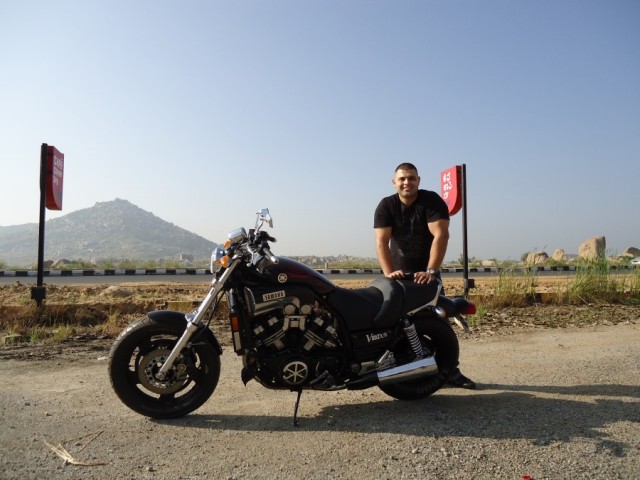
Paul on his Yamaha V-Max

I know Bangalore. I can manage to find my way around. Not so much when I’m on a superbike, I realize. Keeping my eyes peeled open for hazards, I try to orient myself, but for a couple of landmarks I recognize, I’ve no clue where we are heading and resort to sticking to the ZX-12R’s tail. If you’ve ridden your way around on a bike, you would have already expressed your disapproval by shaking your head. Trying to follow somebody, without any idea of the general direction you should be heading in, you are bound to fixate on the target, a problem that haunts not just amateurs but seasoned riders too. I’d suggest trying to keep your lead in your peripheral vision, and keep your eyes open for hazards immediately ahead, and ahead of the lead too.

What a Riot!

Paul, Me, Mahima, Arjun and Wasif. What a Riot! Oh and the random stranger behind us clicking pictures.

We are then joined by the pretty lady you’ll see in the pictures, who can, take my word for it, spar with the best of you nerdy auto enthusiasts and win a war of words. Then there’s the fact that she has an appetite for drivers who think women are bad at the wheel, or that women ‘should’ drive slow. She could probably out brake you before a sweeping turn, take you on the outside, and then mash the throttle with the other end of her pointy high heels on the way out of the corner, leaving you in the dust.

We were also joined by a couple of young guns who added flavour with a P200, a Yezdi Roadking and a Yamaha RXZ! Before you ask, yes, the fantastic Yezdi made it to the end, of course why wouldn’t it? The RXZ was bloody fast and happily screaming along at 120 odd kph.
Yamaha V-Max : DetailsYamaha V-Max : DetailsYamaha V-Max : DetailsYamaha V-Max : Details

I remember Baiyappanahalli Railway station, having seen it once on the Volvo from Bangalore to Chennai. After that it was pretty much sparse traffic. It was at that moment the ZX-12R, feared drag racing machine (and much more); the V-Max whose throttle response is a rude shove in your back; the extensively modded R1, which even when half naked catapults you effortlessly to this-is-scary-fast speeds, got going. Got going, they did. Max helpfully points out that we pretty much stick to the road and head straight.

Bangalore to Kolar

Not having to worry about getting lost and riding around in circles on a superbike, I decide to open the taps and try to understand the sinful temptations of speeds I’ve never seen on the meters of bikes I’ve owned till date. For the time since I’ve been on the R1, I steal a glance at the speedo, and I’m shocked to find triple digit numbers, when the drama, or lack of it thereof had lulled me into believing I was doing maybe a 70 or and 80kph. No, don’t get me wrong. I was not going ga-ga over how fast the R1 got there, although I did, but I do not want to admit it here, in this story – I think I just did though – well, digressing, red light, stop, back to earth. I was stumped about the fact that I was riding at those speeds, and I had yet to actually subject the throttle to calculated violence.

Yamaha V-Max : THE Engine

This image was inserted here just to give you a scare. Like you see in cheap horror flicks. Seriously though, this motorcycle is mostly engine, some chrome and then tyres. The V-Max. Perfect.

'01 Yamaha R1'04 Kawasaki Ninja ZX-12R

Rather than twist the throttle of the Yamaha R1 to the stop and kill myself, I feed in the power gradually as I’d been taught to do by the Max. Beyond what I’m guessing is the 6-8k rpm mark, the engine transforms and starts swearing at you. As is the norm with free flow exhausts ( in my experience, correct me if I’m wrong) you will hear rabid explosions when you downshift or back off the throttle momentarily. That, is fantastic. What’s even better is when you have the throttle pinned to the stop, and the engine leaves no fuel wasted, and the exhaust has  no unburnt hydrocarbons to set on fire and create those big bang explosions. You know this masterpiece of engineering is working like your typical English butler with utmost efficiency and making sure you get your petrol’s worth. Almost like it gives a damn about the rising fuel prices.

'01 Yamaha R1

Continue Reading >

MotoGP is not the only series that Suzuki is withdrawing from.  It is out of the World Superbike series as well.  It will however participate in Motocross and Supercross events officially.  In the World Superbike series, Crescent Suzuki will run a two bike team as a privateer entry.  Crescent Suzuki was the official representative of Suzuki in the British Superbike series till this year.  Crescent Suzuki is run by Paul Denning who was also the manager of the MotoGP team.  Francis Batta who ran the official Suzuki effort in World Superbikes under the Alstare Suzuki team till this year is a bitter man.  Like in MotoGP, Suzuki limited its presence in World Superbikes also to one motorcycle that was ridden by Michel Fabrizio.  Batta has accused Suzuki of playing unfair with him and after 15 years of association ditched him without the slightest hesitation.  The Belgian has said that this is unbecoming of the conduct of a Japanese corporation.  Batta has also revealed that Suzuki is taking back the motorcycles that were with him in the Alstare garage and also all the small parts that they have contributed.  Batta is bitter about Suzuki giving the privateer contract to Crescent rather than himself.  Batta has claimed that the Suzuki motorcycle has not been developed since 2008 and that the existing motorcycles are pretty much worn out.  He said that Denning and Crescent will find it difficult to salvage anything from those motorcycles.  Crescent is partnering with Yoshimura for getting some performance upgrades.  Batta has said that he is retiring from his passion since he has no where else to turn, especially after the promise of running MV Augusta in the World Superbike or Supersport fizzling out.

What was already a foregone conclusion right at the beginning of the year, when Suzuki cut its involvement in MotoGP to one motorcycle, has turned out to be true.  Suzuki has finally announced that it is leaving MotoGP but it claims that its absence is temporary and that it will return to the series in the year 2014.  Suzuki has cited the ongoing downturn in the economies of the developed countries and the unusual strengthening of the yen as reasons for its withdrawal from the MotoGP series.  Paul Denning who managed the Suzuki MotoGP effort will run a Suzuki motorcycle team in the World Superbike Series under the name of Crescent Suzuki.  Denning’s outfit Crescent ran a team in British Superbikes and will now move to World Superbikes.

When the test mules of the now revealed version 2.0 of the R15 were undergoing tests, there were wild rumours that said that this was the new 250cc Yamaha.  However, despite those rumours having turned out to be untrue, new speculation about Yamaha launching a 250cc motorcycle in the Indian market has yet again come to the fore.  Some websites seem to believe that Yamaha will launch the Fazer 250 to take on the Kawasaki Ninja 250R, the Honda CBR250R and the soon to launched Hyosung GT 250.    While we are at it we wonder what happened to Suzuki’s plans of launching the GW250.  Will the Auto Expo provide the answers?  We certainly hope so.

The Yamaha Fazer 250


The Suzuki GW 250

For quite some time now the internet has been carrying pictures of test mules of the Honda’s new CR-V undergoing testing.  The bulbous rear has been the distinguishing feature of the new CR-V which has been officially shown to the public at the Los Angeles International Auto Show.  The new CR-V is less radical than the one it will replace which means that it is more mainstream and less weird and also that wee bit more butch.  Now that the wraps are off, we may expect Honda to display the new CR-V at the Auto Expo, since the CR-V is imported as a CBU.  Even though it sports a petrol engine only, the CR-V is very much liked by Indians and has a strong brand reputation in our country.  From all appearances it seems that the new CR-V will further build on the reputation of the brand in India.


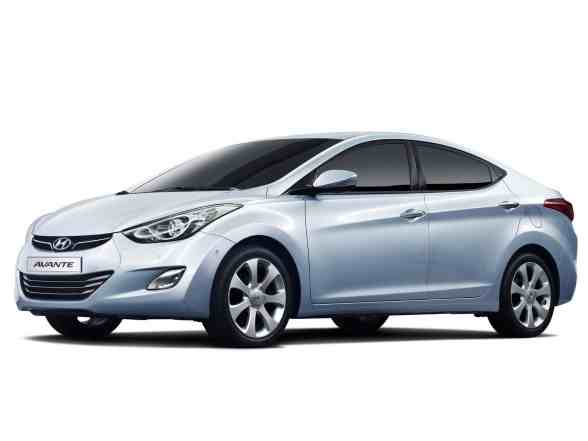
Ford is not the only manufacturer to promise a slew of new launches.  Hyundai said the same thing too.  Only their number is even more than the new Fords.  Rohan Salian has taken photographs of the new fluidic Avante/Elantra test mules undergoing tests with red plates and camouflage.  Surprisingly the number plates are Delhi registered.  Hyundai is also testing the new fluidic Sonata or the i45 and test mules have been spotted near Chennai which is the home of Hyundai.  The success of the new fluidic theme as seen in the sales of the Verna and upgraded i10 perhaps has emboldened Hyundai to go back to those segments of the market that it had earlier abandoned.  The Elantra is a good example of that.

Pictures courtesy: Rohan Salian, Team-BHP, Indianautosblog.com

General Motors is testing the MPV to take on the Maruti Eeco which is doing quite well in the market after it went from being Versa with a high roof and high price to an Eeco with a low roof and and a lower and realistic price.  General Motors wants a share of that market which also sees the Maruti Omni selling in pretty big numbers.  The Wuling MPV will come to India thanks to the tie up that GM has with SAIC, the leading Chinese automobile manufacturer.  It is also interesting that GM India’s long time President and Managing Director Karl Slym is going to China for his next assignment and Lowell Paddock who has been with the Chinese GM operations will be coming to India.  This could mean that GM is seriously trying to work out synergies between the Indian and the Chinese markets, which are considered to the engines of growth for the automobile sector in the years to come.  It is also reflective of GM’s strategy of becoming a mass market player, a reversal of the original strategy of the mid 1990s when it wanted to be at the higher echelons of the automobile ladder and therefore had launched the Opel brand which performed quite dismally.

Autocar India.com believes that the Ford EcoSport a mini SUV built on the very capable Ford Fiesta (new) platform will come to India next year and that it would be displayed at the Auto Expo in January at New Delhi.  This version will not be the one that is on sale in Brazil presently, but a completely new one, which after being shown at the Auto Expo in India will debut in Brazil first by replacing the existing EcoSport there.  It is after that that the EcoSport will come to India.  This bit of news can be true since Ford did say that it was going to launch a slew of new vehicles in India.  It makes sense that new avenues be explored since Mahindra, Ford’s erstwhile partner will be launching at truncated Xylo as a mini SUV.  The Premier Rio which is already in the market as a compact SUV is not a threat since Premier does not have proper dealers and distribution channels for the product.  Ford could therefore get into a new segment and make hay while the competition prepares vehicles to take on the EcoSport.

Picture Courtesy: Autocar India.com

It is quite likely that many of you who see the headline of this article will see this as a manifestation of paranoia. But you can rest assured that this is no paranoia; on the contrary it is a reality check.  Just a couple of days ago, Carmelo Ezpeleta, the man behind Dorna the holders of the rights of MotoGP, has said that MotoGP has to change with immediate effect.  He said otherwise come 2013 there will be only two Honda motorcycles on the MotoGP grid and none else.  Anybody who has been following MotoGP will know that in the last few years grid sizes have been simply ridiculous. Ever since MotoGP shifted to the four stroke format all motorcycles have only been factory motorcycles and the concept of the privateer team has simply vanished.  Satellite squads such as Tech3 for Yamaha and Gresini for Honda have to pay anywhere between 4 to 6 million Euros to lease bikes, which they have to return to the factories at the end of the year.  The Ducati is leased for a little less around 3 million Euros.  Adding to the woes of MotoGP are the withdrawal of Kawasaki from 2009 and now Suzuki.  Honda has decided to cut back its involvement from six to four motorcycles and same is the case with Ducati.  The reason behind these developments?  Rising costs in a global economy that is seeing crisis after crisis from the one that started due to the sub prime housing loans in the USA in 2008 to the ongoing Eurozone problems.  Last month, Shuhei Nakamoto the HRC boss said that they would not supply the latest transmission that was used on Casey Stoner’s and Daniel Pedrosa’s bikes because “it cost more money than a luxury villa”(Nakamoto’s words).

Formula1 has also been seeing turbulence.  In the year 2008, Honda withdrew from the sport citing recession and the inability to meet rising costs.  The following year saw the withdrawal of BMW and Toyota, the latter without winning a single race in nearly 10 years of involvement in Formula1.  BMW had a few sporadic wins when they were engine partners of the respected Williams F1 team.  Renault too has become an engine supplier even though there is a team that is called Renault but is owned not by Renault but by Genii Capital.  From next year on the team’s chassis will be called Lotus and Renault will just be an engine partner to it officially.  The first decade of the new Millennium saw the disappearance of many well known names from the Formula1 grid.  Arrows, Super Aguri, Jordan, Midland, Spyker, BAR apart from Honda, BMW and Toyota.  The reason for the turmoil- rising costs and dwindling budgets. Both F1 and MotoGP have been hit hard by the ban on tobacco sponsorship that was the main source of income.  When technical sponsors such as HP went away from the sport it was due to the down turn in the global economy.

So what is it that pushes up costs in GP racing?  Both F1 and MotoGP fall into the category of prototype racing, where cutting edge technology is used and experimented with before finding application (supposedly) on road going vehicles.  The intense competition in both forms of GP racing has meant that millions and millions of dollars or Euros are spent in finding an extra tenth of a second per lap.  And most times that extra tenth of a second is tantamount to nothing because in a competitive field all players are finding that extra tenth and therefore there is a maintenance of status quo.  However, the bane of F1 racing has been aerodynamics.  In the last few decades, aerodynamics has pushed costs up into the stratosphere and wrecked the spectacle of racing.  Things have reached such a pathetic stage that artificial aids such as the Drag Reduction System (DRS) have to used to make overtaking possible.  Otherwise, races are pretty much processions with positions changing not due to overtaking on the track but due to botched up pit stops.  So how did F1 arrive here?

Anyone who is familiar with the history of Formula1 will know that till the 1960s F1 was all about cars that relied on ground effect grip or mechanical grip.  Cars were front engined, had open wheels and no aerodynamics whatsoever.  What differentiated a winning car from the others was the engine and the driving skills of the racing driver.  In the initial decades of Formula1, it was the Germans who dominated the sport.  The Germans renowned for their precision and perfection were creating engines and cars that simply blew the competition away.  Mercedes Benz was the forefront of this with other makes such as the Auto Union cars and BRMs being the second line.  Ferrari were always there, they won many races, but never dominated.  Other manufacturers such as Alfa Romeo and Maserati were there for sometime but again not consistent winners.  The British Jaguar cars did run some impressive races, but ultimately were not a patch on the all conquering German Mercedes Benz cars.  But Mercedes Benz withdrew after the horrific crash at the Nurburgring that killed even spectators.

Things began to change towards the end of the 1960s.  A few months ago, the Chairman of Ferrari, Luca Montezemolo when asked about the underperforming Ferrari cars said that F1 was going in the wrong direction, one of too much reliance on aerodynamics which was a British thing.  That is hardly the answer to the question that was posed to him, for after all, Ferrari also have been using aerodynamics and won so many world titles in the Michael Schumacher era due to good aerodynamics.  But let us not bother with that; what is interesting for us is the bit about aerodynamics being a British thing.  Today everyone knows that with the exception of Ferrari, all other teams have their chassis building bases in England.  Even Mercedes Benz has its wind tunnels and chassis building factory in Brackley, Williams in Grove, McLaren in Woking, Force India at Silverstone; the list goes on.  The question then is how did Britain become the spiritual home of Formula1 constructors?

Let us now try to understand that term – constructors.  Originally F1 had car manufacturers who brought their cars to the racing tracks.  But from the 1960s on one sees the birth of the concept of the constructor.  The Brits realized that they were no match for the might of engine horse power of the Germans and to an extent the Italians.  And cleverly and very cleverly actually, they changed the way F1 cars went racing.  Here F1 shares a story with the rock bands of the 1960s (also called the swinging sixties and the Flower Power years) such as the Pink Floyd, Soft Machine, Yes, King Crimson, Jethro Tull and Emerson, Lake and Palmer.  All the bands that have been mentioned were avant garde and used not just sound but also light to enhance the experience of their music.  There were literally loads of art school graduates who had nothing to do and their talents could be used to create visuals that went with the music.  Till date bands such as Pink Floyd use those abstract art visuals to go with their genre of music which was once termed experimental but now called progressive.

What happened in Formula1 too was similar, except that instead of using Art school graduates, it used the skills of aerodynamicists who lost their jobs due to the British aircraft manufacturing industry going bust.  The services of the unemployed aerodynamicists were available for pittance.  Enter a person called Bernie Ecclestone.  He created the concept of the constructor.  An astute person who was till then languishing selling used cars and motorcycles, he saw a window of opportunity in Formula1.  He bought the Brabham team and along with him another person who goes by the name of Max Mosley entered the scene with the March F1 team.  Frank Williams of Williams F1 ran his office from a telephone booth.  Bernie Ecclestone brought all these people under the umbrella of an organization which he called FOCA or Formula1 Constructors Association.

The British constructors beat the might of the Germans and the Italians by focussing upon the chassis rather than on the engine, which was turning out to be expensive.  The aerodynamicists were used to create cars that could go faster even without having an engine that was very powerful.  The word handling now comes to mind.  The Brits created aerodynamic cars, which handled well, meaning they went faster around turns and bends even though the engines were not powerful.  F1 became the playground of disgruntled and disappointed aircraft airframe engineers who inverted the principles of lift to create aerodynamic down force and grip.  Formula1 changed its ways to become like aircraft manufacturing.

With virtually all teams adopting the aerodynamic solution, the race began in earnest to out do each other.  Wind tunnels that run 24/7 for 365 days in the year became the norm.  With aerodynamics not being a big differentiator, the search to make cars lighter also began.  Metals like aluminium and magnesium were used till carbon fibre became the de rigeur.  Engines became smaller and used exotic materials like titanium and beryllium and each new step pushed the cars costs into the stratosphere.  Racing suffered, since aerodynamic grip essentially means that being the air behind another meant loss of grip.  Overtaking became non existent.  What started off as an exercise in finding low cost solutions for high speed racing became a high cost solution for processional racing.  People like Frank Williams were firm believers in technology and pushed for the greater involvement of technology in the sport.  Active suspension, launch control, traction control, fast shifting gearboxes  and other such innovations made the Williams car of 1993 a technological tour de force.

Mercifully by this time Max Mosley became the President of the FIA.  He saw that too much technology was affecting the spectacle of racing and therefore ended up banning things such as active suspension and other driver aids.  The world is firmly divided in its opinion of Max Mosley.  Many see him as high handed and dictatorial and some see him as the person who has saved F1 a few times. Both of the perceptions are true.  F1 needed someone like him to keep the sport from going overboard.  If there are 12 teams and 24 cars on the Formula1 grid today, the credit should go to Mosley.  Measures like cutting down the number of cylinders of the engine to 8 and freezing engine development and bringing Cosworth back into racing as an engine supplier did help in maintaining the size of the grid.  Bernie Ecclestone became the Supremo of F1 and kept it alive by taking it to new destinations to protect it from economic depressions that come and go in Europe.  However, Formula1 is still horribly expensive and is very much in unstable equilibrium.  Too much technology and diminishing driver importance are still a bane of the sport.  Valentino Rossi who tested for Ferrari a few times decided that he would not race in F1 since “it was not a driver but an engineer sport” (Rossi’s words).  Launch control for example meant that the driver just sat in the car till the first turn when he pressed the brakes and then took over the throttle and the full control of the car.  Till then the car was under the control of the engineers who would launch it remotely from behind their computers when the red lights went out.  This is akin to fighter pilots taking off from aircraft carriers where engineers on the ship launch the plane with the help of a catapult and the pilot gets control of a plane only when it is airborne.  Rossi wanted things to be in his control, so turned his back on F1.

While on the face of it a rider is in control of the bike that he is riding and does not get constant inputs from his race engineer like in F1 where the engineer goes through the telemetry to rectify problems on the car and also keeps talking to the driver on radio, the spectacle of racing has diminished in the four stroke era.  The shift to four strokes was to make GP racing closer to road going motorcycles.  But the shift has proved to be anything but that.  This has been pronounced in the case of the 800cc era which has mercifully come to an end this year.  Traction control, dual clutch gearboxes for fast shifting, pneumatic valves, titanium engine casings have pushed the costs through the roof of the Hotel Burj in Dubai.  Where would all these innovations be used?  Who can afford a motorcycle that has a gearbox that costs more than a luxury villa?  So Carmelo Ezpeleta is right when he sees a crisis, one that threatens to dismantle MotoGP right now.  It is good that CRT rules and teams have been introduced.  But it may make more sense to merge World Superbikes where motorcycles such as the Aprilia RSV4F have been created like prototypes and then homologated, with MotoGP.  Both series are seeing a fall in numbers on the starting grids. Formula1 is safe for now, but continued reliance on aerodynamics will mean that costs will not fall.  Marussia Virgin’s getting rid of Nick Wirth means a return to traditional wind tunnels.  Perhaps in the interests of better racing, it may make sense to return to ground effect or mechanical grip cars.  But then we don’t change till such time that our existence is threatened.

P.S: For more on CRT motorcycles and Nick Wirth and CFD please find below the links to articles where we have discussed the merits of CFD over wind tunnels and the CRT motorcycles over the factory prototypes.  They are in two separate articles.

Subaru enthusiasts around the world are going bonkers over Subaru’s BRZ, a rear wheel drive sports coupe developed with Toyota. Toyota has presented concepts of its version as the FT-86 whereas Subaru has till date shown to the public only the skeleton, at the Frankfurt Motor Show. This car has grabbed everybody’s attention to the extent that stories have been posted on a number of auto websites about just the logo – BRZ. The car has also birthed a new word – Toyabaru, for all things that include this Toyota Subaru collaboration.

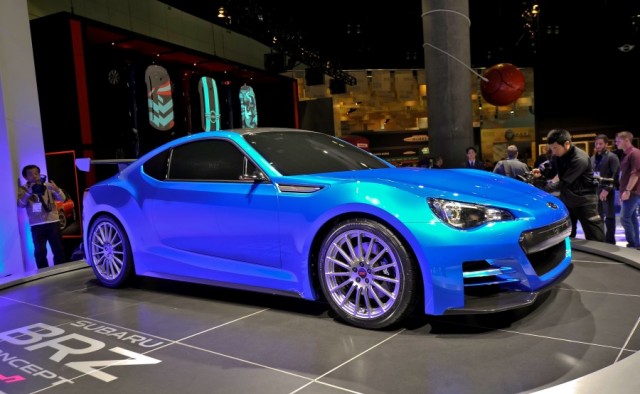
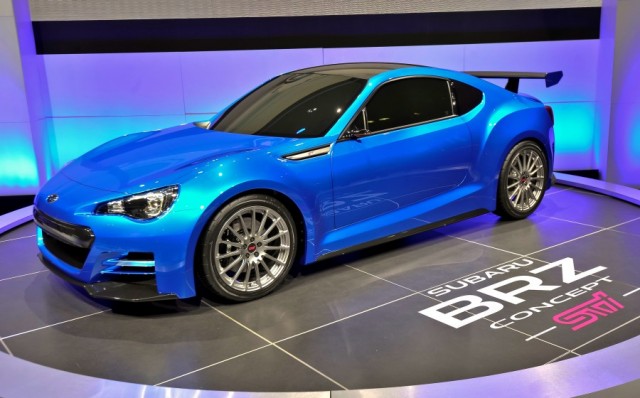
Subaru, for the first time gave us a glimpse of what the production BRZ would look like with this Subaru BRZ Concept – STI unveiled at the LA Auto Show. STI is Subaru’s performance brand.

Subaru BRZ Concept -STI

Sleek, low and tightly-coiled bodywork blends with STI performance touches for a sporting profile. A hexagonal lower front grille, hawk eye headlights and fin-shaped fog lamps are instantly recognizable as Subaru. The exterior color “WR Blue Pearl II” is a new generation of the iconic WR blue paint scheme that has adorned both racing and production STI’s.

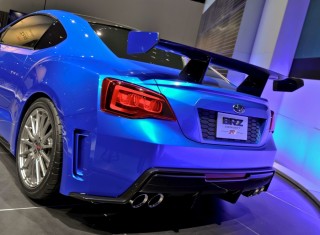
Other design features of note include the aero-tuned lower front spoiler, unique rear fascia and a rear wing for added down-force. A carbon-fiber roof has been added to lower the center of gravity (CoG), which Subaru says will be one of the lowest of any car made.

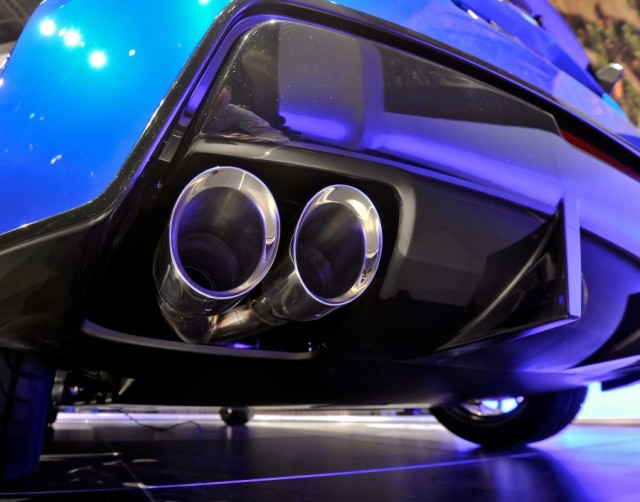
Subaru BRZ Concept -STI : Quad tailpipes

The rear design features bold rear fender flares and large rear diffuser giving way to polished stainless-steel quad-tailpipes. Vented rear bumper corners contribute to improved aerodynamics performance.

Subaru also mentions the concept car will be powered by the new Subaru “FA” BOXER™ engine exclusively designed for the RWD BRZ sports car. This is in contradiction with information we’ve seen elsewhere that the Toyota FT-86 will be powered by the same engine that powers the BRZ. We’ll just have to wait for more information. The overall structure of this 2.0-liter naturally-aspirated four-cylinder boxer engine has been designed with a square bore and stroke of 86 X 86 mm. The inherent qualities of the Subaru BOXER engine were mated to a direct injection fuel system, which further improves combustion efficiency, running smoothness up to high rpm and high environmental standards, says Subaru.

Subaru BRZ Concept – STISubaru BRZ Concept – STI : Rear

The lightened BRZ Concept – STI – features an STI-tuned suspension, Brembo™ brakes and unique 18-inch wheels and tires. The Subaru-engineered and built chassis boasts a rigid frame housing a two-plus-two interior and front engine/rear-wheel drive layout. With the engine mounted low and rearward in the engine compartment near-perfect balance is achieved which Subaru says will lead to razor sharp handling. The low engine placement also accommodates the low blade like hood design. Short front and rear overhangs reduce the yaw moment of inertia, which is the tendency of the car to rotate about the vertical axis through the center of gravity.

Subaru BRZ Concept – STI

Compared with other Subaru models, which already feature a low center of gravity and optimal weight distribution, the engine in the Subaru BRZ – STI – sits even lower. It is 4.7 inches lower and is positioned 9.4 inches closer to the center of the chassis compared to a Subaru Impreza.

The first RWD Subaru, the production Subaru BRZ will begin production in spring 2012 as the only mass-produced front-engine, BOXER engine rear-wheel drive sports car in the world.

Subaru BRZ Concept – STI