After showing an interest in India as early as June 2011, Triumph Motorcycles UK last month announced its decision on venturing out in the lucrative Indian imported bike scene where some analysts have mentioned that by 2020, big bikes (half liter and over) are going to capture almost 10% of the market. With the sheer volume of 2 wheelers being sold in India and the increasing spending power, it is only natural that once great Indian dream is also seen as a big fish waiting to be explored by the hallowed marques.

Triumph Motorcycles in India : Ashish Joshi, MD, Triumph Motorcycles India

Then what better way to announce its arrival than to make an impact through the biggest Auto Expo in the country! To start off, Triumph Motorcycles has its own website, the Triumph Motorcycles India website. Triumph Motorcycles has showcased the entire 2012 range during the 11th Auto Expo, held at Pragati Maiden, New Delhi from 7th to 11th January, 2012 and on display were all the models ranging from the friendly Street Triple to the monster Rocket III and almost everything in between. Almost because there were some missing models, but we will get to that later. The models displayed in Hall 8 were the Street Triple, its bigger brother Speed Triple, the Daytona, the Bonneville, the Rocket III, the Thunderbird and the Tiger.
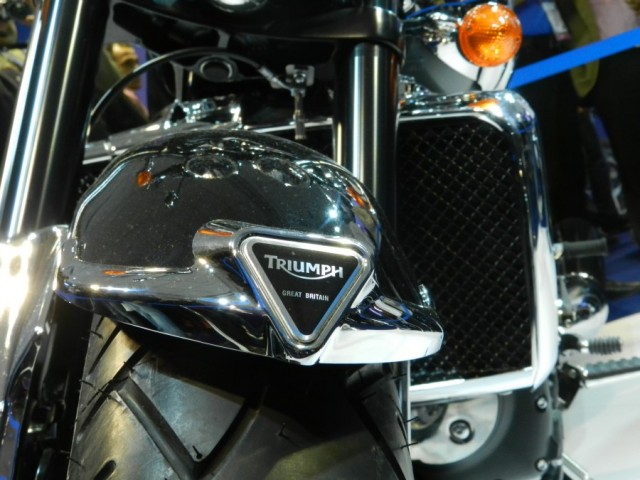
Triumph Motorcycles : Great Britain

Triumph Motorcycles, just like other British Automobile ‘Brands’ (read Aston martin, Mini Cooper), is not just an automobile company, rather it is a ‘Brand’, a life style and although it has never looked at voluminous sales, the Triumph market grew by 15% last year. The enviable factor of the world’s oldest motorcycling brand is that it has its products for any kind of bike lover, so whether you love a cruiser or a sports bike or a street bike, there is a Triumph for you.

Triumph Motorcycles Speed Triple : SideTriumph Motorcycles Street Triple : Front

Moving on to the bikes, in general, except for the cruisers and classics and that too not including the Rocket III, all Triumph bikes have the same in-line 3 cylinder layout while the classics and cruisers, rather retro cruisers have air cooled parallel twins. On the display at the expo, you are greeted by the stunning Street Triple, the 675cc in line triple and the younger brother of the naked rockstar and iconic Speed Triple. For the uninitiated, the way to remember the names of the 675cc and the 1050cc, that is which is the Street and which is the Speed, just remember the 675 is meant for the ‘Street’ while the 1050 is for… you guessed it… ‘Speed’.

Triumph Motorcycles Street Triple : SideTriumph Motorcycles Street Triple : Rear

Both brothers, although almost identical to look at with the twin naked headlights and all, are different with the Speed being more muscular, thanks to the small fairing below the tank and also the single swingarm on the Speed. You will never ever see a more ‘naked’ bike than these two siblings, full of attitude and the kind of ‘you-wanna-try-me-dude’ attitude. Of course the Speed Triple has also been featured and by now has become a cult Hollywood scene when Tom Cruise rode it in Mission Impossible II. That bike with bullet holes and all, seems to have fetched a large sum of money when it went under the hammer some years ago.

Triumph Motorcycles Street Triple : Front

Okay, moving on, you meet the Daytona 675, considered by many critics as the best middle weight super sports bike if not the best super sports bike in the world. It has little to debate against it as it known for its stunningly agililty stunning agility and take a look at the specs, the bore x stroke reads at 74 x 52.3 mm. With that kind of a ratio, maximum power figures of 125ps at a howling 12600rpm and maximum torque figures of very impressive 72Nm @ 11700rpm to move the nimble 185 kg beast, any biker would fall heads over heels for it however it looks like.

Triumph Motorcycles Daytona 675

But wait, I bet you would never see a better looking sports bike in the world if you just leave aside some Italian ones and it can easily meet stride to stride to them too! You cannot really point as to what looks so good on it, but as a total package, this guy is one stunner which will stand out even among naked metal bikes. It is that good looking!

Triumph Motorcycles Daytona 675 : RearTriumph Motorcycles Daytona 675 : Top


Triumph Motorcycles Rocket III Roadster : Rear

Then there is the humongous Rocket III in the middle of the display stand, actually standing there all alone and believe me, it does need a separate stand of its own. It has so much road presence that it would put a Hummer to shame and that too without even trying. Not that you can anyway choose to ignore the sheer 2.5 meters of its longitude, the monstrous 2.2 liter engine is something difficult to take your eyes off.

Triumph Motorcycles Rocket III Roadster : Front

The bike on display here has matt finish black and even on just standing there, you could see people’s jaw dropping on the floor just due to sheer size of it and you can very well imagine what would have happened if it spoke it its deep baritone through the 3×1 exhaust. And after all, you if want the biggest baddest production motorcycle on earth, this is where you come to.

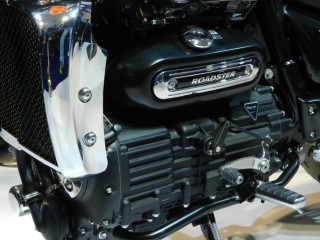
Triumph Motorcycles Rocket III Roadster : BadgeTriumph Motorcycles Rocket III Roadster : Roadster Badge

You would then feast your eyes on 2 classics, the Thunderbird and the legendary Bonneville, yes the same Bonne which Steve McQueen rode into glory, the same Bonne which Marlon Brando rode into glory and so many numerous actors ‘had their moment’ riding a Bonne. Nothing comes close to a Bonne if you want to have an original classic motorcycle.

Triumph Motorcycles Bonneville : Front

If you scrutinize the looks, it is made just the way a motorcycle is meant to be, with 2 parallel air cooled engines, two side panels hoisting the air filters, spoked wheels, 2 twin pods, a round lamp, a flat seat… just perfect! It is as plain as the Mohave Desert and the Bonne Salts, and just as mesmerizing as these hallowed grounds are. This bike has absolutely no frills and no ‘added’ design components, but if you have red blood running in your veins, I dare you not to fall in love with this bike.

Triumph Motorcycles BonnevilleTriumph Motorcycles Bonneville : Side

Triumph Motorcycles Thunderbird Storm at the 11th Auto Expo

On the other hand, the Thunderbird is your typical cruiser, rather typical power cruiser and I say that because at 1700cc, if you do not use the word ‘power’, I don’t know when you will. The TB here was the ‘Storm’ version in matt black finish, looking as intimidating as a big liquid cooled parallel engine monster with stretched out features, bulbous tank and 2 round headlamps can be. It is just a shadow smaller to the Rocket III at 2.3 meters long but pound for pound, it can stand with the Rocket III. This is a very big bike with is extremely handsome and at over 330kg, this bike can intimidate any newbie and so is meant for weekend gateways with your friends…not now, but when you complete 40 circles or close around the sun. Don’t get fooled by its size, with almost 100 horses beneath the engine and with more than 150 Nm of torque, it can go around circles around many lighter sports bikes.
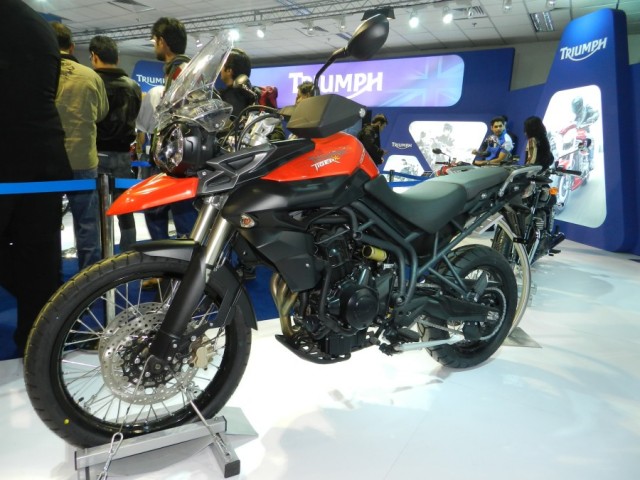
Triumph Motorcycles Tiger 800XC

Ending the lineup was the Tiger 800, probably the lesser known bike from the Triumph stable, but undoubtedly the bike that you can get the most fun on. It weighs just 200kg for a bike that tall and big and has almost a 100 horses aiding it. The Tiger 800, of course in the same line as with the BMW F650, Honda Transalp, Suzuki V-Storm, and most KTM bikes, that is all-purpose-all-terrain and add to that any-mood-any-biker. Really, whatever kind of style a biker prefers and no matter whatever mood s/he is in, get astride the Tiger and s/he will be only one thing – A Happy Biker.

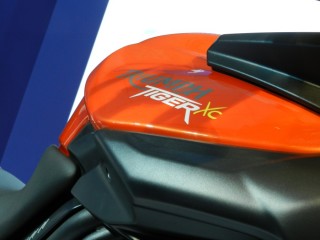
Triumph Motorcycles Tiger 800XC : RearTriumph Motorcycles Tiger 800XC : Logo

The Tiger is practical, easy to control and ride due to the tall stance, will never be out of place anywhere including in front of the cafes where you would probably find lots of British boys with tight leather pants or lots of American dudes with handlebar moustaches. It looks rugged and is actually rugged than most other bikes, it is pretty tall and (looks) big for an 800cc engine and whether you like its looks or not whether you feel at ease or not riding with say a bunch of Rocket owners, the one definitive thing you will have is the smile on your face.
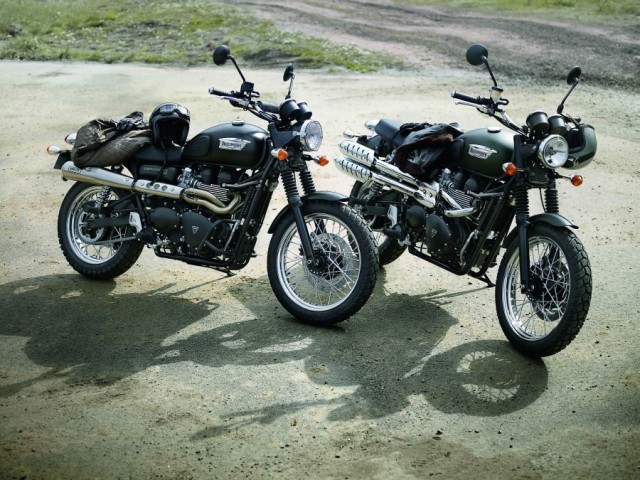
Triumph Motorcycles Scrambler

So there you have it. The entire line of Triumph Motorcycles, or is it? Now, wait a minute, where is MY favorite Triumph? Where is the Thruxton, the one true mass produced Café Racer? And what about the legendary Scrambler which got a whole new attitude in 2011? And now come to think about it, I didn’t really see the 1000 cc tourer, The Sprint and neither the other cruiser, America. But fret not, what Triumph Motorcycles India is saying that the entire range will be available and this is their first public outing in India, so with time and when they get dealers, you can just search the Triumph Motorcycle UK website and ask for your model and they will get it for you.

Triumph Motorcycles Thruxton 01Triumph Motorcycles Thruxton 02

As of now, the entire range with be bought in as CBU while plans are there, and definite plans and that too pretty soon (read mid 2012) when 4 of the models will be bought as CKD units and (now salivate!) prices are expected to start from 5.5 lacs INR starting from the Street Triple. Yes for less than 6 lacs, you can get a Triumph in your garage… for keeps! No more the Great Indian Dream, eh! And if you are young and too proud to ask money from your father, well for starters, Triumph has got the entire clothing and accessory range which will be available in all the showrooms. So a good start is half done, right. And that goes for Triumph Motorcycles too, they have promised to deliver and there is no reason why the twinkle in your eye that was there when you first saw Steve McQueen astride a Triumph in ‘the Great Escape’ finally needs to rest.

Triumph Motorcycles Bonneville at the 11th Auto Expo

DIESEL also has his own blog, Visual Gratification, which you’ve probably heard of already.

Back in the 1980s when the Hero group, makers of the then ubiquitous Hero cycles and the Pacer and Panther mopeds tied up with Honda to make motorcycles, they announced the collaboration as the dawn of a “Brave New Horizon”.  The collaboration was path breaking in many ways.  The world’s no.1 in motorcycles had collaborated with the world no.1 in cycles.  For the first time ever in India a 100cc four stroke engine featured in a motorcycle and put to rest all suspicions about its efficacy that came into being because of a notoriously unreliable 350cc four stroke engine in a motorcycle called the Enfield Bullet.  It also ushered in the previously unheard of mileage figure – 80 kmpl.  It kick started a new version of the Indian obsession with fuel consumption.  Nothing less than 80 kmpl was acceptable anymore.  The Hero Honda CD100 had arrived and how.  It had styling that could be credited to someone who failed all the examinations in a design school.  It sounded like a Deepavali ladi, had no visible frame and the engine looked like it could fall off any moment.  But it was anything but all that.  Despite its ungainly appearance, it was bullet proof (pun not intended) and more importantly kept its promise about mileage.

Hero Honda CD 100

The 131st Hero Honda CD100 in the country, still running, with probably three to four services only done.

When talking about Maruti people claim that it is the car that put India on wheels.  I disagree.  It was the Hero Honda CD100, a product of a collaboration made in heaven, that really put India on wheels and offered to the common man an affordable alternative to the erratic public transport system that existed then and continues to exist even today.  The fill it, shut it, forget it ad campaign became the new mantra that was chanted by every aspiring motorcycle rider and he went straight to a Hero Honda dealer and got himself one.  The appearance of fragility of this light motorcycle actually belied a ruggedness and hardiness.  Hero left all the technology and design work to Honda and concentrated on marketing and since their forte was always the rural areas (their expertise in rural marketing was a result of their selling of cycles and the Panther and Pacer mopeds which were sold mainly in the rural hinterland) they took care to see that they had as much rural penetration as they did in urban markets.
Then the launch of the Splendor and later the Passion created history, albeit slowly and gradually.  The Splendor and the Passion were the two motorcycles that ensured that sales of the Hero Honda company went through the roof and left competition far, far behind.  There was only one instance for a couple of months when Bajaj overtook Hero Honda in motorcycle sales.  That galvanized Hero Honda into pushing their products forward and the competition backward in the market place.  The city slickers and boy racers mocked Hero Honda.  They said Hero Honda was sticker company and that their sense of aesthetic was absolutely favouring the garish and unsightly.  That did not seem to deter Hero Honda buyers, both urban and rural, from buying Hero Honda motorcycles.  Today the company which is renamed Hero MotoCorp but sells the same brand of motorcycles sells the double the number of motorcycles per month than does its competitor Bajaj.  Some years ago Hero Honda did the unthinkable and the unforeseeable, which is it overhauled Honda as the largest motorcycle manufacturing company in the world. So why did this JV come to an end?  We will come to that, but a small detour first.  This detour will help us understand the Honda story and mindset better.

At the same time when Honda entered into a joint venture with the Hero group, it also entered into another joint venture with Kinetic Engineering to make scooters which were two strokes and featured a gear less CVT transmission.  It introduced to India the first proper scooter that had the twist and go feature.  While the macho men (especially up North) thought this scooter was for sissies, the Kinetic Honda (as the scooter was called) achieved another first.  It put more and more of India’s young women on wheels.  A centrally mounted engine made for ease of balance, the CVT meant ease of driving and like all Honda’s it also had ease of maintenance.  These qualities slowly started drawing even men especially when they were reaching middle age towards the Kinetic Honda.  Honda’s JV with Kinetic was slightly different from the one with Hero.  Honda’s equity in the JV was higher than in Hero Honda.  Towards the end of the last century, Honda held nearly 64% of the Kinetic Motor Company.  It had more people on the Board of Governors.  It looked as if Honda was all set to take over Kinetic.  Just then Honda did the unthinkable.  It sold its share to Kinetic and exited the joint venture.

Two years later in the new millennium it set up its own subsidiary in India, the Honda Motorcycles and Scooters India.  It had an agreement with Hero Honda.  As per this agreement Honda would not make motorcycles for at least three years.  But it would make scooters.  In doing so Honda yet again did a first.  It introduced the Activa, a four stroke 100cc scooter with CVT and all metal body, the rear of which could be lifted for easy access to the engine.  More importantly it did not look feminine.  India’s burgeoning economy increased the size of the middle class considerably and this meant that more and more people were buying their own private vehicles, leading to increased traffic and as a consequence chaotic roads.  This in combination with no driver etiquette and lack of adherence to road rules (because most drivers and riders procured licences without passing any driving test or any test for that matter) meant that traffic snarls and crawls were becoming increasingly the order of the day.  At this time a four stroke scooter with a CVT and decent mileage made more and more sense.  And so at a time when everyone thought that the scooter segment had died and when the traditional scooters were no longer being bought, Honda single handedly revived the scooter market.

Bajaj tried to hit back with the Sapphire and later the Wave and failed miserably.  A little earlier TVS tried launching a 150cc geared four stroke scooter called the Spectra, an excellent product that just did not take off.  The Activa began the process of putting Indians, especially men, back on scooters.  Even women who contributed in great measure to the success of the TVS Scooty range started moving to the Activa.  The result; long waiting lists.  Honda also launched a plastic bodied and sporty scooter featuring the same mechanicals as the Activa and called it the Dio.  It did not do as well as the Activa but sold in decent numbers.  Honda then decided to attack the cow belt with the Eterno, a 150cc geared, all metal bodied scooter featuring a four stroke engine.  The scooter did well in the markets it was meant for but Honda pulled the plug on this scooter in a few years.  It saw no point in making scooters for a small number of people when there were long queues building up for the Activa.  Honda also introduced a 110cc scooter which looked and felt more upmarket than the Activa and called the Aviator.  It continues to do well in the market.  A couple of years ago, the Activa was upgraded to the same 110cc engine and demand continues to be unabated with waiting periods stretching up to 9 months.

Honda Unicorn Black With Red Graphics

Once the three year period where Honda promised it would not make motorcycles was over, it launched its first motorcycle, the 150cc Unicorn.  The motorcycle had all the Honda traits. A silky smooth engine, bags of torque, decent power, a monoshock suspension and rugged looks all contributed to its bullet proof reliability.  This introduction of a 150cc motorcycle was for two reasons.  One to not compete with Hero Honda’s products and two to take on Bajaj that was going great guns with the Pulsar 150.  Later on Honda introduced the 125cc Shine.  Strangely a year and a half ago, Honda added the CB prefix to all its motorcycles.  The Unicorn was CB Unicorn, the Shine became CB Shine and it also introduced an upmarket 110cc CB Twister and then a variant of the Unicorn called the CB Unicorn Dazzler.  People were mystified by this until the beginning of 2011, when the pieces of the jig saw puzzle started falling into place.  Honda was exiting the Hero Honda JV.  It wanted to keep the CB and CD as its trade marks and it was in preparation for this that the CBising was happening.

This means that Honda, after March 2014, will prevent its erstwhile JV partner Hero from using CBZ and CD Dawn and CD Deluxe branding on their motorcycles.  At the Auto Expo Hero MotoCorp showed all its offerings sans the Honda name and the CBZ Xtreme was shown as just Xtreme and the CD Dawn was shown as HF Dawn.  And talking of the Auto Expo, let us see what Honda did at the Auto Expo 2012.  After all this series of articles is about what can be inferred from the activities of companies at the Expo.  Honda’s display of cars was almost pathetic.  No new cars, no new launches, no concepts, nothing.  This was due to the fact that Honda suffered badly once because of the tsunami in Japan and the second time because of the floods in Thailand that destroyed its plants and reduced their vehicles to junk.  But when it came to two wheelers Honda at the Expo was aggressive and unstoppable.

Honda Dio for 2012 at the 11th Auto Expo

Hitler would have been proud of Honda’s efforts at the Expo.  Honda simply blitzkrieged competition with a dazzling array of products from the humble scooter to its flagship and updated for 1012 CBR1000RR Fireblade.  Last year Honda issued a serious warning to Bajaj and Hero.  It launched the CBR250R at a price that was half that of the Ninja250R’s and it also provided it with ABS.  The CBR250R had runaway bookings which were triple that of the number of Ninjas that Bajaj moved in one year.  Out of the blue at the Expo, Honda showed the CBR150R and announced its intention to launch this motorcycle by March.  This is a warning to both Bajaj and its arch rival the world over Yamaha.  If the pricing of the CBR250R is anything to go by, the 150cc version will be well under the R15 that Yamaha makes.  But this is not all.  Honda has shown that it is now ready to go for the jugular of the Indian two wheeler market.  It showed its first major update for the Dio scooter which now looks even more gorgeous and sporty.  It has also unveiled its first mass market commuter the Dream Yuga and displayed it alongside the first motorcycle that Honda every built, the Dream.

Honda Dream Yuga with the iconic 'Dream D'

A lot of people have pooh poohed the name Dream Yuga.  Behind what seems to a ridiculous name lies the ambition and intent of the company.  Yuga can have many translations in English.  But Honda seems to be using it to convey the idea of an era.  The original Dream motorcycle started the Honda domination in the world.  Honda is probably looking at the Dream Yuga starting the Era of Honda in India – read that as Honda becoming number one in India.  It has no other option.  After ending its JV with Hero and with Hero deciding to build its own brand without waiting for the end of March, 2014 it is obvious that the world’s largest motorcycle manufacturer in the world, for the first time in many decades will not be Honda nor will it be one with the Honda name appended to it.  So Honda’s becoming number one in India is not just about India.  Hero had overtaken its old partner in sales to become number one in the world.  Honda has to become number one in India in order to reclaim its status of world number one in motorcycle sales.  Honda knows that it has capacity constraints and therefore is in the process of setting up new manufacturing plants in different locations in India so that not only will there be more capacity but also distribution from factories and logistics will become simpler and more efficient.  What Honda wants, Honda gets, so ladies and gentlemen whether you like it or not, get ready for the Honda Era or the Honda Yuga.  How nice for Honda that it coincides with the new century and the new millennium.

 IndiaFirst Life Insurance, a joint venture of two of India’s largest public sector banks – Bank of Baroda and Andhra Bank along with UK’s leading risk, wealth and investment company Legal & General, today launched ‘Autolife’ – a simple process of getting life insurance cover instantly at an affordable cost.

 The announcement was made by Dr. P. Nandagopal, Managing Director & CEO, IndiaFirst Life Insurance.  Mr. M D Mallya, Chairman & Managing Director of Bank of Baroda, Mr. B A Prabhakar, Chairman & Managing Director of Andhra Bank and Mr. Gareth Hoskin, CEO – International Business, Legal & General were also present at the launch.

“Today we are witnessing two quite distinct yet obvious trends – one in the automobile industry and another in life insurance.  Both these industries while may seem to be non-related to each other, offer an interesting possibility for synergy. In the recent times, the automobile industry has seen an upsurge not only in terms of numbers but also the kind of involvement and time spent by end users in deciding the right fit.  The second trend noticed is the growing preference of investors for returns over protection and instant gratification/ solutions instead of long waits.  This we see as a gap as well as a great opportunity for us as we increase our focus on group business,” said Dr. Nandagopal.

Under Autolife, automobile buyers can now not only ensure their family’s happiness about also secure them from future uncertainties of life.  They can now avail the benefits of a life insurance cover at the same time and place as buying their new car and that too at an affordable cost. 

Autolife is a win-win proposition for all – the customer, dealer and the insurer. 

It is convenient as it does not require any documentation/ medicals or waiting period and assures speedy and empathetic settlement of claims within 48 hours*.

The company has entered into its first tie-up with Varun Motors of Andhra Pradesh to offer life insurance cover to its customers. IndiaFirst Life is planning similar tie-ups at a nationwide level across various untapped segments in the near future so that customers across the country can avail the benefit of a life insurance cover through a simple process.

Varun Motors today caters to over 15000 customers every month.  They are spread across Andhra Pradesh through 100 centers.

 Under its first tie-up for Autolife, customers of Varun Motors (two wheeler/ four wheeler) besides availing vehicle insurance; will also be able to avail a life insurance cover of upto Rs. 20 lakh at an affordable cost. Customers have the flexibility of selecting from any of the four options – blue, silver, gold or platinum, which will provide life insurance cover of upto Rs. 3 lakh, Rs. 5 lakh,  Rs. 10 lakh and Rs. 20 lakh respectively.    

“We believe such an initiative is important for a country like India which is still under insured and will help achieve greater insurance penetration”, further added Dr. Nandagopal.

IndiaFirst Life Insurance is constantly working towards making insurance buying a simple and informed process for its customers.  Some of the unique initiatives launched by the company include – LifeStore, a ‘Do-It-Yourself’ online store for understanding and buying insurance, and Ask Apply Get (AAG) – an innovative and customer friendly process to buy life insurance in the most hassle free manner over the counter. IndiaFirst was also the first to introduce product audio-visuals as a compulsory part of their sales process to bring transparency in product information dissemination.

Notes:

1.     Autolife is a process of issuance of life insurance cover for automobile purchasers. 

2.     Life insurance is being offered to Varun Motor customers through the group insurance route, with Varun Motors as the Master Policyholder and IndiaFirst Life Insurance as the Insurer.

3.     Society for Indian Automobile Manufactures (SIAM) recently said that the passenger cars sales will grow by 11-13 per cent in FY13 while the two-wheeler segment is pegged to rise by 11-14 per cent. There were 58 new launches including 12 green and nine concept vehicles in the recent Auto Expo 2012.  The auto industry has been growing at a compound annual growth rate of 15% over the past 5 years.

About IndiaFirst Life Insurance

Headquartered in Mumbai, IndiaFirst, which is capitalized at Rs. 605 crore, is the country’s youngest life insurance company promoted by two of India’s largest public sector banks – Bank of Baroda and Andhra Bank along with UK’s leading risk, wealth and investment company Legal & General. Bank of Baroda holds a 44 per cent stake in IndiaFirst, while Andhra Bank and Legal & General hold a 30 per cent and 26 per cent stake respectively.

Suzuki GSR 750 ABS

Suzuki was the first Japanese Automobile Company to enter India.  Their entry into India was due to the cherished dream of a man who wanted to make affordable motor cars and because his mother had the tenacity to ensure that the dream would become reality even after his death.  Yes, I am talking about the infamous Sanjay Gandhi and his mother the Prime Minister of India Mrs. Indira Gandhi.  Sanjay Gandhi started work on an indigenous car, prototypes were made and one fatal morning he died in an air crash while performing aerobatics.  He was the one who called his company Maruti.  Post this Mrs. Gandhi as the Prime Minister scouted around for international partners who would provide the small car for Indian masses.  Renault and Suzuki were the main contenders and Suzuki won.  So Maruti Udyog Limited was born and it made the 800cc Suzuki Fronte in India as the Maruti 800 for two years before the Alto from Japan replaced the Fronte as the Maruti 800.  You know the rest of that history, so let us not invoke it anymore.

Even in the two wheeler space Suzuki became the first Japanese company to come into India with India Motorcycles Limited a company that was later to become Ind-Suzuki Motorcycles, then TVS-Suzuki Motorcycles and now TVS Motor Company.  The first Suzuki two wheeler that came into India was the Suzuki AX100.  It sold reasonably well and made a name for itself.  TVS decided to become an engineering company in its own right and therefore used the AX100 as a base for other motorcycles that it later created.  Strangely TVS while doing most of the development work on the engine of the AX100 and developing newer models like the Samurai, Shogun and the Shaolin, dropped its own name and all the three models that have been mentioned above did not bear the TVS name anywhere.  They were sold as Suzukis.  Later a 150cc model called the Fiero with Suzuki technology was launched and it was sold as a Suzuki.

Anybody who has been following the history of Suzuki will know that Suzuki is a notoriously difficult partner to have.  Its latest is that it has fought with Volkswagen and dragged the latter to the International Court of Arbitration.  Even with Maruti it engaged in a prolonged combat with huge advertisements running into two broadsheets informing the people of India that Suzuki made no money through Maruti and threatened to take Maruti to the International Court of Arbitration.  Maruti could fight back only because it was a Govt company.  In the two wheeler arena, the relationship between Suzuki and TVS soured and since TVS was the majority partner in the joint venture it exercised its option of buying out Suzuki’s stake in TVS-Suzuki.  The head of TVS, Venu Srinivasan, successfully negotiated with Suzuki and prevented them from setting up a company on their own or with another Indian company for a certain period of time.  His reasoning was that by selling TVS-Suzuki products as Suzukis, TVS had built the Suzuki brand and that he needed time to build the TVS brand separately so that Suzuki would not gain an upper hand unfairly in the market. Fair enough.

Suzuki did come back into the Indian market but when it did so, it was almost reluctantly and very lethargically.  Though the Indian company is called Suzuki Motorcycles India Pvt Limited, it has Indian partners in it and very little is known of the Indian partners’ business track record. Suzuki in the new millennium decided to be a four stroke company, something that was forced on all motorcycle manufacturers.  Suzuki decided to not get into the 100cc space because of the overwhelming domination of Hero Honda in that space. Suzuki quietly tried to do what Rajiv Bajaj loudly announced he was doing.  That was to try to obliterate the 100cc motorcycle in the minds of the Indian consumer and make the 125cc the new 100cc.  The logic of this game plan is simple to understand.  Hero Honda is not known for its 125cc products despite having the Super Splendor and the Glamour range in that space.  Suzuki tried to create a 125cc motorcycle that would be like a 100cc.

Suzuki Hayabusa at the 11th Auto Expo 2012 : Side

It launched the Heat (which was squarely aimed at the rural population) and the Zeus (which had some styling cues and was aimed at the urban commuter).  Both motorcycles shared the same 125cc mill which put out power that 100cc motorcycles were putting out but also importantly they had lot of torque.  However, they received a lot of bad press from the automotive journalists and failed to take off.  Suzuki then took advantage of the liberalization of import norms and brought its famous Hayabusa (which is the Japanese name given to a falcon) and the massive cruiser the Intruder. The reputation of the Hayabusa is legendary and Suzuki was trying to showcase its technological prowess by putting this motorcycle up for sale. In continuation of this approach Suzuki later on brought in the GSX1000R sports motorcycle also.  The Hayabusa was displayed briefly in some dealer showrooms and people went there to look and gasp in awe but ultimately came back without buying one because of its stratospheric price. The showing off of these motorcycles did little for the sales of the Heat and Zeus, both of which disappeared from the mind space of the Indian commuter.  It looked like Suzuki was following in the foot steps of Yamaha and was committing hara kiri.

At that time Suzuki showed what Yamaha did not, the smartness to aim for the hugely overbooked Activa space.  The Honda Activa commanded waiting lists and Suzuki saw an opportunity to get into the scooter space and garner some market share.  So it launched the 125cc, metal bodied, unisex scooter called the Access.  Perhaps it was to tell the scooter buyer that while they did not get the Activa they had Access to a better scooter.  The Access indeed was a better scooter.  It had telescopic suspension up front, a super smooth and torquey motor, styling that offended none and it produced the desired effect.  Many who could not wait for the Activa decided to plumb in for the Access.

It also produced another undesirable effect.  Suzuki entered the market rather cautiously and therefore did not build up manufacturing capacity.  When frustrated buyers moved in droves from Activa to Access, the Access also went the Activa way and a waiting period of 3 months is still in place if one wants an Access.  In the meanwhile Suzuki had launched a 150cc motorcycle called the GS150R but the sales of this bike too have been tepid thanks to Suzuki wanting to concentrate on its cash cow the Access.  Suzuki also expanded its big bike portfolio to bring in the Bandit and the Intruder 800 more recently to take on the lower capacity Harley Davidsons and the Hyosung ST7 and in a round about way even the Ninja650R from Kawasaki.

However what matters most is the fact that Suzuki is showing signs that it is not being sluggish anymore.  It withdrew the Heat and the Zeus from the 125cc space and replaced them with a slightly more stylish bike called the Slingshot.  Not only is the name strange but its ads were stranger.  But let us let that be.  Suzuki’s intentions at the Auto Expo are the ones that are worthy of mention.  First of all the Suzuki area buzzed with energy and optimism.  All its international models worthy of mention were there. The V Strom could come to India.  But more importantly they showed two new mass market products, a scooter and a motorcycle.

Suzuki V-Strom 650 ABS

The scooter is another and more stylish iteration of the Access, is aimed at the younger population, has a lot more style and is called the Swish.  The motorcycle is the more important one.  It is Suzuki’s first 110cc, that means that it is entering, the 100cc commuter space and is called the Hayate.  Strange choice of name.  When Kawasaki withdrew from MotoGP and when it was forced back on to the MotoGP grid by invoking legal clauses, Kawasaki raced as Hayate (apparently Japanese for Hurricane in Kawasaki speak and Gentle wind in Suzuki speak, so you decide which is correct).  Suzuki is showing signs of coming back to life and shrugging of its lethargy.  Now to build that all important capacity and we could be seeing more relevant for the mass market Suzukis on the roads.

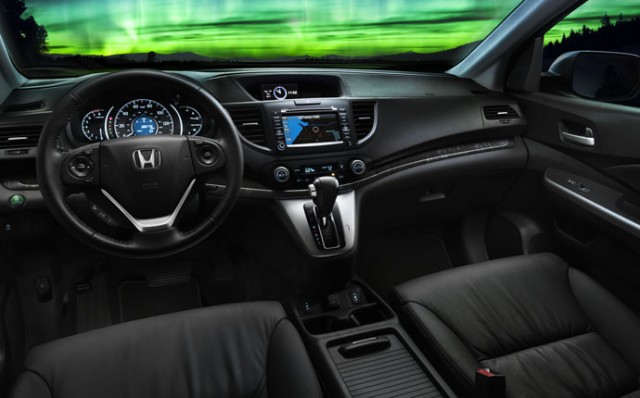
Oh yes, there do seem to be different versions of the CR-V. While the US version is already on sale, the European CR-V Prototype will be unveiled on March 6th 2012 at the Geneva Motor Show.

While the 11th Auto Expo held in January 2012 in New Delhi was supposed to shed some light, Honda put up a sombre display due to the devastating floods in Thailand.

The European version is expected to get a slightly different treatment for the bumper. The US version also does not have the diesel engine option, which we hope Honda will bring to India.

2012 CR-V for the US Market

2012 Honda CR-V for the US Market 01

2012 Honda CR-V for the US Market 02

2012 Honda CR-V for the US Market 03

2012 Honda CR-V Interior

Honda Earth Dreams Technology

“Earth Dreams Technology” is Honda’s next generation set of technological advancements aimed at enhancing both driving performance and fuel efficiency using advanced environmental technologies. It is a series of measures in which efficiency of internal combustion components including engine, and transmission, as well as electric-powered motor technology, is further improved.

As part of this grand scheme, Honda announced in November 2011 the newly developed 2.4L gasoline engine based on DOHC and VTEC technologies, that employs VTC and direct injection technology and implements extensive friction reduction measures. Standalone engine features 5% improvements in fuel efficiency and output as well as a 10% improvement in maximum torque compared to the previous engine.

Honda Earth Dreams Technology 2.4 Litre Gasoline Engine

At the 2012 Geneva Motor Show Honda will have on display the new 1.6 liter diesel engine that will be the first engine from this series for Europe. The lightest engine in its class, delivering sub 100g/km CO2 levels, the engine will offer a class-leading balance of fuel economy and performance.

Why is the the 1.6 liter diesel engine special?

By optimizing engine rigidity and combustion pressure, an aluminum open deck for the cylinder block could be used. This in addition to the weight reduction in the reciprocating sliding section makes the 1.6L the lightest in its class.

The 1.6L is a replacement to the outgoing 2.2L engine doing duty in the Honda Civic in Europe. By downsizing the cubic capacity, mechanical friction in each section is reduced to the extent that a friction level equivalent to present gasoline engine models was achieved.

Optimized thermal management system thanks to improvements in the cooling system reduces CO2 output by over 15%.

Employment of a compact, high-efficiency turbocharger, for increased output to keep the enthusiast driver happy.

This new smaller diesel engine will first be mounted on Honda’s new Civic and will be launched in late 2012. This 1596 cc engine is rated at a peak power of 88kW (120PS) at 4000rpm and torque of 300 Nm at 2000rpm.

The possibilities of a diesel powered Civic in India is mind boggling. Of course, the Civic in the UK is not the Civic sold in India, but rather a hot hatch that competes with the likes of the Ford Focus. The chances of seeing this diesel mill in the new CR-V , if and when it comes to India, are on the higher side.

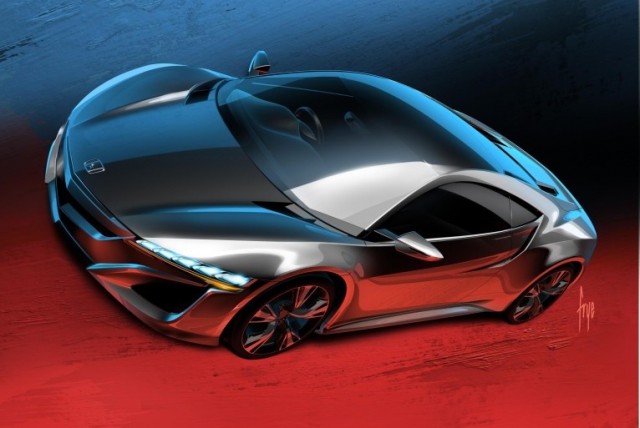
2012 Honda NSX Concept Design Sketch

Your everyday supercar, the Honda NSX. While the Italians, Americans and the English were making supercars that were as famed for their tendency to break down as their performance, Honda stunned enthusiasts with the kind of reliability that has NSX fans still worshiping their cars.

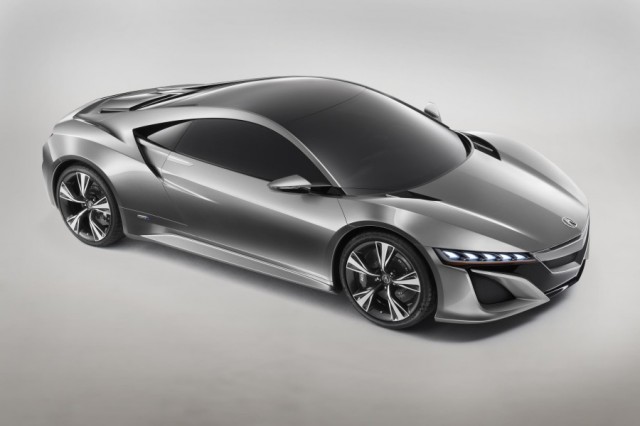
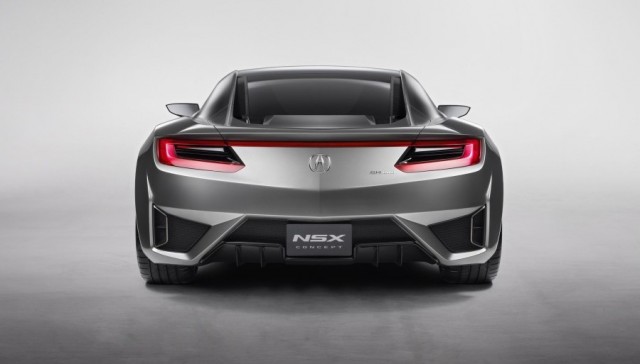
2012 Honda NSX Concept
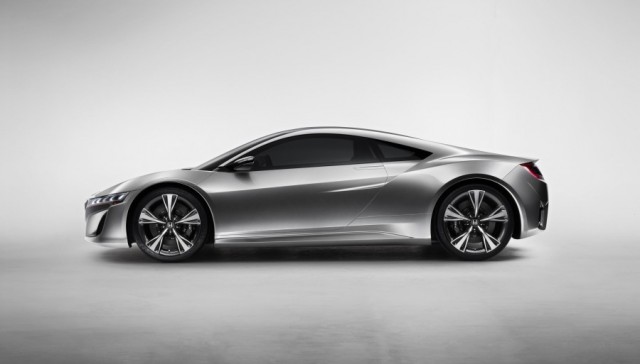
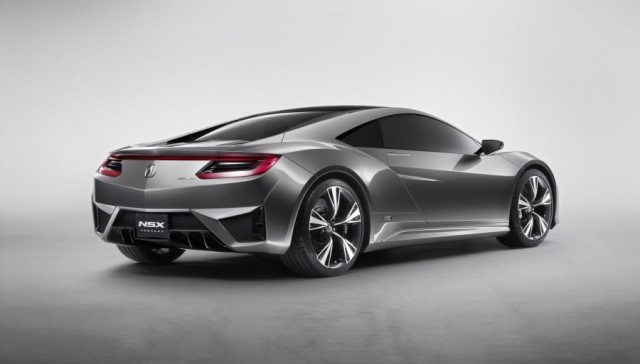
After ceasing production sometime in 2005, Honda has revived the brand with the 2012 NSX Concept. Staying true to its origins, the NSX Concept is a mid engined, rear wheel drive, two door coupe with looks that could kill.

2012 Honda NSX Concept Detroit, Geneva Motor Show : Rear2012 Honda NSX Concept : Front 3/4

The NSX uses lightweight materials and is powered by a mid-mounted VTEC V-6 engine with direct-injection, complemented by the new Sport Hybrid SH-AWD® (Super Handling All Wheel Drive™) hybrid system.

Speaking at the Detroit Motor Show, Takanobu Ito, President and CEO of Honda Motor Co., Ltd, who led the development of Honda’s first NSX supercar, explained the values of the new NSX, “Like the first NSX, we will again express high performance through engineering efficiency. In this new era, even as we focus on the fun to drive spirit of the NSX, I think a supercar must respond positively to environmental responsibilities.”

This Sport Hybrid SH-AWD system will make the NSX the ultimate expression of, “the synergy between man and machine,” added Ito.  “The NSX will make the driver one with the car to enhance dynamic driving abilities without getting in the way.”

2012 Honda NSX Concept Rear

The Sport Hybrid SH-AWD uses a unique 2 Electric Motor Drive Unit with a bilateral torque adjustable control system and can instantly generate negative or positive torque to the front wheels during cornering, which Honda anticipates will deliver handling performance unmatched by previous AWD systems.

A dual clutch transmission with built-in electric motor, takes care of transmission duties.

2012 Honda NSX Concept Side View

2012 Honda NSX Concept : Rear 3/4

The Auto Expo which happens once in two years is usually something that everybody looks forward to with great anticipation.  Fans of different brands of cars and two wheelers salivate in anticipation of what their favourite manufacturers have in store for the future.  This edition of the Expo had Yamaha fans waiting in nervous anticipation for what Yamaha could be showing.  There has been talk of scooters from Yamaha doing the rounds with Yamaha personnel making suitably vague statements about an impending launch of an India specific scooter and also an electric scooter.  The rumour mills were also working overtime and saying that Yamaha would surprise everyone with not just scooters but also a new motorcycle which would most probably be of 250cc capacity.  It was even being called the Fazer 250 with some enthusiastic webzines even “previewing” pictures of the said motorcycle.

Yamaha VMAX at the 11th Auto Expo, 2012

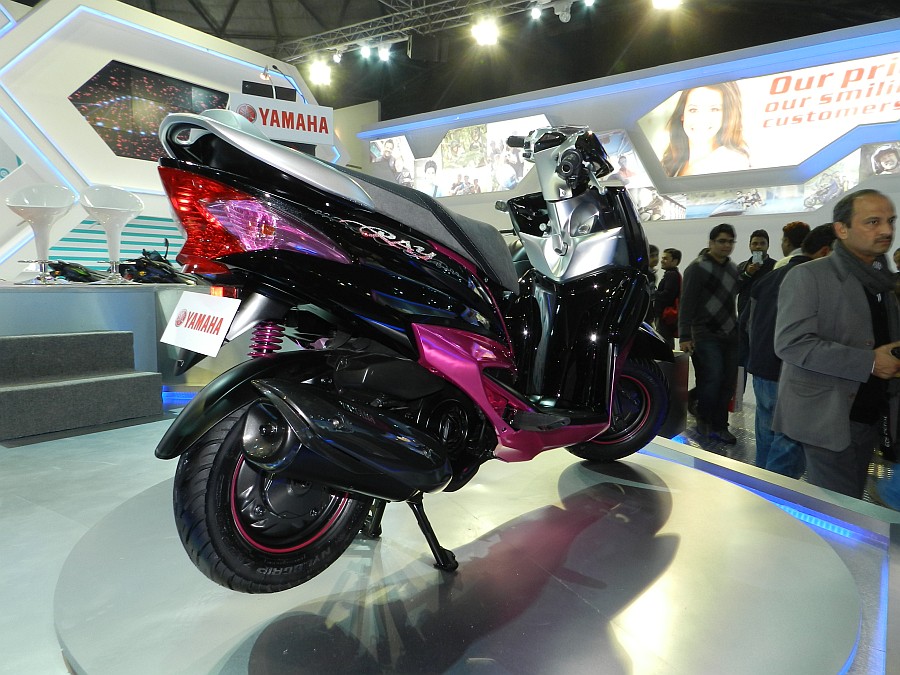
Yamaha did surprise everyone.  All the saliva that was dribbling from the enthusiasts mouths in anticipation just evaporated and they were left stunned and speechless.  The most charitable way to describe Yamaha’s approach to the Expo would be to call it lackadaisical.  Yeah, yeah they showed the new R1, the new FZ1, the new MT-01, the new V Max and the R15 Version 2 and the usual array of its existing FZ-16, FZ-S, Fazer and one concept scooter aimed at women riders which was called the Ray.  Yamaha explained that this was still a concept and not the production version and that the production version would be different from the one on display.  There is no doubt that the big capacity Yamahas are exciting, Jorge Lorenzo’s M1 from 2011 was simply awesome but come on how many of us general people from the aam aadmi category are ever going to find the money to buy these big capacity and big price beasts?

Yamaha India Ray Concept Front

The Ray and the proclamation that went with it (that it was aimed at women riders) may or may not have excited women riders. I am yet to see women going ooh and aah over scooters meant for them like they do when they see a hint of John Abraham’s butt and now that we have mentioned the individual’s name we may as well go whole hog and say that he seemed to be the only star attraction at the Yamaha display, and for petrol heads that is not saying much.  For the young male motorcycle anorak this was a big blow to the assiduously and painstakingly built six pack abs.  All that working out in the gym only to take blows and not getting a chance to use the powerful biceps and triceps to control a new beastly motorcycle has pushed many young boys deep into depths of depression.  We hear psychiatrists are doing very good business since the Expo all over the country and the profile of the new patient is “depressed performance biker”.

Yamaha India Ray Concept

Yamaha in India is now a matter of concern.  Every now and then we read in business newspapers that Yamaha is on the verge of increasing capacity and are considering new locations for new plants and that a certain amount of money will be invested in the Indian venture and these statements were made vaguely again during the Expo.  But sceptics like me have been asking ourselves as to what Yamaha would do with new factories, increased production and greater investments when they have not announced any new products except for the Ray, which again is a concept and primarily aimed at women.  I somehow cannot see women in the millions rushing to Yamaha dealerships to buy the scooter aimed at them and this necessitating increased everything.  Let us look at some cold and hard figures.  Hero MotoCorp has been selling something like five lakh motorcycles per month, while Bajaj has been selling anywhere between 2.5 to 3 lakh units per month with Honda edging towards the 2 lakh per month mark (including their scooters) and TVS also being there and there about (including scooters).  Yamaha on the other hand has been averaging between thirty and thirty five thousand motorcycles per month as their sales.  Even Suzuki is threatening to overtake Yamaha and the only company that looks like it will stay below Yamaha is Mahindra2Wheelers.  Yamaha is a globally recognized performance brand, the second largest Japanese two wheeler maker behind Honda but in India it seems to be able to do nothing at the hustings.

Yamaha YZR-M1, 50th Anniversary Limited Edition

Yamaha’s Indian foray has been chequered.  They first came in as technology suppliers to Escorts the makers of the venerable Rajdoot. Escorts in the 1980s were an ambitious company.  They not only wanted to make the famed RD350 from the Yamaha stables but also wanted to get a licence to make the Citroen 2CV for India.  The licence Raj ensured that the latter did not happen but the former did happen.  The RD 350 came with Rajdoot branding on the tank, something that could not be digested by the Indian public.  For the Indians, especially in northern parts, the Rajdoot was the mule that did all the hard work.  Having come to India through Eastern European channels, the bike which was originally a DKW featured an antiquated 175cc engine, had a nightmare of a gearbox but its suspension especially the Earls type in the front was rugged.  So in the rural north it sold in decent numbers.  The bike was never a city slicker though.  Escorts tried to change that and also wanted to give the stepny loving Indians a spare wheel by creating a motorcycle on small wheels.  The Model was called the GTS 175 and it was first featured in the hit film Bobby and therefore earned the sobriquet Bobby Rajdoot.  The success of this model was limited.

Rajdoot Yamaha RD 350

Thanks to Max for this photograph!

So when a performance oriented, race track derived, twin cylinder 350cc motorcycle from Yamaha was sold as a Rajdoot, it made little sense to people.  Traditional Rajdoot lovers could not digest the RD 350 and Yamaha fans could not bear this fire spitting Yamaha being called a Rajdoot.  What united everybody against it was its steep asking price and petrol consumption that was reportedly around 18 to 20 kpl mainly because mechanics did not know how to tune it and anyone who bought the bike was not going to ride this thoroughbred like a mule.  In those days, the 1980s that is, there was quite a bit of motorsport and all of it was in the form of rallies.  Both cars and bikes rallied together.  The cars of choice were Premier Padminis with souped up engines and suspensions, military Jongas and later the ubiquitous tool for rallying the Maruti Gypsy. Of course, if you were Rajeev Khanna then you would be driving an imported car.

The two wheeler riders choice was usually limited to the Yezdi.  The nightmares associated with changing punctured tyres and legendary engine unreliability ensured that very rarely was the Enfield Bullet even considered for rallying.  The Rajdoot (not the RD 350) could go on and on perhaps but progress would be very slow due to lack of adequate power, speed and false neutrals in the gearbox that would emerge out of nowhere.  So the RD 350 was manna from heaven for the rallyist.  Souped versions used by Jagat and Anita Nanjappa and Thirumal Roy went like stink and motorcycle rallying found a new love.  But this romance had a slightly brief history.  Lack of regular sales and the consequent lack of spares meant that the RD famed and loved as it was as a tool of rallying had to make way and it did.  But it made way for another Yamaha, the RX100.

Escorts learnt from their mistakes with the RD 350 and so when they launched a 100cc they put the Yamaha name on the tank, the engine, the speedometer console and everywhere else.  This new motorcycle was advertised as “Authentic Yamaha”, and for a 100cc engine, it had good performance.  More importantly it was affordable.  There was an instance transference of emotions to the RX100.  Everyone who loved the RD 350 but could not buy one, went and bought an RX100.  It became the bike of choice for rally riders.  The word performance got associated with Yamaha and the RX100 just as fuel efficiency got associated with the Hero Honda CD100.  These glory days lasted a long while till a politically correct government decided to introduce limits on how much a vehicle could pollute.  The wonderfully sonorous two strokes such as the RX100 did not meet the pollution norms.  Yamaha decided to increase the cubic capacity to 135cc and decreased performance in the interests of cleaner emissions.  They also changed the name of the motorcycle to RXG where the G stood for green.

One could hear the collective groan of the RX loving bikers when the RXG hit the roads.  Sales took an instant hit.  Nobody wanted this non performing RX.  So Yamaha reacted by changing the name to RX135 and tried to bring some zing back into performance by introducing a stylish RX-Z but to no avail.  Escorts by not looking at the future was left standing still.  Bajaj which made a disastrous debut into motorcycling saw the future better and by going the four stroke way it became the second biggest motorcycle manufacturer in India.  Escorts were clueless and sold their motorcycle manufacturing division to Yamaha who made this their full subsidiary.  They then introduced the YBX 125 four stroke motorcycle which was a good handler and had reasonable performance but aesthetics were lacking and all those who associated Yamaha with the RX100 could not digest the YBX 125. Thus troubled times set in for Yamaha in India.  Something from which the famed manufacturer did not recover even now.

However, Yamaha has managed to pull itself back from what seemed like certain closure of its India operations.  Instead of offering commuter motorcycles such as the Libero (first with a reptilian head look alike head lamp and then later with anonymous styling with a 106cc engine and the last of them was called the G5 signifying that there were five iterations of the Libero), the Crux an even more utilitarian style less motorcycle meant for the rural folk with same 106 engine and the Fazer 125cc with a grasshopper face like headlamp which was then replaced by the Gladiator, which was alright to look at and good to drive but nothing spectacular, Yamaha decided the time was ripe to reclaim its legacy as the performance and sporty motorcycle builder.

Yamaha R15 Limited Edition 50th Anniversary Special at the 11th Auto Expo 2012

This led to a change of strategy.  The son of the legendary R1, the R15 was created.  It had a delta frame, forged metal pistons and amazing handling with a reasonable dose of power.  But the technology made it expensive.  Yamaha was clear that the 150cc liquid cooled, R15 would be used to showcase its performance potential and that the look alike of the FZ1000 called the FZ16 would do the business for it.  The FZ16 featured the same styling cues as the bigger FZ1000.  It had a sculpted tank, a fat rear tyre, an adequately performing air cooled version of the R15’s engine and overall looked futuristic.  Yamaha launched a slightly more sporty looking version and called it the FZ-S. This found acceptance and this emboldened Yamaha to re-launch the Fazer with half a fairing a la Hero Honda Karizma and the Bajaj Pulsar 22o.  It too found acceptance but not in sufficiently big numbers.  Yamaha’s performance has been improving but only in very small numbers.  All its products have now been in the market place for a while and the Version 2 of the R15 is not much of paradigm shift from the Version 1.

Yet again Yamaha seems to be standing still.  Honda has upped the ante as has Bajaj.  Honda has announced its intention of launching the CBR150R in a short while and if the pricing of the CBR250R is anything to go by, it would be priced pretty close to the R15. Honda has better brand recall in India and is a huge threat.  On the other flank the KTM Duke 200 from Bajaj has been priced dangerously close to the R15 and it outperforms the R15 in all departments.  As if that is not enough Bajaj has unveiled the brand new Pulsar 200NS with a promise of better performance than the R15 and at a price substantially lower than the R15 and dangerously close to the Fazer.  Yamaha seems to be back at the cross roads and its Expo display did not show that it is prepared to repel this impending onslaught.  However, it could be hedging its bets and sand bagging by keeping its cards close to its heart.  Maybe it has plans that it does not want to divulge yet.  I would like to believe that, but there are some good reasons to believe that it has nothing in reserve.

The first of the main worries is that Yamaha is feeling the effects of the economic recession, the tsunami in Japan more than Honda because its operations globally are not on the same scale so as to make up from one region when another is hit.  The second pertains to the complex and secretive structure of management of India Yamaha Motors.  It is actually a consortium of various Japanese corporations one of which is the enormous Mitsui Corporation.  Japanese corporations are bureaucracies in their own right and the involvement of too many of them slows the decision making process.  I suspect that is what is happening to Yamaha in India.  It is perhaps standing still yet again. It is well known that Honda is experiencing capacity crunch for its scooters.  An international giant like Yamaha should have pounced on the opportunity to break into the scooter market, but it did not thus far.  Suzuki acted better with the Access scooter and TVS with the Wego to make in roads into the Activa space. And with TVS and Suzuki showing newer intentions and products at the Expo, Yamaha is in great danger of falling out of sight of the Indian biker.  So what is the prognosis for Yamaha in India.  Well it went from critical into remission but all signs suggest that the malady has begun to come back again.  Yamaha could turn critical again. I would hate that as would many like me.  So we cross our fingers and hope for the best.

Bajaj, KTM & Kawasaki in India

You think the headline is strange?  Let me assure it is not.  If one were to see the activity at Bajaj Auto in 2012 starting with the Auto Expo till the launch of the Pulsar 200NS, there are some interesting things that come to the fore.  Bajaj did not participate at the Auto Expo with its two wheelers.  It only showed the RE60, a strange contraption on four wheels.  There may be more to this thing than just the strange looks but that is a subject for another article, which you can expect very soon.  Rajiv Bajaj who likes to project himself as a maverick declared at the launch of the RE60 that Bajaj was anti-car company and therefore was not interested in building cars.  Yet he wanted to “concentrate” on showing the four wheeled RE60 to the world (technically the RE60 is a four wheeler on a three wheeler platform which itself is a derivation of a two wheeler platform.  But then like I said that is a subject for another post, so for now just hold your horses).  Bajaj had two spectacles to show in the month of January but held them back till after the show.  One was the KTM Duke 200, which unfortunately became only half a spectacle thanks to innumerable “spy pics” of the KTM Duke 200 circulating on the various auto webzines for months and months.  The real interest was the price, which was a killer at less than Rs. 1,20,000/-.  The second spectacle was the launch of the Pulsar 200NS, a bike carefully hidden from prying cameras and revealed in full to an ecstatic bike enthusiastic population with information that it will be prices at less than Rs.1,00,00.

So when Bajaj had this much to say and show to the world why did it skip the Expo with its two wheelers.  The most common reason that is being inferred by bike enthusiasts is that Bajaj did not want to dilute the importance of both the launches at a venue where there are many other things happening.  Logical?.  Maybe, maybe not.  If you see the buzz that Honda generated at the Expo by announcing the launch of the CBR150R and the updated Dio apart from several other things, it is clear that the typical auto enthusiast is a glutton whose appetite for information (including pics) of all things auto is insatiable.  And for the focussed enthusiast, the search for something to excite his/her imagination is ongoing thing that will not be distracted by lesser things (in his/her mind).  So the explanation that Bajaj feared the dilution of its important product launches in a big Expo to my mind are not necessarily logical.  However, as an explanation I will not rule it out.  But then could there be any other reason to why Bajaj may have decided not participate in the Expo?  I think yes and I think that has something to do with Bajaj’s old partner and teacher in making motorcycles (as per Rajiv Bajaj’s own admission), Kawasaki.  And in all editions of the Expo where Bajaj participated there was a dedicated Kawasaki corner telling people to “Let the good times roll”.

Before proceeding further with this line of thinking, it maybe useful to take a look at the relationship that Bajaj and Kawasaki shared.  For that we have travel back into the 1980s.  When the first phase of liberalization of the Indian economy happened it included in it the two wheeler sector and foreign technological collaboration and equity participation were both allowed with the rider that the foreign partner’s equity could not exceed at any point 49% of the total investment.  When the doors were thus opened another condition was placed and that had something to do with various fiscal concessions if the motorcycles/scooters were below the 100cc capacity.  Bajaj was practically NUMBER ONE in a field of ONE.  Various Bajaj scooters (with the Chetak at the top of the heap) commanded premiums since waiting lists stretched to decades.  Automotive Products of India or API only made Lambretta scooters of the 1940s and 1950s and even though these scooters also commanded a waiting period of up to 12 years, that phase ended in the early 1970s due to the indifference of the manufacturer to the market which was a controlled market.  Then Mrs. Indira Gandhi’s brand of socialism wanted the participation of the Indian State in the manufacturing sector and so when the original makers of the Lambretta, Innocenti Scooters, went kaput in Italy, Mrs. Gandhi wasted no time in purchasing the manufacturing assets and the intellectual property of the company.  Thus in 1974-75 Scooters India was created as a public sector undertaking.

Staying in line with the rhetoric of her general politics Mrs. Gandhi made sure that the brand of scooter to emerge from the newly created Scooters India Ltd would be given an Indian name and thus the then latest model Lambretta 150 was called Vijay Deluxe.  The members of the Indian Hockey team which won the World Championship under the captaincy of Ajit Pal Singh were all gifted with this scooter for their considerable achievement.  Mrs. Gandhi continuing her thinking even allowed various State Governments such as the Govt of Andhra Pradesh and the Government of Karnataka to make the same scooter under different brand names.  The former called the scooter Vijay Pushpak and the latter Falcon.  Since this scooter was built by State undertakings there was no effort to even sell the scooters leave alone things such as marketing.  Though technically all these scooters were available not too many wanted them.  Motorcycles of that period were mainly three.  The Enfield Bullet, the Yezdi (which started as a Jawa) and the Rajdoot were the available brands.  All of them suffered from various types of problems, such as reliability, no ease of service, expensive spares, oil leaks but most importantly they lacked the one feature that was of greatest importance to the then Indian two wheeler user, a stepny tyre (Rajdoot tried  fit a stepny tyre to the engine cradle at the rear of the front wheel but that compromised the steering of the bike so it was hastily given up).  It was most important because punctures were an everyday occurrence thanks to poor roads but it also had something to do with the utilitarian bent of mind.  Scooters offered storage place with bags being attached to the rear side of the front apron and in the case of the Vespa derived Bajaj scooters a lockable box on the left side panel, something that no other scooter had.  Maybe difficult to believe, but that lockable box may have been one of the most important reasons for success of the Bajaj scooters.

1986 Bajaj Chetak

Other scooter brands and motorcycles  just languished while Bajaj minted money with its Bajaj 150 first and later with the Chetak, Super, Priya (in collaboration with Maharashtra Scooters which had an equity participation by the Govt of Maharashtra) and later the Cub as well.  So when the liberalization happened new players tried to enter the market and go for Bajaj’s jugular.  And what better way to do it than collaborating with Bajaj’s old partner Piaggio, the maker of Vespa scooters.  So there was Lohia Machines Limited and the public sector undertaking Andhra Pradesh scooters who found collaborations with Piaggio.

Typically Andhra Pradesh Scooters messed up with the technically very sound Vespa PL170 scooter, while Lohia Machines Limited (later to become LML Limited) tasted success initially with the 100cc Vespa XE and later the Vespa 150.  This success was very limited and again the lockable side box played a big role in the limiting of success.  The Vespa scooters emerging from LML had placed the spare wheel under the left side panel, thereby eliminating the possibility of a lockable storage box.  Despite LML’s concerted efforts to tell people that their arrangement improved the balance of the scooter not too many were convinced.  Hence LML ultimately shifted the stepny to the rear of the scooter and created a lockable space at the left. However, this did not really hurt Bajaj since it was a bit late in the day to make the change and also because LML went into management problems and changed hands from the Lohia family to the Singhania family.  As is usually the case such transitions set companies back by years.

Meanwhile other entrants into the two wheeler market decided not to go headlong in competition with Bajaj and therefore they took another route, a route that changed the face of the Indian two wheeler landscape radically.  They decided to go into the under utilized and under exploited motorcycle segment.  TVS took the lead.  It created a new company called India Motorcycles Limited and collaborated with the Japanese Suzuki company.  TVS looked to Japan because it knew that Japanese companies had decimated European two wheeler makers in all markets including the European markets.  But Suzuki was a strange choice.  There are reasons for that yet again.  Escorts India, the makers of the venerable Rajdoot, had in the very early 1980s (before the liberalization process began) collaborated with Yamaha to bring out the wonderful RD350 a bike that was too ahead of its times and since it was race derived it was expensive and returned poor fuel consumption figures.  But the collaboration was there and so was the bike, though it sold in minuscule numbers.  Honda wanted to come into India but its first choice was Bajaj.  Honda always wants to be numero uno and a collaboration with Bajaj would have ensured that.  So negotiations were on between the two companies.  So TVS went to the third biggest Japanese bike maker Suzuki and launched the first Indo-Japanese 100cc motorcycle, the Ind-Suzuki AX100 and it tasted success with it.

Meanwhile, negotiations between Honda and Bajaj broke down.  Bajaj knew that it was big in India on a monetary scale due to its near monopoly for decades and only wanted a technical collaboration (the kind it had with Piaggio) while Honda wanted equity in the company since it wanted a foothold in the Indian market.  With neither side refusing to budge there was no prospect of any collaboration.  Therefore, Honda scouted for new partners.  Honda even at that time was world number one in motorcycles and scooters and wanted a partner who would be at its bidding rather than the other way round.  If TVS (Sundaram Clayton) makers of TVS mopeds could go to making bikes with Suzuki, Kinetic Engineering (makers of the Luna mopeds) wanted to get into scooter making.  Arun Firodia the head of Kinetic was prone to doing things differently so he tied up with Honda to make gear less hundred cc scooters, a first for the Indian market.  Everyone who knows Honda also knows that Honda is as much about marketing brilliance as it is about technological superiority.  Hence Honda did not want to place all its Indian eggs in the Kinetic basket.  While it agreed to enter into a joint venture to produce two stroke scooters with Kinetic it also entered into a joint venture with the Hero group who were till then making cycles and yes, mopeds under the Hero Majestic brand.  The Hero group was not technology savvy nor were they so big that they could resist Honda’s domination, so they were the perfect partner for Honda.  Honda decided to make motorcycles with Hero and make four stroke motorcycles at that, a domain that was till then the exclusive prerogative of the Enfield Bullet.  But this is not a story about Honda, so lets get back to Bajaj.

Now where did these developments leave Bajaj?  Its traditional bastion, scooters, was being attacked by not one but many players, and one of the many was Honda.  At that time Rahul Bajaj famously said”Honda is serious competition for me, I just cannot sit around doing nothing”.  So what was the option for Bajaj?  In scooters the only manufacturer of consequence from Europe was Piaggio and Bajaj did not end its collaboration with the Italian company too well.  Also Piaggio tied up with not one but two manufacturers, so that was a closed road.  All motorcycle manufacturers in Europe had shut shop or were in the process of shutting down and the ones that survived made big and ungainly motorcycles that would not fit the 100cc norm.  Bajaj therefore had to look east. Honda, Yamaha and Suzuki were taken.  Only Kawasaki was left.  Though in its history as a two wheeler maker, Kawasaki did build scooters, they were not known for them.  Though they were smaller than Bajaj in output, they were pretty good technologically.  Something that was to Bajaj’s liking. So Bajaj inks a deal to make motorcycles for the first time through a technical collaboration with Kawasaki.  Kawasaki was happy enough to get royalties for its technology.

Kawasaki Bajaj KB 100

Bajaj chose the KE series from the Kawasaki range, a range comprising of motorcycles with small engine capacity and the relatively low tech and easy to maintain two stroke engines (what a lovely place the world was before it went politically and environmentally correct).  Bajaj picked up a model that was a scaled down version of Kawasaki’s wonderfully styled GPz500 from the late 1970s.  As opposed to the other Indo-Japanese bikes the KB 100 that came out of the Bajaj stable had pleasing styling cues and it came with all the bells and whistles that were possible at that time.  A dashboard that featured a tachometer, fuel gauge, speedometer, tell tale warning lights, a rear fairing, a concealed carburetor, single ignition and handle bar key and lock, thumb operated choke on the left hand side of the handle bar, solidly built foot rests and the best electricals (it was the first motorcycle to feature 12 volt electricals while all others had 6 volt electricals) in the market then were standard on the KB100.  It also had the best handling chassis (I am willing to join issue about this with any die hard Yamaha RX 100 fan) with ideal front and back end weight distribution and an engine that could rev happily till 10, 500 RPM and put out only .5 PS less than the RX 100.  It was also the cheapest bike, despite featuring saree guards, crash guards and rear view mirrors on both sides as standard fitments while most other manufacturers sold all those as extras. The bike was a recipe for huge success.

Kawasaki Bajaj KB100 in Blue

When launched in the Indian two wheeler market, the bike bombed, in spectacular style.  While people were fighting for Hero Honda motorcycles and buying the TVS-Suzuki and Yamahas in decent numbers, they did not want anything to do with the KB100. So what went wrong.  It was not one thing, but a combination of many things.  First factor was that Bajaj, a company used to selling scooters to people who were waiting for decades, did not know anything about marketing products and did not even have a marketing division.  Second, the dealers of Bajaj scooters knew nothing about motorcycles and since they were also used to customers falling at their feet for Bajaj scooters, they knew nothing about customer service.  Then there were mechanics who did not know a thing about servicing and repairing motorcycles.  Most could not even find the correct clutch and carburetor settings.  Due to the existence of a rear fairing the seat on the KB100 was relatively cramped, and the rear end did not have a carrier (of the cycle variety) and the pillion rider foot rests did not have a separate sub-frame (like the RX100 did) and were welded to the swing arm itself.

The Indian buyer used the idea of utilitarian modes of transport did not give two hoots to styling, tachometer and other such things.  What he wanted was a seat that could three comfortably (while the KB100 barely seated two in comfort, though young boys who had girl friends appreciated the seat tremendously), did not have the rear carrier and due to the indifference of dealers, motorcycles that were never serviced properly gave bad fuel efficiency figures.  The younger lot while appreciating the seat did not understand motorcycle dynamics too well.  They fell in love with the RX100 since it had a long seat and a light front end and that combination (especially with pillion riders sitting) produced effortless wheelies and most believed that it was an indication of the “brute power” of the motorcycle.  I must say here that many were terribly miffed when I pulled effortless wheelies on a 1971 model Vespa 150 made by Bajaj.  The heavier front end of the KB100 due to good weight distribution would not levitate easily.  The benefit of this was that braking was phenomenal on the KB100 and it also did not change its handling with a pillion on board.

The resounding failure of the KB100 galvanized Bajaj into action.  It set up a marketing department.  It started getting tough with the lax dealers.  It lengthened the seat on the KB100 by shortening the rear fairing, changed the front chain sprocket’s number of teeth from 14 to 13, added a sub frame for the rear footrests, increased the power to 11PS and added RTZ and Delta Super tuned to the KB100 name.  But the more important thing was that it decided to go head on with Hero Honda and set to work on the BR100 project that launched the 4s motorcycle, unimaginatively named the 4s for four stroke.  The 4s was smaller and lighter than the KB100 and was de specced completely.  The tachometer was gone along with the ignition/handle bar lock, the seat became longer and ended with a carrier, choke went to the now exposed side draft carburetor but the motorcycle gained bragging rights over fuel efficiency.  Thus Bajaj joined battle with Honda.

The engine on the 4s continues till date with some very minor modifications on the Platina just like the Honda motor that continues almost unchanged on the Hero Honda CD 100 and Splendor.  With the 4s under the tutelage of Kawasaki, Bajaj learnt the art of making motorcycles and selling them.  That was till the turn of the century, when Rajiv Bajaj decided that the way to go was to start developing its own products.  This became especially important with the scooter market dwindling and only supporting the twist and go scooters.  The legendary Chetak had to be laid to rest and newer scooters that Bajaj developed on its own such as the Sapphire, Wave, Sunny, Spice, Spirit and Kristal (the last of the scooters that Bajaj made) also quietly lay down and died.   The M80 and the ahead of its time big wheeled Rave scooter based on the M80 mechanicals also vanished.  Bajaj had started making the Pulsar and I don’t need to tell you the success story of the range.  But other bikes spawned by the 4s such as the Boxer (not the new BN150 but the old AT, CT), Caliber (in all its avatars such as the Chroma and the 115 aka hoodibaba), the CT 100 all disappeared.  The Discover in its first 125cc iteration found very limited success and the 110cc Discover fell like a stone to earth and the Platina sold in reasonable numbers (enough to keep the hopes of the company alive) but the 100cc Discover kick started good numbers again.  At this time Bajaj started slowly buying into specialist European manufacturer KTM who has had tremendous success in the Dakar.  Bajaj slowly took its stake to nearly 40% in KTM, thereby getting Rajiv Bajaj a crucial position on the Board of Directors of the company.  This is crucial because it this that started this new synergy between the two companies that came to the fore with the launch of the KTM Duke 125 in different markets but made in India followed by the launch of the KTM Duke 200 in select markets including India.  More importantly Bajaj will manufacture bikes for KTM in cubic capacities up to 350.  To facilitate all this the Bajaj Probiking showrooms which were distributing the Kawasaki Ninja 250R and the Ninja650R have been rebranded as KTM dealerships. So now comes the question where does this leave Kawasaki?

Before the KTM effort Kawasaki and Bajaj forged synergies by distributing each other’s products in markets where they had dealer and distribution networks. Bajaj even made small capacity motorcycles such as the Wind 125 for Kawasaki.  It was this that brought Kawasaki to India to distribute its made in Thailand/Japan Ninja250R and the Ninja650R through the Bajaj Probiking network.  The Ninja250R was atrociously overpriced and old rival Honda cocked a snook at Bajaj by making an affordable 250cc for half its price. Now Bajaj has tried to get back by launching the KTM Duke 200 at even lower price but with better specs.  Good for Bajaj, good for KTM, but hey where is Kawasaki in this?

In spite of Bajaj saying that it will sell the Ninjas through the KTM network, it does not look convincing that Kawasaki will put its hugely overpriced and underselling products in KTM showrooms and get salt and spices rubbed into its wounds.  More importantly even if they do put their bikes there who is going to push them and who is going to buy them?  I therefore am sure that Bajaj’s two wheeler no show at the Expo had something to do with this imbroglio. It is difficult to believe Rajiv Bajaj’s proclamations that they kept the two wheelers out of the Expo to concentrate on the RE60.  Some months ago Rajiv Bajaj when questioned about Kawasaki in the context of KTM had said that it was up to Kawasaki to decide the way forward.  Kawasaki set up India Kawasaki Motors Ltd but no one knows if this entity exists still or where from it functions and what it actually does.  There is no address, no website, nothing.  So here comes the painful question.  Have we seen the last of Kawasaki in India?  I am not sure, but don’t be surprised if the answer turns out to be a yes.

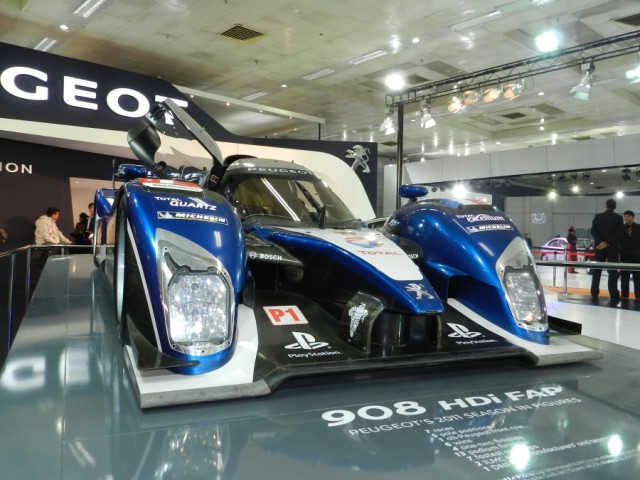
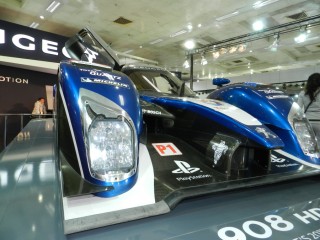
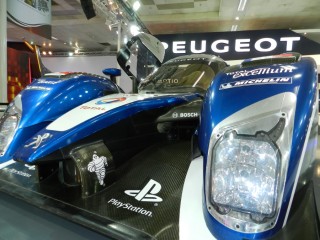
In June 2005 Peugeot announced their intention to win the Le Mans 24 Hours, with a car powered by a diesel engine. The Peugeot HDi diesel DPFS engine was designed as a 5.5 Litre 100° V12 engine, the DPFS hinting at the twin diesel particulate filters at the end of each exhaust system that guarantee smoke free operation of the engine under all conditions. Peugeot’s closed cockpit LM P1 prototype evolved over a course of two years into the 908 HDi FAP that made its debut at the 2007 Le Mans Series Season’s race at Monza, and also clinched the first position.

Peugeot 908 HDi FAP at the 11th Auto Expo 2012

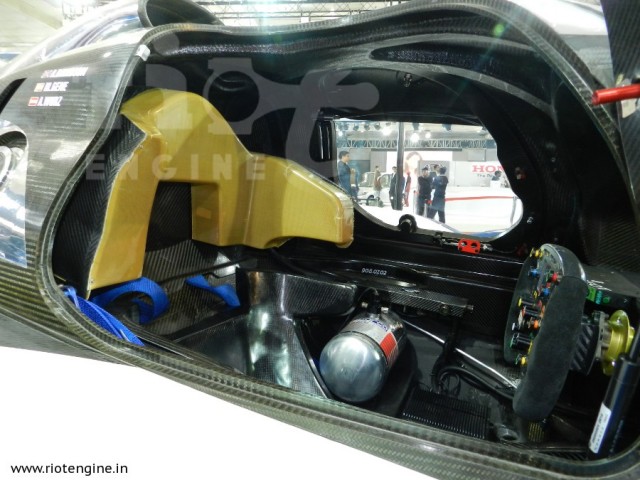
Riot Engine had the privilege of stepping beyond the security barriers to get close to 908 HDi FAP, we bring you some exclusive pictures of the interior of the 908 HDi FAP.

Peugeot 908 HDi FAP Steering Wheel

Peugeot 908 HDi FAP Cockpit

The “908” comes from, ’90’ designating an exceptional Peugeot model and 8 the next number in sequence after the 907 concept car. The transmission is controlled electro pneumatically using the paddles on the steering wheel. The cockpit is designed as a two-seater, as mandated by Automobile Club de l’Ouest (ACO) regulations, though the passenger seat is not used. The space is used to hold the fire extinguisher (sparco makes fire extinguishers too?) and electronic equipment.

Peugeot 908 HDi FAP : Fire Extinguisher

Forged Magnesium BBS Wheels look stunning. Michelin Tyres provide the road holding abilities.

Peugeot 908 HDi FAP : BBS Forged Magnesium Wheels, Michelin Tyres Peugeot 908 HDi FAP : Fuel Cap

While the Audi R8 ( the Le Mans Racing car, not the production one) as well as the Audi R10 TDI were open top cars, Peugeot went ahead with a closed cockpit design based on regulations announced by the ACO on 16 June 2006. Of course, this had a number of technical disadvantages including additional weight and increased height of the COG. The Peugeot Sport team felt that it also offers advantages, particularly in terms of chassis rigidity and aerodynamics.

Apart from wanting to maintain a link with the two-times winner of the Le Mans 24 Hours in 1992 and 1993, the Peugeot 905, Peugeot had a compelling reason for going the closed cockpit way.

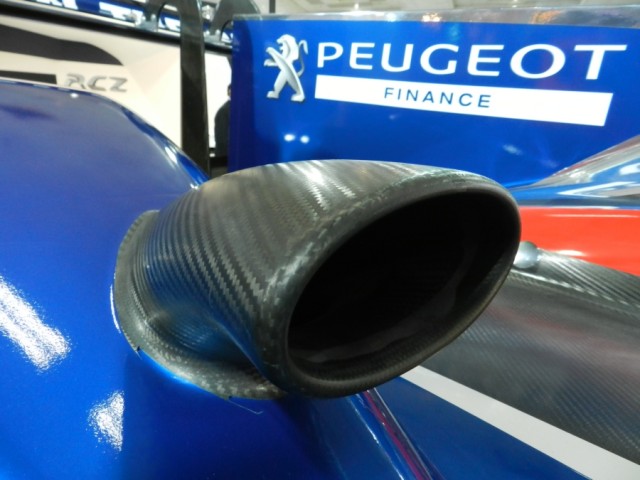
Closed Cockpits were mandated to have air conditioning to keep the temperature at a 32° Centigrade. Regulations permitted the use of a larger diameter inlet for the turbocharger on such closed cockpits to compensate for the presence of air conditioning equipment. Shown below is the larger diameter turbocharger inlet. This gave the 908 HDi FAP additional power, that was put to good use.

Peugeot 908 HDi FAP : Turbocharger Inlet ( Larger Diameter thanks to the closed cockpit requiring air conditioning)

Peugeot says the car’s profile results not only from the necessary compromise between aerodynamic efficiency and drag, but also the need to provide optimum airflow to the different radiators and intercoolers located within the bodywork.

Peugeot 908 HDi FAP : Front View 01Peugeot 908 HDi FAP : Front View 02

Peugeot 908 HDi FAP : Rear View 01Peugeot 908 HDi FAP : Closed Cockpit

The monocoque body is made of carbon and offers strong natural rigidity (the “eggshell” effect) and allows the weight of the monocoque body to be optimised. The gearbox is positioned longitudinally and allows provision for up to 6 gear ratios, the limit laid down by the regulations. It was designed to withstand the torque of the engine, while ensuring optimum weight and size characteristics. As we mentioned previously, the gearbox is controlled electro-pneumatically using the paddles behind the steering wheel.

Peugeot 908 HDi FAP : Mirrors

Peugeot 908 HDi FAP : Splitter

The 100° V12 HDi FAP engine with particulate filters

Peugeot 908 HDi FAP Diesel Engine

We haven’t seen a more sinister looking engine. Looks straight out of the Alien vs Predator franchise. Fantastic!

Peugeot 908 HDi FAP 100° V 12Peugeot wanted to keep the bore diameter very close to that of a production series engine to make best use of diesel combustion knowledge gained by their engineers over the years and also to limit the stroke length. These requirements were best achieved with the use of a 12 cylinder engine. The V12 is also known for keeping vibrations to a minimum.

The 100° V angle, of the V12 architecture, allowed the height of the centre of gravity to be lowered without affecting the torsional rigidity of the engine. Two diesel particulate filters are mounted at the end of each of the exhaust systems. Derived from technology in Peugeot’s road cars, these will provide a guaranteed control of exhaust emissions under all operating conditions. The two diesel particulate filters fitted to the engine being presented, have the serial numbers 1.195.520 and 1.195.521 as on any other particulate filter from the Peugeot factory.

Twin turbocharged Peugeot 908 HDi FAP with particulate filters

The two exhaust systems are as short as possible. On each side a 6 into 1 exhaust manifold is connected to a Garrett turbocharger, then to a very compact diesel particulate filter before ending in a side exhaust pipe, located in front of the rear wheel. The V12 makes around 515 kW (700 bhp) and a torque in excess of 1200 Nm, which Peugeot proudly claims is a result of their diesel engine expertise, and the choice of a V12.

100° V12 HDi FAP engine in the Peugeot 908 HDi FAP LM P1 prototypeProduction Serial Number on the Particulate Filter in the Peugeot 908 HDi FAP's engine