Yearly Archives: 2011

Nissan has unveiled the V platform sedan in India and contrary to most expectations it has retained the name Sunny for the Indian market.  The car is called the Versa in the USA and March and Almeira in other markets.  Since Bajaj owns the rights to the name Sunny in India (it used to make a scooterette with that name but the product is now defunct) it was assumed that Sunny may not be the name for the sedan in India. Similarly Versa was used by Maruti on its van before it revamped it and rechristened the Eeco.  But Nissan seems to have got the rights to the Sunny name and have decided that the V platform sedan will be called Sunny like it is in China.  Since today’s ceremony was only the unveiling and not a full fledged launch certain other details were not available.  But read the Sunny story in our design section to get an idea of the important role that India played in the development of the Global Sedan Sunny.

Riot Engine also had scooped images of the Sunny undergoing testing.  Here they are.


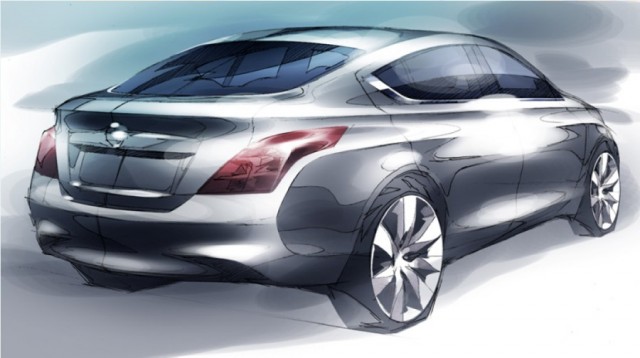
Nissan Global Sedan Sunny/Versa Indian Launch Design Sketches

The Nissan Global Sedan called the ‘Sunny’ was launched today (August 3rd, 2011) in Mumbai and Riot Engine prides in bringing you the design story.

“I wanted to design a perfect robust sedan,” says Yamane, Associate Product Chief Designer in charge of designing the new Global Sedan.

That, definitely doesn’t sound easy. Designers at Nissan produced numerous full scale mock-ups of the global sedan and spent time in the seats, and tried different variations of the roof shape and packaging, just to ensure the cabin felt airy and spacious. Well, that’s a start to getting close to perfection.

It doesn’t end there, and neither does it start there. The design and development of the Nissan Global Sedan Sunny started here, in the streets of Delhi and Mumbai. “We visited New Delhi and Mumbai. The road conditions were bad, and it was very dusty because of the ongoing urban renewal. Small cars were speeding by in groups in the haze, rather like cars in a Formula One race. I felt strongly determined to design a car that would stand out in such situation in order to play a winning game.” says Mitsunori Morita, who was in charge of exterior design for this car. The bit about cars speeding like its F1 season all day long is something we get, but the latter part about designing a car that can be picked out of the blurry haze of wheels is something we might have to delve into deeper.

“Our objectives were to create a global car that would be accepted by our customers around the globe, incorporating that sedan concept while realizing advanced performance and beauty. In doing that, we wanted to achieve a good balance of functionality and sedan ‘presence’, a spacious cabin, and a fine design in a compact car with size limitations. It was indeed a challenging but rewarding job,” says Yamane, reflecting back on his team’s hardships with a smile.

Design requirement number one, and we bring this information to you straight from Nissan, the car needed to have a distinct character that would allow it to standout even in an unwashed, dusty condition. Nothing can convince us better that this was a car designed for the Indian market!

Nissan believes the usage and needs of a sedan car vary by country and region and based on its research they have concluded that in China a sedan is a status symbol, and that in India it is primarily a means of transportation for the chauffeured businessman. Now, we are a bit skeptical when it comes to surveys that think they can generalize a population as diverse and complicated as that in India. This one is no different. How a sedan is perceived in India is something that definitely cannot be stated in one sentence, but then again, a sedan designed for the businessman in the rear seat, priced competitively with the likes of Maruti Suzuki DZire and the Tata Manza, should work for the rest of the population.
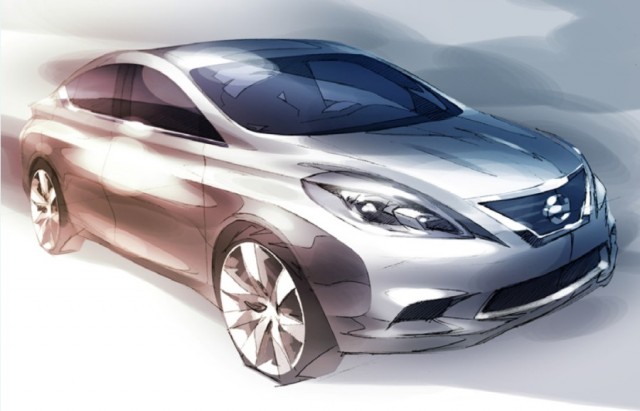
Nissan Global Sedan Sunny/Versa Indian Launch Design Sketches

“I knew that nondescript proportions would not do to create a car that would be marketable worldwide. A distinctive rear deck that describes the concept of “sedan-ness” was necessary for this car. I wanted to maintain a good balance between such conventional points and some forward-looking design to realize a new type of sedan car.” explains Morita.

The exterior design of the Nissan Sunny is described by Morita as “a design integrating a wide, robust, horizontal-based lower body and an elegant but dynamic upper body.” The distinct features include a character line inspired by human muscles that runs along the side of the body but disappears around the B pillar.

“It’s one of the highlights of this car, and I was inspired by human muscles. I wanted to express a sculptural image of strong muscles hidden under a smooth skin. On the other hand, I definitely wanted to avoid expressing dynamism through the wedge shape,” Morita states flatly.

The new Hyundai Verna as well as the new Ford Fiesta are cars that have been soaked to their gills in the wedge-shape-expresses-dynamism philosophy and they aren’t bad lookers, are they? Going by the number of the new Hyundai Vernas on the road already, it would seem the wedge shape definitely finds appeal with the Indian palate.

Nissan though has decided to shun the wedge shape and traded it in for a ‘horizontal-based design, developed for the lower part of the body across the body width to give it a feeling of stateliness’. In the mind of this writer, all that translates to trying to dress up this compact sedan in the clothes of ‘stately’ luxo-barges ala the BMW 7-Series, which has a straight and minimal belt line.

“It’s a middle-class compact sedan car, but I wanted give it the most mature presence with a dignified elegance in this class.” says Morita.

Nissan lays emphasis on the the character line that goes around the rear part of the body when observed from the top and the beautiful curve of the roof. Perception of a the cabin as being spacious is supported by the lines from the rear seat eye point that do not obstruct a wide view.

Nissan says the rear seat knee room of the Sunny is actually wider by 100mm compared to the competition, achieving the spaciousness of an upper class sedan. We aren’t exactly sure whether the competition mentioned here is that of the Versa in the United States, or the Japanese rivals of the sedan, we’ll have to wait for the test drive for a clarification.

“It needs to be physically spacious, but it’s also important to be visually spacious. And that gives designers a great chance to show their skills. We continued to re-design and retry the mockup to achieve, uncompromisingly, the kind of spaciousness that our customers could feel in their hearts,” Morita commented, beaming with pride.
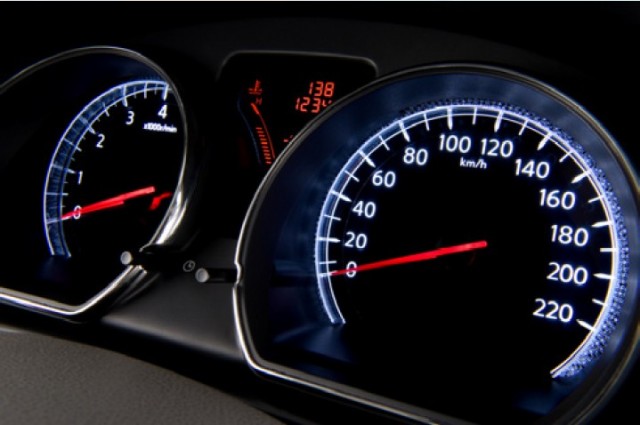
Hiroyuki Amagi, in charge of the Interior Design for the car explained the inspiration that led to the sparkling meters courtesy of the 0.5mm pyramids around the dial.

“There’s always a cover at the front of the meter too, so you can’t actually touch the meters and dials inside. Our design idea started there, with the possibility of comparing it to jewelry in a showcase.”

Again, nothing was decided upon the first trial. “We asked the model maker to provide us with various samples to achieve that spatial effect of sparkling precious stones, a crystal-like image. A slight change in the face pattern affects its attractiveness.” says Amagi. Various models were tried and finally a choice was made, to get this beautiful effect. For Hiroyuki Amagi and Nissan, it was all about the details.

“When driving at night, a woman in the passenger’s seat will notice the sparkles in the instrument panel. I hope that will provide a pleasant surprise while enjoying a drive.”

We will leave you to ponder over that statement and arrive at whatever entertaining conclusion that you think is appropriate, or not.

Amagi, also is the man behind the silvery bits in the sedan’s cabin. Having to work within a fixed budget for the interiors, Amagi decided on a color not unlike deep gloss of an oxidized silver pot, but with spatial effect that renders the surfaces exquisite under light.

Having completed the project, Yamane speaks contentedly. “I take great pride in the fact that all our ideals were cast into shape in the design of the new global sedan. It’s dynamic, beautiful, and dignified, but also spacious and comfortable. You see a good balance between the two contrasting themes. Nissan’s new sedan design will surely provide excitement to our customers around the world eachand every time they use the car. It was very challenging, but also rewarding.”

Just to recall why the hype around the V-Platform, the V-Platform is versatile enough to accommodate, without development or cost or any weight inefficiencies, customer requirements of all global markets whether RHD, LHD, diesel, petrol, Euro 3 to 6, and all worldwide crash test requirements including the US, EU and Japan. The Nissan Micra is the hatchback built on the V-Platform, the Global Sedan to be launched in India on August 3rd, 2011 known elsewhere as the Sunny/Versa is the sedan and a possibility of an MPV in the near future cannot be ruled out.

More info on the V-Platform here.

Riot Engine also was one of the first automotive magazines to have very clear pictures of the Nissan Sunny, caught testing.

After an independent agency ARPA conducted tests at the Motegi circuit to test the levels of radiation and came out with the results that suggest that it is safe for MotoGP to go to Motegi, the FIM has given the all clear for racing there.  Jorge Lorenzo and Casey Stoner have been saying that they will refuse to go to Motegi if the race is held because they fear a threat of radiation.  The Motegi circuit is about a 130 kms from the Fukushima reactor that suffered a melt down after the tsunami and earthquake that hit Japan in March leading to the postponement of the race from its original April date to October.  However even the food samples have been found to be safe by ARPA and said that they comply to the regulations laid down by EU.  However it is still believed that Lorenzo and Stoner are trying to organize a revolt against going to Motegi.  This is surprising because studies have shown that the radiation levels at Motegi are lower than what would be if a rider was subjected to an MRI and most riders after a fall routinely undergo MRIs on a regular basis. No wonder then that Stoner is called a fast rider with no brains while Lorenzo is likened to a bull dog for his tenacity.  Lorenzo only has the tenacity of the bull dog and does not have any of the good qualities that the said animal has.  This makes everything he says and does akin to a whole load of bull s***.  Interesting times for MotoGP especially given the fact that the Chief of FIM, Vito Ippolito has said that he will travel to Japan with his son for the Motegi race.

Yamaha has announced that it will withdraw from World Superbike racing at the end of the 2011 season, citing financial reasons.  The official Yamaha World Superbike team has been running without any sponsors just as the MotoGP team.  However, MotoGP gets money from the factory in Japan directly while the Superbike team is funded by the associates of the company in Europe.  The financial crisis in the world markets has not gone away fully and this has impacted severely on the sale of motorcycles in Europe.  With no sponsor likely to appear, the writing on the wall was clear.  Yamaha quits at a time when it is actually doing quite well in the World Superbike championship.  Both its riders Eugene Laverty and Marco Melandri have been on the podium a few times and the latter in fact is placed in a very good place in the overall championship points.  Yamaha may however provide racing kits to interested parties just as they are doing with the World Supersport category.  Melandri must consider himself extremely unlucky.  His effort at Ducati was terrible and he signed for Kawasaki in MotoGP only to find that the team had withdrawn from MotoGP.  Efforts of Dorna produced a single bike team which ran as Hayate and Melandri had some decent results on that.  Now when he has just announced that he would remain in World Superbikes with Yamaha, the news of Yamaha’s withdrawal has come.  However based on this year’s performance it can be assumed that both Melandri and Laverty could find rides for next year’s championship.

While fires in the Tata Nano have ensured that the car does not set sales charts on fire (at least not yet) the potential of an inexpensive car in the Indian car market has not gone unnoticed.  It is for that reason that Maruti is reviving the 800 and Hyundai is working on its own 800cc small car.  Fiat too has announced that it wants to make a small car below the Punto as has Ford which says that it will make a car smaller and cheaper than the Figo.  It is therefore unsurprising that almost all car makers are betting on the small car market.  Mahindra which has the intent of being present in all segments from two wheelers to behemoth trucks and buses, has served notice of its intent to enter the small car space with its own indigenous car that will be priced around Rs. 3 lakh.  The car is expected to hit the market around 2014.

The new Swift from Maruti Suzuki is scheduled to be unveiled on the 17th of this month.  But dealers have started taking bookings for the car since the production of the old car has been stopped what with the strike at Manesar and all.  We believe that the new Swift already has 40,000 bookings and dealers are still taking bookings for the car.  The dealers are however not taking bookings for the Dzire, so it remains to be seen what the plans for that car.

The BMW X1 has been a success in the Indian car market.  The cheapest and therefore the most affordable BMW has found many takers who want to own a car from that marque.  If the X1 is successful can the competition by far behind?  Audi has grand designs for India and intends to take the X1 head on by launching its own Q3 next year. A test mule of the Q3 has been caught testing by On cars.in

Picture courtesy: Oncars.in


India Yamaha Motor continues to show an upward trend in the sales growth, registering 28.5 % growth in its overall sales that stood at 38,197 units in July 2011 vs. 29,728 units in July 2010. In the domestic market, the company sold 29,021 units in July 2011 vs. 22,899 units sold last year. The export figures stood at 9,176 units in July 2011 while 6,829 motorcycles were exported in July 2010.

Here is the full press release from India Yamaha Motor

New Delhi, 1st August, 2011: On a consistently successful path, India Yamaha Motor again continued to show an upward trend in the sales growth, registering 28.5 % growth in its overall sales that stood at 38,197 units in July 2011 vs. 29,728 units in July 2010. In the domestic market, the company sold 29,021 units in July 2011 vs. 22,899 units sold last year. The export figures stood at 9,176 units in July 2011 while 6,829 motorcycles were exported in July 2010.

Speaking on the results, Mr. Hiroyuki Suzuki, CEO & MD, India Yamaha Motor Pvt. Ltd., said, “We are pleased with the consistent sales growth that we’ve been witnessing month-on-month this year. The new variants of the FZ Series and the SZ Series have largely contributed to the highest-ever monthly sales we have achieved in domestic market this year. We are engaging in targeted marketing activities and expanding our dealer network to tier 2 and tier 3 cities to further strengthen our market share in the 150cc+ segment. We are also very upbeat about the upcoming festive season which will further propel our sales.”

Yamaha continues to reinforce its relationship with the customers and has launched the YES!YAMAHA campaign that endeavors to provide the Best 3S Experience so that the customer always appreciates Yamaha and accepts the brand like the word “YES”. The company is making steadfast efforts by conducting consumer-centric marketing initiatives such as Yamaha R15 One Make Race, Yamaha Safe Riding Science (YSRS) for college students & kids, Yamaha Service Camps to name a few.

About India Yamaha Motor Pvt. Ltd.

 Yamaha made its initial foray into India in 1985. In August 2001, Yamaha India became a 100% subsidiary of Yamaha Motor Co., Ltd, Japan (YMC). In 2008, Mitsui & Co., Ltd. entered into an agreement with YMC to become a joint-investor in the motorcycle manufacturing company “India Yamaha Motor Private Limited (IYM)”.

IYM operates from its state-of-the-art manufacturing units at Surajpur in Uttar Pradesh & Faridabad in Haryana and produces motorcycles both for domestic & export markets. With a strong workforce of more than 2,000 employees, IYM is highly customer-driven and has a countrywide network of over 400 dealers. Presently, its product portfolio includes VMAX (1,679cc), MT01 (1,670cc), YZF-R1 (998cc), FZ1 (998cc), Fazer (153cc), FZ-S (153cc), FZ (153cc), SZ, SZ-X & SZ-R (153cc), YZF-R15 (150cc), SS125 (123cc), YBR 125 (123cc), YBR 110 (106cc) and Crux (106cc).

The versatile V platform from Nissan has already spawned the hatchback Micra in India.  A sedan built on the same platform goes by the name of Sunny, March and Almeira in different markets of the world.  In India the Sunny name is owned by Bajaj Auto.  Nissan will unveil the sedan and the name for the Indian market tomorrow.

As has been predicted the Tata Aria has a version without Adapterra or four wheel drive and this version retails at a price significantly lower than the Adapterra version.  It now competes head to head with the Toyota Innova which should have been in its cross-hairs right from the beginning.  The two wheel drive Aria is available in three trims.

Pure:11.61 lakhs

Pleasure:12.61 lakhs

Prestige:14.26 lakhs

All prices are ex-show room in Delhi, which means that in some parts of the country it will be priced a little higher.