Breath taking landscapes, ear splitting howl of the Ferrari, the kind of background score that always makes your hairs stand on the ends and a driver whose mug never gets shown. Perfect recipe for a promo video.
Yearly Archives: 2011
Jaguar’s entry ticket into the 300km/h series production cars club, the Jaguar XKR-S features a number of engineering feats. This video released by Jaguar features an animated clip of the internals of the Jaguar AJ-V8 Gen III R direct-injection engine, which features quad camshafts, all of which have a dual-independant variable cam timing system that features actuation rates of more than 150 degrees per second. The powerplant with a revised fuelling map boosts power and torque to 550PS and 680Nm.
The video also emphasizes the aerodynamic superiority of the car. There’s also a juicy bit towards the end that shows the internals of the active differential. In Trac DSC (Dynamic Stability Control System) mode this utilises specific traction, stability and eDiff settings to alter slip thresholds, differential torque distribution and intervention levels to allow the experienced driver to limit the computer’s intrusion and put to use the hand eye feet coordination skills very few of the human race have been gifted with.

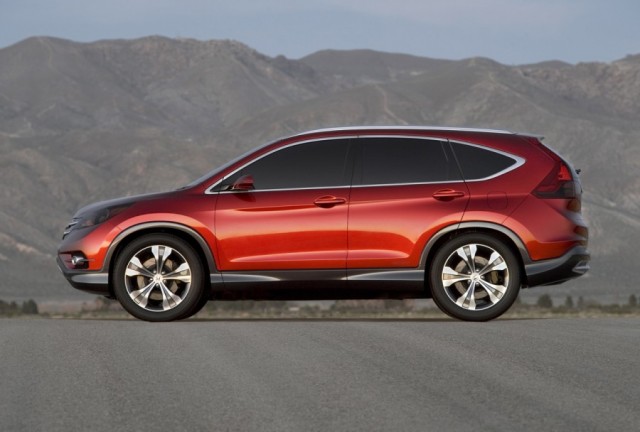
Autoblog caught this camouflaged Honda CR-V testing in the South of France. The 2012 CR-V will be based on the Honda CR-V Concept that will debut at the 2011 Los Angeles auto show to be held on November 16-17.
Autoblog reports the production version will carry over most of the lines and surfaces from the concept. The CR-V definitely needs a revamp in India, so here’s hoping Honda doesn’t wait too long to bring the new CR-V to our shores.
Pictures courtesy: www.autoblog.com

Ron Dennis, Executive Chairman, McLaren Automotive and McLaren Group, announced plans for the subsidiary McLaren Automotive Asia Pte Ltd, based in Singapore that will manage McLaren’s Asia Pacific network.
The first three directors of McLaren Automotive Asia Pte Ltd have been announced as Ron Dennis, Peter Lim, a self-made billionaire from Singapore, who invested in McLaren Automotive in August with significant shareholding and thus joining the executive board and Greg Levine, McLaren Automotive’s Sales and Marketing Director, based at the company’s UK headquarters.
Ron Dennis said: “2011 is a landmark year for McLaren. The new car company comes to life with dedicated McLaren retail partners around the world supplying the first ‘pure’ McLarens that are built in a brand new factory at our UK base. This is an exciting new chapter in our history, and success in the Asia Pacific region is vital to our ambitions. Confirming Peter Lim’s involvement with the company and the setting up of McLaren Automotive Asia shows our ambition for the region that is becoming the world’s focus for premium cars.
“Singapore is the natural location for our regional business. Strategically located with one foot in the east and one foot in the west, it is commercially vibrant and home to successful entrepreneurs and proactive business leaders with a ‘can do’ attitude and an interest in sports cars. We have enjoyed racing success here in the past and I am confident that the region will also prove to be hugely influential in the future for McLaren Automotive.”
McLaren Automotive Asia Pte Ltd., will handle importation, distribution, logistics, sales, marketing, technical support and financial services for McLaren’s range of high-performance sports cars. McLaren has five dedicated retailers in the Asia Pacific region who already hold on average around 18 months of orders for the company’s first ‘pure’ McLaren sports car, the McLaren the MP4-12C.

Do not forget to check back while we try to get some information on McLaren’s plan for India.
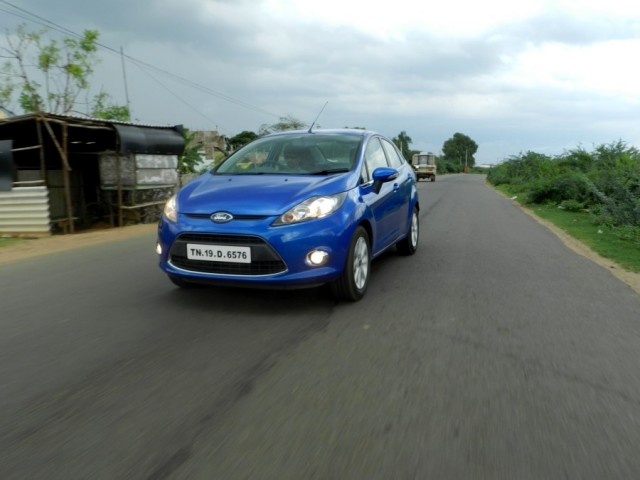



On the East Coast Road
It was a sultry afternoon in Chennai. And a roadside with no trees on either side of the road, was not a good place to be in at this temperature. I waited as sweat beads slowly trickled down my forehead.
The sighting of a car painted in Ford’s signature shade and the ringing of my mobile happened simultaneously. It was my colleagues checking to make sure I was where I was supposed to be – waiting for them at the roadside.
The new Ford Fiesta rolled to a stop next to me. Maybe we should give it a name similar to the new Verna which is called the ‘fluidic’ Verna, I thought. I began to wonder how ‘kinetic’ Fiesta would sound.
The kinetic energy exuberated by the Fiesta was not convincing enough to challenge the powerful thermal energy from the Sun, which meant we decided to do all the talking after we were inside the car and into realm of the air conditioner.
There was only one place where we could get a feel of this car in Chennai at this time of the day. The three of us headed to ECR against the backdrop of the setting sun.


We reached ECR and decided it was time to evaluate the physical traits of the car. A good long look at the car and I felt the design was striking at the front, with the striking-ness withering as you walk towards the rear of the car. Something which makes you ask the question if this was a hatchback first. Which incidentally, is true. But it is not like the Dzire and Manza where the boot feels as if it was welded on as an afterthought. It is just that the same design fizziness is missing at the rear when compared to the front.
If you are interested in knowing more about the design language and the engine of the Fiesta, please do check out our dedicated sections on Engineering and Design on pages 3 and 4 of this article.
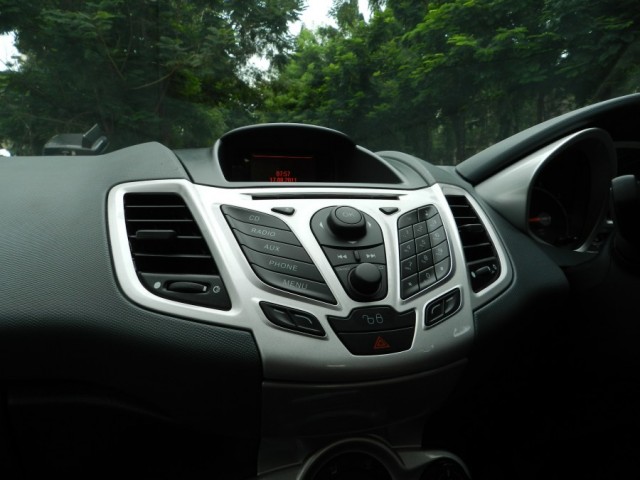
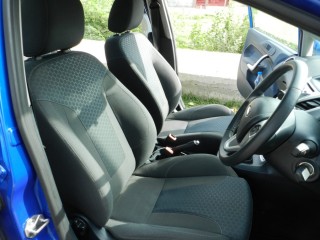
Initial feel inside the car– well laid out controls, chunky steering wheel with the controls for audio and cruise control (as we had got the Titanium variant). Hop on to the driver’s seat and one can feel the bolstered seats almost immediately. I then tried the height and length adjustments of the driver’s seat. The height adjustment was an amusing experience as you have to pump a lever as the height steadily rises. This felt like a massage to the back and the pumping was a good exercise to the arms.
The central console, designed after gadgets these times, has panels painted silver, not unlike how the rest of the body panels are painted. Quality of the other plastics though – disappointing, in one word. The glovebox felt flimsy, the plastics were too, err… ‘plasticky’. Not that it was bad but we don’t expect this in a car in this segment. One look at the interiors of the Vento and you know what we mean.


We then tried playing around with the by now famous voice activation system. We were able to set the temperature on the climate controlled AC without much of a vocal effort. We will have more on this and the sound system later.
One of my colleagues was already not happy where he was – at the back bench, saying it was not as good as his second generation Honda City. We decided to check it out and understood what the complaining was about. Even though Ford’s are known to be ‘driver’s cars’ their treatment of the rear benchers has always been questioned. Both the Ikon and Fiesta did not have great rear leg room. The Figo was the car which helped their case by being more generous to large families. But things haven’t remained the same with the new Fiesta. The rear leg room is still just adequate.

As we moved on ECR, we came across a side road which led to the sea. This road looked like it was going to be a good test for the ride of the car. We turned into it and were amazed at how well mannered the car was on the undulated road. The high ground clearance gives you the confidence to let the car run over the potholes at pretty decent speeds.
Coming to what’s under the hood, the Fiesta now comes with an all new 1.5 litre petrol engine which generates around 110PS. So the engine is smaller than the previous Fiesta but makes more power. Wow… That might translate into more fun on the road, I had said aloud. We couldn’t wait to find out.
We let the car sprint the moment we encountered an empty stretch of the road. And sprint it did. But in a controlled, less aggressive manner. This is in spite if this being the petrol car and of course this is not what the previous generation Fiesta was known for. No necks pinned to the headrest, no adrenalin pumping surge…
That is when we got the feeling that the look of this car does not complement the engine that it has. It is evident that Ford has played it safe when it came to the pricier fuel. It has tried to find the balance between outright performance and fuel efficiency, two parameters which are almost mutually exclusive. Not that this is a bad thing considering the current prices of petrol. But fans of the previous generation Fiesta might feel slightly disappointed. With these thoughts in mind, we watched the sun set and decided to head back to the city and into thick traffic.
The traffic meant we could test another facet of the car – how it behaved in choke block situations. The first thing that you realise is that even though the low range grunt is not mind blowing, it is more than adequate to keep the car rolling along in second and third gears. Fuel efficiency was shown as 10.5 to 11.5 while navigating through traffic which was appreciable for a petrol car.
My colleagues then dropped me home, after we having decided that tomorrow was the highway day where we would test high speeds and handling among others.
Cruising the by lanes of Chennai

At dawn the next day, as we were traversing some of Chennai’s posh localities towards the highway, a thought struck us.
It actually hit us while we were taking pictures of the car at various places. The kinetic design seemed to complement certain backgrounds better than others. Parked in a dusty road, next to old buildings, it seems futuristic. Seemingly out of place. But parked next to a snazzy new mall or shopping complex with geometrical shapes and lots of glass panes and windows, it seems to be perfectly at home. Take a look at some of the images let us know if you agree!


The question above is becoming more and more inconvenient if you are either a Valentino Rossi fan or an Italian motorsport journalist. When Valentino Rossi went to Ducati amid the celebratory sounds of bugles and the blaring of klaxons it was thought that Italy’s favourite son was going to decimate opposition on an Italian motorcycle icon. Then the first test after the last round of the 2010 championship happened. Rossi went very slowly on the Ducati to finish 15th on the timing sheets, as good as slowest and last. Casey Stoner who got off the Ducati and hopped on to a Honda went fastest, straight out of the box, exactly like he did in 2007 when against all expectations he went super fast on the Ducati and took victory in the first race and finally the championship itself. In that process he made Valentino Rossi look very ordinary and that ruffled Rossi so much that he threatened to quit Yamaha if Masao Furusawa did not take greater interest in matters. He also asked for Bridgestone tyres which Stoner was using and got his way. In the process Michelin was so demoralized that after a couple of years they quit MotoGP.
The devotion that Yamaha showed to Rossi and the hard work that Rossi and Jeremy Burgess his crew chief meant that the following year Rossi could wrest the initiative back from Stoner and went on to claim the championship in 2008 and 2009. Even while Rossi was winning championships a threat to his supremacy was brewing across the Yamaha pit garage on the other side of the wall. Jorge Lorenzo, young, ruthless and ambitious (some would also say disgusting but that is another story) was making his intentions of wanting to be MotoGP world champion very clear and that meant that he would not play second fiddle to Rossi. Rossi and Burgess were insisting at every possible juncture that Lorenzo was reaping the fruits of the plants whose seeds were sowed and nurtured by Rossi.
 Meanwhile at Ducati things were not exactly quiet. Two things were happening there. One was that Casey Stoner’s victories were becoming more sporadic and he was crashing a lot more just like when he started racing in MotoGP on a 990cc Honda (with LCR). But he was still winning and finishing on the podium quite regularly. The second thing was that Loris Capirossi was out of Ducati after being Stoner’s teammate for a year. Loris Capirossi won the odd race but his record on the Ducati of whatever cubic capacity was no match for what Stoner had done in 2007. So Loris Capirossi leaves Ducati to go to a non performing Suzuki team where he continued a few more barren years in MotoGP. Loris Capirossi was replaced by another Italian Marco Melandri. Marco Melandri appeared pathetic on the Ducati with just one decent top five finish in China but otherwise ending up at the tail end of the field, much like Toni Elias this year. Melandri was so embarrassed by his non-performance that he hung his head in shame and voluntarily left Ducati and was replaced by Nicky Hayden.
 Nicky Hayden was the world champion in 2006 on the 990cc Honda, though many would argue that he became one only because of the lack of reliability of the Yamaha. Whatever maybe the case, Hayden was a world champion. When Nicky Hayden was announced as Melandri’s replacement there was a lot of talk about how Hayden’s style was more like Stoner’s and how they would make a super duper team. Unfortunately for Hayden no such thing happened, even though it must be said that he managed to acquit himself a little better than Melandri had. But on the whole he too was spectacular in not getting to grips with the Ducati. By the time Hayden had gone to Ducati in Melandri’s place, one big change took place technologically on the Ducati Desmosedici. Till 2008 Ducati had raced a motorcycle with a conventional frame, but unlike the Japanese motorcycles which used an aluminium twin spar or Delta box frame, Ducati was using a steel trellis frame.
 For a moment just let us get a wee bit technical here. We Indians have grown on antediluvian motorcycles of capacities of 250cc or 350cc or on 100cc pocket rockets such as the RX 100 from Yamaha and to some extent the KB100 and KB125 two stroke motorcycles from Kawasaki-Bajaj. The antediluvian motorcycles such as the Yezdi and the Enfield Bullet had handling characters that could make Tata and Leyland trucks feel like they were Formula1 cars. But the Japanese motorcycles handled quite well and one of the key reasons for that was a frame that was flex free. Flex free frames are rigid and actually give confidence to the rider but only if they are tiddlers like the Indo-Jap 100cc bikes. But bigger bikes that put out 150 bhp to 200 bhp would spit the riders off if they were completely rigid. Enter Japanese ingenuity. Instead of using steel for the frame the Japanese started using aluminium that is more friendly to building flex at the right places so that the rider is not thrown of the bike. Over a period of time the Japanese had perfected the art of building Delta box aluminium frames that could be tuned as per the necessities of the riders and their different styles.
 Ducati’s steel trellis frame was trying to do what the Delta box frame was trying to do i.e build flex to make the motorcycle handle better. The philosophy of the trellis frame is that it is built in a way where the vertical steel pieces are welded at different angles to build flex and this is actually imprecise. Filippo Preziosi the builder of the Desmosedici believes that it was the trellis frame that was ultimately the undoing of Melandri. He therefore experimented with carbon fibre and built a monocoque chassis of sorts wherein the engine was used as a stressed member. Preziosi argued that carbon fibre lent itself to dialling in flex the best from all available methods. He was actually trying to overcome the problems of the trellis frame without doing what the Japanese were doing for that would only give them an advantage.
So when Rossi sat on the Ducati for the first time he was sitting on a motorcycle of this variety that found limited success in Stoner’s hands. In fact, when an even firing order was used in the Ducati engine (screamer engine) and when this was mated to the monocoque it seemed to give Stoner better feed back than it was doing when Ducati shifted to the uneven firing order or Big Bang or growler engine and mated it to the monocoque. Stoner only won three GPs and all of them after the Motorland Aragon GP (including it). When Rossi rode this motorcycle to 15th on the timing sheets, most people thought it was just a small thing. Rossi too simply said that the “Ducati should be ridden differently, in a more dirty sort of way”. Then the 2011 season began and Rossi has looked far from being a winner. His detractors were overjoyed and one among them was Casey Stoner. Stoner had been vexed by criticisms by Rossi fans and their booing every time he won a race. He was also put off by the sympathy that journalists had for Rossi.
Rossi is not only a very skillful rider but one who knows how to keep journalists happy. He could hold press conferences where he would pull a chair and sit in their midst and with great charm and grace field their questions. He knew most by name and made it a point to use their names while answering questions. The same journalists fraternity has now started defending Rossi. They say that Rossi looks ill at ease with the Ducati and after months of investigation have declared that it is the bike that is a dud and not the rider. It also helps immensely that Loris Capirossi who returned to the Ducati fold found himself more on the asphalt than on the bike as did his teammate at Pramac Ducati, Randy De Puniet. Nicky Hayden too has not been going very well and so the popular verdict was that it is the bike and not the rider. Stoner however has been queering the pitch by questioning Rossi’s inability to ride the bike even after truck loads of Marlboro and Ducati money are being thrown. Those questions have become very inconvenient with all of Rossi’s experiments with the Ducati in terms of various designs of chassis and different materials being used, all leading to no improvement of any kind.
 So is Stoner the better rider? In the face of the overwhelming evidence that is available to us today, the answer has to a yes, however inconvenient that maybe to the Rossi fan. Italian journalists are at a wit’s end to deny this. If you deny then you vilify an Italian marque’s motorcycle and if you don’t then you damn an Italian great who is a nine times world champion, seven of those in the premier class and five in the four stroke class and four on the Yamaha to make it the most successful marque in the 800cc era. Rossi humbled the might of Honda and resurrected Yamaha by making it rise from the ashes. Dani Pedrosa, Andrea Dovizioso, Marco Simoncelli and before them Nicky Hayden could not bring the world championship in the 800cc era to Honda. That may well have been the case this year too if it wasn’t for Casey Stoner who is riding the wheels of the RC212V and looks certain to take his second world championship and the first for Honda in the final year of the 800cc era. This at a time when Rossi is languishing at the back of the field and generally making up the numbers. So it does appear as if Stoner is a better rider especially since both he and Rossi rode the same bike from last year and where Stoner won and Rossi looked like anything but a winner. But then life’s mysteries are seldom so easy to resolve. So let us consider a few things.
When Casey Stoner jumped on to the Ducati in 2007 he was all of 21 yrs old and eager to prove his mettle as a rider. He was fearless and took risks to establish himself. Remember he won the championship on a trellis framed bike. Rossi got on to the Ducati when he was 31 years old. It is well known that advancing age makes people more aware of their mortality and therefore fewer risks are taken. Rossi also went as one of the greatest champions of all time. So the determination to explore the outer limits of a bike could be missing. In fact, the ego of the nine time world champion must have felt that it was up to Ducati to give him a winning bike and not up to him to make the bike win. He also thinks he is this great development rider and so has taken on the onerous responsibility to developing the Ducati into a rider friendly bike. In doing so he has found that he is just a rider and Ducati did not have the wherewithal to build an aluminium space frame or delta box. So everyone is struggling. Perhaps what Guy Coulon of Tech3 had to say when it comes to riders is very important here. Coulon is the person who designs the Moto2 frames for Tech3 apart from being Colin Edwards’ crew chief. In an interview with David Emmett a renowned journalist when questioned about the lack of innovation in frames, Coulon said that innovation in MotoGP is limited by the fact that rider’s want what they are used to. He believed that conventional delta boxes delivered a certain kind of feedback that a rider to could process but if the nature of the feedback changed then the rider does not know how to process it. That is perhaps where the answer to Rossi’s problems lies. After years of riding Japanese machinery and with advancing age Rossi could be finding it difficult to process the information that he needs to. A younger, eager and needing to prove himself Stoner had perhaps been able to do that. No wonder then that Preziosi said that he would once like to have Stoner ride the Ducati to see where they really are. Good thought but in the complex world of MotoGP contracts that is never going to happen. And so we will never really know for sure as to who is better, Stoner or Rossi.

After months of speculation, spy photographs and rumours, Yamaha finally launched their R15 V2.0 early this month. Now that the dust has settled, we can analyse in detail about this launch from Yamaha.
Even though R15 has been in the market for some years now, there is nothing wrong in Yamaha calling the V2.0 as a new bike. It has got a totally redesigned rear, an all new ECU and new alloys, to talk about some of the changes. Compare this with some other bikes that are garnished with a new sticker and rechristened “New”, and we can come to the conclusion that there is a lot new about the V2.0.
The changes in the V2.0 should have delighted some and disappointed others. And both the groups of people would have ample reasons to support their claim. Let’s look at some of the reasons for delight and some for despair.
The R15 is one of the best bikes in India. There is no other way to put down this fact. Yamaha, which as a manufacturer, was down in the doldrums, rose from its ashes with this bike and the FZ. It was a slap in the face of the Indian two wheeler industry. When makers were extremely cautious with their new designs, Yamaha had the guts to bring out two stunning bikes. Yamaha fans rejoiced and felt they were vindicated. Their favourite manufacturer has shown what it was truly capable of. At that time, the Japanese bike makers were criticised of being too cautious and being bothered about volumes when they were capable of bigger bikes. Yamaha took the steps to bring India’s first sports bike for the masses, something which was expected for a very long time.
The bike was an instant hit. It was the first affordable sports bike in India which had the looks that were in line with the legendary R family of bikes from Yamaha. The fact that it had a 150cc engine, in spite of it being liquid cooled and fuel injected, didn’t go down well with those who had expected more power. But Yamaha wanted to keep it to a budget and was very sure of its plans. And anyways, the looks of the bike made sure that the engine capacity was not much of a dampener.
One of the few sore points that were brought up was the rear of the bike. The bike seemed to have true R style front but the rear seemed a compromise. The tail lights looked ordinary and the bulky nature of the bike meant that the 100mm tyres looked thin on the rear. Yamaha seemed to have tried to find the balance between practicality and being radical with the rear of the bike.
This brings us to a primary reason for delight on the V2.0. The rear has been redesigned and now the bike looks totally revamped. The compromising design of the rear seats on the earlier bike has given way to step up seats and the tyre sizes have been increased to 130mm. And the tail lights have now gone the LED way. Yamaha, just like a good manufacturer should, has gone ahead and incorporated the user feedback while designing the new bike.
The V2.0 also receives 10 spoke alloy wheels. Not that this was a problem with the earlier bike, but the new look gives it a feeling of lightness. The design of the exhaust, with the R15 logo on it, also has a look of class. With the combined effect of all these changes, the bike is now sportier than ever, menacing and ready to pounce from all angles.
So far, we have discussed about all the happy and positive things about the V2.0. But there were some factors before the launch of this bike which lead the expecting public to think that the V2.0 would be a different bike than what it is now. We can try to understand some of these factors.
When Yamaha launched the R15, they were appreciated for being brave. For trying to believe that India was ready for such a bike. It was only normal then, that Yamaha was expected to continue doing this and keeping pushing the envelopes of bike segments in India. These expectations lead to hyper rumours and speculations whenever a supposed Yamaha was to be launched.
After the R15, Yamaha kept updating their products and introducing new ones. But the updated products were different colour schemes and minor tweaks, and new products were bikes based on their existing 150cc engine. When the different colour schemes and tweaks are required to keep the volumes coming, the original expectations which were for bigger, trendsetter bikes, remained unfulfilled with Yamaha refusing to go beyond 150cc.
This is when Honda comes into the picture. Here is one manufacturer which is known for its ultra sensible and slow mannerisms. They had made it obvious that most of their new launches would be in the volumes segment. The talks about a bigger bike were rare and it was evident that with their super cautious approach, there wouldn’t be such a bike till they had covered all their bases with the right market surveys, studies and analysis. It was almost a given that Honda would be the last manufacturer to give India the next trend setting bike.
And out of the blue, late last year, we get confirmed reports that Honda’s newly developed CBR 250R, with prices within 2 lakh INR is destined for India too. This news single handedly changed the equation for the R15 in India. There was going to be a challenger to the leader of ‘wallet friendly performance bike’ category in India. The sleeping, dormant Japanese giant had shocked us all with their new offering.
This brings us to the primary reason for despair with the launch of the V2.0. With impending rumours about the testing of a new Yamaha bike, Yamaha aficionados and Indian motorcycling enthusiasts alike looked upon this opportunity as a chance for Yamaha to make a fitting reply. A thrilling competition among two Japanese majors was expected. When the spy shots of the new bike from Yamaha were doing the rounds, there were speculations galore that this might not be just a new R15 but it might be Yamaha’s bigger engined answer to the CBR. But all this was not to be.
Looking at it, there is a lot of sense in what Yamaha did. In terms of real world performance, the R15 will not lose sight of the CBR on the road. And considering the fact that the R15 is a dedicated track tool whereas the CBR is more for the road than the race track and that the R15 is still a good 30-40K INR lesser than the CBR, the Yamaha still has a lot of points going for it. But in our country which is fixated about the engine capacity (we had 150, 160, 180 etc.); a CBR 250 meant that Honda had already won the first battle. If, like the rumours regarding the bike being a CBR 150 had been true, the plane would have been much more even and with the V2.0, Yamaha would have had a more than worthy competitor on their hands. For now, round 1 of this battle does go to the CBR.Yamaha fans and Indian motorcycle enthusiasts will be keenly looking forward to a round 2 of the battle and Yamaha’s fitting reply.
Kawasaki sells a 150cc Ninja in the Indonesian market. It comes with 30 PS of power and has a Mikuni carburettor and double cradle frame mated to a swing arm made of aluminium. This model is heading for a facelift according to Indonesian blogger Taufik whose blog is called TMCblog.com. He has posted pictures of the facelifted model without the Kawasaki stickering but in the typical Kawasaki green and featuring design cues from the Ninja 250 R. Now this little fella is powerful and handsome but to call it a ZX 150 RR is a little too difficult to digest. Motoroids.com is speculating that this motorcycle may make it to India but that is unlikely given the fact that the Indonesian spec engine is unlikely to pass the Indian pollution norms. To meet the pollution norms the engine will have to be detuned and this motorcycle will go up against the Yamaha R15 which is the bench mark. From the specs it does not seem like the Kawasaki can match the handling of the R15 which uses a delta box frame. But if it is sold for the price of a Fazer, it may go down well with the Indian youth. But does Bajaj want competition to its own Pulsars? Anyway please feast your eyes on the pictures, there is no harm in that.


 The first ever Formula1 Grand Prix of India will be held from the 28th to the 30th of October, 2011 which is needless to say in the very immediate future. So far there have been no pictures of what the track and facilities look like since the promoters Jaypee were keen to ensure that no unnecessary rumours are circulated. However, yesterday the company itself released some pictures of the track and grand stands and they seem to be very impressive and there will be no unsavoury drama of the Commonwealth games variety. That is good news indeed.


In a bid to improve sales during the festival season, TVS Motor Company has launched a limited edition Star City with the bike having been signed by the Star City brand ambassador and the dashing Indian cricket captain Mahendra Singh Dhoni. TVS uses another cricketer Virat Kohli for the Sport model. The changes are only confined to new colours and new graphics and the mechanicals remain what they are.
