2014 Chevrolet Corvette Stingray 01

Say hello to the new Stingray! The Chevrolet C7 Corvette as it was known to us before the official reveal at the 2013 NAIAS at Detroit marks the return of the iconic ‘Stingray’ name. Chevrolet says only a Corvette with the perfect balance of technology, design and performance can wear the Stingray designation. This is only the third Stingray in the history of Corvettes. The first was the second generation C2 Corvette which was known as the Sting Ray and the second the very popular C3 Corvette which was of course, the original Stingray. Powered by a 6.2 V8 the new Corvette Stingray makes around 450 horsepower and delivers a peak torque of 610 Nm and accomplish 0-60 in less than four seconds. Riot Engine presents a detailed look at the styling of the new Corvette as well as the technology that makes the new Stingray tick in this Design & Tech article.

Styling

2014 Chevrolet Corvette Stingray : Hood
2014 Chevrolet Corvette Stingray : Vents
2014 Chevrolet Corvette Stingray : Exhausts
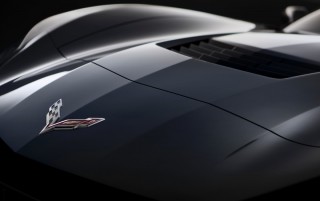
2014 Chevrolet Corvette Stingray : Stingray Badge

..more angular crossed flags logo

2014 Chevrolet Corvette Stingray : Crossed flags

2014 Chevrolet Corvette Stingray : Rear“For the new Corvette to be called a Stingray, it had to deliver an incredible, purposeful visual impact – just as the original did in 1963,” said Tom Peters, exterior design director. “That visual impact is evident in fighter jets and the Stingray animal itself. Their beauty comes from their purpose, designed to cut through air or water as quickly and efficiently as possible. As with aircraft and living forms, every transition on every surface of the Corvette Stingray serves a purpose executed with beauty and proportion.”

The new Corvette Stingray draws from aerospace as well as nature to that effect and the most distinctive feature would be the profile defined by the long hood and the glass area evoking the canopy of a fighter jet with of course, the dual-element tail lamps.

Lighting features of the Corvette set the tone for the aggressive stance of the new Corvette Stingray. Indirect white LED light forms a signature slash in the headlamp that is the daytime running lamp. The HID projector is housed in a black-chrome lamp housing up front. The rear receives the biggest change seen in the design of the Corvette. The afterburner inspired dual taillamps are no longer circular. The lens elements are sculpted and houses LED lamps that are hidden and used to cast their light up from the bottom of the housing into a reverse reflector, creating an even glow. LED lamps are also used for the white backup lamps. The tail lamps integrate functional aircraft-style air vents that are actually functional and remove warm air from the differential and transmission coolers.

Do note that the 2014 Chevrolet Corvette Stingray also wears the Stingray badge just above the side vents.

2014 Chevrolet Corvette Stingray : Rear 3/4

Aerodynamics

2014 Chevrolet Corvette Stingray : AerodynamicsAs you would expect, a lot of work has gone in to designing the new grille/radiator arrangement and the hood vents. Venting air out of the hood reduces total front-end lift for improved steering response at high speeds. Vents on the front fender as expected, reduces underhood pressure and reduce drag. Models with the automatic transmission or Z51 Performance Package feature a functional vent on driver’s side ( left, in the US) directing air over a heat exchanger for the transmission fluid. There’s also a similar arrangement on the passenger side that directs air over a heat exchanger for the electronic limited slip differential. As we’d mentioned earlier, the air through these vents exit from the vents housed in the tail lamps. The Z51 Performance Package also includes brake-cooling ducts, a unique rear spoiler and additional air deflectors for enhanced track capability.

2014 Chevrolet Corvette Stingray : Aerodynamics

2014 Chevrolet Corvette Stingray 14

Chassis & Powertrain

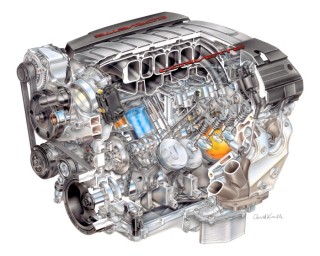
2014 Chevrolet Corvette Stingray LT1 6.2L Small Block V8 David Kimble Illustration
Illustrated by David Kimble
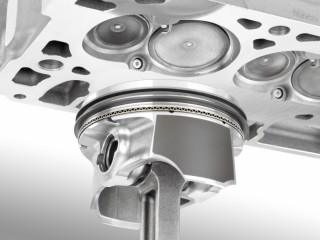
2014 Chevrolet Corvette Stingray LT1 6.2L Small Block V8 Piston And Connecting Rod
2014 Chevrolet Corvette Stingray LT1 6.2L Small Block V8 Piston And Combustion Chamber
2014 "LT-1" 6.2L V-8 VVT DI (LT1) Direct Injection Fuel System for Chevrolet Corvette
2014 Chevrolet Corvette Stingray Active Exhaust System 01
2014 Chevrolet Corvette Stingray 7 Speed
2014 Chevrolet Corvette Stingray : AerodynamicsThe seventh generation Corvette bids farewell to the steel frame and adopts a new aluminium chassis that is 57% stiffer and nearly 45 kgs lighter. Chevrolet has used various composite materials including carbon fiber for the hood and roof panels, lightweight Sheet Molded Compound for the fenders, doors and rear quarter panels, and carbon-nano composite for the underbody panels thereby reducing weight of the body by 17 kilograms.

While the previous frame structure was made of a single continuous hydroformed main frame rails with constant wall thickness of 2mm, the new frame features main rails composed of five customized aluminum segments. The thickness varies anywhere between 2m to 11mm customizing the gauge, shape and strength properties based on actual requirements at that part of the frame leading to again, weight reduction. The frame is assembled using a unique laser welding process in which a computer-controlled beam of high energy joins the components with tolerances of about 0.001-inch!

The lightweight elements of the Stingray contribute to the ideal 50/50 weight balance. The new LT1 6.2 L V8 powertrain delivers a staggering 450 horsepower and a power to weight ratio which throws the new Corvette Stingray into the ring with the likes of the Porsche 911 Carrera, Audi R8!

2014 Chevrolet Corvette Stingray LT1 6.2L Small Block V8

Active exhaust systems are less restrictive than previous generations thanks to the increase in diameter from 2.5 to 2.75 inches. The standard system offers a 13-percent improvement in airflow and features a pair of butterfly valves that makes things quiter when cruising and the engine is operating in fuel-saving V-4 mode.

Optional dual-mode active exhaust system offers a 27-percent improvement in airflow. It features two additional valves that open to a lower-restriction path through the mufflers. When open, these valves increase engine performance and produce a more powerful exhaust note.

The LT1 is mated to either a six-speed paddle-shift automatic transmission or an industry-exclusive TREMEC TR6070 seven-speed manual with Active Rev Matching.
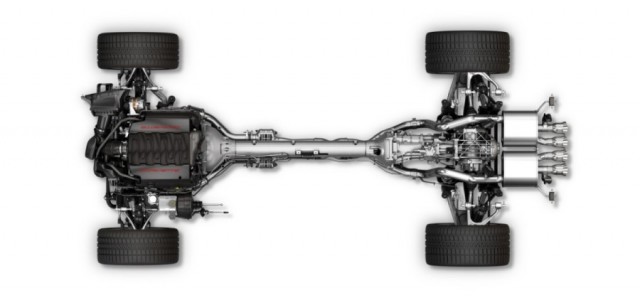
2014 Chevrolet Corvette Stingray Powertrain,  rear transaxle layout for optimal weight balance

The seven-speed manual incorporates rev-matching technology for upshifts and downshifts. This driver-selectable feature can be easily engaged or disengaged via paddles on the steering wheel. The seven-speed is used with a new dual-mass flywheel and dual-disc clutch, which deliver greater shift quality and feel through lower inertia. The transmission with the Z51 Performance Package includes specific close-ratio gearing for more aggressive driving.

Interiors
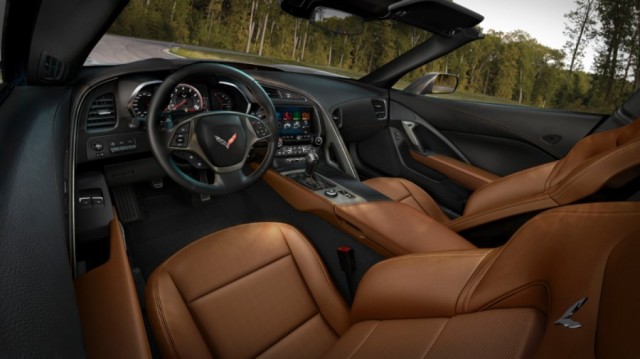
2014 Chevrolet Corvette Stingray Interior 02The Corvette offers you the choice of two types of seat. Comfortable GT seats, or a Competition Sport seat with more aggressive side bolstering which provides greater support on the track. The smaller, 14.1-inch-diameter (360 mm) steering adds to a more direct feel to direction changes. The flat, precise stitching on the steering wheel is designed to provide a smooth, consistent feel.

2014 Chevrolet Corvette Stingray Interior 01

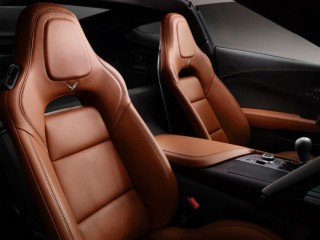
All models feature fully-wrapped interiors. Depending on trim levels, there are choices of Napa leather, aluminum, carbon fiber and micro-suede. A blend of hand craftsmanship and machined precision is intended to ensure the fit, finish and ambience of the cabin is first-rate, says Chevrolet. The leather-wrapped instrument panel, for example, features hand-selected and hand-stretched materials for better grain matching with stitching performed by robots that deliver perfect seams.

The new Corvette Stingray seems to have everything in its favour and while the use of the Stingray will always be debated by the internet, we think it is fitting.

2014 Chevrolet Corvette Stingray Interior 06
2014 Chevrolet Corvette Stingray Interior 052014 Chevrolet Corvette Stingray Interior 04
2014 Chevrolet Corvette Stingray Interior 03

2014 Chevrolet Corvette Stingray Interior 08
2014 Chevrolet Corvette Stingray Interior 07

2014 Chevrolet Corvette Stingray 16

Technical Specifications

Engine LT1 6.2L V-8
Displacement (cu in / cc): 376 / 6162
Bore & stroke (in / mm): 4.06 x 3.62 / 103.25 x 92
Block material: cast aluminum
Cylinder head material: cast aluminum
Valvetrain: overhead valve, two valves per cylinder
Fuel delivery: direct injection
Compression ratio: 11.5:1
Horsepower / kW: 450 / 335 (est.)
Torque (lb-ft / Nm): 450 / 610 (est.)
Transmission seven-speed manual with Active Rev Match
OR
six-speed paddle-shift automatic
Suspension Front: short/long arm ( SLA) double wishbone, cast aluminum upper and lower control arms, transverse-mounted composite spring, monotube shock absorber
Suspension Rear: short/long arm ( SLA) double wishbone, cast aluminum upper and lower control arms, transverse-mounted composite spring, monotube shock absorber
Active handling: Magnetic Selective Ride Control (avail. with Z51)
Traction control: StabiliTrak, electronic stability control
Brakes front and rear power-assisted discs with four-piston fixed front and rear calipers (slotted rotors with Z51)
Rotor diameter (in / mm): front: 12.6 / 320 (13.6 / 345 with Z51)
rear: 13.3 / 338

Wheel size: front: 18-inch x 8.5-inch (Stingray)
front: 19-inch x 8.5-inch (with Z51)
rear: 19-inch x 10-inch (Stingray)
rear: 20-inch x 10-inch (with Z51)
Tires: Michelin Pilot Super Sport run-flat
front: P245/40R18 (Stingray)
front: P245/35R19(with Z51)
rear: P285/35R19 (Stingray)
rear: P285/30R20(with Z51)
Wheelbase (in / mm): 106.7 / 2710
Overall length (in / mm): 177 / 4495
Overall width (in / mm): 73.9 / 1877
Overall height (in / mm): 48.6 / 1235
Weight distribution
(% front / rear):
50 / 50

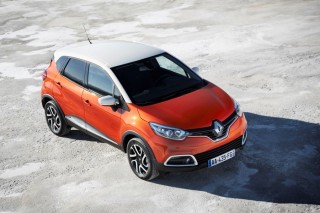
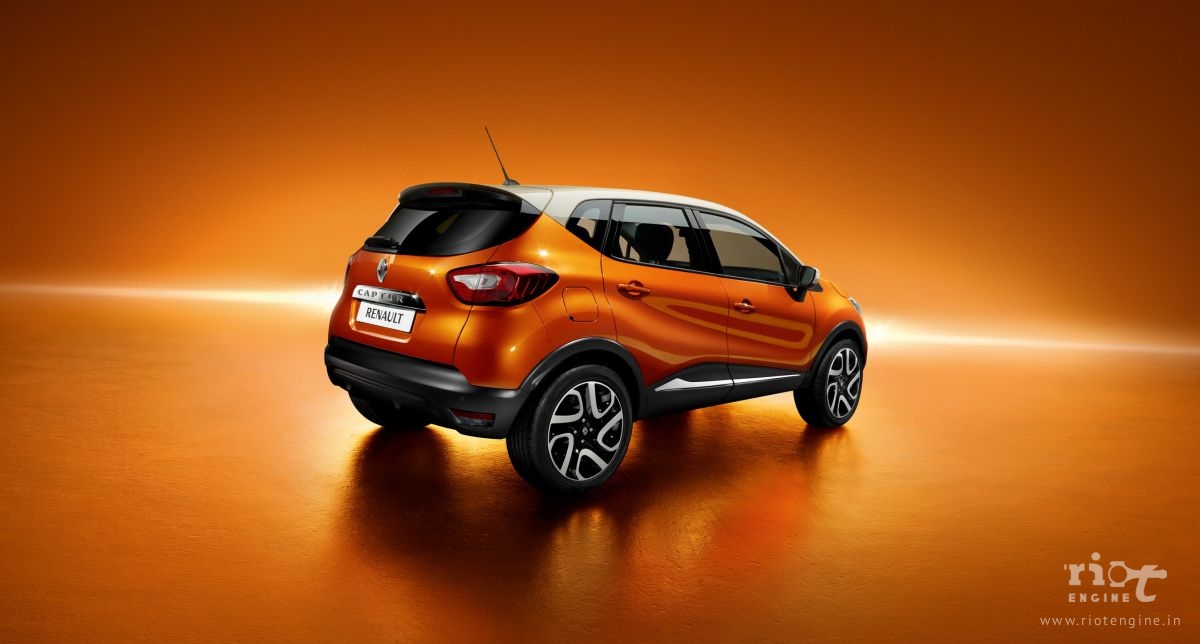
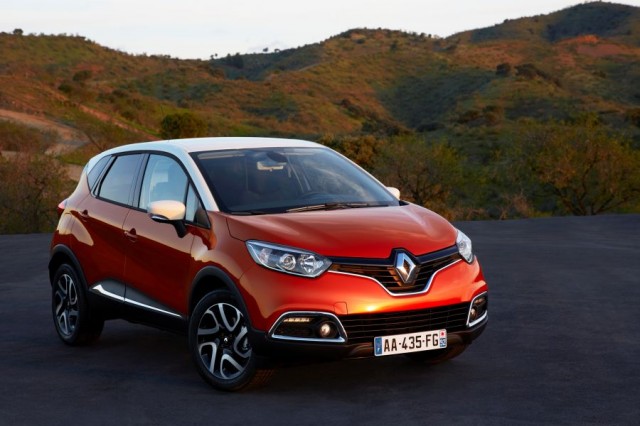
Renault Captur Production Urban Crossover 01

The Renault Captur concept starred in the 2011 Geneva Motor Show as Renault’s idea of an urban crossover. The Captur was one in a series of four designs under the stewardship of Laurens van den Acker, Senior Vice President, Design Renault. The series which included the luscious DeZir, R-SPACE, FRENDZY and of course the Captur was inspired by Renault’s ‘Drive the Change’ motto. After more than just a year, Renault has announced the production version of the Captur, which retains the name and the basic ethos of the concept, but has a host of welcome additions in its production guise.
Renault Captur Production Urban Crossover 02

Renault Captur Production Urban Crossover 06

Renault Captur Production Urban Crossover 05
The Captur is built on the Renault-Nissan alliance’s B-Platform shared by the Nissan’s Note, Juke and Renault’s Clio III, Modus. The highly successful Renault Duster is also built on B0, a platform derived from the B platform. Renault presents the Captur as an urban crossover that brings three important elements of design together in a single package. The styling of an SUV, the practicality of an MPV and the handling of a compact sedan.

Styling like an SUV

Renault says the Captur form is smooth and balanced. While the lines make the Captur seems unpretentious, the steeply raked windscreen says otherwise. The Captur in front three quarter angles seems extremely dynamic. Renault also has swathed the Captur in a two tone finish and we have to say it looks stunning!

Renault says there will be a number of customization options for both the exterior and interior of the Captur. The interior, Renault says will be warm and relaxing thanks to the colourful cabin. Renault is also providing a selection of interior customisation solutions based on a choice of colours and motifs for the different trim features.

Renault Captur Production Urban Crossover 03

Practicality like an MPV

The Captur has a small footprint, yet has a very airy cabin. At a length of just over 4.12m the Captur is smaller than the Juke by 15mm. The MPV theme carries on into the interior with a high-up driving position, large boot, modular interior and innovative stowage solutions.

The standard Renault Captur will have an equipment specification found only in vehicles up a segment. Keyless entry, hill start assist and rear parking sensors are some of them. Also available will be the new, connected, in-dash Renault R-Link touchscreen multimedia tablet, plus an entertainment system that comprises six loudspeakers, Bluetooth® connectivity, audio-streaming and Arkamys® hi-fi sound.

Renault Captur Production Urban Crossover 08

Agility of a Sedan

Renault Captur builds on the confident driving manners on another car the shares the B platform, the much acclaimed New Clio. Renault leads us to believe the Captur will deliver best-level dynamics, from road holding to engine response and agile handling. In addition, the combination of its compact volumes, raised ground clearance, large-diameter wheels and sill guards will also enable it to handle surfaces that aren’t smooth tarmac.

Autocar points out that the engines available will be the latest 89bhp 0.9-litre turbocharged three-cylinder petrol and 89bhp 1.5-litre turbodiesel from the Clio. Renault says these engines will offer best in class fuel consumption and CO2 emissions, starting from as low as 96g/km.

Renault Captur Production Urban Crossover 07

Renault Captur Production Urban Crossover 09

Renault Captur Production Urban Crossover Interiors

Renault Captur Production Urban Crossover 11
Renault has website for the Captur that goes live from the 5th of March 2013. Renault Captur will be manufactured at Renault’s Valladolid plant in Spain and will be unveiled at the forthcoming Geneva Motor Show in March.

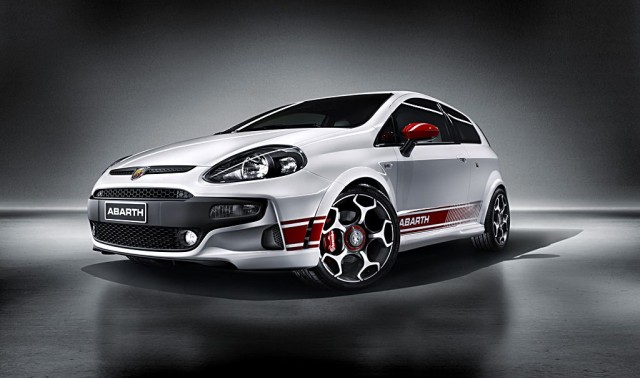
Abarth Grande Punto 01

Autocar India reports that Fiat might bring in a localized version of the Grande Punto to India as soon as this year. The asking price for such a performer is said to be in the 8-9 lakh region!

It is speculated that the company might use the existing 1.4 litre T-jet engine, increase power output to around 165 HP and improve handling capabilities by stiffening the chassis, swapping the springs for stiffer suspension and improved brakes.

ACI also thinks that this might be a four door version rather than the usual Abarth two doors. Expect a clearer picture in the new few months.

Source : Autocar India

There is of course, the Abarth Grande Punto based on the newer Punto with the new face. We aren’t exactly sure which one the desi Abarth Grande Punto will be based on, but honestly we hope its the older one, maybe with alloys from the newer one!

Abarth Grande Punto 03

Bajaj Kristal 01

With Rajiv Bajaj at the helm, Bajaj Auto started transforming itself from a successful scooter manufacturer to a successful motorcycle manufacturer. The Pulsar and Discover brands have been around a long while now and have helped cement Bajaj’s reputation as a motorcycle brand. The second attempt by Bajaj at making scooters was but a miserable flop. Models came and went with none making much of an impact on the market.

Autocar India now reports the Bajaj might be set to launch another scooter in the next few months. The scooter is said to be powered by a single cylinder 125cc- 150cc engine. It is as yet unknown if the engine will be yet another DTS-i mill. Telescopic forks, larger wheels than on any other scooter in the market are expected to make the scooter stable and handle well on tarmac.

Source: ACI

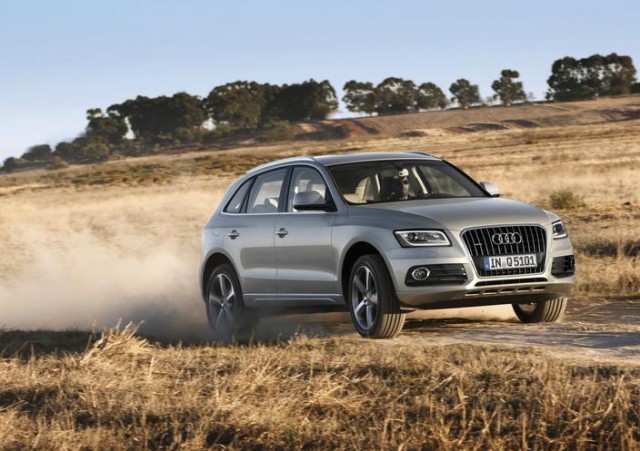
Audi Q5 Facelift 01

Audi has launched the Q5 facelift starting at a price of Rs. 43.16 lakhs. The changes are mostly on the grille, headlamps and bumpers. Audi says three engine options are available including the 2.0-litre petrol, 2.0-litre diesel and finally the 3.0-litre diesel.

Prices

2.0-litre petrol Rs 43.16 lakhs
2.0-litre diesel Rs 43.47 lakhs
3.0-litre diesel Rs 48.71 lakh

All prices are ex-showroom, Delhi.

Audi also claims that the new Audi Q5 is 15 percent more fuel efficient that its predecessor.

Audi CES 2013 Swarm 02

CES 2013 plays host to manufacturers showcasing their latest products and technology. CES 2013 at Las Vegas has so far given us a preview of the numerous 4K televisions, the NVIDIA Project Shield gaming console, innumerable cameras, smartphones and more. Automotive brands like Audi and Toyota have showcased their ‘self-driving’ cars while manufacturers like Ford and GM have announced initiatives aimed at enhancing the user experience with regard to cars and smartphones. Audi, a much loved favourite for auto enthusiasts for bringing Daytime Running LEDs to mainstream cars with style, showcased some phenomenal designs enabled by new advances in lighting technology. We look at some of them in this Design & Tech article.

Audi Matrix LED headlights

Audi CES 2013 Matrix LED Headlights 01

This phrase is often repeated by Audi at various other shows, Audi says its represents headlight technology of the future. The “Matrix Beam” principle is about dividing the LED main-beam headlight into a large number of individual segments. There are two primary applications of such technology. One, there’s no need for a swivelling mechanism to turn the entire headlamp to light up a corner, two, parts of the light beam itself can be dimmed out to prevent dazzling drivers of cars in the oncoming traffic lane. This is done by switching on/off or dimming the small individual diodes that make up the Matrix. These small diodes are backed by lenses or reflectors to provide excellent illumination without needing a swiveling mechanism.

Audi CES 2013 Matrix LED Headlights 02

The Matrix LED setup uses information from a camera, the navigation system or other additional sensors. As mentioned earlier, the headlights can fade out appropriate areas on the high beam when the camera detects a car travelling in the opposite direction. Audi goes as far to say that the system can also illuminate the areas between several vehicles in complex situations. Like Cornering Headlights Audi can use navigation data to enable the high-beam headlight to anticipate the bend and swivel (not mechanically, but using the reflectors, if we aren’t wrong in out interpretation) to illuminate the road before the driver has even turned the wheel.

With the advent of such flexible lighting technolgy comes the inevitable benefits of stunning new styling of headlights. Audi says the challenges faced will be extremely low tolerances during manufacture and assembly of the components, the methods used to energize the headlights and control them independently, along with the overall efficiency of the package, the uniformity of the conical light beam and the airflow path through the headlights. Audi states proudly that it is in a position to take up these with the confidence that all this tech will be introduced on production cars.

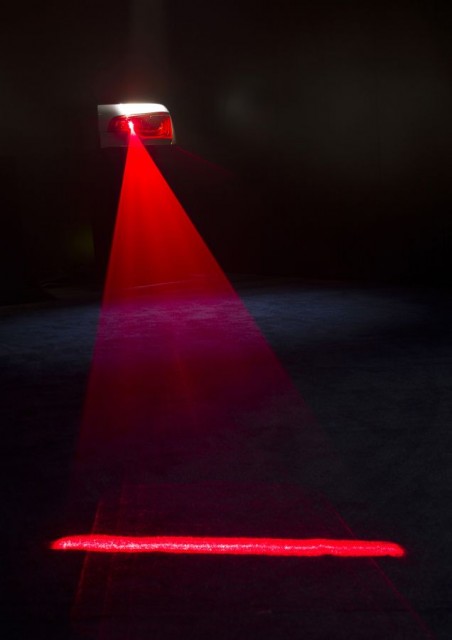
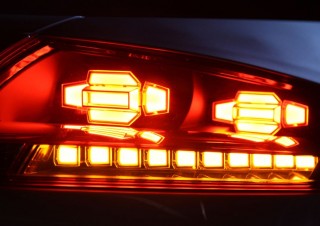
Audi CES 2013 Laser Rear Light
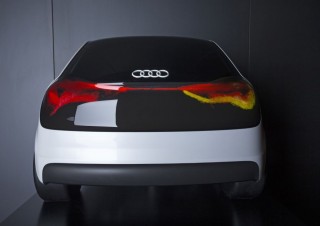
Audi CES 2013 3D design of tail lamps using OLED

3D design of tail lamps using OLED


Audi CES 2013 3D design of tail lamps using OLED
Audi CES 2013 Swarm 05
Audi CES 2013 Swarm 04

Laser tail light

Audi has put to work a laser diode at the rear which lays down a virtual stop line for vehicles behind. The fan-shaped laser tail light shines slightly downward and looks like a red line on the road, which Audi hopes will prompt the driver behind to keep distance. In bad visibility conditions, like fog or spray, the laser beam strikes the water droplets in the air and makes them visible while the virtual stop line is seen as a triangle. The laser tail light looks like a large warning triangle! We like the concept, a lot.

OLED technology

OLEDs use organic materials instead of the semiconductor crystals used in LEDs. If you own a smartphone with an AMOLED screen, you’ve probably experienced the benefits of OLEDs. OLED TVs are the next big thing in television. Audi wants to adopt this tech for external lighting on their cars of the future. Audi claims OLED makes external lights attractive as well as intelligent. These lights can be programmed to react to an approaching driver, follow his or her movements and highlight the main contours of the vehicle or the door handle.

Audi CES 2013 OLED 01

Design model showing design flexibility using OLEDs

OLED Swarm

Audi CES 2013 Swarm 03

Audi engineers have designed a vehicle’s rear end as a large, continuous light surface, with innumerable small points of light flickering like a swarm of fish. The OLEDs can be programmed so that when a right turn is made, they flow to the right, or when the car is braked, they flow rapidly forwards! The swarm can be made to move faster in proportion to the vehicle speed. All this improves the communication of the drivers intentions to the vehicles behind providing for a safer drive.

AMOLED displays for RVMs

Premiered first on the Audi R18 e-tron quattro AMOLED screens will be used in place of conventional rear view mirrors inside the car.

These designs and the technology that enables these designs are stunning to say the least and the best part is, this is just the beginning.

2014 Mercedes-Benz New E Class 2013 NAIAS Debut, Detroit

Following the reveal of the new E-Class sedan and wagon in December and then the Coupe and Convertible in the first week of this month, Mercedes-Benz has nonchalantly published an image showing the new E 63 AMG announcing the new E-Class AMGs. Mercedes-Benz’s 4MATIC all wheel drive system will make an appearance on the new E 63 AMG for the first time in an AMG that isn’t an SUV.

Mercedes Benz New E 63 AMG : NAIAS 2013 debut, Detroit Motor Show

With the obvious styling changes brought by the new E-Class, there are also a series of new BlueDIRECT four-cylinder petrol engines with direct injection technology,a new high performance six-cylinder engine and of course, efficient diesel engines. Mercdes-Benz says all models in the E-Class family will be equipped with assistance systems that will be found in the next generation S‑Class. Active Lane Keeping Assist, anti-dazzle continuous main-beam headlamps (Adaptive Highbeam Assist Plus) are some of them.

Mercedes-Benz also claims that the new E-Class will be priced at almost the ‘same level’ as its predecessor.

Also making its debut will be the much talked about CLA Class. The CLA will go on sale in the US market soon after its NAIAS debut on 14th January 2013.

Mercedes-Benz CLA-Class, CLA 45 AMG, 4MATIC, testing

Shown here is the Mercedes-Benz CLA 45 AMG 4MATIC testing.

Mr. Rajiv Bajaj, MD and Mr. K Srinivas, President - Motorcylcles, Bajaj Auto Ltd. at the launch of company's new motorcycle Discover 100T

Bajaj Auto claims the Discover 100 Tourer is the world’s most advanced 100cc motorcycle. Powered by a 4-valve DTS-i 102cc engine making 10.2 Ps of peak power, 30% more than other 100cc motorcycles, the Discover 100T manages to deliver fuel efficiency of 87 kpl.

At the launch event, Mr K Srinivas, President (Motorcycle Business) said, “For too long, the average commuter had to be satisfied with boring and undifferentiated 100cc bikes. While 100cc bikes do offer good mileage, their style, features and performance leave a lot to be desired. The steady growth of the more expensive 100cc bikes at the cost of the cheaper models is a clear evidence of this. The all new Discover 100T delivers the power of a 125cc with the economy of a 100cc to bring in the joy of riding to this segment. We call it the ‘The Ultimate 100’ as it brings unprecedented levels of power, style and features to this important segment of the market.”

On the styling front, the Discover 100T is identical to the 125ST, well almost with the exception of the rear shocks. While the 125ST features a monoshock the Discover 100T makes do with twin Nitrox suspension. Bajaj was one of the first manufacturers to adopt the strategy of giving more for less to compete with Hero Honda. A number of 125cc motorcycles offering more performance than HH’s 100cc offerings and competitive mileage didn’t do for Bajaj what was expected of them. Bajaj has realized that displacement still rules in the Indian market and anything more than 100cc will just not do for the average commuter looking to get the most of every drop of fuel.

Bajaj has now taken the plunge, gone back to offering 100cc motorcycles but with features loaded to the gills. The 10.2 PS engine ensures you can take the Discover 100T to a top speed of 100kph via the 5 speed gearbox. Electric start is standard as is DC electricals for the headlamp. This ensures flicker free lighting at all speeds. There’s also an auto choke for easy start in all weather conditions.

Bajaj has priced the Discover 100T competitively at Rs. 50,500 ( ex-showroom Delhi)

Ford Ecosport Yellow 01

Image Source Gearheads.in

Mutiple sources have stated that Ford India has met with the Hon’ble Chief Minister of Tamil Nadu Ms.J.Jayalalitha with an invitation to the launch of the much awaited Urban SUV Ford EcoSport. It is said that the Chief Minister has accepted the invitation and the launch is scheduled sometime in mid February 2013.

There have been innumerable spy shots of the EcoSport without any camouflage floating on the web. The compact SUV which until recently was being spotted only in the outskirts of Chennai now has also been spotted in Cochin. Images of the EcoSport in yellow have been doing the rounds at various automotive forums in India and suffice to say, people have their wallet out already.

The five seater EcoSport has an appreciable ground clearance of 200mm with an approach angle of 25° There’s boot space of 346 litres. Expect the EcoSport to flaunt Ford’s most advanced systems including Microsoft SYNC for smartphone integration and voice control, Hill Climb assist, Keyless start and more.

The 1.0 litre EcoBoost engine will play a pivotal role and will probably be the first engine to power the EcoSport in India. Transmissions on offer with the 1.0 litre EcoBoost will be the IB5 five speed manual box seen in the new Fiesta and though the possibility is slim, maybe even the six speed MMT6 for the AWD variant. The 1.5 L Ti-VCT which we first experienced on the all new Fiesta will also be available and play the crucial role of powering the automatic variant which will have the much loved DPS6 PowerShift Automatic transmission box. An in depth look at the various Fords powered by the 1.0 litre EcoBoost shows that there hasn’t been an instance of the 1.0 litre EcoBoost delivering power to a DPS6 PowerShift box, so expect the 1.5 L to power the automatic variant.

We’ve said this before and we say it again, we believe the 1.5 L Duratorq diesel TDCI I-4 will give way for a brand new diesel mill that reflects the sporty attitude of the EcoBoost! At an event celebrating Ford India’s milestone of assembling 400,000 engines in the Chennai plant, Michael Boneham, President & Managing Director, Ford India had two important announcements with regard to the EcoSport. One, was that the EcoSport would be assembled here for the export markets too, second being that while there will be the petrol 1.0 L EcoBoost engine, there will also be a diesel variant, the details of which he did not want to divulge at the time. He pointed out in a lighter vein that he needed to save at least some details for the actual launch event.

Our sources also claim that the petrol variants will be launched first and the diesel mill will follow later, which we belive supports our claims of a new diesel mill.

Pricing has been a topic of hot debate everywhere and there seem to be a multitude of factors, more than one would expect.

While the sub 4 metre length makes the EcoSport eligible for excise duty cuts, this is applicable only for the 1.0 litre EcoBoost and the diesel mill variants. The supposed base variant of the EcoSport which is expected to be powered by the 1.5 L Ti-VCT engine through the five speed manual transmission, will be denied excise duty benefits ( petrol engines capped at 1.2 litres displacement for eligibility) which plays havoc in any pricing estimate.

An interesting discussion is on at popular automotive forum Team-Bhp.com

1.5L petrol MT
1.0L Ecoboost (1.5 MT + 50K/-)
1.5L petrol AT (Ecoboost + 25K/-)
1.5L diesel (1.5 AT + 25/-)

Originally Posted at Team-Bhp.com by swiftnfurious

A pretty good estimate we think, but for the positioning of the 1.5 L AT and the diesel. Will the diesel with its excise benefits be priced lower than the 1.5 L AT? There’s a good probability that it might after all be so.

Sources: MotorVikatan, Team-Bhp

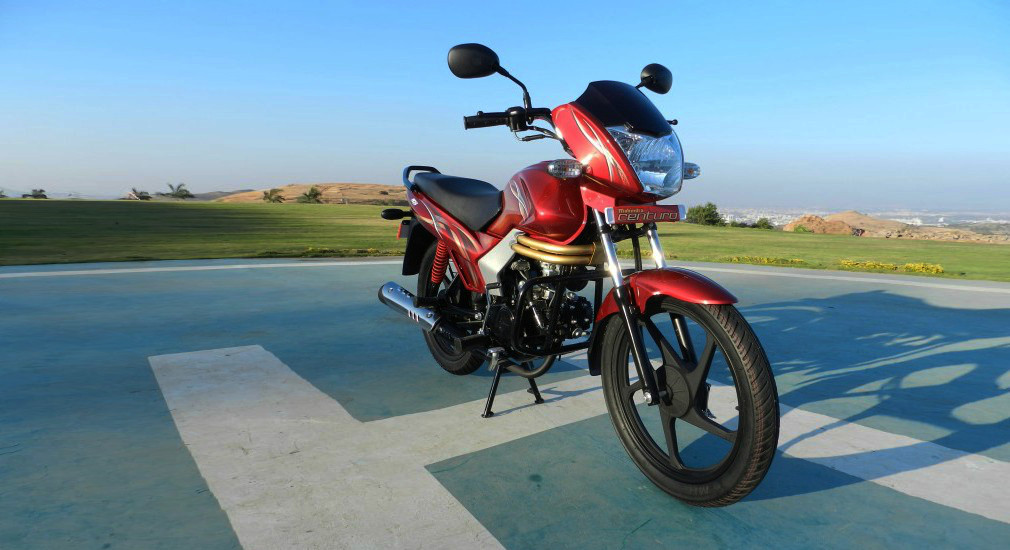
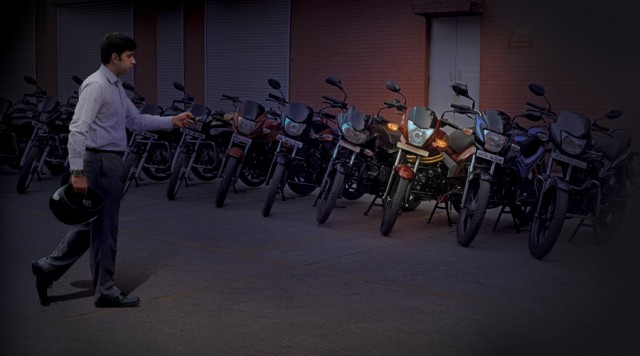
Mahindra 2 Wheelers Centuro Wide 01

Comprehending the needs of the motorcyclist in India looking to purchase a 100cc motorcycle, is as much a dark art as is designing a trellis frame for a motorcycle. The masters of this art are undeniably the folks at erstwhile Hero Honda (now Hero MotoCorp) who sell, sell and will probably continue to sell. While the formula is a simple one, other manufacturers who’ve attempted similar strategies with equally reliable engines have failed to bite off significant chunks from the ‘Hero Honda’ share of the market. As tough as it may be, cracking the 100cc segment which generates hold-your-breath-in-anticipation volumes is the priority for any motorcycle brand in India. Mahindra 2 Wheelers has jumped ‘over the hedge’ and stepped outside the well trodden path with the Centuro, a radically different approach to enticing customers away from the big H. We take a look at the design and technology aspects of the Centuro in this story before we get around to doing a full review when the motorcycle is launched.

Anti Theft System with Engine Immobiliser

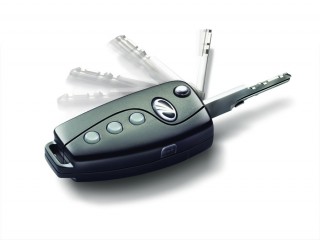
Mahindra 2 Wheelers Centuro Key Fob
Every new product needs one big feature that can drag people from the street to the showroom. The Centuro’s would be ‘Central Locking Anti Theft System’ with an Engine Immobiliser and a remote 128 bit encrypted flip key. Once the prospective customer in the showroom, a much longer discussion on why the Centuro is different from the other motorcycles in the market could tip the scales in favour of Mahindra.Mahindra 2 Wheelers Centuro : Flip Key

The term ‘Central locking’ can be misleading here as you cannot actually lock the motorcycle remotely with the key fob. The encrypted key ensures if a duplicate key is used to attempt to unlock the bike, the engine immobiliser ensures that your bike cannot be started.

The topmost button on the key fob garnished in chrome, flips out the key and the other three buttons bring us to the next set of features on the Centuro.

‘Find Me’ lamps

Mahindra 2 Wheelers Centuro 'Find Me' lamps

The first two buttons activate the ‘Find Me’ lamps, a pretty nifty feature to help you find your Centuro parked in, say a shopping mall parking lot. The first button activates the Find Me lamps and audio feedback from the motorcycles whereas the second buttons keeps things quiet and it is only the lamps that are activated. The last button is used to power on a LED on the side of the key fob.

..a feature that is only slowly trickling into mainstream cars

Follow me home headlamp

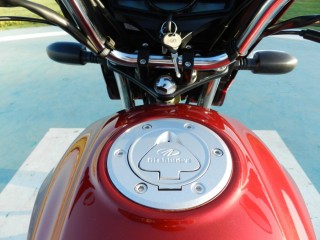
Mahindra 2 Wheelers Pantero Centuro Unveiling : Fuel Tank

8.5 BHP @ 7500 RPM and 8.5 Nm of peak torque at 5500 rpm

Mahindra 2 Wheelers Pantero Centuro Unveiling : Petrol Tap

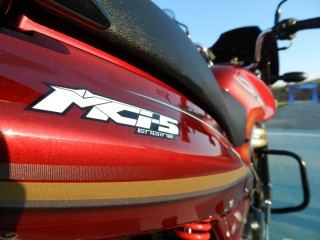
Mahindra 2 Wheelers Pantero Centuro Unveiling : MCi-5 engine

Mahindra 2W Centuro HeadlampThis is something I can definitely see myself using. The follow me home lamps, or as Mahindra calls it, the ‘Guide lamps’ will be a great help when you’re carrying tons of gear and have to park in a dimly lit lot before heading up. This is a feature that is only slowly trickling into mainstream cars and Mahindra deserves a pat on the back for bringing it to the Centuro.

Powertrain

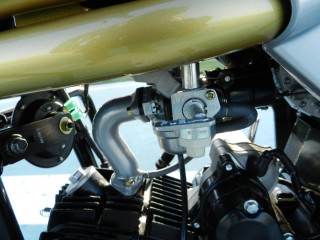
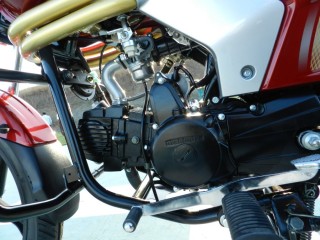
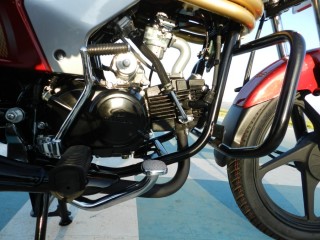
The Centuro and the Pantero will be powered by Mahindra’s new MCi-5 engine. The 106.7cc engine makes 8.5 BHP @ 7500 RPM and 8.5 Nm of peak torque at 5500 rpm. The MCi-5 engine has a bore of 52.4mm and stroke length of 49.5 mm. Regardless of the nifty features on offer on the Centruo, the engine and its ‘mileage’ is what will be the deal breaker in this segment. The fuel tank has a a capacity of 12.7 litres, a liter lesser than that of the Pantero. In our review of the Pantero we found the engine to be comfortable for zipping around the city. The engine does get vibey at the extreme reaches of the speedo, but 60 kph in 4th gear is not bone shattering and that is all that matters in a city commuter.

Mahindra 2 Wheelers Pantero Centuro Unveiling : Engine LeftMahindra 2 Wheelers Pantero Centuro Unveiling : Engine Right

The gearbox is again the newer one with the 4-up shift pattern which we found to be much smoother than the previous iteration on the Stallio.

The Centuro also claims to have best in class ground clearance of 173 mm, which is slightly higher than that of the Pantero (165mm).

Styling

Mahindra 2 Wheelers Centuro 01

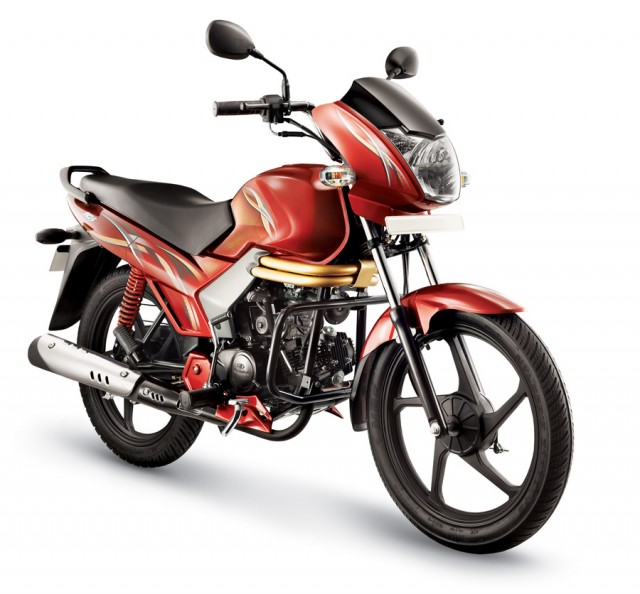
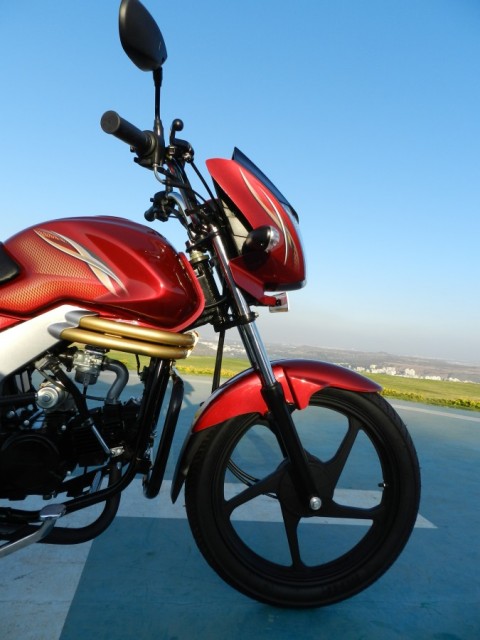
Mahindra has played a card here that might not exactly be in their favour. Remember the double barrel tubular frame on the Mojo? Mahindra hopes to capitalize on the ‘mojo’ of the Mojo and has used two horizontal gold bars to draw attention to the otherwise uninspiring design of the Centuro. This indicates one, the Mojo is after all coming sometime in the future, two, Mahindra is pretty confident that the Mojo will be successful if it thinks it can borrow design elements from the Mojo on to lower segment offerings.

We aren’t big fans of the exhaust either, but this should do. The ‘belly-pan’ isn’t actually a whole unit, but two plates slapped on either sides for aesthetic purposes only.

The Centuro is 2031 mm long, which is nearly 31mm more than that of the Pantero, though both motorcycles share the same wheelbase of 1265mm. The Centuro also has a 5mm lower seating height of 800mm.

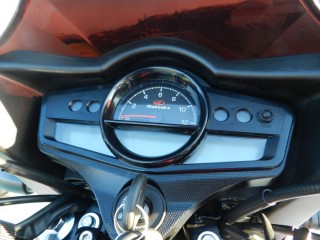
Mahindra 2 Wheelers Pantero Centuro Unveiling : White backlit dashboard

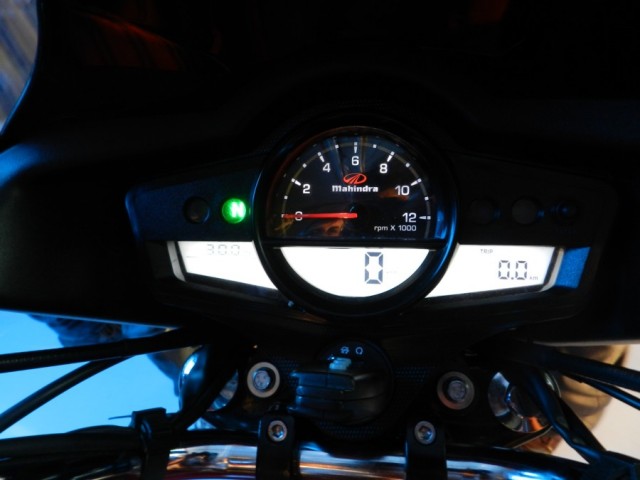
White backlit dashboard looks good in the dark. It has an in built ‘Service Due Indicator’ and ‘Distance- to-Empty Fuel calculator’ and several other features. Mahindra says the DTE calculator works by estimating fuel quantity in multiples of 100ml to give a more accurate distance to empty reading.

Will the Indian consumer buy into this concept of having additional ‘premium’ features on a 100cc segment motorcycle to set the motorcycle apart from the rest of the crowd? Will Mahindra be able to keep the costs competitive with all these additions? We think the pricing might be on the premium side, while the Pantero will continue to be the bare knuckled 100cc fighter priced competitively. We look forward to seeing if the Centuro can make inroads into this segment, do come back for a comprehensive review when the Centuro is launched .

Mahindra 2 Wheelers Pantero Centuro Unveiling 017
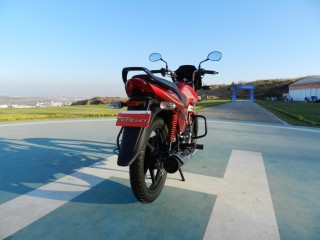
Mahindra 2 Wheelers Pantero Centuro Unveiling Rear
Mahindra 2 Wheelers Pantero Centuro Unveiling 015

Technical Specifications

Engine Single Cylinder, 4-stroke, Air cooled, Mci-5 engine
Displacement 106.7 cc
Bore X Stroke 52.4 X 49.5 mm
Maximum Power 8.5 PS @ 7500 rpm
Maximum Torque 8.5 Nm @ 5500 rpm
Starting System Electric Start / Kick Start
Transmission: Gear Box Constant mesh 4 Speed
Frame Double cradle steel Tubular structure
Suspension: FRONT Telescopic , Coil spring
                       REAR Coiled 5-step adjustable
Brake:           FRONT Drum – 130 mm
                       REAR Drum – 130 mm
Tyre Size:     FRONT 2.75” x 18”
                       REAR 3.0” x 18”
Battery:        Electric Start 12V / 6 Ah (maintenance Free)
                       Kick Start 12V / 2.5 Ah (maintenance Free)
Headlamp 12 V – 35W/35W – Halogen
(Multi-reflector)
Tail lamp LED Type
Speedometer Digital / Analog
Dry Weight 111 kg
Kerb Weight (90% fuel filled) 120Kg
Overall Length 2031 mm
Overall Width 735 mm
Overall Height 1111 mm
Seat Height 800 mm
Wheel Base 1265 mm
Minimum Ground Clearance 173 mm
Fuel Tank Capacity 12.7 liters
Other Features White Twin Pilot Lamps -LED Type +WOW features