Tata Motors Vista D90 Xtreme 02

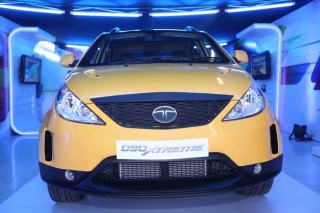
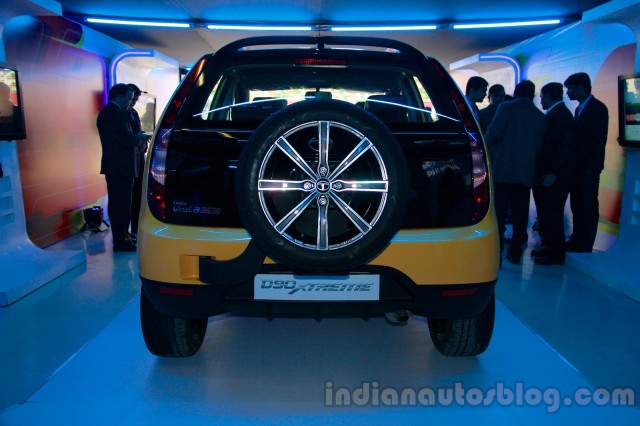
The D90 Xtreme is based on the Tata Vista D90. The suspension has been raised by 25mm and 16 inch alloys add to the butch presence of a compact SUV. Of note is the fact that the spare wheel is not mounted on the tail gate but instead on an extension that is mounted to the chassis at the rear bumper. This, Tata says will help reduce rattle at the rear and also to keep the weight of the rear door minimal enough to open with ease.

Tata Motors Vista D90 Xtreme 04

Autocar India also reports that the 1.3 litre turbocharged Quadrajet engine has been tuned by Tata with help from Abarth to make 104 bhp courtesy of a modified exhaust, a remapped ECU and an optimised turbocharger.

Prices are expected to be Rs. 80,000 more than that of an equivalent Vista D90.

Tata Motors Vista D90 Xtreme 01Tata Motors Vista D90 Xtreme 03

Images courtesy of Autocar India, IndianAutosBlog

Renault Fluence 2013 Face Lift Istanbul Motor Show 04

The updated Renault Fluence that adopted the refreshed Renault family look seen first on the new Clio will be coming to India in the first quarter of 2013 if reports from Autocar India are to be believed. The face lifted Renault Fluence was unveiled to the world in November 2012 at the Istanbul Motor Show and sales began in January 2013.

The vertically-set Renault lozenge at the centre of a broad black strip picked out by chrome beading, provides all Renault cars with a dynamic stance. The rumoured LED daytime running lights make an appearance, but in stark contrast to the initial spy images flooding the internet, the daytime running LEDs are in the lower part of the bumper and not integrated in the headlamp housing. The tastefully placed chrome/gloss black inserts add a premium feel without compromising on elegance.

In markets abroad, Renault will proudly introduce the new 1.6 16V 115 engine in the Fluence that will be mated to the new-generation X-Tronic CVT automatic transmission. India might be on the backburner for this mill as well the diesel dCi 130. The dCi 130 is a 1.6-litre diesel engine which is most powerful in its class but with an astounding fuel consumption of 21.7 kpl

India should get the dCi 110 mated to the EDC (Efficient Dual Clutch), essentially a six speed automatic transmission which improves fuel efficiency by 17%.

Head to our design story for more images and details on the new Fluence.

Yasumori Ihara, Director and Senior Managing Officer, Toyota Motor Corporation; Takeshi Uchiyamada, Executive Vice Chairman and Representative Director, Toyota Motor Corporation; Dr. Herbert Diess, Member of the Board of Management of BMW AG, Development; Klaus Fröhlich, Senior Vice President Product Line small, midsize series of BMW Group.

L to R: Yasumori Ihara, Director and Senior Managing Officer, Toyota Motor Corporation; Takeshi Uchiyamada, Executive Vice Chairman and Representative Director, Toyota Motor Corporation; Dr. Herbert Diess, Member of the Board of Management of BMW AG, Development; Klaus Fröhlich, Senior Vice President Product Line small, midsize series of BMW Group.

On the 24th of January 2013, BMW and Toyota signed a binding agreement in Nagoya,Japan that follows up on the MOU signed in June 2012 and that of December 2011 where BMW agreed to provide Toyota with highly efficient diesel engines. The are four distinct elements of the agreement as outlined in the title.

1. Fuel Cell System by 2020

Not unlike the recently signed agreement between Daimler,Nissan and Ford BMW and Toyota have also committed to working together to jointly develop a fundamental fuel-cell vehicle system, including not only a fuel cell stack and system, but also a hydrogen tank, motor and battery, aiming for completion in 2020. The companies will also be involved in jointly developing codes and standards for the hydrogen infrastructure.

2. Sport Vehicle Platform

If Subaru and Toyota can make something as jaw droppingly fantastic as the GT-86, we can’t wait to find out what a BMW Toyota collaboration will bring. The companies have agreed to set-up a feasibility study to define a joint platform concept for a mid-size sports vehicle that is to be completed by the end of 2013.

3. Lightweight technology

The agreement also commits the companies to jointly develop lightweight technologies for vehicle bodies using reinforced composites and the like. This technology will be used in the sports vehicle platform to be jointly developed by the two brands.

4. Lithium-air technology with greater energy density

The current crop of electric cars with lithium-ion batteries have been held back from reaching the masses due to the limited range of the Li-Ion batteries. The BMW Toyota collaboration will work to develop a lithium-air battery with energy density much higher than that of current lithium-ion batteries.

Norbert Reithofer, Chairman of the Board of Management of BMW AG said: “TMC and the BMW Group share the same strategic vision of future sustainable mobility. In light of the technological changes ahead, the entire automotive industry faces tremendous challenges, which we also regard as an opportunity. This collaboration is an important building block in keeping both companies on a successful course in the future.”

Akio Toyoda, President of TMC said: “It is just over a year since we signed our collaborative MoU, and with each day as our relationship strengthens, we feel acutely that we are making steadfast progress. Now, we are entering the phase that promises the fruit. While placing importance on what we learn from the joint development, we will work hard together in reaching our common goal of making ever-better cars.”

Raj Nair, Group Vice President, Global Product Development, Ford Motor Company, Prof. Thomas Weber, Member of the Board of Management of Daimler AG, Group Research & Mercedes-Benz Cars Development and Mitsuhiko Yamashita, Member of the Board of Directors and Executive Vice President of Nissan Motor Co., Ltd., supervising Research and Development.

Raj Nair, Group Vice President, Global Product Development, Ford Motor Company, Prof. Thomas Weber, Member of the Board of Management of Daimler AG, Group Research & Mercedes-Benz Cars Development and Mitsuhiko Yamashita, Member of the Board of Directors and Executive Vice President of Nissan Motor Co., Ltd., supervising Research and Development.

While BMW and Toyota have their own agreement towards joint development of fuel cell systems, Daimler, Ford and Nissan have now penned an agreement to jointly develop a fuel cell system, reducing investment costs with an aim to bring to the mass market affordable zero emission vehicles by 2017.

Zero emission vehicles include the battery operated kind as well as the fuel cell powered vehicles. Fuel cell vehicles are more ‘zero-emission’ than the battery equipped vehicles which get their energy from thermal power plants or nuclear power plants whereas the FCEVs are self sufficient system that use hydrogen to generate electricity using a fuel cell stack that is used to charge the battery and power the automobile.

Each company will invest equally towards the project. The three brands have a collective 10 million kilometres in test drives of their FCEVs. In the press release issued yesterday they are quick to point out that the agreement will push policy makers to build the infrastructure required for hydrogen powered vehicles. “The collaboration sends a clear signal to suppliers, policymakers and the industry to encourage further development of hydrogen refueling stations and other infrastructure necessary to allow the vehicles to be mass-marketed.” it said in the press release.

“Fuel cell electric vehicles are the obvious next step to complement today’s battery electric vehicles as our industry embraces more sustainable transportation,” said Mitsuhiko Yamashita, Member of the Board of Directors and Executive Vice President of Nissan Motor Co., Ltd., supervising Research and Development. “We look forward to a future where we can answer many customer needs by adding FCEVs on top of battery EVs within the zero-emission lineup.”

“We are convinced that fuel cell vehicles will play a central role for zero-emission mobility in the future. Thanks to the high commitment of all three partners we can put fuel cell e-mobility on a broader basis. This means with this cooperation we will make this technology available for many customers around the globe”, said Prof. Thomas Weber, Member of the Board of Management of Daimler AG, Group Research & Mercedes-Benz Cars Development.

“Working together will significantly help speed this technology to market at a more affordable cost to our customers,” said Raj Nair, group vice president, Global Product Development, Ford Motor Company. “We will all benefit from this relationship as the resulting solution will be better than any one company working alone.”

Tata Motors Indica Vista D90 01

Tata Motors has slapped on a turbo on the 1.3 Quadrajet engine for 90 horses, laid down on the road through a Euro-tech 2 gearbox, resulting in a 0-100 kph time of 15.5 seconds and a top speed of 158 kph.

The ridiculously placed central instrument cluster has now been moved back to where it should have been all along, just behind the wheel. The other variants of the Vista will continue to have the central instrument cluster, the D90 will have what Tata Motors calls ‘Drive Aligned Instrument Cluster’.

The new D90 also gets a comprehensive touchscreen multimedia system with navigation and Blue5 technology. The D90 also gets automatic climate control and a small digital screen that provides details on mileage, average fuel consumption, distance-to-empty, ambient temperature and a digital clock, in what Tata Motors calls ‘Advanced Driver Information System and Fuel Computer’.

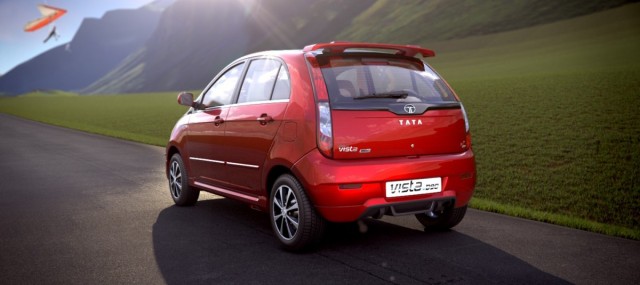
The new Vista D90 gets new front and rear bumpers, more chrome, a spoiler, triple barrel headlamps, black roof and 2-tone alloy wheels.

In addition to Porcelain White, Spice Red, Cavern Grey and Jet Silver, there’s a new colour – Ultra Violet.

Tata Motors Indica Vista D90 Ultra Violet 01

The D90 is available in two trims, D90 VX and D90 ZX+. The D90 ZX+ gets the touchscreen system, auto climate control, follow me home headlamps and dual front airbags which the D90 VX has to miss out on.

The Tata Vista D90 range starts from Rs. 5.99 lakhs (ex-showroom, New Delhi) and comes with a warranty of 2 Years/ 75000 kms.

Speaking at the launch, Mr. Ranjit Yadav, President, Passenger Vehicles Business Unit, Tata Motors, said, “At Tata Motors, we develop our cars around the evolving car customers, matching our products with their demanding needs and growing aspirations. The Tata Vista D90 truly fits into their fast-changing lifestyles with its dynamic and sporty looks, its powerful yet refined powertrain, technology-packed features and luxurious & spacious interiors. All these offerings make it the most premium hatch in its class. We remain firmly committed to developing new products across our entire range and we will continue to set new benchmarks with first-in-class features, designed to meet the needs of the Indian car buyer.

“Our customer-centred cars are backed by customer-engaging purchase experience at our dealerships. We recognise and are changing, in phases, customer engagement levels across our dealerships. With the Tata Vista D90, we begin 2013, with a journey that will see several Tata Motors’ product actions through the year.”

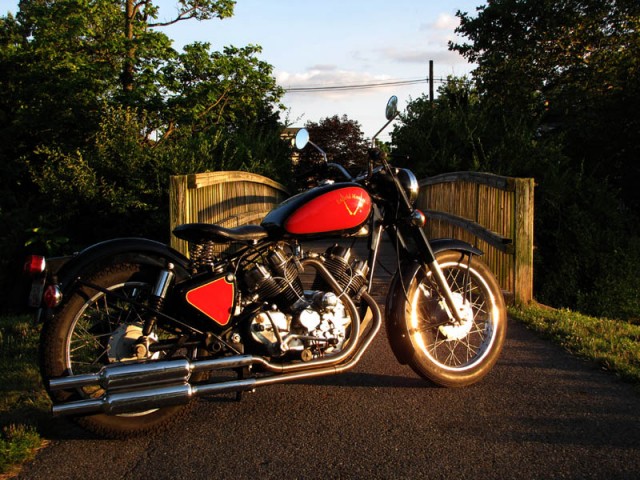
Aniket's Musket 998 V Twin 01

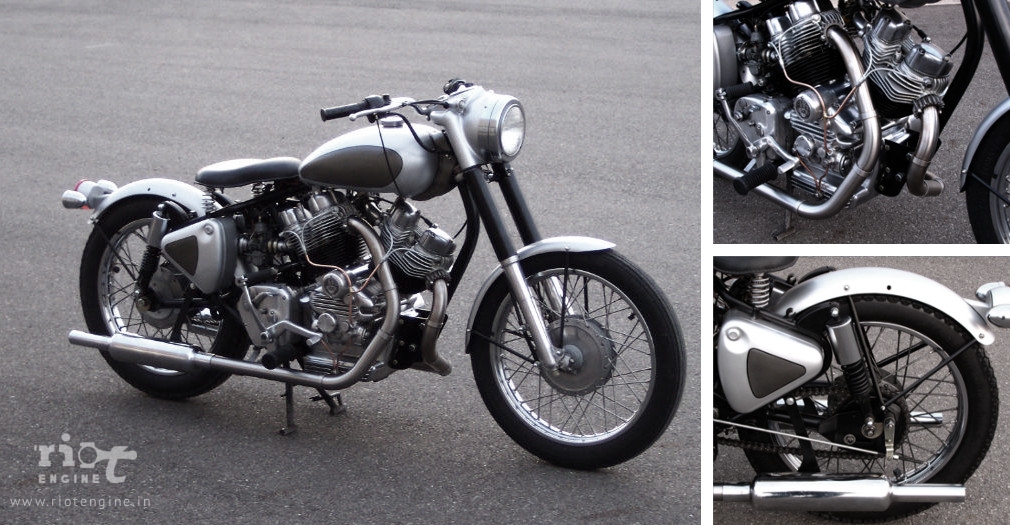
First glance at the Musket 998 V-Twin was one of those rare moments where the lack of imperfection in a true masterpiece misleads one into thinking that this beauty came right out of the factory and not out a small garage. The V-Twin has been so beautifully crafted that your mind happily skips past the fact that there’s a V-Twin in place of the usual single cylinder and it takes a while for the instantaneous love potion to ebb away and the world comes to a standstill while you wonder who is this crazy bloke who engineered this piece of art? Meet Aniket Vardhan.
Aniket's Musket 998 V Twin 02
Anikets Musket 998 V Twin 11
Anikets Musket 998 V Twin 10
Anikets Musket 998 V Twin 06
Aniket's Musket 700 V Twin 02

Aniket Vardhan was an architect in New Delhi, who moved to US to study Industrial Design, well at least that’s the official stand. On a personal level, Aniket admits it was the lure of the potato-potato that pushed him to visit the land of Harley Davidson. After a stint as an Industrial Design faculty, Aniket moved full time into realizing his dream of building a Enfield based V-Twin. Shown above in ‘Indian’ motorcycle colors is his first attempt, the Musket 700cc V-Twin with an angle of 70 °. Aniket wanted to push the boundaries and the result is the new Musket 998cc V-Twin.

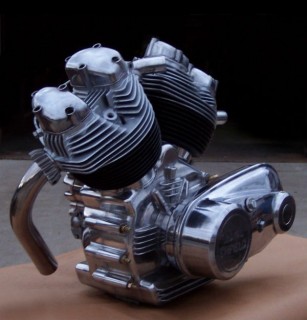
This is professionalism at an all new level for a hobbyist. The crankcase has been designed to accommodate both the 350cc and the 500cc engines, the choice resulting in either a 700cc twin or a 1000cc twin. The angle Aniket has paid attention to the details, notice the beautiful copper pipes that have been retained to cool the oil flowing through the engine? This donor Enfield sold in the US comes with a four speed gearbox with a not so reliable linkage that brings the shift lever to the left side. Aniket has received praise for his design which retains the shift on the right side, and use a much more mechanically reliable setup.

Anikets Musket 998 V Twin 04Anikets Musket 998 V Twin 03

Aniket’s biggest engineering challenges were shaping the exhausts to retain a symmetric design within the confines of the space restricted by the downtube of the chassis at the front. “The classically beautiful symmetrical exhaust of machines such as the 1939 Triumph Speed Twin is very dear to many and was a worthy cause to strive for, in spite of the challenge posed by this V twin as opposed to an inherently symmetrical parallel twin.” says Aniket on his website.

The downtube was also curved to accommodate the relatively larger engine and this has enabled him to keep the wheelbase much lesser than normally would’ve been required for such a V-Twin. Just take a look at the Musket 700 and you’ll know what we mean.

Anikets Musket 998 V Twin 08
Anikets Musket 998 V Twin 07
Anikets Musket 998 V Twin 05

“It was taken for a brief yet *truly exhilarating* ride – she goes, solid punchy torque available right from idle. Tying up random loose ends while it’s still below freezing and snowed up. Wiring, re-routing cables, new tank emblems done this weekend, couple of other things next and then waiting for warm weather.” he concludes.

Riot Engine wishes you the very best Aniket, and we hope once the winter passes you’ll delight us with some videos of the new Musket in action!

All images courtesy of Aniket Vardhan’s website www.musketvtwin.com

This video from Volvo has racked up an astounding 3.5 million views since it was uploaded just around a week ago. We couldn’t tell why, until we hit the halfway point on the video. The sight of a Volvo FH with its trailer loaded to its maximum capacity of 40 tons GCW shedding speed autonomously while the cab rocks on its feet is simply incredible!

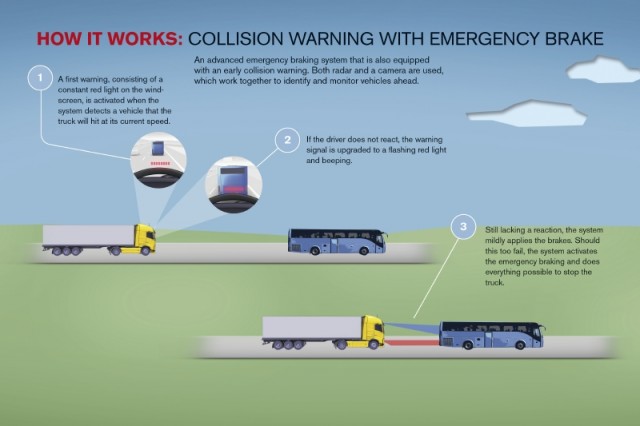
Carl Johan Almqvist, Traffic & Product Safety Director, Volvo TrucksWhat’s more fascinating is the fact that the video shot from the inside isn’t half as scary, a fact our inside source from Volvo attests to. Volvo’s Collision Warning with Emergency Brake system works using radar and cameras to identify the vehicle up front.

The system works for both stationary and moving vehicles and with moving vehicles, the system works as long as the relative speed is less than 70kph.

“We don’t want to take over from drivers because we believe they are in the best position to respond, as they might be able to safely drive around the vehicle,” says Carl Johan Almqvist, Traffic & Product Safety Director, Volvo Trucks.

Staying true to this principle the system only initially warns the driver about the obstacle with a constant red flashing symbol on the windscreen, when the driver fails to respond (steering or braking), the red light starts flashing and a beeping sound tries to bring the driver’s attention back to the road. If all this fails the brakes are initially applied gently, and then applied to bring the behemoth of a truck to a complete halt.

All trucks makers in Europe are expected to have such systems in place by November 2015.

Volvo Trucks Collision Warning Emergency Braking System : How It Works

Royal Enfield Cafe Racer Production Spec 01

The folks at RideApart have penned a crisp piece detailing the changes on the production version of the Royal Enfield from the design concept showcased at the 2012 Delhi Auto Expo.

Royal Enfield Cafe Racer 535 : New Yoke
Royal Enfield Cafe Racer 535 : New Taillight

The changes include a new top yoke (the triple clamp or in much simpler words, the part the connects the handlebars to the shock absorbers), new tail lamps, a more generic head lamp which might actually be swapped for the final production version with those from the new Thunderbird 500 ( boo? Yaaay?). RideApart ( known better as Hellforleathermagazine) also point out that the forks appear to be from the older RE Thunderbird which raises the front end height. The seat that was bare all the way up until the rear now gets a fibre glass tail. The rearsets (heel guards) are different and are adjustable too. The rear shock absorbers also seem to be Paioli while the concept had Ohlins.

Royal Enfield Cafe Racer 535 Production : Rearsets 01

RideApart also adds that the larger tank doesn’t fit flush and lifts up at the rear end. Of note is also a visible weld seam around the tank, probably a measure to cut costs where Royal Enfield possibly can. You might notice the tank on the concept is seamless and adds much to the aesthetic value. The report also says that the fuel cap seems to be much taller, which isn’t something we can attest to with just these images at hand.

Classic Motorworks which is the official importer for Royal Enfield in the USA, has pointed out that the engine powering the Cafe Racer will be a 535cc UCE, which is again confirmed from the branding on the tappet cover.

Royal Enfield Cafe Racer 535 : Images from EICMA 2012 courtesy of omnimoto.it

Riot Engine also discovered that the production variant will forgo the sweet looking Ohlin steering dampers seen on the concept.

Royal Enfield Cafe Racer 535 Production : No steering damper 01

Head to RideApart for more details.

Images of the production version of the Royal Enfield Cafe Racer at the EICMA 2012 are from omnimoto.it

Royal Enfield Cafe Racer 535 : Images from EICMA 2012 courtesy of omnimoto.itRoyal Enfield Cafe Racer 535 : Images from EICMA 2012 courtesy of omnimoto.itRoyal Enfield Cafe Racer 535 : Images from EICMA 2012 courtesy of omnimoto.itRoyal Enfield Cafe Racer 535 : Images from EICMA 2012 courtesy of omnimoto.it

Head to our coverage of Royal Enfield at the 2012 Delhi Auto Expo for more images of the Royal Enfield Cafe Racer Concept.

Mercedes-Benz Sprinter in 'A Good Day To Die Hard ' shot at  Moscow 02

Mercedes-Benz Sprinter

Is there an individual more perfect to advertise your tough guy cars than John McClane? Mercedes-Benz thinks not. “From the C-Class to the Zetros, the Mercedes-Benz model fleet could not be better suited to this action film with its spectacular stunts in the streets of Moscow. An exciting film with many emotionally appealing vehicles,” says Anders Sundt Jensen, Head of Brand Communication Mercedes-Benz Cars. “Mercedes-Benz vehicles stand for safety, performance and distinctive design. And they are at home in all major European cities. This suits them perfectly and completely authentically to the screenplay. For example, the G-Class, Sprinter, Unimog and Zetros are the ideal “hero cars” for the hard-as-nails requirements of John and Jack McClane”, continues Jensen.

Mercedes-Benz Unimog in 'A Good Day To Die Hard ' shot at  Moscow 01

Mercedes-Benz Unimog

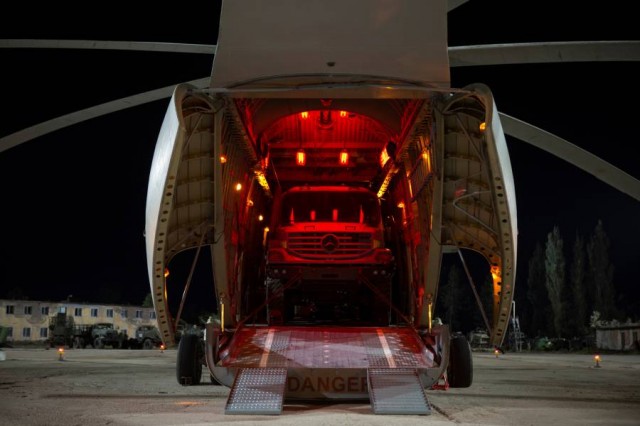
For this installment of the Die Hard franchise, John McClane flies to Moscow to help his son Jack. In the process, he’s behind the wheel of various Mercedes-Benz vehicles including the Unimog! Read our story on the Unimog here. If the Unimog wasn’t enough, here’s the intimidating Zetros, Mercedes-Benz extremely capable off road truck staring menacingly from the depths of the transport plant!

Mercedes-Benz Zetros in 'A Good Day To Die Hard ' shot at  Moscow 01

Mercedes-Benz Zetros

The lead image for this article shows father and son facing off in front of the Mercedes-Benz Sprinter. Good product placement, we think. Read more about the Sprinter here.

Mercedes-Benz G-Class in 'A Good Day To Die Hard ' shot at  Moscow 02Mercedes-Benz G-Class in 'A Good Day To Die Hard ' shot at  Moscow 01

Mercedes-Benz G-Class

Four indestructible Mercedes-Benz models play a key role in the battle for survival to save the world: the G-Class, the Unimog, the Sprinter and the Zetros. In addition to the ‘hero-cars’ the other Mercedes-Benz vehicles include the C-Class, Vito, E-Class Saloon as well as the new G 63 AMG, a GL-Class and a Maybach 57.

Mercedes-Benz Sprinter in 'A Good Day To Die Hard ' shot at  Moscow 01Mercedes-Benz C-Class in 'A Good Day To Die Hard ' shot at  Moscow 01

Lewis Hamilton CLA Class 01

Bernie believes Lewis Hamilton is a strong contender for the win, and with people like Niki Lauda and Toto Wolff supporting the team with their technical and managerial expertise, Bernie says the team no longer has any excuses not to be at the front.

“I believe Mercedes to be much stronger this year because of Lewis. He will be a contender,” he said of Hamilton. “I hope these [changes] will lead to Mercedes becoming much stronger,” Ecclestone added. “I believe Niki Lauda and Toto Wolff can do it. New people, new thinking. They will do the job. Mercedes have the best engine, top drivers, not less budget than other leading teams, so everything would be in place. I would be disappointed if they weren’t there up front. There are no more excuses.”

Read the whole story at AutoSport