I must admit that I have been a little late in writing this piece.  This should have been written before the commencement of the World Superbike Championship of 2013. Unfortunately other commitments have kept most of us away from doing this writing which has been the main identity that Riot Engine has acquired.  So not only are we apologising for the delay, we are also claiming that maybe the delay in writing this piece has actually worked in our favour (meaning both you the readers and us the writers).

There must be some curiosity on the part of our readers as to why we have decided to start talking about World Superbike racing in 2013 while in the past we have only restricted ourselves to brief reports of the results of the races.  But there is a clear reason for that, or let me say there are three clear reasons why this time around it maybe useful to discuss the World Superbike series.  The first reason is that the Buddh International Circuit or BIC as it is now being referred to, will host a round of the World Superbike Races this year.  Those of you who follow the series and the news about the series will  be aware that the BIC was to host the second round of the the World Superbike Championships from the 8th to the 10th of March, 2013.  But this date was postponed to the 17th of November (meaning the weekend starting with 15th of November and ending with the 17th of November) and this has now become the last race of the season.

Becoming the last race of the season can become a thing of advantage if the championship is going down to the wire as it did last year.  But if the championship is clinched before the last round, then that would turn into a disadvantage since the race will be of academic interest only.  But the question that needs to be asked here is what were the reasons behind the postponement?

Even before the postponement was formally announced various websites and motorsport magazines were carrying stories of how the Indian round of the World Superbikes was being postponed due to the interference of the now (in)famous Indian bureaucracy.  Stories that went around initially were those which were claiming that the Indian round was completely cancelled.  Then came the announcement that the round was postponed but the reason given was rather astounding.  It was claimed that the round was being postponed mainly due the fact that marshalls did not have adequate training to deal with injured riders if in case there was a misfortune of an accident.  The reason is rather strange, because the BIC has been hosting Formula 1 races for the last two years without a glitch. The reason why I am going so much into the story is that there is still one small little theory that says that the round will ultimately be cancelled and the grounds suggested are that Dorna the series promoter is extremely unhappy with the deal that Infront (the organisation that was in control of the World Superbike series) had actually reached a deal in a hurry and has surrendered the TV rights which were the main source of revenue.  So the fact is that Dorna does not want the deal to go through. Last year there were rumours that Dorna was keen on bringing MotoGP to India but Infront beat them to a deal with BIC which included the retention of TV rights by BIC. After Bridgepoint the company that owns Dorna took over Infront completely they gave Dorna the responsibility of running both the MotoGP and World Superbike series.  Now we have to wait and see if there is going to be a race in India.

The second reason why we are interested in writing about World Superbikes this year is again India specific.  In what can only be called a stunning development the operation of the official World Supersport team of Kawasaki has gone to Mahi Racing in which Indian Cricket team captain Mahendra Singh Dhoni and Telugu Film superstar Nagarjuna Akkineni have invested.  Mahi Racing has stunned the world by taking over the mantle of being the official Kawasaki team in the 600 cc category after Lorenzini (who represented the official Kawasaki effort) had won the championship with Kenan Sofuoglu last year. This year Mahi Racing has inherited the riders along with the official status.  And they have started on the right note with Kenan Sofuoglu starting his defence of the world championship in style with a victory in Australia. In Australia one of the sponsors of the World Superbike effort of Kawasaki was Mahi Racing.  The reasoning was that TV coverage is hardly given to  World Supersport races and therefore it made sense to advertise Mahi Racing on the 1000 cc machines of Kawasaki run by the Spanish outfit Provec.

The third reason why we have decided to turn our attention to the World Superbike series is that which pertains to this being the last time that we will see the World Superbikes being run in this format.  Right now World Superbikes allows for modifications to street going machines and this has brought the series into conflict with MotoGP. In fact, the lap time differences between MotoGP and World Superbike machines on one circuit where both series had their races, was less than 2 seconds.  That was the reason why factories, especially Honda at one time threatened to pull out of MotoGP and move to World Superbikes.  But with Dorna now in control, the power of factories such as Honda has been neutered.  Apparently in the present form the World Superbike series sees the use of upto 39 engines per season per motorcycle by a number of teams.  Dorna CEO, Carmelo Ezpeleta, has made it abundantly clear that during times of economic recession (which is now) it was extravagant to allow the use of so many engines.  In MotoGP the number of engines that can be used by a factory is limited to 5.

Ezpeleta has already hinted that there will be a cap on number of engines in the series from next season on.  In fact, the changes for next season include dumbing down of the series and the pointers that have emerged so far show that the series is headed towards becoming production machinery based.  That means that the lap times will go up and maybe the races will not be as closely fought as they are now. Then there is the question of the format as well.  The present Superbike series is really not very TV friendly.  The existence of two races that are separated by the World Supersport race has meant that most TV channels are not interested in showing all the races.  Last year in India, one got to see only one of the races live while the other would be delayed or sometimes not even covered.  The fact that most TV channels have successfully marketed the various football leagues from around the world has meant that football gets precedence when it comes to coverage and within the motorsport caste system Formula 1 is top and gets preference over everything else and then comes MotoGP. World Superbikes is at the bottom of the caste hierarchy and so the coverage of this is left to the whims and fancies of ESPN Star Sports which have the rights of coverage for the series.

The million dollar question therefore is what form will World Superbikes take next year? Will it be totally dumbed down and become uninteresting or will it have an exciting new format one that is more TV friendly?  Will it feature pit stops?  This has been one of the innovations that has apparently been proposed.  Rumours about the shape that the series will take have suggested that the World Supersport category will be eliminated and that the Moto2 category in MotoGP that is now restricted to Honda engines of 600 cc capacity being put in custom built chassis.  If the Supersport category is abolished then engines from various manufacturers will be allowed to be put in the custom built chassis.  If this happens and the abolition of the Supersport category also becomes reality then one of the formats being considered apparently is the 200 mile format where Superbikes (1000 cc) will run a race of 200 mile length with pit stops.  How will TV stations receive it is the question. We will have to wait till the middle of May for some clarity to emerge about the direction that World Superbikes will take under the stewardship of Dorna.

Till then what you can do is watch whatever is shown of the series on TV and enjoy close racing between riders on machinery that includes Honda, Suzuki, BMW, Aprilia, Ducati and Kawasaki. And in the meantime also hope that from next year on it will be a more TV friendly series that will get shown just as MotoGP and Formula 1 are shown.  Meanwhile we will try our best to get you as much coverage as possible from the races.

Bosch Wabco Safety Drive Header1

Bosch India, along with WABCO India, a global company specializing in Commercial Vehicle braking systems, suspensions and transmission systems, came together to conduct a ‘Safety Drive’, a symposium aimed at demonstrating the importance of various safety features that consumers take for granted.

Bosch wanted to showcase the advantages of ABS and ESP on passenger cars, while Wabco wanted to do the same for Commercial Vehicles.

Bosch Wabco Safety Drive Chennai 10

The event started out with a presentation on the need for having such safety features. Studies show that Indian roads are among the most dangerous on the planet. Statistics show that in 2011, on an average, one person was killed in a road accident for every 3.7 minutes.

According to the UN, 1.3 million people die in road accidents every year and 50 million are injured. In the next 10 years, deaths could reach up to 1.9 million. The UN has thus declared the years from 2011-2020 as the ‘Decade Of Action For Road Safety’, it’s objective is to reduce the road deaths by 50%. One of the methods to achieve this is to provide safer vehicle, with ABS and ESP in all vehicles.

Bosch Wabco Safety Drive Chennai 03

Bosch Wabco Safety Drive Chennai 12

Bosch Wabco Safety Drive Chennai 02

Then the demonstrations began, with Bosch showcasing the advantages of ABS and ESP in passenger cars. A Suzuki Swift Dzire and a Nissan Sunny, equipped with ABS were put into action. The location was WABCO’s proving grounds. The vehicles were driven at a speed of 70 kmph on a wet Skid Pad. On the first run, the cars were driven with the ABS turned off. When the driver jammed the brakes, the cars simply locked up their front wheels and skidded to a halt. A cone was placed to mark the distance traveled by the cars. On the second run, the ABS was turned on, and the same test was carried out, and the stopping distance was considerably shorter. The advantages of ABS was apparent.

The second demonstration was to show what the ESP was capable of doing for passenger cars. A Tata Aria and a Mahindra XUV 500 were chosen cars. An obstacle had been placed on the skid pad and the driver, drving at 70 kmph had to avoid the obstacle and regain control of the car. During the first run the ESP was off and the when the driver turned the steering wheel left to avoid the obstacle, braked and immediately turned right to get back on the road, but the vehicle simply lost traction and spun around and halted. On the second run, the ESP was turned on and the same was repeated, only this time, the driver was able to regain absolute control of the vehicle and was able to stop the vehicle without much of a problem.

Bosch Wabco Safety Drive Chennai 04

Bosch Wabco Safety Drive Chennai 05

Bosch Wabco Safety Drive Chennai 06

Bosch Wabco Safety Drive Chennai 07

Bosch Wabco Safety Drive Chennai 15

Bosch Wabco Safety Drive Chennai 16

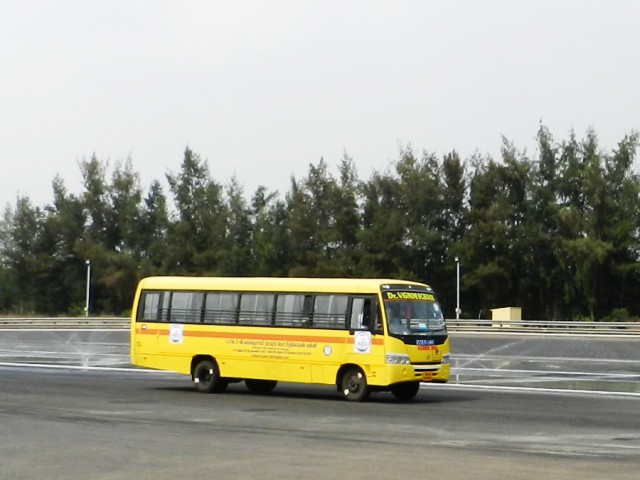
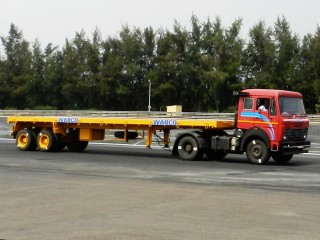
After these demonstrations, WABCO took over and demonstrated the advantages of these safety features in commercial vehicles. The Vehicles that were present for this demonstration were a School bus, A State Transport bus, an Army 4X4 truck, a Tata LPS Tractor trailer, and a Tata Prima tractor trailer. The Tata Prima was the only vehicle here, equipped with ESP. The school bus, The State transport bus and the Army truck demonstrated the ABS advantage. The Tata LPS tractor trailer was used to show how ABS helped in avoiding jackknifing. Jackknifing is the term used to describe the phenomenon where the trailer loses traction and starts sliding in a direction often opposing the direction of travel of the cab. The Tata Prima was used to demonstrate ESP in a way similar to the way the passenger cars did.

It isn’t unusual for us to take ABS and ESP for granted. After witnessing the XUV5OO and Aria that spun out recklessly and the mammoth Prima trying not to topple over and the Stallion (blue cab) that burnt rubber like a rear wheel drive V8 sportscar, one can’t help but suggest that you forget all the other optional extras and just make sure you tick those boxes that say ABS and ESP.

In a country like India, where bikes are more common place than cars, a question does arise about ABS for bikes. Bosch India is currently working on a ABS system for two wheelers that will be very affordable and more versatile, to be used for disc brakes as well as drum brakes. On inquiring about the availability of after market ABS systems for cars, Bosch says that the process of installing ABS system after market is quite tricky as there are lot of components going into the car and many alterations need to be done. Also, training of the technicians for this would be a very huge task and is not viable. Bosch India And WABCO are also pushing the Government bodies to make ABS and ESP mandatory across all vehicles, thereby making the roads a safer place. But it will be a long time before that becomes reality.

Those who follow the MotoGP championship are aware that Suzuki has shown interest in coming back to the MotoGP world championship with an inline four powered 1000 cc motorcycle, after it abandoned the series at the end of 2011.  Suzuki was then using a V4 configuration 800 cc engine to power its MotoGP efforts.  Suzuki’s return to the series in 2014 is not a surprise news since for sometime now there has been talk of the 1000 cc being tested by factory rider Nobuatsu Aoki and the news that Suzuki has held talks with series organiser Dorna for an entry position on the grid for 2014.  However, Dorna has been playing coy saying that Suzuki does not get an automatic entry as a manufacturer and that they either have to buy out an existing team or team up with them to run the factory effort.  Suzuki seems reluctant to take this route and it has been seen that negotiations are still continuing with Dorna and if at all there is a necessity to do so, Suzuki is expected to team up with Aspar who will then run their official MotoGP effort.

Even while this puzzle still remains unsolved, the boss of the Forward team, that ran a single BMW-Suter entry in the CRT category last year and has shifted to the Kawasaki-FTR combination, again to compete in the CRT,  has revealed that he has been in talks with both Suzuki and Kawasaki to become the front for the factory efforts.  This is the first time that Kawasaki has mentioned in the context of MotoGP.  What gives credibility to Giovanni Cuzari’s statement is the fact that when Kawasaki withdrew at the end of 2008 and was forced by Dorna to field at least on bike (or pay up a hefty fine) the manufacturer was linked to team Hayate which then ran a black liveried motorcycle for Marco Melandri.  At the end of 2009 even this entry was withdrawn and whatever was left of Hayate became Forward Racing who took a step down to go racing in the Moto2 championship.  Last year Forward Racing while continuing its efforts in Moto2, also stepped back up with Colin Edwards riding the BMW-Suter, to the MotoGP class, albeit as a CRT entry.  Colin Edwards’ travails with the BMW-Suter meant that the team has shifted to the Kawasaki-FTR combination that was being used by Avintia Racing, for 2013.

However, Giovanni Cuzari, the boss of Forward Racing seems set on running a full factory entry or go with the customer Honda RC213V or with a Yamaha M1 engine in a custom built chassis.  But his interest is obviously to run a full fledged factory entry with either Suzuki or Kawasaki.  While the Suzuki angle is not very clear, the Kawasaki angle is.  Cuzari not only has contact with the Japanese factory but also with the man the Kawasaki lured away from Yamaha’s racing division, Ichiro Yoda. Yoda was the man behind the Hayate effort and is also now the main in charge of the factory effort of Kawasaki in World Superbikes.  The year 2012 was good for Kawasaki in the World Superbike series with rider Tom Sykes missing out on the World Champion ship by .5 points.

Cuzari’s talk may not be without substance given the fact that Kawasaki has always had a practice of letting their factory effort in World Superbikes and initially when they returned to MotoGP, run by other teams.  In World Superbikes, Kawasaki won the championship with Scot Russel when the team was run by Rob Muzzy.  Later on the team was handed over to Harald Eckl who also started running the MotoGP effort before Kawasaki found that he was working with Illmor engineering also.  The Illmor effort was still born but Eckl lost his place in Kawasaki.  The effort of Kawasaki in World Superbikes was with Paul Bird Motorsport who were fired after drugs and guns were discovered in the Kawasaki transport trucks and the Spanish outfit Provec now runs the effort.  Last year the Kawasaki World Supersport team which won the World championship was run by Team Lorenzini and this year that honour has fallen on Mahi Racing an Indian Team run by cricketer Mahendra Singh Dhoni and actor Nagarjuna Akkineni.

It is therefore entirely conceivable that Kawasaki may want to work with Forward Racing for the 2014 MotoGP World Championship.  Equally significant is the fact that World Superbikes will not be the same from next year on.  Dorna has now taken control of the series from Infront and while it has promised that there will be no merger of the two series, it has also said that the series will go more towards racing production machines rather than souped up machines that are now the norm in World Superbikes.  The rules of the 2014 World Superbikes are not yet in place but it is believed that by May of this year there will be clarity in which the series will go, though most people concerned with the series in some capacity have been saying that it is most likely to go the production bike racing way.

If it does move in that direction then it makes great sense for Kawasaki to comeback to MotoGP which will then become a series of cutting edge technology yet again. And given the work culture at Kawasaki there are established precedents of the factory effort being run by third party teams, it is entirely conceivable that Kawasaki may renew their ties with MotoGP and with Forward Racing from 2014 onwards. Giovanni Cuzari has said that a lot now depends on Ichiro Yoda and his ability to convince the bosses at Kawasaki that entering the MotoGP space yet again would be sensible.  One could expect to see a clearer situation post May, 2013 when the new rules for the World Superbike Championship for 2014 will be announced.  That may be the clincher for Kawasaki to decide about participating or not participating in the MotoGP World Championships again from the year 2014.

MotoGP fans may also wait expectantly for the news of Aprilia and BMW also showing some interest.  In the past, the head of Aprilia’s racing division Gigi D’all Igna had said that if the rules were stable then Aprilia will consider returning.  Their ART machines in the CRT category are already testing waters. Now BMW could be interesting. However, please remember a lot of this speculation and the possibility of MotoGP remaining where it is today with none of the factories mentioned above, including Kawasaki not returning to the series.  But the hopeful will want to believe that there could be a change and MotoGP can yet again become the vibrant series that it once was.  So lets wait with fingers crossed and hope for the best.

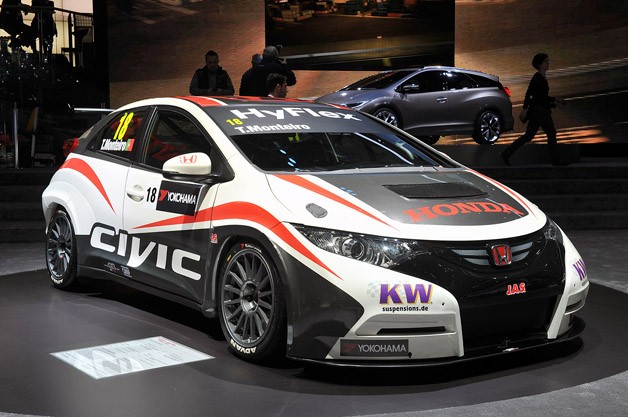
The FIA WTCC or the World Touring Car Championship lost the one factory that was a fixture in the series at the end of last year.  When Chevrolet pulled the plug on its factory involvement in the WTCC it looked as if the series would become completely dominated by privateer entries.  But Honda stepped in late last year (the last three races) to see if it could officially enter a works team after having tasted success in the British Touring Car Series.  This year the only factory involving team is from Honda and it is using its European version of the Civic (hatchback style) to compete in the series which has been dominated till last year by Chevrolet.  At the Geneva show, Honda showed off its contender for the WTCC throne and added some excitement to the show. What you see below is the car that Honda will be using to race in the WTCC.

2013 Honda Civic Wtcc Geneva

Pic courtesy: Autoblog.com

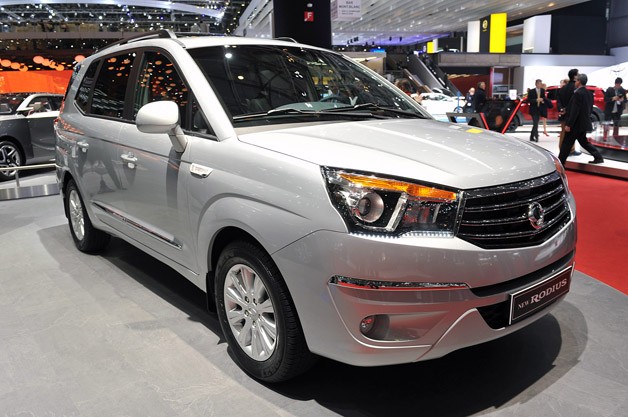
Ssang Yong was a company that was once known for styling of cars that could be anywhere in between quirky and purely ugly.  The Rodius was one such SUV which qualified to be called UGLY.  When Mahindra took over the ailing Korean company one wondered about the logic of it.  But now things are clearing up with Mahindra insisting on removing the unpalatable aspects of design and making them more eye friendly.  The Rexton received a front end make over which made the car look better than what it was.  At Geneva, the Rodius has been shown with a full makeover. You may even want to call the Rodius pretty. Here take a look.

2013 Ssangyong Rodius Geneva

Pic Courtesy: Autoblog.com

After Pinninfarina, Bertone is the other Italian studio that is very well known.  Bertone has enjoyed a very successful relationship with Aston Martin for a little over 60 years now.  It looks like a customer (who did not want to be identified) commissioned Bertone to work their magic on the Aston Martin Rapide.  So here is a one off by the famed designer studio which customised the Rapide and called it the Jet 2+2.  Bertone did most of the customising at the rear of the car and made it a proper hatch by lifting the roof line.  That also means a wee bit more of headroom for those who are insane enough to occupy the rear seats of the car. Bertone left the engine as it is so it is the same 6 litre V12 pumping out a stonking 476 horse power.

Bertone Jet 2 Plus 2 Geneva

Pic Courtesy: Autoblog.com

2014 Rolls Royce Wraith Geneva

Pic Courtesy: Autoblog.com

Who would have thought Rolls Royce would have sporty intentions.  But apparently they did.  And they used the Ghost platform to create it.  The car features a coupe styling with two doors (suicide type, after all its a Rolls) a gorgeously sloping roof, dual tone colours and carries a name that has been dropped so long ago, that nobody even remembers it.  Yes, its called the Wraith and comes with a V12 engine that pumps out a neck snapping 624 BHP. It also features the usual Rolls Royce features such as cowhide interiors, big die cast wheels shod with ultra low profile tyres and it costs a whopping 100,000 USD more than the once stable mate the Bentley Continental GT Speed Coupe.  Is it worth it?  Well if you consider the fact that the car has a programmed eight speed satellite aided ZF auto transmission.  The satellite aided transmission selects gears on the car with a Satnav system which takes road conditions into consideration.  Whew.  The Germans have taken the battle on British soil very seriously and it seems that this round goes to BMW and Volkswagen will have to think of ways to retaliate with the Bentley brand.

Aston Martin is 100 years old and they have decided to celebrate that in style by showing of a glittering silver coloured Vanquish called the Vanquish Centenary Edition.  A lot of effort has gone into making the car shiny and drool worthy.  The car has been painted specially using the graduated finish method and features  solid silver badges inlaid with enamel.  The interiors features rich  black leather seats finished with hand stitching of silver coloured threads.  Here take a look at the stunner.

Aston Martin Vanquish Centenary Geneva

Pic Courtesy: Autoblog.com

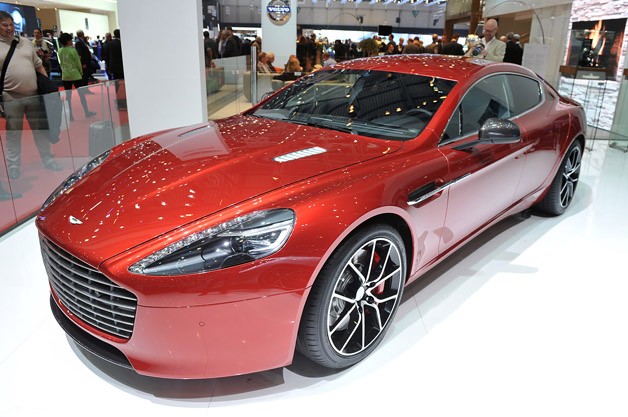
Aston Martin has displayed the replacement for the Rapide, it is now called the RapideS.  The car features a few styling updates on the outside but it gets 80 horsepower more than the outgoing car. The four door Aston Martin looks even more gorgeous than the outgoing model and is bound to be a hit with both Aston Martin fans and those who are not yet fans of the marque.

2014 Aston Martin Rapide S Geneva

Pic courtesy: Autoblog.com

07 Ferrari Laferrari Geneva

Pic courtesy: Autoblog.com

The successor to the iconic Ferrari Enzo is here. And it has broken the convention of naming which usually was F40 or the F50.  Ferrari has called it the LaFerrari, so do we read that as THEFerrari?  I guess that is the intention.  At Geneva Ferrari took the wraps off the new car which will be sold in limited numbers, 499 to be precise.