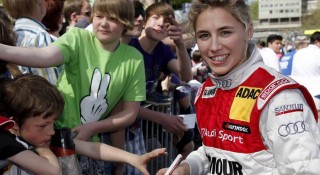
Jamie Green, winner of the DTM final round at Hockenheim

Jamie Green (Mercedes-Benz) won the DTM season finale at the Hockenheimring Baden-Württemberg having started second on the grid. Second place in the final round of the season went to the newly-crowned DTM champion Martin Tomczyk (Audi) who started third on the grid. At the finish, Tomczyk was 7.620 seconds down on Green. Miguel Molina (Audi) who started from pole position lost his lead early to Green and Tomczyk but managed to secure his maiden podium finish in third place.

Norbert Haug, Head of motorsport Mercedes-Benz: “That was a fantastic race by Jamie (Green). He was very dominant. His fast laps were in a class of their own. That was a very mature performance. Martin (Tomczyk) is a worthy champion. Bruno (Spengler) is a top class driver, but when you start on the wrong side of the field, getting an optimal result is difficult.”

2011 DTM final round at Hockenheim : Jamie Green takes a commanding lead2011 DTM final round at Hockenheim : Martin Tomczyk ahead of Miguel Molina

Jamie Green takes a commanding lead, 2011 DTM Champion Martin Tomczyk ahead of Miguel Molina

Susie Wolff’s bad luck streak continued with her car stalling at the start. Bruno Spengler, who could have been this year’s champion if not for a damper failure in the Oschersleben race, started at sixth position but lost three places was pushed down to ninth position by the end of lap 1. Prior to the race, Spengler had a 2 point lead over Ekström in the driver’s standings. Spengler’s slide down to ninth paved way for Mattias Ekström to complete the 1-2 for Audi in the drivers’ standings by finishing sixth and scoring three points in the finale.

Rahel Frey DTM 2011 HockenheimRahel Frey in the Glamour A4 DTM at Hockenheim

Rahel Frey (Glamour Audi A4 DTM), in the last round of her debut season in DTM was awarded a penalty for jumping the start, and managed to finish sixteenth. Lap 26 saw Susie Wolff in the pit lane for her drive through penalty awarded after an unsafe release from her pit stop in lap 19.

Audi also claimed victory in the DTM teams’ classification. The Audi Sport Team Abt Sportsline won with 85 points from THOMAS SABO/Mercedes-Benz Bank AMG (76 points). Italian Edoardo Mortara (Audi) was awarded with the prize for the ‘Best Performance’ as a DTM rookie.

2011 DTM Podium2011 DTM : Jamie Green in his AMG Mercedes C Class

Jamie Green (AMG Mercedes C-Class) :“I feel very proud to have won this race which is also the final outing for the AMG Mercedes C-Class, the most successful car in DTM history. My car was perfect and I’m so pleased to have won here at Hockenheim for the second time. Now I can start the winter break on a high as a race winner this year. Many thanks to my team for all their work today and throughout the season. I’m looking forward to the new DTM era which starts in 2012. I’m sure it will be just as exciting as the old one, if not more so…!”

Miguel Molina (Red Bull Audi A4 DTM), 3rd place:“A tremendous race. Unfortunately, I made a small mistake at the start but then we had a good pace and were fighting for positions. It’s great to have mounted the podium in the last race of the Audi A4 DTM. I’m also happy about my pole position. We’d like to continue like this.”

Mattias Ekström (Red Bull Audi A4 DTM), 6th place: “I’m very pleased. As far as performance goes, this has been my best season in the DTM. In the first half the results weren’t the way I’d have liked them to be, but the second half was very good. On the whole, I’m proud and happy. We made a lot of improvements in the Abt team and the people from Audi Sport worked hard as well. We’ve learned a lot for the coming season.”

Rahel Frey (Glamour Audi A4 DTM), 16th place: “My start was bad and my nerves were shaking. The race had a weak beginning but a good ending. I’m quite pleased. The times were solid; we had two very good pit stops and finished the race without damage. For me it’s been a nice close of the season. My thanks go to all the people that have supported me this season.

Bruno Spengler (Mercedes-Benz Bank AMG C-Class) – Ninth: “Unfortunately, my bid to end the season as runner-up in the championship didn’t quite come off, but all the same, I take satisfaction from having won two races and having started from pole position in four. That’s much more important than finishing second in the standings. So all in all, this has been a good year for us. The team worked really hard and, right up to the final lap, we gave it everything. I was faster than Oliver Jarvis and Timo Scheider today, but they proved too difficult to overtake.”

Susie Wolff (TV Spielfilm AMG Mercedes C-Class) – 15th: “I had, of course, hoped to do better than 15th place in my first race as Susie Wolff, but it was tough to move up the field more than a couple of places from P17 on the grid. Like all the team, I’m pleased for Jamie and his victory – the 85th for the C-Class – I love this car!”

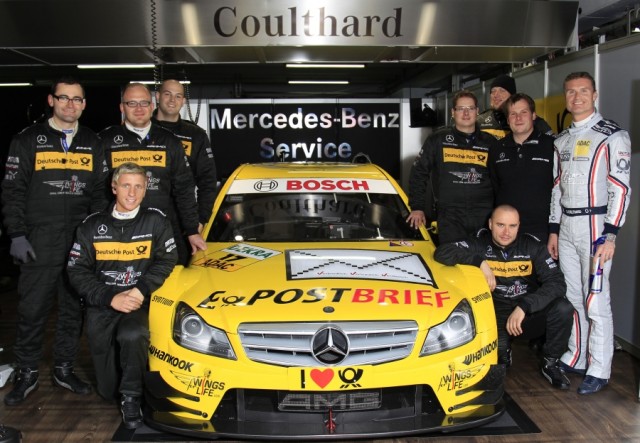
David Coulthard (Deutsche Post AMG Mercedes C-Class) – 17th: “This was an unlucky race for me – my first pit stop wasn’t brilliant, unfortunately. After that my race was more or less over, since I had no chance to move up the field. I would of course have wished for a better result for the end of the season.”

2011 DTM : David Coulthard with his Deutsche Post AMG Mercedes

Wonder what David’s so chipper about?

The Formula One drivers will only turn a wheel for the first time at the Buddh International Circuit on Friday morning. But although those practice laps will mark the beginning of a new learning process, the teams and drivers are far from starting from zero when they actually take to the track. Preparations for the race have been underway for nearly a year – and by race day, around one million simulations of the race will already have been completed.

When did the team’s first preparations begin for the inaugural Indian Grand Prix?
The process of preparing for a new race begins with the logistical challenges rather than the technical ones. The team’s travel department conducted a recce of the local area in December 2010, and made hotel reservations shortly afterwards. The logistics crew generally make a visit around nine months ahead of the race, in order to plan the layout of the garage, access routes and storage areas. In terms of technical preparations, these begin with architects’ plans of the circuit. The elevation and camber provided on these are used to construct a basic track map for virtual simulation, around six weeks before the event. This map is gradually improved as more information becomes available from the FIA and the circuit. In recent years, circuits have only been completed very shortly before the first race weekend – and the same is true for the inaugural Indian GP – which means the team cannot make a digitised map of the track. Set-up simulations, which provide the baseline settings for the car at the start of the opening practice sessions, are carried out the week before the event.

What factors are taken into account when devising the baseline set-up?
Circuit characteristics can be distinguished from a basic two-dimensional map. Factors such as downforce levels, braking duty and g-force loadings are all a function of the circuit’s geometry, and basic simulations will provide a direction for those parameters. Initial simulation suggests that the cars will spend around 65% of the lap at full throttle, with the longest full throttle period of 14.5 seconds, between turns three and four. The cars will exceed 285 kph at three points around the lap, while the fastest corner is expected to be turn 12, which is expected to be taken at 255 kph. The maximum g-loading around the circuit is expected to be 4.0 G, at Turns 5, 9 and 11.

How is the driver-in-the-loop simulator used before the event?
The basic nature of the track map means that the simulator can only be used for basic familiarisation with the circuit, because the track map is not detailed enough to include information such as bumps and kerbs which influence set-up tuning. The team will generally complete around 100 laps (nearly two race distances) in the simulator, programmed with a variety of fuel loads and grip levels, to ensure as many possible scenarios as possible are covered. In addition to using the driver-in-the-loop simulator, the team conducts strategy simulations to analyse as many race outcomes as possible. By race day, we will have performed around one million iterations of the potential race, which are used to inform decisions about how to approach qualifying and the race itself.

What preparation do the drivers have to do for a new circuit?
Like with other circuits, they must be familiar with the KERS deployment schedule (when KERS is deployed to the greatest performance advantage around the circuit), the DRS zones and also the pit-entry and exit lines, for speed limiter activation and deactivation. In terms of learning the circuit, the drivers will conduct their usual track walk on Thursday to inspect it on foot, and potentially note specific signs and markings that they will need to be aware of when in the car. In terms of learning the circuit, this is an ongoing process through the weekend, as grip levels increase, and the team structures its practice programmes to give the drivers maximum time to familiarise themselves with the intricacies of the layout.

Which track does the new Buddh International Circuit most resemble?
The circuit has similarities to Turkey, with a long main straight and a very long, sweeping corner (Turns 10 and 11) that resembles the triple-apex Turn Eight in Turkey. However, while Turn Eight was taken with an average corner speed of 270 kph, in India the corners are expected to be taken at 170 kph (Turn 10) and 210 kph (Turn 11) respectively. The lap time and speed will be very much dependent on the grip level achieved by the Pirelli tyres on the new asphalt surface. A lap time of 1:25.000 would correspond to an average lap speed of 218 kph, while a lap time of 1:30.000 would equate to an average lap speed of 205 kph.

As with the previous press release from Mercedes-Benz, Riot Engine has reproduced the article as released by Mercedes-Benz without any changes. If you have any suggestions as to how we could have made it better, do mail us at feedback [at] riotengine.in


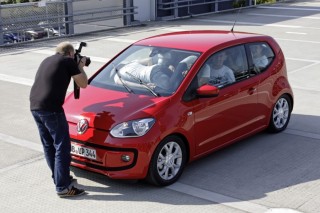
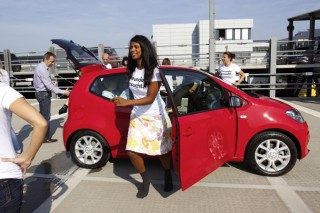
Employees at Volkswagen Communications made an attempt at an unofficial world record when 15 women and one man squeezed themselves into the interior spaces of a Volkswagen up!.

16 people in a Volkswagen up!

Two in the boot, one on the dashboard, seven on the rear bench, four on the front seats, two in the footwells – then the boot lid and doors were shut, and the windows were closed. That’s how VW set a world record for 16 people in the new up!.

16 people in a Volkswagen up!

Volkswagen, in its press release also states that back in the 1950s it was extremely popular to cram as many people as possible into a telephone booth. At a car meet in Australia, 17 Beetle friends spontaneously decided to squeeze into this Volkswagen icon. In 2010, 20 people raised the bar with a record in Wilmore, Kentucky (USA), which landed them in the Guinness World Records. Naturally, attempts were also made in the successor model. In January 2001, a record 27 students from the USA squeezed into a New Beetle.

16 people in a Volkswagen up!16 people in a Volkswagen up!16 people in a Volkswagen up!

We also found this video on his channel about a training session for bikers on dual purpose bikes like the F 800 and the Katooms. They do seem to be having fun, a lot of it.

There are more videos at his channel which we think might be of interest to you, the biker.


Eight years after Daijiro Kato died riding a Gresini Honda MotoGP motorcycle, Marco Simoncelli met with the same fate on a Gresini Honda MotoGP motorcycle.  Both were works spec machines; the difference lay in the cubic capacity.  Kato died riding a 990cc Honda while Simoncelli died riding an 800cc Honda.  Both suffered head, neck and chest injuries but Kato lived for two weeks in a coma before finally succumbing while Simoncelli died almost instantaneously.  After the death of Kato, Suzuka the racing circuit on which he died, did not host motorcycle racing anymore.  But Honda in conjunction with other manufacturers felt that in order to slow motorcycles down, they had to bring down the capacity of the engines of the MotoGP class to 800cc from 990cc.  It also helped that around the same time Formula1 was bringing down engine capacity to 2400cc from 3000cc and the number of cylinders from ten to eight.

If the intention of the manufacturers, Dorna (the rights holders of MotoGP) and the FIM (the governing body) was to slow the pace of the motorcycles, then they failed right from the word go.  In testing it was found that the 800cc motorcycles were much faster around turns and chicanes than the preceding 990cc motorcycles were.  Lap times in races started coming down right from the word go and even today the highest speed of a MotoGP motorcycle stands against the Honda RC212V (800cc) ridden by Dani Pedrosa (at 218 MPH) and not against a 990cc machine.  Progressively over the years the 800cc motorcycles though disliked by all were going faster than ever and in the wake of increasing speeds and decreasing lap times leaving behind more and more riders with all kinds of injuries.  MotoGP fans can scan their memories to see if in the past few years there was one year where some rider or the other had not been injured sufficiently to be out of a few Grands Prix.  None will be found.

The afore mentioned Dani Pedrosa has been injured in all of the last three seasons, Valentino Rossi in two, John Hopkins, Loris Capirossi, Hector Barbera, Alvaro Bautista, Randy De Puniet, Cal Crutchlow, Colin Edwards, James Toseland and Ben Spies in at least a few races of at least one season.  Almost every rider has crashed and starting grids which were as it is very small have become smaller still with riders injuring themselves severely and requiring surgeries.  The grand finale of this history is the death of Marco Simoncelli.  We say this history with reference to the 800cc machines which will not race after the one final race this year at Valencia.  From next year on it will be thousand cc engines and who knows what that will bring.  But to come back to the 800cc machines and Simoncelli’s death.  Before progressing further, it should be clarified that work on this article was well on the way before Marco Simoncelli died and now it is being redone keeping this rather ghastly development also in view.

Marco Simoncelli had as many antagonists as he did protagonists.  His fans loved him, the mop of hair, the colourful persona and the devil may care attributes all made him attractive to fandom.  His detractors however were many.  After his crash that saw him take Dani Pedrosa out of a race with a fractured clavicle, Pedrosa’s disreputable manager Alberto Puig called Simoncelli a person with only hair and no brains.  Pedrosa even refused the handshake the Simoncelli offered him.  While at the beginning of this season, Casey Stoner and Valentino Rossi were engaged in a wordy duel, Jorge Lorenzo started one with Simoncelli calling him a dangerous rider who was a threat to his fellow riders.  Even in the days of 250cc racing, Simoncelli had been reprimanded a couple of times for putting dangerous moves, one that remains in mind is that which he did at Jerez on Hector Barbera which saw the latter crashing into the pit wall, mercifully without serious injury.

Simoncelli has been the MotoGP equivalent of the gunslinger of the good old wild West.  He believed in the old school idea that racing should show no mercy.  Max Biaggi, after he and Luca Cadalora banged fairings and when the latter complained of bad riding, famously said “This is motorcycle racing, not classical music”.  Recently Valentino Rossi also called present day racers pussies (his idea of a sissy) and the general tenor is that people are becoming unnecessarily alarmed about things.  But apart from Simoncelli’s shock death, the unending list of injuries is necessarily a thing to be alarmed about.  And many have been injured not by coming into contact with others but simply by falling of the motorcycle all by themselves.  So where is the problem then?

To understand the source of the problem a walk down history is necessary.  Prior to MotoGP turning into a four stroke category, in the premier class which was the two stroke 500cc class, there was such a thing as a privateer entry.  People rode around on bikes such as the Patton, though invariably last on the grid, it was there for most of 500cc racing’s existence.  There were also the Elf branded 500cc motorcycles.  There was then Kenny Roberts’ Modenas and later Proton KR3 effort.  But once under pressure from Honda when MotoGP became four stroke, the category of a privateer vanished.  In effect all teams have become factory teams, while those which are called satellite outfits did not get one or two developments in electronics.  So strictly speaking all entries are factory entries and in order to protect their patented technologies, manufacturers have preferred to crush older machines rather than leasing them out or selling them to privateers.  It is this development which is most significant if we have to understand the current state of affairs.

Motorcycle factories have shown a contradictory tendency.  In the first instance they expressed an intent to slow motorcycles down by bringing down the cubic capacity of the engine but then made every possible attempts to make the 800cc motorcycles go faster and faster.  Electronics have played a very big part in this process of speeding bikes up.  But we have to explain the cause for the contradiction.  As is the case with all intentions, the intention to slow the motorcycles was well meaning, but as is the case with all competition and racing specifically to win one has to be fast and every factory wanted their motorcycles to be the winners.  One development that no one can underestimate or understate is that which pertains to Ducati and Casey Stoner emerging as top guns at the beginning of the 800cc era.  The combination stunned the Japanese manufacturers and some riders like Valentino Rossi.  Ducati and Stoner were unstoppable.  Accusations were levelled that the Ducati was more than 800cc or that it was consuming more than the 21 litres of fuel allotted per race.  All were proven wrong.

The factories realized that they had been beaten fair and square and pundits claimed that Ducati was benefitting because of its Desmodromic valves and that conventional spring valves were the undoing of the Japanese manufacturers.  First Suzuki and then Kawasaki shifted to pneumatic valves from spring valves but Yamaha and Honda, obdurately (and rightly) insisted that the issue was not with valves at all.  But the chatter about valves reached such a crescendo and included riders of Yamaha and Honda, so much so that Yamaha and finally Honda shifted to pneumatic valves.  But the improvement in performance was not going to come from there.  The Japanese as usual went the high tech way and more and more electronics came into the picture.  There were engine maps that cut out engine braking that is usually pronounced in four stroke engines, there were settings for traction control and many other such innovations to make the bike go faster.

Now add another variable to this recipe that is already primed for disaster.  The controlled tyre from Bridgestone.  Bridgestone not wanting to be accused of favouritism created tyres that could well race for twice the length of the actual races.  This meant that it usually took a while for the tyres to come into their own and offer proper grip.  But the mentality of a racer is never going to be “let me wait for the tyres to warm up properly and provide me with good grip”.  It is always going to be “that guy at the front is getting away, let me catch up with him”.  And compounding this situation are riders like Casey Stoner who seemed to be able to take off on tyres that do not offer optimum grip.  Not all are as talented as Casey Stoner and usually pushing early meant crashing.  Marco Simoncelli was the prime example of this.  This year he crashed so many times because of trying to do too much on cold tyres.  And the end came for the same reason. Unfortunately, this time the motorcycle instead of going away from the track and into the gravel went straight into the path of motorcycles following it.

Even in the days of the evil handling 500cc two strokes did so many riders not get injured so frequently and so many times.  The reason for that is that it was the rider who rode by the feel that he had with the bike rather than electronics doing all that for him and cutting him off from the road.  The riders then knew where the limits were but now they do not since the feeling from the road is not fully transmitted back to the rider.  In the days of the five hundreds there were privateers.  They got their engines from Yamaha and put them in chassis made either by ROC or by Harris.  There were always back markers to slow down the leaders.  It was usual for the Patton to be lapped up to three times in a race.  Now with all factory bikes, that does not happen.

For MotoGP to slowdown and to get safer, it is essential that electronics be limited and tyre compounds that degenerate with every passing lap be used.  CRTs is the right way to go forward and more of them should be encouraged to break the strangle hold of the factories on the sport.  All these can make the sport much safer than it is today and more lives need not be lost and injuries can also be minimized.  Hope sense prevails.

The organizers of the Formula1 Grand Prix of India are trying to ensure a full house for the inaugural race on the 30th of October, 2011.  So far the organizers have been able to sell about 60% of the available tickets.  The scheme so far is that of one ticket for all three days but to try and sell the available 40% of the tickets, the organizers are now offering tickets only for the day of the race as well.  Those intending to go only on the 30th of October can get Grand Stand tickets for Rs. 15,000, Classic Stand tickets for Rs. 4,000 and Picnic Stand tickets for Rs. 3,000.  We say that this is an amazing deal.  We suggest you grab the tickets before they are sold out.

The Maruti Estilo is now available at an ex showroom (Delhi) price of Rs. 2.75 lakhs according to Carwale.com.  This offer is valid till the 31st of October.  This seems to be a move to push sales of a petrol car that is otherwise not doing too well in the market and Carwale.com is even speculating that this could be to neutralize some of the Hyundai Eon effect in the car market.

The BMW S1000RR from BMW Motorrad is one of the most powerful and fast motorcycles in the sports category.  It is used by the company as a part of its World Superbike Racing effort.  The motorcycle puts out 193 PS of power and is considered the finest effort from BMW Motorrad.  In what is typical of the Teutonic pursuit of perfection, BMW Motorrad has improved the driveability of its motors and also made some changes to the exterior such as a smaller rear cowl not only to make the motorcycle look good but also to drive well.  This model is the 2012 model which should be available in India from January of 2012 onward with a slightly upward revision of price.

The BMW 330d is the latest in the line of convertibles that the company offers.  It is one of the three that BMW sells, the other two being the 6 series convertible and the Z4.  The convertible is available in India now and it features a metal roof that electrically folds away and opens as per the command of the driver.  The car features the diesel motor used in the 530d.  The motor displaces 2993cc, is a straight six cylinder configuration and will pump out 243 PS of power and 55.1kgm of torque.  The car is brought into India as a CBU and prices start at Rs. 57/- lakh ex showroom Delhi.