Lito Green Motion SORA : Render, Front 3/4

The notion of an electric superbike has been thought of, ridiculed and ignored for ages now. A handful of enthusiasts though, could see the potential of an electric motor that could deliver Goliathan torque right from the word ‘Go’. Meet Mr. Jean Pierre Legris, a Mechanical Engineer from Montreal who is one such enthusiast.
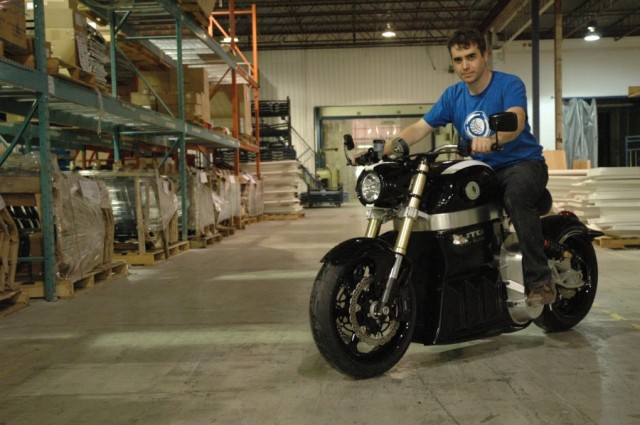
Jean-Pierre Legris, President, LITO Green Motion and The SORA

Having worked for Honda in Japan for over 2 years on the design of a V6 engine, and then moving to France working on panoramic sliding glass roofs for Peugeot-Citroën, Legris has a good understanding of the process of development of an automobile. He started out by gathering a team of reputed experts competent in their specialization. Legris also understood the need to present to the consumer an electric superbike, with styling as one of its biggest priorities. Taking design cues from bobbers and cafe racers, Martin Aubé , President, The Creative Unit, penned the lines for this motorcycle. This first step in the right direction has worked well for LITO, with orders pouring in from all over the world. This was also helped the SORA stand out from the other electric superbikes that were available off the shelf, some of them with victories at the TTXGP under their belt.

As easy as it would have been for the team behind the SORA to build a more generic product like a scooter, or a commuter motorcycle, Legris knew that with the kind of expertise the team had, they would be better off targeting a niche market like that of the electric superbike.

LITO Green Motion SORA : Rear 3/4

When detailing the specs of the SORA, Jean-Pierre Legris realized the need to ensure the components be chosen so that homologation, a formidable task for any small manufacturer, would be as smooth in various parts of the world specifically the US, Canada and Europe.

The SORA has a number of firsts to its credit. We will delve into each of these.

First electric motorcycle with CVT transmission

LITO Green Motion SORA : CVT, Elka Suspension, Aluminium Swingarm

Most automobiles using electric propulsion have either the motors integrated in the wheels themselves or have a single speed transmission setup. The SORA stakes claim to being the first electric motorcycle to have CVT. This means efficient utilization of the power generated by the motor.

Having a CVT means a top speed of 200 km/h without compromising the bike’s 0-100 km/h time of  4 seconds.

Integrated Touchscreen GPS & Power Management System

LITO Green Motion SORA : Front 3/4

The SORA has a touchscreen GPS system mounted up front, a world’s first on a motorcycle LITO claims. What sets this GPS apart from the crowd is that, it is also connected to the SORA’s power control unit which optimizes power delivery from the motor to ensure you have enough juice in the battery to reach the destination set in the GPS system. This is LITO Green Motion’s patented Safe Range System™.

First motorcycle with electrically adjustable seats

LITO Green Motion SORA : Electrically Adjustable Seats, Touchscreen GPS

The guys at LITO Green Motion suggest you raise the seat, electrically of course, while riding in the city for the ‘street-fighter’ feel and better maneouverability and lower the seat while riding on the highways for the relaxed riding position.

Pretty cool that the technical specifications of the bike detail seat height as “750 to 850mm”.

First “Keyless” motorcycle

LITO Green Motion SORA : Front 3/4,  in the factory

I have never been excited by key less entry, a concept that always leaves me befuddled. How can you trade in the the comfort of the physical action of slotting in the key and twisting it to ignition and hearing all the electronics going ‘whirrr’ before thumbing the starter, for the minimal convenience of key less starting?

I imagine though, others would disagree and would simply love the idea of getting on the bike, thumbing the starter, the SORA then detects if  they key is in proximity and then she roars, er.. whistles to life!

Battery, Charging Duration & Range

LITO Green Motion SORA : Lithium Polymer Battery Modules covered by the massive carbon fibre fairing

The SORA uses 12 kWh lithium-polymer battery modules with integrated Battery Management System housed up front and covered by the carbon fibre fairing.

On an external fast charge system, it should take around two hours to charge it fully, and using the onboard charger it should take 8 hours. Another patent LITO scored here is an email notification system that lets you know once your motorcycle is fully charged.

The SORA has a specified range of 300km on a single charge, with the usual disclaimer that its valid only when ridden at ‘urban speed’. The faster you go, which you are probably bound to considering the tempting 200kph top speed, the sooner you’re going to have to end your ride.

The SORA features a USB port inside the storage compartment, allowing you to choose different riding profiles (acceleration curves, regenerative braking, etc.).

The SORA makes good use of LITO’s advanced software that controls power output of the motor. There are also  3 control modes : performance, eco, safe range.

The SORA also has regenerative braking, as every energy efficient automobile should. Under braking, the kinetic energy of the SORA, instead of being lost as heat is fed back into the motor via the transmission belt, the motor acts as a generator at this moment and produces electricity that is used to charge the battery.

LITO Green Motion SORA : Side View

The SORA is also engineered with the high quality suspension and braking, without the benefit of a test ride yet, we can only hope all the engineering makes it as good a handling machine as its combustion engine counterparts.

Jean-Pierre Legris has also tried to source all the components on the SORA locally. Nearly 90% of the components on the bike come from suppliers in Quebec. Legris seems to have achieved what he set out to do : “Be the first Canadian company to develop and market an electrically powered motorcycle without compromising performance”.

Where does this leave us, the enthusiasts? Would you shell out close to 42,399 Canadian Dollars for an electric superbike when you get some wild Italian exotics for much less? What happens though, when a couple of years down the lane, petrol (ah, gasoline) becomes so expensive that it will no more be affordable for the common man? Wouldn’t the enthusiast who bet on the SORA have the last laugh? More so when you consider Legris assures us that this motorcycle has been built to last, maintenance free for at least thirty years?

LITO Green Motion SORA : In the Shadows

The Grand Prix Comission has confirmed nine CRT entries apart from the twelve factory and leased bike entries for next season.  One team has also been placed in the reserve list.  The names of teams have not been revealed.

Confirming a long expected move, the Sahara Force India F1 team has reported that it is taking in its reserve driver for this year Nico Hulkenberg into a race seat next year.  It has also confirmed that Paul Di Resta will continue in the other car.  This means that Adrian Sutil is out of the team with only two openings one each at Williams and HRT remaining to be filled.  He may have to fight Toro Rosso oustees Sebastien Buemi and Jaime Alguersuari for those two seats.  Scuderia Toro Rosso has confirmed Daniel Ricciardo and Jean Eric Vergne as its drivers for next year leaving the present incumbents out in the cold.

Economic Times has reported that Suzuki will be launching yet another scooter at the Auto Expo.  It has quoted Mr. Atul Gupta, VP- Marketing as having said that the company is unable to meet the demand for its existing Access scooter and so it is in the process of launching another scooter!!! We suspect ET has quoted Mr. Gupta wrongly and suspect that Mr. Gupta may have said something to the effect of there being pent up demand in the scooter market and therefore launching another scooter was logical.  But that is conjecturing.  Anyway the Auto Expo is nearing and all should be clear soon.

When the Fluence was first launched by Renault a few months ago, the diesel version was considerably de-specced in comparison with the petrol version.  Renault has now started offering a new diesel variant which has all the bells and whistles that the highest spec petrol version has.  This car, called the E4 variant is priced at Rs. 15.2 lakhs ex showroom Mumbai.  It however continues with the existing 1.5 litre diesel engine that does duty in the lower variants.

Hyundai i-oniq Concept Design Sketch

Hyundai has released a teaser of the i-oniq concept car which will debut as the 2012 Geneva Motor Show. Hyundai will use this concept to showcase the evolution of the ‘fludic sculpture’ design language.

Hope they have penned down better looking lines at the rear.

Thomas Bürkle, Hyundai’s European Chief Designer, commented: “Two strong arched curves define the silhouette of i-oniq, creating a playful contrast between the sharp character lines and soft but muscular features.”

The i-oniq concept was designed and developed at the company’s European R&D centre in Rüsselsheim, Germany.

Source: carbodydesign

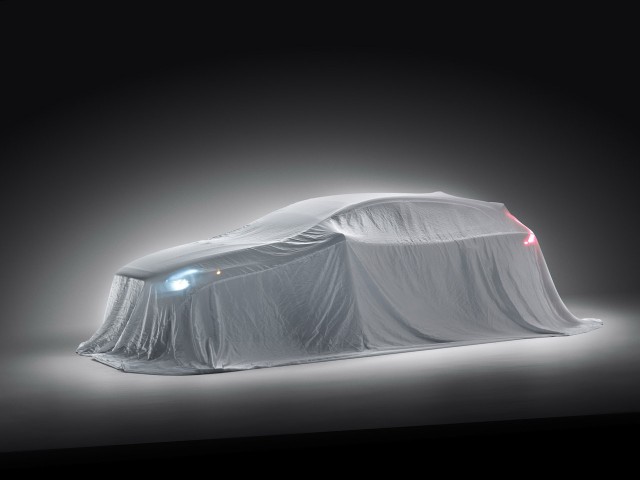
Volvo V40 Teaser : Geneva Motor Show 2012

Volvo will unveil the V40 at the upcoming Geneva Motor Show in 2012. The five-door hatch/sportwagon is supposedly replacing the C30, S40 and V40 in various guises.

Considering all the recent products to have been penned down by the Swede company, we are guessing this one should be a looker too.

Source : AutoBlog

1952 Mercedes-Benz SL Roadster W194

1952 Mercedes-Benz SL Roadster W194

I love using black and white pictures of vintage automobiles. Aside from the fact that most of those pictures are actually beautiful, they also have my love since they make this correspondent seem like a very knowledgeable automotive journalist. Competing with the rest of the Riot Engine team in spewing out automotive facts is definitely not something I’d want to do on a Sunday evening. Every time I put up one of these ‘Design’ features, I’ve to resort to warp speeds and travel back in time.

My first experience of the original Gullwing was in Test Drive Unlimited, a very popular console/PC game with a huge list of impressive cars to drive about town. When Mercedes-Benz launched the SLS AMG and had a number of journalists from India and elsewhere do the Carrera Panamericana Mexico run, I had the first of my lessons on the Mercedes-Benz 300 SL. Pretty much every magazine off the shelf talked us through the grainy black and white film that told us the story of the SL. That it was so successful and Mercedes-Benz decided to do a production run in 1954, targeting the American consumer is something we’re all familiar with now.

My memory having the structural integrity of smoke floating up towards the ceiling, I barely remember any mention of the roadster version of the 300 SL. It would seem the Jubiläum Grand Prix for sports cars at the Nürburgring in August 1952 saw the first appearance of four 300 SL coupés modified as roadsters, with one also having a slightly shorter wheelbase and narrower track. The competition wasn’t much to talk about and the four cars duly took the first four places.

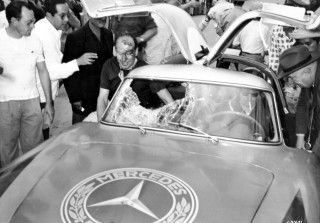
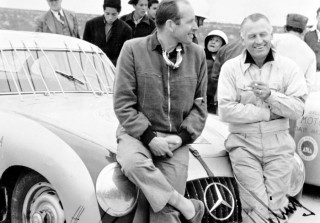
Third Carrera Panamericana Mexico, 1952. Winners Karl Kling and Hans Klenk at the wheel of a Mercedes-Benz 300 SL after a vulture crashed through the windscreen.1952 Mercedes-Benz SL Racing Coupe W194 with the mesh to offer protection against 'vulture' related accidents, Seen here are  Hans Klenk and Karl Kling

The Vulture and the Windshield

The double victory in November 1952 of Karl Kling/Hans Klenk and Hermann Lang/Erwin Grupp in the Carrera Panamericana – an eight-stage race covering a total distance of 3,130 kilometres in far-off Mexico caused a worldwide sensation. This was the race where the Kling/Klenk team collided with a vulture, which smashed the windscreen. From then on the 300 SL windscreen was protected by a mesh outside the screen.

Having spent the last few hours trawling through pages of Mercedes-Benz history, I could go on, but what would I write about when we do get around to driving the SL? So, back to the future.

2013 Mercedes-Benz SL

Though the phrase ‘All New’ has been bandied about recklessly these days, the 2013 SL is truly all new, for the first time Mercedes-Benz has implemented an all-aluminium bodyshell in a series-production model. High-strength steel tubing is integrated in the A-pillars for occupant safety. Branded the ‘SL’, in reference to the sporty and light nature of these cars, the endeavour to lose weight is not something that Mercedes-Benz intends to stop anytime soon. The SL, is available as either the SL 350 or SL 500. The SL 350 is lighter than its predecessor by 140 kgs and SL 500 lighter than its predecessor by 125 kgs! The new aluminium bodyshell weighs around 110 kilograms less than it would compared to the steel technology used before.

2013 Mercedes-Benz SL 500

The steering knuckles and spring links on the front axle are also made out of aluminium to reduce the unsprung masses. The same also applies to virtually all the wheel location components on the rear axle. The frame of the various versions of roof offered, is made of magnesium, reducing around six kilograms thus providing a lower centre of gravity for the vehicle and, in turn, better agility.

“The effect is rather as if a heavyweight-class passenger had got out of the car” says Dr Thomas Rudlaff, responsible for the aluminium bodyshell at Mercedes-Benz. “The result is perceptible and measurable. Less weight means more dynamism and less consumption. In other words: the motoring enjoyment increases, the environmental burden sinks.”

Design

The bonnet is characteristically long, with the passenger compartment set far out to the rear. As with other Germans auto majors this year, the rear end has a lot of horizontal elements that give an impression of a wide rear end. The powerful looking flanks are defined by elaborately styled lines. The ventilation grilles on the side of the car with chromed fins, cues of traditional Mercedes-Benz design heritage, clearly emphasise the legend of the SL.

2013 Mercedes-Benz SL 500

Falling in line with recent Mercedes-Benz design language, the radiator grille stands upright. The centrally positioned star needs no introduction and stands proud at the center of the grille.

Opinion at Riot Engine is divided about the dynamically slanting headlamps. They flank the front end and give the new roadster its own unmistakable face.

2013 Mercedes-Benz SL 500

The headlamps come as standard with the Intelligent Light System (ILS). With five different lighting functions that are tailored to typical driving and weather conditions, and are activated depending on the driving situation, they offer the driver a much better illuminated field of vision. The sidelights and the horizontal strip of the daytime running lamps in the far ends of the bumper are LEDs.

2013 Mercedes-Benz SL 500 , SL350

Exemplary aerodynamic qualities of the SL design are obvious benefits. Mercedes-Benz stakes claim to having the lowest drag coefficient (cd = 0.27 in the SL 350) in its segment, lowest wind noise that is virtually on a par with a closed saloon, the best comfort for open-top motoring so that you can still have the roof down even at high speed and virtually no accumulation of dirt on the side windows.

Interiors

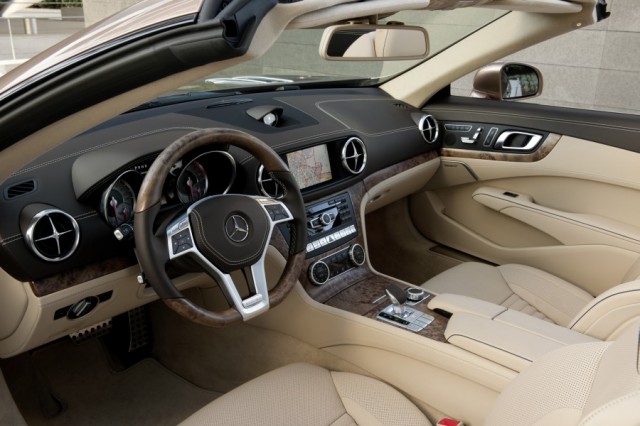
2013 Mercedes-Benz SL 500 Interiors

As Mercedes-Benz puts it, fine materials, perfectly finished with great attention to detail, distinguish the style and character of the interior.

Compared with its predecessor, the new generation of the SL is much longer 4612 mm (+50 mm) and wider 1877 mm (+57 mm), providing more room for more comfort in the interior, too. Shoulder room (+37 mm) and elbow room (+28 mm) have been increased, exceeding the dimensions normally found in this vehicle class.

2013 Mercedes-Benz SL 500 Interiors

The wood trim extends from the centre console across the dashboard into the doors, creating a cool wrap-around effect. Three types of wood along with two different aluminium trim finishes are available.

2013 Mercedes-Benz SL : Headlamp2013 Mercedes-Benz SL 500 Interior

When the Sunny was launched in September last year, all reviews lamented the lack of a diesel engine in the ‘caaaaaar’ in a market that had started developing vicious hatred to petrol mills.

In a surprise move, Nissan launched the Sunny diesel in two variants, the XL and the XV on the 12th of December 2011.

Available colours include Bronze Grey, Blade Silver, Storm White, Sapphire Blue, Onyx Black and Brick Red.

Sunny Diesel is competitively priced and will be available for Rs 7,98,000 (XL) and Rs 8,78,000 (XV), ex-showroom, New Delhi. Nissan has adopted a uniform pan-India pricing strategy meaning you can buy the Sunny Diesel at the same ex showroom price all over the country.

The 1.5-liter, 4-cylinder K9K engine, has a fuel efficiency of 21.64 kmpl (ARAI certified) and delivers 86PS of power @ 3750 rpm and a maximum torque of 200 Nm @ 2000 rpm.


Mr. Kiminobu Tokuyama, Managing Director & CEO, Nissan Motor India Pvt. Ltd, said, “We are delighted to introduce the diesel variant of Sunny for the Indian market. We are currently witnessing a significant and sustained increase in demand for diesel cars across India and we are confident Sunny’s blend of technology, performance and fuel economy will prove extremely popular with our growing customer base – it’s the right car at the right time for India.”

Mr. G M Singh, Vice Chairman & MD, Hover Automotive India, Nissan’s Marketing & Sales partner said, “Sunny’s introduction is another major milestone in Nissan’s rapid expansion in India – one of the fastest growing markets in the world. The fact that we have already achieved over 3000 sales for the Petrol variant of Sunny reinforces our belief that innovative and exiting products appeal strongly to our Indian customers.”

More from the press release:

Aimed at India’s fast-growing group of young professionals, the Sunny Diesel mirrors the petrol variant’s sophisticated style and roomy interior. It is the second model after the Micra hatchback to use Nissan’s flexible ‘V’ platform. The ‘V’, or Versatile, platform implements Nissan’s advanced engineering to deliver a modern, light weight structure, that provides integral strength, ride refinement and dynamic on-road behavior.

The Sunny Diesel carries high levels of active and passive safety features and technology designed to enhance both the driving and ownership experience. These include Anti-Lock Braking System (ABS), Electronic Brake-force Distribution (EBD), Brake Assist (BA), Engine Immobilizer and Airbags.

Honda City Facelift 2012

Honda Siel Cars India Ltd. launched the refreshed Honda City today, which has been doing the rounds on the internet for a while now.

New Honda City Facelift : New AlloysNew Honda City Facelift : Chrome Front GrilleNew Honda City Facelift : New Rear Bumper with reflectorsNew Honda City Facelift : Integrated ORVM Indicators

Design changes include new chrome front grille, restyled front and rear bumper and all new taillights and new 10 spoke Alloy Wheels.

New Honda City Interiors

The interiors have also been subject to the scalpel with the central console having – in Honda’s words – stylish Chrome fittings that give the car an upmarket feel. This should address the gripe most enthusiasts had with the City, the cheap feeling knobs and central console.

New Honda City Interiors : Blue Backlit Instrument ConsoleNew Honda City Interiors : Chrome door handles

The instrument console with the blue backlight should definitely find favour with the 10 year old inside every enthusiast.

Honda City Facelift 2012

The New Honda City now comes with enhanced ground clearance of 165 mm, 5mm more than its predecessor and it longer by 20mm than the previous City, although wheelbase remains same at 2550mm.

A sunroof, available only on the V (Sunroof) variant, Cruise Control System and Turn indicators on ORVM ( Outer Rear View Mirrors, dear All New Auto Enthusiast) are other value additions to the new City.

The new Honda City is available in a choice of six colours. In addition to the Carnelian Red Pearl shown above, there is another new colour the ‘Sparkling Brown Metallic’ and the usual Taffeta White, Urban Titanium Metallic, Alabaster Silver Metallic and Bold Beige Metallic.

New Honda City Taffeta WhiteNew Honda City Urban Titanium MetallicNew Honda City Alabaster Silver MetallicNew Honda City Bold Beige Metallic

Speaking on the occasion Mr. Seki Inaba, Director Marketing, Honda Siel Cars India Ltd. said, “Honda City is one of the most successful car brands in the country and certainly the most desirable sedan in its category. Honda City has 11th time achieved No.1 Rank in JD Power Initial Quality Survey in the mid size segment which is a record in itself. It is our constant endeavor to study customers’ emerging demand and introduce features that enhances the overall ownership experience. I am confident that the new range will appeal to our customers even more and will be the most admired offering in its category.”

The 1.5L, 4 cylinder new generation i-VTEC engine that delivers 118PS power and fuel efficiency of 16.8 km/l remains unchanged.In addition to the standard safety features like ABS (Anti-Lock Braking System) with Brake Assist (BA), Dual SRS airbags, pre-tensioner seat belts and G-CON (G-Force Control Technology) body.

Honda’s weirdly named G-Force Control Technology(G-CON) controls impact energy in the event of a collision and limits injuries. Honda has worked to protect the occupants as well as reduce damage to the other vehicle involved.The external body structure of the new Honda City ensures advanced pedestrian safety features.

Prices ex showroom Delhi:

1.5 Corporate (MT) : Rs. 6.99 Lacs
1.5 E (MT) : Rs. 7.70 Lacs
1.5 S (MT) : Rs. 8.20 Lacs
1.5 V (MT): Rs. 8.70 Lacs
1.5 V (AT) Leather : Rs. 9.42 Lacs
1.5 V (MT) Sunroof: Rs. 9.50 lacs
1.5 V (AT) Sunroof : Rs. 10.22 Lacs