Yearly Archives: 2012

Yamaha has always performed below expectations sales wise in the country compared to its international stature. That can be attributed to the fact the company lost its way for a few years but from 2008 onwards the fortunes of the company have been on the upswing.  Still there is enormous potential for further growth in the company and in the last year one has seen a continuous increase in sales leading to the belief that the company is now fighting its way back to the top, where it deserves to be.  The month of March, 2012 saw an increase of 15.6% month on month sales in the domestic market alone.

Here is the press statement issued by the company

Triggered by the success of its celebrated product line-up as well as an upturn in consumer sentiment, India Yamaha Motor has registered a growth of 15.6 % in domestic sales during March 2012 as compared to the corresponding period last year. It sold 29,819 units in March 2012 as against 25,786 units sold in March 2011 in the domestic markets. In the Export markets the company sold 12,067 units in March 2012 as compared to 10,982 units in the same month last year. The overall sales stood at 41,886 units in March 2012 while 36,768 units were sold in March 2011, thereby registering 13.9% overall growth.

Commenting on the results, Mr. Hiroyuki Suzuki, CEO & Managing Director, India Yamaha Motor Pvt. Ltd. said, “We are pleased with the encouraging response we have been receiving for our deluxe & premium segment bikes such as the YZF-R15 Version 2.0, FZ series & SZ series. We are planning to strengthen our Best 3S (Sales, Service & Spares) set up in tier-2 & tier-3 cities and increase sub-dealers in the rural areas to further boost our sales in the coming months.”

Yamaha continues to reinforce its relationship with the customers and has launched the ‘YES!YAMAHA’ campaign that endeavors to provide the Best 3S Experience so that the customer always appreciates Yamaha and accepts the brand like the word “YES”. The company is making steadfast efforts by conducting consumer-centric marketing initiatives such as Yamaha R15 One Make Race, Yamaha Safe Riding Science (YSRS) for college students & kids, Yamaha Service Camps to name a few.

About India Yamaha Motor Pvt. Ltd.

Yamaha made its initial foray into India in 1985. In August 2001, Yamaha India became a 100% subsidiary of Yamaha Motor Co., Ltd, Japan (YMC). In 2008, Mitsui & Co., Ltd. entered into an agreement with YMC to become a joint-investor in the motorcycle manufacturing company “India Yamaha Motor Private Limited (IYM)”.

IYM operates from its state-of-the-art manufacturing units at Surajpur in Uttar Pradesh & Faridabad in Haryana and produces motorcycles both for domestic & export markets. With a strong workforce of more than 2,000 employees, IYM is highly customer-driven and has a countrywide network of over 400 dealers. Presently, its product portfolio includes VMAX (1,679cc), MT01 (1,670cc), YZF-R1 (998cc), FZ1 (998cc), Fazer (153cc), FZ-S (153cc), FZ (153cc), SZ, SZ-X & SZ-R (153cc), YZF-R15 Version 2.0 (150cc), SS125 (123cc), YBR 125 (123cc), YBR 110 (106cc) and Crux (106cc).

In January 2012, the Renault Mégane family which was powered also by the dCi 110 engine got the Energy dCi 110 powerplant. This engine makes 20Nm more torque and as icing on the cake also reports a 12 % increase in fuel efficiency.

Here’s what else you would have got with the new Energy dCi 110

  • Stop & Start Tech that would have driven the fuel efficiency upto atleast around 26 kpl ( claimed of course)
  • ESM braking/deceleration energy recovery
  • EGR low-pressure exhaust gas recirculation
  • DLC-coated (Diamond Like Carbon) cam followers ( Renault says that’s Formula 1 tech)
  • ANI fuel injection nozzles (with individualised spray cone angle)
This is NOT the engine you get with the slightly more powerful Fluence launched yesterday.

What’s all the fuss about? Some of the online media entities also went to the extent of having the usual ‘speculation’ post the day before about what Renault was going to unveil today! The fact that the slightly newer dCi 110 engine was going to shove out the older engine in the Fluence’s bay was revealed at the Auto Expo when Renault had the dCi 110 engine on display alongside the Formula 1 RS27 engine.

Renault announces dCi 110 for Fluence

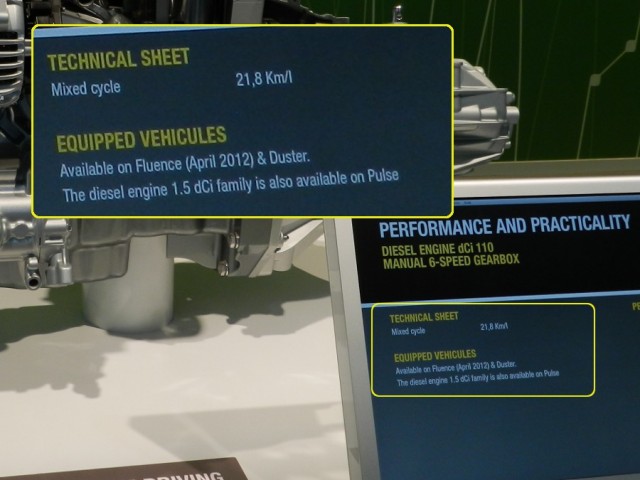
Contrary to what you may have read elsewhere, the claimed fuel efficiency figures seem to have remained unchanged. The ARAI fuel efficiency of 20.4 kpl being advertised by Renault now is probably the equivalent ‘Mixed Cycle’ fuel efficiency of 21.8 kpl that was the figure mentioned previously with the 106 PS engine. We shall wait for Renault to clear our doubts.

So where does the new variable geometry turbo with simplified air intake path show its prowess? Better driveability, and the marginal increase in horsepower, without loss of fuel efficiency, with lowered emissions, that’s where. This ought to make urban commuting much easier for prospective customers, but we will hold our opinions until we do a comprehensive review.

The features list remains unchanged and you get decent bang for your buck with a host of features including ABS, EBD, brake assist, ASR and also ESP along with front and side airbags for the drivers and the passenger riding shotgun. Other features include rain sensing wipers, automatic headlamp on feature, ICE with USB, AUX and Bluetooth connectivity, engine stop/start button, cruise control and rear parking sensors.

Now, although we do love the welcome change in the form of better driveability there’s a reason we sound not so enthusiastic. In January 2012, the Renault Mégane family which was powered also by the dCi 110 engine got the Energy dCi 110 powerplant. This engine makes 20Nm more torque and as icing on the cake also reports a 12 % increase in fuel efficiency.

Here’s what else you would have got with the new Energy dCi 110

  • Stop & Start Tech that would have driven the fuel efficiency upto atleast around 26 kpl ( claimed of course)
  • ESM braking/deceleration energy recovery
  • EGR low-pressure exhaust gas recirculation
  • DLC-coated (Diamond Like Carbon) cam followers ( Renault says that’s Formula 1 tech)
  • ANI fuel injection nozzles (with individualised spray cone angle)

Check out this video and tell us you do not want the Energy dCi 110.

There must be economies of scale, customer requirements and more factored into why Renault didn’t skip one generation of dCi 110 engines and jump directly into the ‘Energy Engines’ bandwagon, but we are disappointed nontheless.

So again, what’s all the fuss about?

The to be launched Duster also gets the dCi 110 engine.

When it comes to bad driving, terrible traffic management and utter lack of road sense we Indians are there right at the top of the list of the worst.  The first thing that shocks people who come to India is the complete chaos on the road and for a few days they can only talk about how terrible Indian roads and driving are.  I am a patriotic person, I wholeheartedly love my country and I am quite proud and happy to be an Indian except in two matters; our toilet habits and our driving.  I will not talk about toilets since this magazine is not about sanitation but I will talk about driving since this space is all about all things automotive.

I live in the glorious city of Hyderabad Deccan, a city that has been defaced by greed for money.  Atrocious constructions that have no link with the heritage and the past of the city have come up and have wiped out the history of the place and replaced it with ghastly malls, horrendous multiplexes and where a house of four to six people once stood, it has been razed to the ground and replaced by apartment blocks.  People park cars on the roads and the carriage ways are almost non-existent.  Parks and places earmarked as lung spaces have gone having fallen prey to the rapacious desires of land sharks.  The original inhabitants of the city have all gone off to the US of A in search of greener pastures and along with them took whatever culture that Hyderabad once had.  They have now been replaced by the nouveau riche whose sole purpose in life is to show that they have arrived in life. And when you want to talk of having arrived, what better than a gaudy, garish coloured SUV/MPV to show to the world that the arrival has happened.

Having expensive and big vehicles is something that also brings out another facet of the nouveau riche.  You have to shove everybody out of the way through intimidating driving and constant honking of the horn.  Hyderabad has always been a city blessed with pretty wide roads; else where in the world that would have been a huge advantage but in Hyderabad it means that this is scope for further lawlessness on the road.  People drive on the wrong side of the road – I have actually seen a two wheeler being driven on the wrong side of the road on the elevated expressway to the airport where two wheelers are prohibited and where the boy racers use their weapons of choice to set land speed records. It is truly a miracle that at an average only some 20 Hyderabadis die in accidents on the road every day.  One would have thought that the city should now have been free of any human occupation what with people driving through red lights, with trucks having iron rods sticking out of them and no tell tale warning signs in the day or night and the ubiquitous autorickshaws that move like the Queen does on the chess board.  Two wheeler riders merrily zip in between two moving cars placing trust entirely on the abilities of the car driver and the car’s brakes.  Mercifully due to congestion traffic moves at a snail’s pace and this means that very serious accidents are usually averted.  But most vehicles in Hyderabad carry their battle scars rather loudly and proudly.

In all this the role of the police is most interesting.  The policeman sees a two wheeler or a car or sometimes even trucks being driven on the wrong side of the road.  He pulls out a camera and takes photographs of the offending vehicle and a few months later if someone has actually been able to trace the owner of the vehicle and electronic challan is delivered at the door step of the offender.  The previous practice was to simply throw away the challan but now the police have gotten savvy so they have palm held devices which will show if there is a vehicle that has been repeatedly involved in traffic offences and then the owner is made to pay a fine- if the police have been able to stop the vehicle in the first place.  There are those who do pay and the police love them because Andhra Pradesh due to a slew of meaningless populism which has made the rich richer and the poor poorer has become a victim of poverty itself.  The fines are most useful in paying salaries of the police at least and therefore bad driving is encouraged.  The police is now showcasing its achievements by putting gory videos of people dying and getting maimed in accidents on Facebook.  Anyone with a strong heart and stomach can go to the Hyderabad Traffic Police page and watch the gore unfold.  What is great is that you can also hit the like button.

If the police represent one level of failure then the policy makers represent another level.  Hyderabad is one unique city where all flyovers end at a red signal.  I have often wondered what the purpose of the flyover was in the first place.  There are also so many instances where some rich and powerful person will construct a huge office complex and convert the space shown for parking for even more offices.  The Municipal Corporation authorities never check or serve notice for violations but the traffic police will hide in a corner and suddenly pounce on a row of vehicles parked outside in the no parking zone since there is no parking option and the offices in some of these buildings are not just some shops but offices where people “have” to go.

And then there are all kinds of under-powered vehicles like the Piaggio Ape, the Mahindra Alfa, the Bajaj Auto rickshaws that carry loads.  I have actually seen some of these vehicles being so overloaded that they do wheelies when they engage gears and try to move.  It usually requires the help of a few amused bystanders who will stand on the front of the loaded auto so that its front does not levitate.  Hyderabad is also home to steep gradients and state transport buses, autos and assorted two wheelers wheeze their way up the slopes causing traffic pile ups.  I have a simple question; why cannot the government determine that vehicles should produce a certain minimum torque and power before it is sold in the market?  Top speeds can easily be restricted through the programming of ECUs.  The problem is not confined only to Hyderabad, many cities in India have hilly terrain and having some norms would facilitate the flow of traffic.

But the biggest offenders are we citizens.  If you ask yourself you will see that we do not need the police to tell us to stop when the signal has turned red.  We do not need someone to tell us that we should not drive on the wrong side of the road.  We do not need someone to tell us that we should not go the wrong way into one way traffic zones or get our two wheelers onto roads that prohibit their plying.  Yet we do it and if something happens then it is always the fault of the other or that of the traffic police who did not “enforce” a rule.  I was once driving a very racist Swiss national in Hyderabad and he said to me after seeing glaring violations of traffic rules “you have to admit that you Indians have no brains”.  My desire was to punch him in the face but in the face of overwhelming evidence in his favour, I chose to remain silent.

After the conclusion of the Imola race weekend most teams in World Superbikes stayed back for some precious testing.  Tom Sykes riding the factory Kawasaki ZX10R proved that his recent string of sterling performances were no fluke, when he went faster than anyone did in the race the previous evening.  While this was indeed good news for the Team Green a tragedy of sorts also hit them when their other rider Spaniard Joan Lascorz crashed at high speed and had to be airlifted to hospital where he was diagnosed with a possible fracture of vertebrae.  The top four riders in the test were all British riders.

In what can only be termed bizarre Repsol Honda MotoGP rider Daniel Pedrosa was caught while trying to cheat to pass the examination for the yachtmaster licence and was arrested by the Spanish police and later released.  Pedrosa was one from a total of 21 persons who were trying to perpetuate this fraud by taking outside assistance through the use of electronic devices.  The Valencian Council took a serious view of this whole exercise and has vowed to punish all concerned. Pedrosa has apologized to his fans and his countrymen for setting a bad example.  This is very incredible for us Indians who routinely pay bribes, cheat in tests and get our licences.

Anybody who has even remotely been following the MotoGP Championship for the last few years will know that all is not well in the world of GP racing.  The most obvious signs of the illness has been the dwindling grids in the highest category which for some strange reason was named MotoGP after the entire series itself while the series at that time encompassed the 125cc and 250cc categories as well.  Prior to that the premier category was the 500cc category which was the first of the two stroke racing categories to be abolished and the MotoGP category went the four stroke way and the engine capacity was raised from 500cc of the two strokes to 990cc for the new four strokes.  The cap at 990cc was basically an acknowledgement of the understanding that 1000cc engines were for the production based World Superbike series.

Scott Russell Castrol Honda1

Even though this piece is not all about World Superbikes it may not be out of place to mention a thing or two about this series as well.  When the series was incepted it was following the norms of AMA racing in the USA which basically limited the engine capacity of Superbikes to 750cc.  When the World Superbikes series came into being Ducati demanded that it be allowed to build engines upto 10cc since it was using two cylindered engines as opposed to the four cylindered motorcycles that were being built by Kawasaki.  I would like to point out here that the original World Superbikes series was a two way  battle as far as factory involvement was concerned since Kawasaki was the only Japanese factory that was in World Superbikes since it did not want to compete in a far from production two stroke GP racing.  Ducati’s argument against having the same capacity of motorcycle engine for two and four cylindered engines was that extra cylinders gave greater possibilities of harvesting power because of the involvement of a greater number of valves, tappets and the like.  But things changed when slowly starting with Yamaha through Honda and Suzuki all the Japanese manufacturers came into the World Superbike Championship and demanded that irrespective of number of cylinders all motorcycles should have the same capacity.  The might of the Japanese factories could not be withstood by the series promoters who caved into this argument.  What this meant was that even the four cylindered engines could now be of 1000cc capacity so that they could compete on equal footing with Ducati.  This also made great sense to the Japanese manufacturers since 1000cc was a more ‘natural’ capacity as opposed to 750cc.

Carl Fogerty3


Now for those of you who may have by now surmised that I had forgotten why and where I started this article here is the reassurance that nothing like that has happened.  There is a reason for the narration of the story, because it will demonstrate to you my dear reader that there always has been a tripartite battle in any motorcycle racing of any form, Superbikes or GP bikes.  On the one side are the mighty Japanese and on the other side is Ducati and caught between the crossfire is the promoter who would be Infront for Superbikes and Dorna for GP races.  If you have noticed I have made no mention of the FIM the equivalent of the FIA for two wheeled racing.  The FIA is a body that has fangs and has always been successful in defining the rules and regulations of four wheeler racing while the FIM is a toothless body whose existence is barely known to anyone.  Under Max Mosley, the FIA had so much power that it could bring manufacturers and teams to their knees in all four wheeled racing including the notoriously political Formula1.

Vito Ippolito FIM President Reelect

The lack of teeth in the FIM has meant that rules of motorcycle racing series are usually made by the MSMA or the Association of Motorcycle Manufacturers, whether in World Superbikes or in GP racing.  The promoters of the series are happy to play along as long as they are making their monies from selling TV rights and sponsorships.  However, the factories such as Honda and Yamaha have started falling over each other to show that they are the best and in this process the major casualty has been grid numbers.  The lack of numbers and the exorbitant costs of factory prototypes that are leased out has forced Dorna’s hand.  The FIM rubber stamped the CRT concept even though a possible conflagration between the two series seemed imminent.  Dorna drew its strength from the fact that factories were leaving the sport and the withdrawal of Suzuki a long time and committed player in GP racing added teeth to Dorna.  Ducati which usually finds itself outnumbered by the Japanese in the MSMA suddenly found itself with only two rivals and everyone knows that Honda and Yamaha cannot stand each other.

Ducati therefore cleverly went with Dorna and that meant that the power of Honda especially and even of Yamaha to some extent was effectively neutered.  The CRT concept took shape and added nine new entries to this year’s list taking the grid numbers from 12 to 21.  So, is this a case of all is well that ends well?  Well not really for only now do we see some sub plots that actually made up the main plot are being unveiled slowly.  As reported in the news section Infront is actively considering the incorporation of new ideas into Superbike racing.  One of the rumours that has been doing the rounds is that from next season on the format of World Superbike racing could undergo a radical transformation.  Instead of the usual two races there will effectively be one race with the provision for pit stops for tyre change and refuelling.  There are talks about the abolition of the World Supersport category and only this one long race for superbikes.  Add to this the latest rumour about Infront reviving the Imola 200 and you can see a picture emerging.
Carl Fogerty2 Castrol Honda

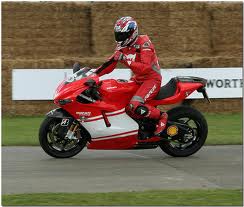
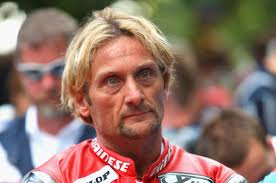
In World Superbikes there are two races.  For the purposes of averages let us look at some ball park figures.  Let us say that at an average each of the races runs for 20 laps on a 5 km circuit.  The distance would then be near 100 kms per race and if you have two races then already the World Superbikes racers and motorcycles are already racing somewhere near the 200 km mark.  Now the idea of a 200 mile race can easily be converted into a 200 km race, just as you see in Formula1.  This would mean that Superbikes that already follows an F1 style qualifying format can adopt the whole F1 style of racing.  So superbikes can become the F1 of two wheels.  You maybe surprised to know that there was once a category in two wheeled racing at the Isle of Man called Formula1 and Carl Fogerty the legendary superbike champion was once a Formula1 champion.  Obviously F1 is now trade marked and that means a new name or simply World Superbike could continue for this new format.
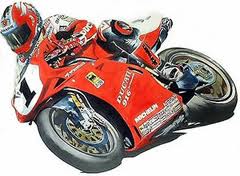
Carl Fogerty Carl Fogerty1

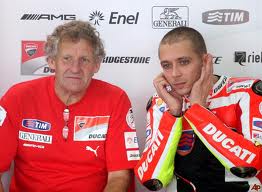
Now let me come to the two people that I have mentioned in the title of the article itself, Jeremy Burgess and Herve Poncharal.  Jerry Burgess trained under the great Erv Kanemoto and is a legend.  He has been instrumental in the success of Wayne Gardner, Mick Doohan and Valentino Rossi.  I will gloss over the fact that Burgess has thus far not been able to work wonders on the Ducati with Rossi, for that in no way detracts his more than considerable achievements of the past.  Casey Stoner is contemptuous of Burgess but then he can afford to be, for all said and done, he is tremendous talent that could tame the Ducati which has humbled even the mighty Rossi.  For some months now Jerry Burgess has been making noises about the direction in which MotoGP is going.  He believes that the move to 1000cc engines was wrong because motorcycles have now become two wheeled missiles that can go over 360 km /h and that could jeopardize rider safety.  He has found an ally in Jorge Lorenzo the once swaggering cowboy of the paddock who has now become the good boy.  Burgess is now suggesting that the move should have been to 600cc engines for MotoGP and lesser capacity for Moto2, maybe 400cc.  Burgess could be carrying the agenda of the factories to protect GP racing from going the production way.  Look at F1, from 2014 the series will shift to 1.6 litre turbo charged V6 engines instead of the present V8 naturally aspirated 2400cc ones.  Burgess is saying that one should go down the cubic capacity ladder and work with new technologies so as to retain the idea that GP racing should be all about cutting edge technologies.  The 600cc is insurance because this would mean that in case factories do not bring down the cost of leasing you can have 600cc CRTs since 600cc engines are very popular in production motorcycles as well.  As for Moto2 it can always drop a few cubic centimetres and go down to 400cc and there already are engines of that capacity in MotoX and those could be mated to different chassis and gearboxes with a different ECU.  Moto3 of course will continue as it is since it is only going to come into being this year.  So is the future of GP racing?  Is Jeremy Burgess acting as a spokesman for the Japanese factories?

Jerry Burgess And Rossi Burgess And Rossi

I say Japanese factories because whatever their outward stances and pronouncements both Burgess and Rossi are ill at ease at Ducati.  The constant barbs that Stoner is throwing their way surely must be making them feel all the more miserable.  So this will not only be a great opportunity for the Japanese to hit back but also for Valentino Rossi to move home so that he can get into his comfort zone again, nationality be damned.  Now is this also consistent with what Suzuki said while exiting MotoGP.  It said “I’ll be back” but in 2014, so does that mean that Suzuki is seeing the present rules as interim and expects big changes sooner than later?  That may well be the case since Suzuki is a relatively smaller factory it may have thought it prudent to wait for clarity to emerge before taking the plunge back into MotoGP.
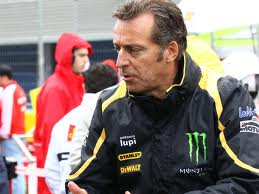
Herve Poncharal Herve Poncharal1

Even more crucial than Jeremy Burgess’ utterances are the ones of Herve Poncharal who is not only the owner of the Yamaha satellite Tech3 team but also the President of IRTA which is the association for the racing teams somewhat like FOTA is to F1.  Yesterday the news spread that Tech3 has stopped work on its CRT motorcycle for next year.  One of the less known fact about the Tech3 team is the fact that it is home to one of the great chassis gurus of our time, Guy Coulon who used to be Colin Edwards’ crew chief till last year.  There have been rumours circulating that Coulon is developing a CRT bike and now Poncharal has said that it was not a question of Tech3 stopping work on the CRT but having ‘postponed the start of the work’.  His reasoning was that since the two parties in the dispute in MotoGP, i.e. Dorna and the MSMA have started talking to each other and are now in the process of reaching an agreement over lower costs of leasing, it would be senseless to start work on a CRT bike since it would be easier to sell space on a Yamaha M1!!

Dalligna_box

To make the picture clearer still let us consider what Gigi Dall’Igna has to say about Aprilia officially entering the MotoGP fray as a factory rather than as CRT providers.  He believes that Aprilia will enter MotoGP provided “the rules are very clear”, and while saying this he even took pot shots not just at the Japanese manufacturers but also at fellow Italian factory Ducati saying that all these companies are manipulating the rules to their own comfort but a solution can come about if the MSMA, Dorna and the FIM sit together and discuss things.  And talking of discussions they are already on and Dorna and the MSMA have been bouncing proposals at each other.  While it is unlikely that anything will happen in the very near future, Dorna’s Carmelo Ezpeleta is very clear that he wants the annual budget of MotoGP teams halved from 30million Euros to 15million Euros.  He also wants to bring the leasing costs of factory machinery down to 1million Euros from the present 2.5million to 5million Euros, depending on the manufacturers.

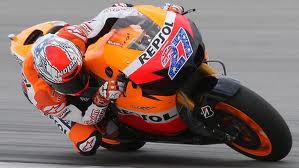
Casey Stoner1 Casey Stoner2

It is in this context that the noises being made by Jeremy Burgess, Herve Poncharal and even Casey Stoner  become significant.  While I have already written about what the first two had to say I have not said anything about Stoner whose power in the MotoGP paddock is growing thanks to his dominating form last season and during the tests this year.  Stoner is adamant that he will not ride in a series that becomes all CRT, something that Ezpeleta is threatening to do if the factories do not fall in line with his diktats.  Meanwhile the factories while emphasizing the necessity for maintaining the technological edge of MotoGP have now become more open to new ideas and proposals to cut costs and boost grid sizes.

Carmelo E

LCR Honda team owner Lucio Cecchinello has also started making noises about how the cubic capacity of the Moto2 category engines should be brought down and how they should be restricted to two cylinders.  What Cecchinello is suggesting is essentially a return to the formula of MotoGP during the two stroke days.  His is therefore an iteration of the old idea of halving cylinders and cubic capacities like in the good old days.  The two stroke 500s usually were four cylindered, while the two stroke 250s were two cylindered and the 125s  were single cylindered.  So effectively Cecchinello is saying 1000cc four cylindered MotoGP, 500cc two cylindered Moto2 and the single cylindered 250cc Moto3.  Cecchinello does not want the single manufacturer four cylindered engine of 600cc formula of the present Moto2.

Cechinello Ready_original

So you see there is a lot of noise about a lot of things, indicating that the present formula of MotoGP could only be temporary.  In my opinion the changes that will take place in the pinnacle category would be cheaper motorcycles to lease and the gradual disappearance of the CRT concept.  Moto2 will probably allow different engines from different manufacturers and the cubic capacity will continue to be 600cc and the frames or chassis will be custom designed by the likes of Suter, Kalex, Moriwaki etc.  I personally do not think that Moto3 will be tinkered with for a while, otherwise all concerned will become a laughing stock of the whole world.  Interesting times these, that there is no denying.
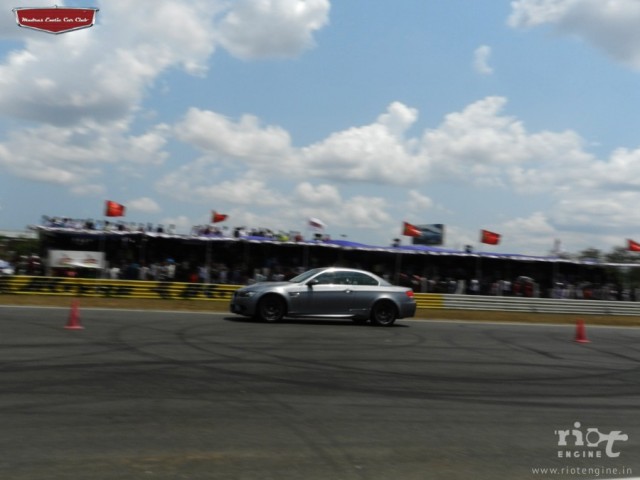
Porsche 911 Turbo at the Drag Races held at Madras Exotic Car Club at MMSC track Irungattukottai

I disagree Mr. Clarkson.

BMW Z4 vs Nissan 370Z

BMW Z4 vs Nissan 37Z Drag : Madras Exotic Car Club at MMSC Track,  Irungattukottai

The BMZ Z4 had lost the last two races and the driver Alexander David was itching to unleash the beast. Unleash he did, the BMW Z4 won this drag convincingly!

BMW M3 vs Audi TT

BMW M3 vs Audi TT : Madras Exotic Car Club at MMSC Track,  Irungattukottai

Well, where’s the Audi TT? Left far behind in the dust! Although it is slightly unfair to pit the lethal new M3 against the much more driver friendly Audi TT, we cannot really complain. Where’s the fun then?

Bentley Continental GT vs Porsche 911 Carrera

Bentley Continental GT vs Porsche Carrera : Madras Exotic Car Club at MMSC Track,  Irungattukottai

That Bentley won everything. Every single race.

Porsche 911 Turbo vs the Audi R8 V8

Porsche 911 Turbo vs Audi R8 : Madras Exotic Car Club at MMSC Track,  Irungattukottai

That speck in the distance, that’s a V8 powered Audi R8. Now before you go ooh over the Porsche’s stunning lead, be advised, that R8 which has clocked close to 12000 kms till date, has spent more than half its life at the track! The owner Balaji, is an avid enthusiast who spends alternate Sundays driving around the track and it was simply bad luck that the clutch gave in just when Inglostadt was fighting for its honor with Stuttgart.

Aston Martin Rapide vs Bentley Continental Flying Spur

Aston Martin Rapide against the Bentley Continental Flying Spur : Madras Exotic Car Club at MMSC Track,  Irungattukottai

You might think these two four door luxo barges probably must have lost an edge over their two door counterparts, but you should have been there. The Rapide took the trophy, well almost. The Flying Spur was definitely catching up driver started braking before the finish line for some reason and the Flying Spur took the lead

Mercedes-Benz CLS vs Nissan 370Z

Mercedes-Benz CLS vs Nissan 370Z : Madras Exotic Car Club at MMSC Track,  Irungattukottai

Interesting eh? Brute power took the trophy home!

In the early 1970s one of the significant races that was  held in Italy was the Imola 200 which drew inspiration from the American event Daytona 200.  The 200 stands for 200 miles and this form of racing is a part of the two wheeler endurance racing.  It along with the Daytona event was a highlight on the racing career and saw the participation of great motorcycle marques and riders.  Even the great Giacomo Agostini raced and won the Imola 200 on a Yamaha Motorcycle in the year 1974.  The event  however has disappeared from the racing calender with the ever increasing popularity of Grand Prix racing.  However, in the last two days Paolo Flammini of Infront Motorsports which is the holder of the World Superbikes franchise has revived talks of restoring the once famous Imola 200.

It is well known that both Infront Motorsports and Dorna which is the organizer of MotoGP races are now owned by the same promoter Bridgepoint Capital and with MotoGP dwindling Dorna has decided to allow production engines in custom chassis thereby blurring the lines between the two series.  The revival of endurance racing along with the Imola 200, Daytona 200 and the Suzuka 8 hours could be the beginning of a new series of endurance racing just as there is one for prototype cars and supercars. But it is early days still, what with the world economy not showing any signs of a quick recovery from the recession that it finds itself today.  However, news coming from Imola has pointed out that the teams in the World Superbike paddock are open to this new development though honestly speaking it does not really appear to in the realm of possibility anywhere in the near future.

Carlos Checa riding the Ducati 1198 took victories in both the World Superbikes races at Imola.  This has put him in the lead in the World Superbikes Championship after two rounds and four races.  However, Kawasaki’s Tom Sykes who finished both the races at Imola and one race at Phillip Island in second place on a resurgent Kawasaki ZX10R managed by the new Provec team has closed in substantially on Checa who did not finish the first race in Philip Island.  Imola also ensured that even the third place finisher in both races would the same; Leon Haslam on the BMW S1000RR standing on the third step of the podium for both the races.  Max Biaggi on the potent Aprilia RSV4 who has been tipped as the next favourite for the title after Checa finished in fourth position in both the races.

In the World Supersports category race victory was taken by veteran Fabien Foret riding a Kawasaki ZX6R thereby rounding off a good weekend for the Japanese manufacturer who is working hard to once again become a force that it once was in World Superbikes and World Supersports series.  Sam Lowes and Ronan Quarmby, both riding Hondas took the second and third places on the podium.