The Kawasaki Ninja 650 R has been launched in India by Bajaj Auto. What gets sold in India and in the USA as the Ninja 650 is actually the ER series of bikes designed originally for Europe as tourers/commuters. The naked version is the ER-6n and the fully faired version is the ER-6f. Due to the American liking for the name Ninja this motorcycle was launched in America as the Ninja 650 R in its previous guise. Please remember that it was the American marketing of arm of Kawasaki that first suggested that its superbikes be called Ninja.
However, when the ER6f underwent some small redesign and was also launched in the USA the R was dropped and it has only been called the Ninja 650. Kawasaki USA’s website proves this. But Bajaj Auto’s website seems to be calling it the Ninja 650 R still so we assume that in India it carries on with that nomenclature. Most of the changes are on the surface and the bike is just under the Rs. 5 lakh mark in terms of its pricing (ex-showroom).
This was indeed bound to happen. Only there was a false start when someone intimated this official news a few days ago through a fake twitter account and then an intimation came that it would be on the 15th of August, 2012 when the teams would assemble at Indianapolis after the summer break that the formal announcement would come. But surprisingly it has come today, five days before the anticipated announcement. As is the usual protocol Ducati first announced that Valentino Rossi would be leaving them at the end of 2012 and soon after Yamaha announced that Valentino Rossi has signed up with them to partner Jorge Lorenzo for 2013 and 2014. News also has started circulating that Ducati have finalized on Andrea Dovizioso as the replacement for Rossi in 2013 and this is most surprising given that last year Dovizioso was firm that he would not go to Ducati since the bike had a notorious reputation of unrideability and also because his present teammate at Tech3 Yamaha, Cal Crutchlow has been more than enthusiastic to replace Rossi, even claiming that he could win on the Ducati. The Dovizioso bit is still in the realm of rumours so one will have to wait a bit more for the official news to be out. We will soon be writing about how the grid could be next year now that the key piece has fallen into place in the rider jigsaw puzzle for next year.
Press Statement
It is with great pleasure that Yamaha Motor Co., Ltd confirms the signing of Valentino Rossi to ride for the Yamaha Factory Racing MotoGP Team for 2013 and 2014.
Valentino Rossi first joined Yamaha in 2004 and achieved four MotoGP World Champion titles with the Yamaha YZR-M1 in 2004 & 2005 and again in 2008 & 2009. He won 46 Grand Prix races with Yamaha over a 7 year period before leaving at the end of the 2010 MotoGP season.
Rossi, who is presently 8th in the Championship standings, will partner Jorge Lorenzo who currently leads the 2012 MotoGP World Championship by 23 points, having taken five victories from the first ten completed races of the 18 race series.
Lin Jarvis
Managing Director, Yamaha Motor Racing
“This announcement is once again excellent news for Yamaha. In June we were able to sign Jorge Lorenzo for the 2013-14 campaign and now we are able to confirm Valentino Rossi for the next two years. In doing so we have been able to put together the strongest possible team to challenge for victories and to promote the Yamaha brand.
We have run this ‘super team’ together in 2008, 2009 and 2010 and during that time we achieved the ‘triple crown’ titles with Rider, Manufacturer and Team World Championship victories for three consecutive years.
The target for the future is obvious and we will do our utmost to achieve our goals.
I have no doubt that with the experience, knowledge, skills and speed of these two great champion riders we will be able to challenge for many race wins and for the 2013 & 2014 World Championship titles.
The signing of Valentino completes our future planning for the Yamaha Factory Racing MotoGP Team. Now that this is done we will put our 100% efforts into completing the job at hand and to supporting Ben Spies and Jorge Lorenzo in their search for race victories and for Jorge’s 2012 World Championship title challenge.”
Business Standard Motoring.com is carrying an incredible story that the Mini Xylo which Mahindra has been testing and testing and testing and testing (sorry no more) is actually going to be launched with a light weight all aluminium three cylinder diesel engine of 1.5 L capacity and will feature not one but two turbo chargers. BSM does say that it is not sure if this is actually two turbo chargers or a twin scroll turbo charger and claims that there is evidence that Mahindra had invested in the latter for some time now and could be developing that technology for the XUV 500’s engine as well.
BSM citing a leaked brochure material says that the engine will weigh on 185 kg and will be using a built to a cost fuel injection system from Bosch and will be BSV compliant at the time of launch with just a few tweaks making it possible to meet future BSVI norms with ease as well. The power is rated at 100 PS and torque at 23 Kgm. The small SUV will feature a five speed transmission.
Picture courtesy: Facebook.com/Motor Vikatan and Business Standard Motoring.com
The Hyundai Accent was the first sedan that the Korean Chaebol introduced in India immediately after the introduction of the Santro. While the Santro has seen a few makeovers the Hyundai Accent has continued in almost its original form after missing some of the updates that were carried out on it in other markets. It was selling so strongly that Hyundai decided to not tamper with it (except that it did introduce the Viva hatchback which for reasons best known to Hyundai was called a notchback). The next generation of the Accent was introduced as the Verna and both models sold side by side sometimes the older Accent’s sales outstripping those of the newer Verna. Hyundai to promote the sales of the newer model (the Verna) discontinued the diesel engine version of the Accent and in fact started selling it only with a petrol engine in one trim but still the car refused to go away. Meanwhile the Verna (which was the replacement of the Accent) was replaced by the next generation fluidic Verna (sold in some markets as the latest Accent) but reasonably good sales of over thousand a month continued with the old Accent. However in the last one year sales have been dipping and with petrol prices rising and more contemporary models coming in from Hyundai itself not to talk of other manufacturers. In the month of July, 2012 the Accent sold its lowest ever 182 units and so presumably the writing is clearly on the wall for the old and trusted war horse. After all nothing lasts forever, not just Cold November Rain, even the Hyundai Accent. But who knows if it still has a trick up its sleeve? We wouldn’t bet against it.
The already beleaguered MotoGP series took two big punches this season in its face with Casey Stoner announcing his retirement from the sport while he is in his prime and Ben Spies announcing that he is leaving the Yamaha factory team. What Ben Spies will do in the future is a mystery as yet but what it has done is that it has blown the silly season open big and wide.
After signing up with Ducati for 2011 and 2012 Valentino Rossi has struggled to come to terms with the Ducati Desmosedeci and at best has been languishing in the midfield in 2011 and thus far in 2012. This had led to speculation about Rossi continuing with Ducati but then Rossi has effectively burnt his bridges with Honda when he left them saying that it is the rider that makes the difference to the bike and not the other way round. He also threw an ultimatum at Yamaha asking them to choose between him and Jorge Lorenzo for 2011 and Yamaha wisely chose to invest in the future and so plumbed in for Lorenzo something that they are quite happy about. While Rossi himself has ruled out going to Honda since he will have to ride a satellite spec machine in either Gresini Honda or LCR Honda with Honda already having signed Marc Marquez and Dani Pedrosa for the factory Repsol Honda team.
Cal Crutchlow and Andrea Dovizioso have been tripping over each other to prove that they are great performers who could take Ben Spies’ place (and this was happening even before Spies had announced his retirement but was doing quite terribly in races due to a combination of bad luck and bad riding) and Andrea Dovizioso has inched a little ahead of Cal Crutchlow who started the season more impressively. What makes Dovizioso look better than Crutchlow is that he has scored three consecutive podiums for Tech3 Yamaha (a first for that team) and finished fourth in the last race. But there are question marks about Dovizioso’s ability since he always was a Honda rider and last year he finished third (and a distant third at that) in the three rider Repsol Honda team that also had Stoner and Pedrosa. Dovizioso has only one victory on the Honda in MotoGP. This must be something that is acting on Yamaha’s mind.
While Crutchlow has shown great aggression this season his last season was nothing to write home about and even this season despite all the promise he is yet to put himself on the podium, thus making him a shaky candidate for the factory Yamaha position. Queering the pitch is the fact that there is only one position available next year even at Tech3 Yamaha since Herve Poncharal committed the cardinal sin of promising Bradley Smith a MotoGP ride for 2013 without even assessing how the rider would do in Moto2. The last two seasons in Moto2 have been most unspectacular for Bradley Smith and while rumours of Poncharal trying to wriggle out of his contract with Smith have emerged it does appear as if there are legal and other problems there.
Let us talk about the other problems since we can. It has now come to light that Cal Crutchlow had an offer from Ducati for the factory team and he was supposed to sign on the dotted line at Mugello. Crutchlow was seen as a replacement for Nicky Hayden who was supposed to be going out but the confusion caused by Spies has meant that Yamaha, despite their dislike for Rossi are now seriously considering him due to the fact that they are not very confident of Dovizioso or Crutchlow. This has made Ducati change tack mid course and they have ended up signing Nicky Hayden thereby hanging Crutchlow out in the open. In the even of Rossi going to Yamaha, Crutchlow will likely go to Ducati but what of Andrea Dovizioso then? He has made it clear that satellite spec machinery is not acceptable to him and therefore he will explore other options (whatever they maybe). But he could be persuaded to stay for one more season at Tech3.
Lin Jarvis the head of Yamaha’s racing department is not inclined to taking Rossi back apparently because Rossi did not deal with Yamaha in a very nice way and also because taking Rossi back would mean that he will come with this entire retinue of Jeremy Burgess and all the mechanics. But Rossi could have an ace up his sleeve and that would be that he could take sponsorship to the now unsponsored Yamaha team. Fiat which was sponsoring Yamaha stopped its sponsorship when Rossi went to Ducati. Another scenario being touted is that Marlboro could be persuaded to ditch Ducati and revive its hey days with Yamaha; something that appears unlikely. The name of Coca Cola and Monster energy are also being bandied as possible sponsors but the latter already has a strong association with the Tech3 team even if they are Rossi’s personal sponsors. Coca Cola seems to be a figment of everyone’s imagination with some suggesting that they will sponsor Yamaha as Dr. Pepper’s (one of the many drinks in the Coca Cola portfolio) and this will work since Rossi has long ago nicknamed himself has Rossi. All this is wild imagination of rumour mongers at work.
But what is indeed true is that Rossi holds the key to further rider movement in the market. Team Repsol Honda have their riders in place; Dani Pedrosa and Marc Marquez. LCR Honda has its rider in place in the form of Stefan Bradl who has contract for next year. Team Yamaha Racing has one rider, Jorge Lorenzo in place and Tech3 has one rider, Bradley Smith. Marlboro Ducati has one rider, Nicky Hayden contracted to them while the fate of the other two Ducati teams, namely Pramac Ducati and Cardion AB Ducati is not clear. Pramac are in financial trouble and Ducati has said that it would prefer to have a junior team a la Tech3 Yamaha and have two riders in it. But where would the resources for this junior team come from is the question. Maybe from Audi and if such a team does take shape the riders tipped of for it are Scot Redding and Andre Iannone. Ionnone being Italian on an Italian bike could bring sponsorship but then the whole of the EU is in doldrums economically.
Then there is also the question of how many of the CRT teams and motorcycles would remain. Gresini who runs an FTR-Honda CRT for Michele Pirro is not overjoyed at the prospect of yet another season of CRT especially since Pirro is very unhappy on the un-competitive CRT machine. What of team Blusens and Aspar? Aspar may continue with the Aprilia ART machines while Forward Racing could shift to ART as well. Nobody knows what Paul Bird is thinking. In all this we can see that the CRTs are fringe players and the only rider from that order who can make an appearance on satellite machinery is Randy De Puniet. But all movements can start happening once Rossi makes his decision or if Yamaha makes his decision for him. Rossi has promised that all will be sorted out in this summer break and make his announcement at Indianapolis. The question is will he? We foresee protracted negotiations not just with Yamaha but with Ducati as well so the announcement at Indianapolis is not a given by any stretch of imagination.
If you believe what Autocar India.com is saying then the answer to that question is yes. And there is no reason to doubt the veracity of the claims of Autocar India.com which is a respected publication with established credentials. Autocar India.com says that the sales of the Civic sedan have fallen drastically in India, making it unviable to continue with the product here. Autocar India.com says that there are a few more CKD kits of the car left and once they are assembled and sold off, the model will cease to exist in the Indian market.
The Civic that sells in India was a smashing looking car that set all kinds of bench marks. It turned out to be such a great car that even Honda have found it impossible to better its appeal with the next generation which has received a lukewarm reception in the markets that it has been launched. The existing Civic has not aged at all but its sales have taken a nose dive due to the lack of a diesel alternative in the face of rising petrol prices. All its competitors such as the Toyota Corolla Altis, the Skoda Laura and the Volkswagen Jetta have diesel engines in their arsenal and that is what has made people move away from the Civic it seems.
At Riot Engine we believe that the withdrawal of the Civic will be only for a limited period and it is well known that Honda is working on clean diesel engines for India as well after initially having vowed to stay away from the oil burners and hedging their bets on hybrids. Hybrids have proved to be expensive to make and have therefore found no takers in developing markets like India and Europe has slowly shifted to a preference for diesel given the fact that the calorific efficiency of the fuel is much better than petrol. Honda has therefore been made to eat humble pie; but we know that the company is all about guts for glory and therefore will make a comeback with diesel engines in its armoury and then perhaps a newer generation of Civic will enter the Indian market.
The Kawasaki Ninja 250 R is a success story for the company and it did not wish to tamper too much with a product that was so successful. This has meant that for many, many years the only things that changed on the motorcycle were colours and the patterns in which they were painted. While Asia and Europe did get the fuel injected engine model the carburetted version has been soldiering on in the USA.
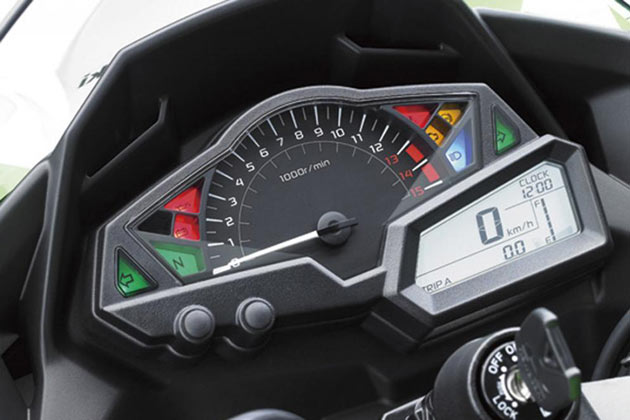
Now IBN live has brought pictures of the for 2013 Kawasaki Ninja 250 R which will make its debut in Japan. IBN live has also posted pictures which it claims are from the manufacturer. When see in the pictures the new Ninja 250 R looks like a scaled down version of the edgy looking Ninja ZX-10 R. The new 250 R now features a face that is very similar to the bigger ZX-10 R and has vertical slits in the fairing to channel air on to the engine. Turn indicators which are now of the clear lens variety sit on the edges of the front fairing. The antiquated dashboard console has been replaced by a more modern looking one and features a speedometer that reads out the speed in digits while the tachometer will continue to have a needle pointing at the number of revs that the engine is making. The rear of the motorcycle is also now more sculpted with edges and wedges in place. IBN live says that the engine also has been uprated with newer alloys and materials for the cylinders and camshafts.
According to IBN live the Kawasaki 250 R will cost the equivalent of INR 2.34 lakhs when it debuts in Japan. Torque and horsepower outputs have not been specified as yet. One also does not know if and when this motorcycle will debut in the Indian market. Kawasaki has set up an entity called India Kawasaki Motors Ltd., but this entity’s office address, or website or any information is not available. Everything points to the Bajaj Auto website. Bajaj has been concentrating on making lower capacity KTM products for the world market and what were previously Bajaj Probiking showrooms have now been re-branded as KTM showrooms throwing open speculation about the nature of relationship between Kawasaki and Bajaj. It is now well known that Bajaj has a 47+% equity stake in KTM and is therefore more interested in that company. Thus far there is not much news of the new Kawasaki Ninja 650 (there is no R suffixed in the new model anymore and not 650R as being reported by the Indian automotive press) which has debuted globally elsewhere.
Immediately after the Auto Expo 2012 Riot Engine had written an article about the absence of Kawasaki at the Expo and the following months have done little to bring some focus on to the brand and its plans for India. Given the scenario we are not even sure if India will even get to see the new model Ninja 250 R India. Even if it does, rest assured that is a loooooooooooooooong way away.
Loris Baz, the 19 year old French rider drafted into the works Kawasaki Racing Team following regular rider Joan Lascorz’s crippling crash, has been improving with every passing race. The youngster who was contracted originally for two races was given an extension of the contract till the end of the year due to the promise he has shown. Baz has not disappointed Kawasaki and had made onto the podium along with Sykes on one occasion. But it was at Silverstone that the French rider showed the stuff he is made of when he won the first race of the World Superbikes after the race was red flagged after the first lap and resumed as a wet race. The rain was not sufficient to put wet tyres and with the exception of two riders everyone went out on dry tyres but towards the end the rain did come down and since this was a wet race it meant that there was no option of another red flag. As conditions got treacherous Loris Baz showed nerves of steel to hold back BMW Italia riders Michel Fabrizio and Ayrton Badovini and take victory. The latter two took the second and third places on the podium.
The second race was held in a torrential downpour and the race saw victory for Sylvain Guintoli who now rides for PATA Ducati after severing ties with the Effenbert Liberty Ducati team. Loris Baz who duelled with Guintoli for much of the race and even held the first position for a while crashed on the lap when the race was red flagged. The result thus went back to the previous lap on which Baz was in second place and so it was a double podium for Baz at Silverstone. Third position went to the Ducati of Jakob Smrz.
With the Baz’s win in the first race at Silverstone, Kawasaki has become the only manufacturer to see both its riders taking wins this season thus far. However, all Kawasaki victories have come under wet circumstances. Tom Sykes who has been the spear head for Kawasaki this season with a spate of pole positions and one win and several podiums did not do well in his home race and could finish only 8th and 12th in the first and second races. Title protagonists Biaggi, Melandri and Checa did not perform too well either and therefore the points position for the title remains relatively unchanged due to new victors and podium finishers at Silverstone.
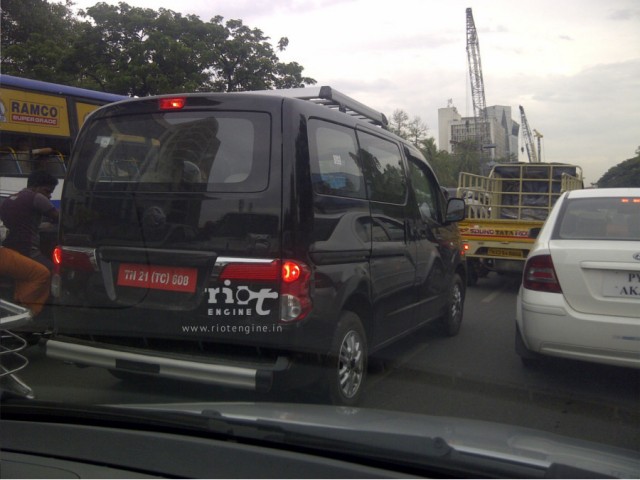
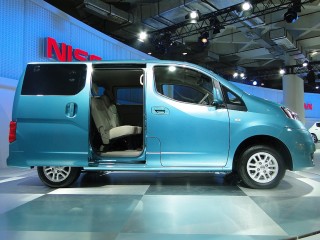
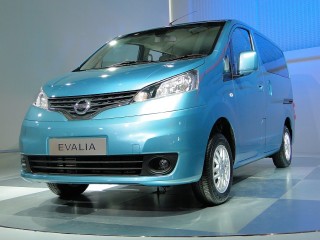
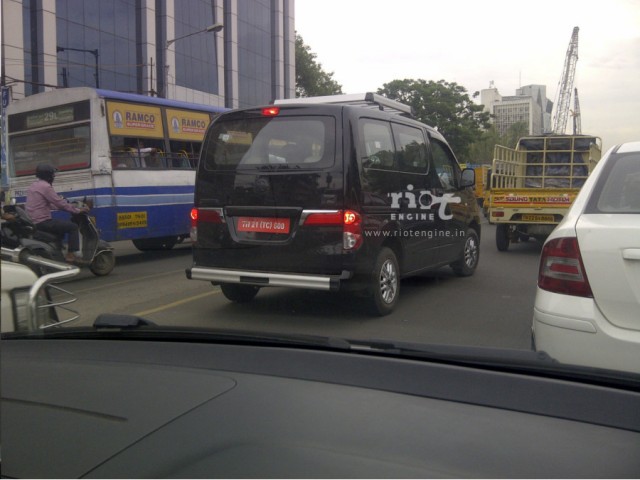
Now that Nissan is due to launch the Nisan Evalia soon, the MPV has been strutting around without camouflage. Our good friend and guest contributor Sanjeev Bhushan spotted the Nissan Evalia on test without any camouflage. This Nissan is bereft of the sporty graphics seen on the other test mule that was spied recently.
The Nissan Evalia is said to powered by the 1.5 litre dCi engine from the Renault Nissan alliance. With the horde of MPVs coming our way this season, the Evalia should only make things more interesting.
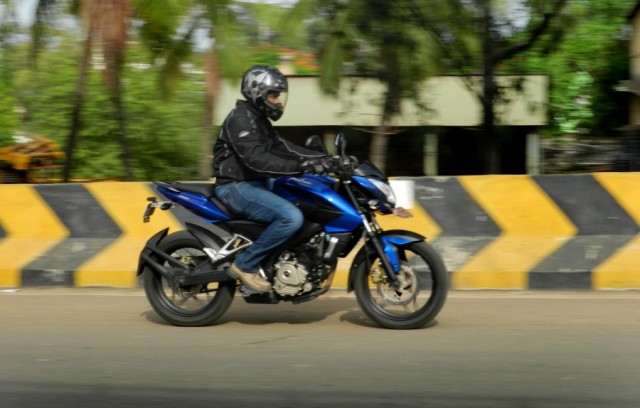
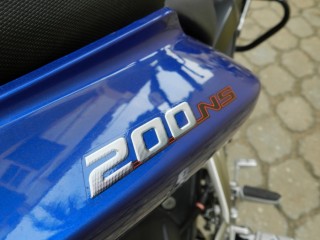
Turn the key into ignition, thumb the starter, twist the throttle, pop the clutch, hit the tarmac, wring the throttle, up-shift, wring the throttle, up-shift, wring the throttle, up-shift, brake, blip throttle, downshift, take the corner, wring the throttle hard, ride on leaving the engine notes to play catch up with you and repeat until you’re so exhausted you can no longer hold on to the handlebars. That, is the only way to ride the new Pulsar 200 NS.
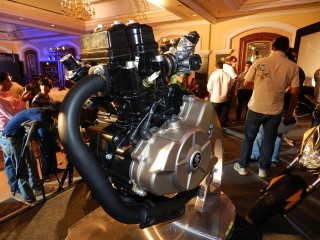
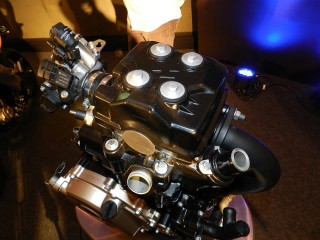
When you finally get off the motorcycle, you feel this intense buzz inside that makes you wonder if this is adrenaline and if so much of it is good for you. You also realize that you’ve been riding faster than you normally would and that you’ve been working the gears hard. That isn’t to say that the 200 NS cannot trundle along at sedate speeds in a not so optimum higher gear, it’s just that it would be a waste of potential. The 200 NS’ triple spark, 4 valve single cylinder water cooled engine is the most fantastic piece of machinery to wear the Bajaj badge that calls for an extra pair of eyes, one for the road and the other to feast on how quickly the needle shoots across the little white bars on the tachometer dial.
It shouldn’t have been a surprise. A new power plant in a new chassis and what less can one expect? Blistering performance coupled with the kind of maturity I simply cannot come to terms with. It wasn’t so long ago we had the brute of a Pulsar 220 DTs-Fi on the market and a number of things have happened since then and bang – we have a fresh-as-the-first-light-after-a-rainy-night motorcycle that has been engineered ground up.
This newfound Road Runner-ish ability to rev to the red line really fast had us dredging out the technical specifications..
‘It kind of creeps like a teenage boy outside a girls dormitory…’
Triple Spark
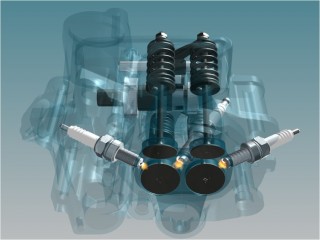
The ‘flame front’, which is the leading edge of the flame that starts from the spark plug and propagates through the air-fuel mixture, has to reach the entire volume of the cylinder to ensure complete combustion, in the short span of time reserved for combustion in the cylinder. To put things in perspective, at 2500 rpm the piston takes around 1/80th of a second to execute the power stroke and at 6000rpm its takes less than 1/200th of a second!
Manufacturers have employed various methods to ensure this happens. The first step would be to use a four valve setup which allows the spark plug to be positioned bang in the centre allowing for a symmetric flame front path that has to travel equal distance in any direction. ‘Swirl’ing the mixture as its enters the cylinder through the inlet is one of the other methods to improve the combustion at the cost of turbulence. ‘Squishing’ the mixture towards the centre, nearer the spark plug, is another method to ensure complete combustion.
Alfa Romeo, one of the pioneers of twin spark plug setup, preferred using the twin plug setup over the much more expensive four valve design in their cars like the Alfa Romeo 75, 155 and 164 in the late ’80s. More recently the Honda Jazz i-DSI used a twin spark setup.
The flame front during combustion of a leaner fuel mixture has a slower propagation rate than a richer mixture. A twin/triple spark overcomes this limitation ensuring better combustion with leaner mixtures leading to better fuel efficiency and cleaner emissions.
Bajaj has used a pent roof design for the cylinder head, which allows for larger valve area. In addition slight squish bands have been designed in to improve combustion. The DTs-i design beats the point of having a pent roof design with four valves, and the choice to have a central plug would have been the most obvious one. The additional slave plugs should give the benefits that DTS-i tech has given Pulsars of the later half of the decade. Triple spark technology should be most effective at part load conditions when it will ensure optimum combustion. Bajaj says combustion in a triple spark engine is 27% faster than a twin spark and 50% faster than a single spark engine.
Was a third spark plug really necessary or could there have been alternate methods, like the multi-spark ignition with one plug per cylinder in the Ferrari F12 berlinetta, is a topic that will always be debated.
Two plugs here..
..and one more here
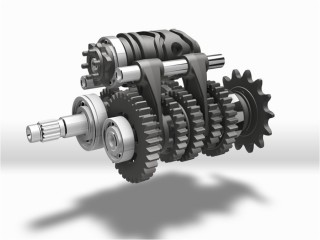
Six Speed Gearbox
Engine & Gearbox
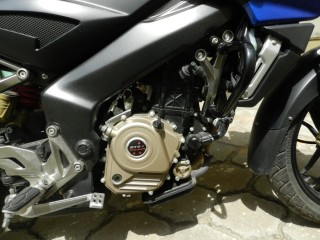
The 200 NS mill is fueled through the 33 venturi UCD33 UCAL carburettor, larger than the carb on the Pulsar 220 DTs-i, the fastest Indian. Of the carburettored motorcycles in the country now, the 200 NS has to be the most delightful to do the blip-downshift routine on. Putting aside the sense of accomplishment every time you pull it off successfully the momentarily orgasmic (we’ll come back to this again) notes from the exhaust when you blip the throttle are reason enough to do it, every single time. This newfound Road Runner-ish ability to rev to the red line really fast had us dredging out the technical specifications of previous Pulsars. While a spec to spec comparo would be largely irrelevant we can tell you this engine is short stroked compared every previous iteration of the Pulsar, including the 135 LS.
Four valves in place of two have the benefit of being physically lighter and smaller. 4 valves also result in a larger valve curtain area resulting in increased flow of air/fuel mixture and improved evacuation of exhaust gases. 4 valves are also what make good high revving power plants.
Engines can be either oversquare, square or undersquare depending on their bore:stroke ratio. The Pulsar 200 NS has a bore: stroke of 1.46 which falls in the oversquare territory. Oversquare engines are said to be far more reliable, more hurried, and good at making power at the higher rpms and not so good with low down torque. There is also the other camp that says while this may have been true before a decade or two, these assumptions are largely irrelevant now thanks to the advancement in engine design.
After time spent with the 200 NS we are not sure where we stand on the undersquare vs oversquare debate. The 200 NS revs lightning quick, makes its peak power of 23.52 PS @ 9500 rpm and maximum torque of 18.3 Nm @ 8000 rpm and also has a healthy mid range. While she could pull comfortably from as low as 28 kph in 6th gear, which assures us of good low end torque, getting her off the line from standstill was not something I could get comfortable with. A fast start is ok; you have your revs pinned at 4k rpm, pop the clutch and off you go. In everyday situations where you have Uncle, Aunty and their kid on the generic beige coloured scooter alongside you at the traffic lights, you really do not want to give them a reason to label all bikers as maniacs. In this scenario, when you feed in the throttle and let out the clutch you cannot help but feel slightly uneasy at least until you hit 3000 odd revs. The NS moves, no doubt about that but it doesn’t do it with confidence. While I’ve been trying to put this in words over the last three days, I stumbled upon Chris Harris’ Living With the McLaren MP4-12C video where he has the perfect analogy. ‘It kind of creeps like a teenage boy outside a girls dormitory…’. Past the four thousand rpm mark, I have to admit I lost all hope in mankind, realized people will judge me anyway, and wrung the throttle to the stop. Uncle and Aunty might have labelled me a maniac, but the kid surely must have had a smile plastered on his face! Scouts ‘Good Deed for the day’ complete!
Bajaj Pulsar 200 NS Design : Cylinder Head with the UCD33 Carburettor
When the Pulsar 200 NS gets going, it gets going. The revs climb quickly and the limiter doesn’t kick in until 11,000 rpm and that’s more than what the distant cousin KTM Duke 200 can do! There is no discernible mechanical difference from when the crankshaft is spinning at 4k rpm or at 11k rpm. The vibration, if you notice any, remains consistent through out, but the noise from the exhaust rises in increments in tandem with the rise in the revs.
Unless you are getting on the 200 NS from a Duke 200 or a wild child two stroke from yesteryear, you’d be shocked at how fast you are astride the NS. The 200 NS can hit 90 in the blink of an eye and is only a little slower hitting the 110, 120 kph mark. I bet you all the crisp notes in my wallet that your guess-timate of how fast you can hit 80 on the 200 NS would be completely off the mark. She’s just that quick. It doesn’t help that there’s no drama characteristic of all Pulsars getting to the ton. If the 220 DTs-Fi was Hulk, the 200 NS would be a stealthy, efficient, scarily quick Ninja, only clad in leather!
Now back to the bit where I said momentarily orgasmic notes, well, the 200 NS cannot hold a candle to the 220s and the last gen 200 in the aural stimulation department. As Shumi once pointed out, any bike sounds good when you blip the throttle when downshifting, and the 200 NS lives up to the statement. The rest of the time though, the Ninja like stealth and speed is what will grab the edges of your lips and drag them all the way to your ears, not the exhaust note.
combustion in a triple spark engine is 27% faster than a twin spark..
You will have trouble finding the choke unless you know what you are looking for. The choke is a metal plate on the left side of the motorcycle, in place of the usual pull-push knob we seen on previous Pulsars. On the 200 NS you pull the choke, and then tap it back into place.
We weren’t paying any attention to the gearbox until a friend popped the question of whether good as that on his FZ. I realized that the NS gearbox is so good at what it does, that I had been completely oblivious to its presence. If you’ve owned a Pulsar you know the gearshift becomes noticeably rougher with each passing hour, when you ride nonstop. Riders have bypassed this problem experimenting with different engine oils. Some found the sweet spot with the Motul 5100T some with the Motul 300V and some seem to be having just enough fun with the Castrol (before Bajaj brought out its Bajaj DTS-i 10000) from the barrell at Probiking.
The 200 NS we believe will have no such issues. The gearbox is slick, finding neutral is easy and we did not experience any false neutrals during our week long stint with the NS. Clutchless up-shifting is a breeze, the cogs fall in line like hot knife through butter, pardon us for the cliche. Downshifting is smooth, but you might have issues letting out the clutch smoothly. Downshifting on the NS works best when you blip the throttle, and slot the lower cog, a technique we sincerely suggest you work on.
Ride & Handling
The steel perimeter frame on the Pulsar 200 NS has thrice the lateral stiffness than the double down tube on the Pulsar 220, and the rectangular section swingarm has a lateral stiffness that is 50% more than that of the 220.
Ride quality on the Pulsars has never been anything less than fantastic, and the 200 NS is no exception. The 200 NS flies through pot holes with abandon. The 220 and the 200 though had marginally better ride quality a price we pay for the fantastic handling on the 200 NS. I strongly believe we would have been waxing eloquent if we had taken the 200 NS to the track, something we intend to do soon.
The Pulsar 200 NS’ suspension is firmer than all previous gen Pulsars put together. The NS is easy to tip into corners, planted enough to inspire confidence in the rider and undeniably, looks good while taking those corners. Anybody who has ridden previous Pulsars will tell you the family’s strength is straight line stability and the weakness, the bull headed stubbornness to change direction. The 200 NS will change all that. The 200 NS is quite flickable and changes direction as any modern day motorcycle should. Unfortunately, what’s also changed is the straight line stability. The 200 NS is as good as its peers on the market today at holding the straight line, but when you compare it to its older siblings, you wonder if it’s just as good.
You would think the new found agility and lackluster straight line stability would be courtesy of the shortened wheelbase, as we have seen astride the Apache RTRs. Surprisingly, no. The 200 NS has a wheelbase longer than the 220 by 13mm and stands at 1363mm! The engineers at Bajaj have mastered the black magic of chassis design and have played with the rake and trail to achieve the balance.
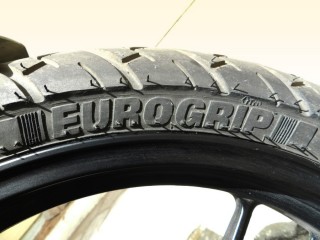
Having sworn loyalty to the fantastic soft rubber on the recent MRF Nylogrips, we found it hard to be convinced by the capability of the Eurogrips shod on the 200 NS. A vast majority of riders should be comfortable with the Eurogrips, noticing no discernible requirement for better rubber. The enthusiasts who feel the need for something better will swap their tyres once they have stripped the current rubber of its chicken strips and treads.
The Perimeter Frame
The perimeter frame, better known to us the twin spar frame is a huge leap for Bajaj from the double cradle downtubes the company has used for years now. We thought a little history, and tech talk were in order.
The twin spar, believe it or not, was born out of the need to accommodate larger engines when the common steel backbone frames required too many adds-ons to hold the engine. Antonio Cobas is considered to be the father of current day twin spar frames when he built the first twin beam aluminium frame housing a 250 Rotax engine for the Grand Prix.
A twin spar frame provides easy access to the spark plugs, and carburettor, a big advantage in racing. The twin spar is also easier and less expensive to design, engineer and manufacture compared to say an equivalent trellis frame. The perimeter frame has allowed Bajaj to use the space around the engine efficiently, packaging the exhaust in that space, not a possibility with the double down tube frame.
Not unlike you, we were also wondering if Bajaj could have taken things a notch further and used aluminium in place of steel for the frame. While the weight savings would have been substantial, it would have driven the costs up. Steel has a higher fatigue strength than aluminium, meaning longer life. In addition aluminium does not have a ‘true endurance limit‘ meaning, regardless of the amplitude of stress, if aluminium is subject to enough stress cycles, it will suffer fatigue failure. Engineers have to take this into account and design the frame to ensure it has a substantial life span. All this would drive the expenses in only one direction-up.
The Yamaha R15 uses a steel deltabox, while the bigger siblings use aluminium.
Petal disc with Bybre Calipers (Above) Eurogrip Tyres
The steel perimeter frame on the Pulsar 200 NS has thrice the lateral stiffness than the double down tube on the Pulsar 220, and the rectangular section swingarm has a lateral stiffness that is 50% more than that of the 220
when you countersteer the NS into a corner, it feels just right..
Unobtrusive saree guard
Ergonomics
The saddle height on the 200 NS is slightly higher but not so much as to be uncomfortable for most riders. The saddle height is perfect when you’re on the move giving you a fantastic perch on the 200 NS. The mirrors provide optimum views unlike the 220, but the we noticed a slight distortion at the edges of the mirror which was disconcerting on the move. Cost cutting?
Cold air from the front passes through the radiator, over the jacketed cylinder and the now considerably warm air flows out through the functional air vents on the side panel which are positioned just slightly below your thighs. Not an issue you will notice most of the time, but caught in really bad traffic jams, you might just decide it to be the most opportune moment to thank your denims.
The handlebars are a joy to hold on to. The feeling is most intense when you countersteer the NS into a corner, it feels just right. The handlebars are still clip ons, but are designed to be idiot proof and will not have amateurs throwing their body weight on their wrists. The grips of the handlebar are of optimum length, with not too long bar end weights, and are also soft enough that you won’t have callused skin on your thumb, if you ride without gloves.
The pass switch is a bit of a reach when you have your thumb on the horn, which is most of the time, at least in the city. The indicator is of the push to cancel type, and could have been slightly larger. The switch is perfect when you ride without gloves, but put your gloves on and you do not get enough feedback and you have to look down at the console to see if the indicators have been activated. We also did not like the fact that Bajaj’s ‘current’ flagship did not come with self cancelling indicators, a luxury cannot live without once you get used to it.
The Mode and Set buttons on the console are also slightly hard to operate requiring a bit too much pressure.
The side stand is of the most perfect dimensions you can imagine and putting it down while still in the saddle is something you’ll do with style. You do not get the main stand as standard, it is an optional extra.
Instrument Console
The Pulsar gets a clock in the instrument console, finally. The console is a simple, stylish affair with just the most essential info on display.
The newer addition is also the service reminder icon that pops up at 450km for the first service and subsequently for every additional 5000 kms. The service reminder icon can be reset by the rider too.
The Coolant Temperature Indicator blinks when the coolant temperature rises above 115 °C something that never happened when we were crawling through traffic. The Low Oil Pressure indicator of course, blinks when you need to top up the engine oil.
There’s also the new Side Stand indicator which won’t stop you from cranking the engine, but will glow in danger red to indicate that the side stand needs to be put up.
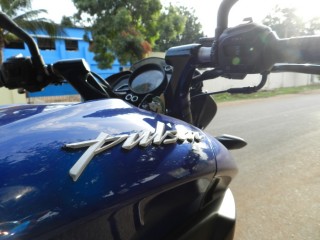
A gimmicky Bajaj logo glows Blue all the time, our only ( yes, only) complaint being it should have been a lighter shade to reflect the actual Bajaj blue.
The chrome ringed orange light at the top is dual functional as with previous Pulsars. It glows when you are whipping the engine beyond the 10,000 rpm or when your fuel level drops to reserve. Of the 12L tank capacity, reserve on the Pulsar 200 NS is about 2.4L of which 0.2L is not usable, preventing air lock we believe.
Electricals
At the unveiling of the 200 NS in Mumbai, Bajaj suggested the headlamps would be 35W, surprisingly though, by the time the NS was rolling off the assembly line, the headlamps were swapped for 55W units. Full DC electricals mean the illumination is constant regardless of the throttle position. The beam spreads out and the intensity is uniform. The high beam is fairly functional.
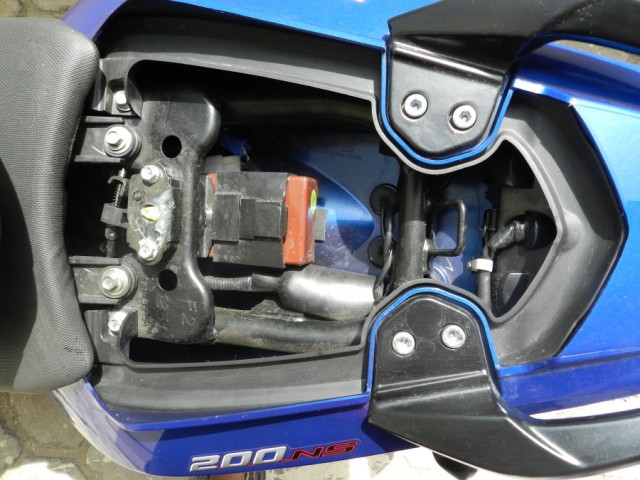
The Pulsar 200 NS uses a totally sealed VLRA (Valve Regulated Lead Acid) battery which is compact compared to conventional lead acid batteries. The VLRA unit does not require top ups, there is no chance of electrolyte spillage and more importantly it can be mounted at any angle. Bajaj in its quest for the most compact package decided to use the space underseat and the mounting surface is slightly inclined, and a conventional battery would have posed the risk of spillage if mounted on such surface.
The miserable single horn makes you want to push the bike into a pond and wait for the electricals to die and the horn to croak to death. The pitiful horn goes ‘beep’ and people do not grasp the reality of the situation that it is this screaming monster clothed in Blue that just rolled up behind them that’s making the noise. A better twin horn setup as an optional extra at least, Bajaj?
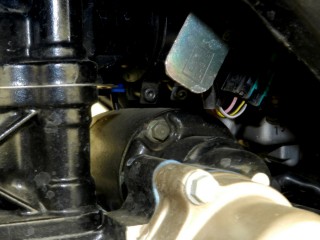
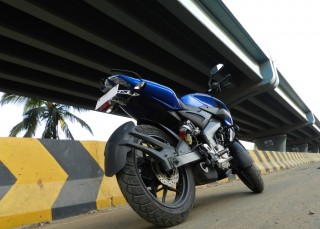
For those of you who have been worried about the low slung exhaust and its effectiveness after a wade through the flooded roads of our metros during the monsoons, here’s some assurance.
Colors Available
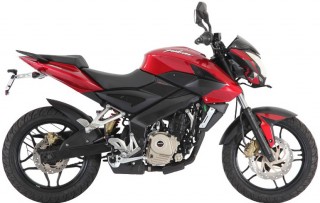
In addition to the Blue we tested the 200 NS also comes in Yellow, Black and Red. You might want to drop by the Bajaj showroom before selecting your colour as the Black and Yellow have a slightly different finish.
Design
Hard to believe that the signature Pulsar tank has been around for ten years now. Designers at Bajaj were given a clean slate this time, without having to work their design around the signature tank. The actual tank is now hidden underneath the layers of plastic panels. The plastic surface around the tank should put off riders who prefer magnetic tank bags but shouldn’t be a deterrent considering you have suction based bags available.
The forward crouched stance is accentuated by the tight packaging of the engine in the perimeter frame. The Pulsar 200 NS is not unlike a crouching predator with all the muscles tense, in a feral display of the potential for strength, or in our case, performance.
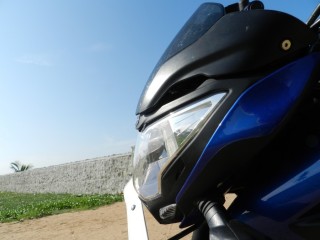
The pilot lamps, which are now a signature design characteristic for Pulsars have been shrunk, narrowed, and positioned just beneath the actual headlamp. The headlamp is a strong design element that distinguishes this Pulsar from the previous generations, yet bears resemblance to a number of other bigger naked bikes.
There hasn’t been a motorcycle in the country that has had to carry unwanted baggage like the Pulsar has had to. Ask any misinformed motorcyclist to review any Pulsar and he will put down the negatives as ‘handling’ and ‘reliability’ regardless of whether he is penning the review before or after riding the bike. While it is fair to say that the Pulsars of yesterday lack the endurance and the handling required to put in lap after lap consistently at the race track, it is ridiculous to say the handling wasn’t good enough for the street or the highway. Legions of Pulsar Maniacs who have delighted us with their weekend stints at Lavasa should stand testament to this.
The new Pulsar 200 NS is the addition to Bajaj’s arsenal that will set the record straight in the handling department. The 200 NS beneath all the extremely styled complex surfaces and lines is a very mature motorcycle engineered to be fantastic, regardless of what you throw at it.
Is the 200 NS worth the sticker price? We think so. A shared bottom end with the KTM Duke 200, better fuel efficiency than the Duke 200, build, fit and finish like we’ve never seen on a Pulsar before and fantastic all round capability characteristic of Pulsars, make the 200 NS a worthy expenditure.
I do feel a pang of sadness though, when I realize that future generations of Pulsar owners will no longer do the chicken dance, or conduct week long seminars on engine oil grades and JASO rating. They will not have the need to find innovative ways to put to use double sided tape or delve into the depths of the mechanics of brake calipers and disc pads. When you ride a Pulsar you do manly stuff like standing up for your Pulsar when she’s just seconds slower than a lower displacement Apache RTR or decades old Karizma on the track, a privilege that shall be denied to Pulsar 200 NS owners. The new Pulsar 200 NS is just that good.