Maruti Suzuki’s second most successful model in India after the Alto is the Wagon R. Recently the sales of the Wagon R crossed 10 lakh units or 1 million units. In order to commemorate the occasion Maruti has launched a limited edition which it calls the Millennium and it features a reverse parking sensor. Most of the other things are also cosmetic in nature. We have already reported that to commemorate the 2 lakh unit sales of the Zen Estilo, Maruti has launched a special edition there too called the Vogue. Neither of the two limited edition models have anything specifically great to offer other than the badging.
Yearly Archives: 2011
Motoring journos the world over have a habit (we will leave it to you to decide whether it is a good one or a bad one); when a product is launched they will beat the hell out of it till people are finally tired of it. Please don’t misunderstand. Even praising a product endlessly constitutes beating the hell out of it, so there is no escaping that really. We are a humble website, just a couple of months old and most manufacturers (Yamaha excepted) have yet to acknowledge our presence. So under the circumstances, what are our chances of getting invited to the launch of new products? Minus whatever number comes to your mind. But then you see we also like to think of ourselves as proper motor journos and therefore we too have the compulsive urge to do a product or a name into the ground, but you the good reader can see the problem; where is the product? At Riot Engine we like to think of ourselves as intelligent and resourceful people (please do indulge us in our delusion) and so we have decided to start the process of beating the hell out of a name. Till yesterday the preferred name that has been on the tip of the tongues and fingers of motorcycle journos has been CBR. Automobile mags (both in their digital and printed formats) have been uttering the CBR name as if it were the Holy Grail of all motorcycling. So everybody has been comparing the CBR 250R with the Ninja 250R and going ga ga (mercifully not that lady, phew) over both but giving the extra star to the Honda CBR 250R while saying a few kind words about the Kawasaki Ninja 250R. But that will all change now and that is where our real story starts.
From yesterday on, the word Ninja has come back into big circulation. The Kawasaki Ninja 650R has been launched in India. Motoring journos must be queueing up for rides or riding the Ninja 650R while we sit in front of our computers and bang this story in. But we will beat the seasoned pros to the Ninja mayhem here and so ours is the first laugh. It was in the year 2009 that the word Ninja entered into the vocabulary of the motorcyclist in India big time. Prior to that there were the old hippie uncles, whose brains were warped by excesses of LSD, Ecstasy, various forms of tobacco and even more forms of liquor, passed on a sacred word to their cute little nephews before the good Lord said enough and raised them to heaven. This sacred word was Ninja and the privileged few nephews (those who had these hippie uncles) uttered the name in great veneration and tried to keep it from reaching the hoi polloi (mainly because they did not know much else about the name). To the lesser mortals (those without hippie uncles) Ninja meant that horrible mutant turtle in the “Teenage Mutant Ninja Turtles” series. To the ones who went to schools that still had good teachers (a tremendous rarity), Ninja meant the short form of the practitioners of the revered and highly difficult martial art form of Ninjutsu.
It goes to the credit of one Japanese company called Kawasaki Heavy Industries (KHI) that the word Ninja has come into the vocabulary of even ordinary and very duh bikers like us. Though the company was Japanese, the suggestion of using that name came from Americans (yeah they have hardly left anything untouched, especially if it had to do anything with petrol, a true American favourite). Kawasaki Heavy Industries was the brain child of a venerable old Japanese man Shozo Kawasaki who built huge shipyard (in 1896) which in turn built ships. In 1906 the company diversified into making rolling stock for trains. Over the years the product portfolio of KHI incorporated everything that one could think of; locomotives, planes (civilian and warplanes), helicopters, robots (well for now we cannot think of anything else). Kawasaki like most Japanese companies was proud of its achievements, but in the absence of a product that was easily visible and identifiable as a Kawasaki, they did not find themselves in the everyday vocabulary of people.
So in the 1950s after Honda and Suzuki had established themselves, Kawasaki decided that building motorcycles was a good way of letting the general population know that there was this technology intensive company that one had to take cognizance of. So Kawasaki became the third Japanese company to turn to making motorcycles and came with a background very different from the two companies before it and the one after it, which was Yamaha. Shoichiro Honda started Honda motorcycles after first making sewing machines, while Michio Suzuki steered his company from making looms to motorcycles and Yamaha, established by Torakusu Yamaha, started off as a maker of pianos and organs (of the musical variety, so don’t go getting any ideas). While for the other three moving into motorcycle manufacture was an up scaling of sorts for Kawasaki it was akin to down scaling.
All the four manufacturers started off with small humble puttering machines that were used as daily transport in Japan, a country ravaged by the World War II (thanks to an irritated Uncle Sam who dropped two and not one nuclear bombs on them because they were proving to be pesky, the Japanese that is). But the Japanese are very resourceful people and they came out of their problems with all their techno prowess firing. And they went to the United States of America, a country that rewarded big moustaches (we assure you it is not mustaches), big fire arms and more importantly huge mouths that believed that a person’s greatness was directly proportional to his bragging abilities. In order to be able to brag, the Americans believed they needed big things. No point in talking about small things, right? In order to acquire their bragging rights the Americans were more than willing to part with the ubiquitous dollar and so for people wanting to sell anything (motorcycles, cars, rock music, Styrofoam, condoms, guns, pet stones, bull shit) the logical destination was the United States of America.
Since everything that the Americans wanted was usually big, it became necessary for the Japanese to manufacture bikes also that were big. And it was in this process that Kawasaki landed up with the name Ninja for their motorcycles. We will save that for part two of this story dear reader, so fret not. Comeback to the website and get the second part of this story, a story like no other.
In the first part of this story we had talked about how the Americans wanted everything to be big so that they could have their bragging rights. The same was the case for motorcycles as well. The original icon of American motorcycling has always been Harley – Davidson. When the Japanese went there, they found that the Harley riders were outcastes. They gave themselves horrible sobriquets like Hell’s Angels and rode in big groups and vandalized everything on the way. They gave motorcycling a bad name. Honda rectified it with the “Only the nicest people ride a Honda” campaign with the launch of its Super Cub. However, while the Americans were willing to consider that even nice people rode motorcycles they were not exactly happy with the size of the Cub. So to sustain, big motorcycles were needed, but they also had to be different from the big Harleys for obvious reasons.
Harley Davidsons were to Americans then, what Royal Enfield Bullets are to Indians now. They were huge and were modified disgustingly with long kicked out front forks and had saddle bags and V twin engines that sounded glorious but leaked oil, broke down frequently and were a pain to maintain. The technology used was the ancient push rod engine technology. In management terms there is a concept called “Opportunity to See” and the Japanese ever the opportunists did not lose this opportunity, so they went to America and conquered it. Their bikes were everything that the Harleys were not. They were packed with new technology, were very reliable and most importantly they went very fast and consumed relatively less fuel. Kawasaki saw another opportunity here, they wanted to do things differently. So they made bikes such as the mad Mach3, called thus because it featured three cylinders in line and went super fast. It also was a two stroke motorcycle that consumed everything that stood in its wake. The Mach3 was not without its problems. The middle cylinder did not cool too efficiently because it was in a sandwich and Kawasaki initially found solutions by changing the angle of banking of the cylinders. But something more radical was required if the in line cylinders were to be cool and efficient. So enter liquid cooling. Kawasaki was not the inventor of liquid cooling but they put it to innovative use.
Kawasaki saw that the Americans had a penchant to do things differently. So they were asking for pollution limits to be brought down and balmy California was at the forefront of this. California has always been an important market for motorcycles and the clue to that lay in the weather. Unlike Europe which was had inclement weather for most of the year, California and some other states in the US had nice weather with temperatures hovering in the eighty degrees Fahrenheit range. The USA has always been the citadel of marketing. You could sell anything, absolutely anything if that thing was packaged very well. The Japanese being who they were again saw an opportunity. Package their bikes well and the Americans would buy them in droves. So Honda and Kawasaki upped the ante with technology. They shifted to four strokes but their motorcycles were most unlike the Harleys that the Americans were used to. Instead of V twin configurations, Honda went for V4 configurations while Kawasaki went for in line four cylinder configurations. But the biggest difference was not so much in the engine as it was in the chassis.
The usual topography of America and especially that of California is long flat lands that had long straight roads that went on and on. So typically bikes were made with no respect whatsoever for handling. Seriously, what great handling do you require to keep going in a straight line for ever? Europe was different and had Grand Prix racing on tracks that were twisting and turning. Honda, the most ambitious among the Japanese wanted to conquer GP racing which was dominated mainly by British and Italian motorcycles. GP racing taught Honda the importance of a light weight motorcycle with a chassis that could enable the rider to turn the motorcycle without losing time or balance. The Japanese saw that the Americans raced their cars (mainly drag racing) and a bit of bikes as well. They took the next big thing to America, circuit racing and the “race on Sunday and sell on Monday” adage took shape. Kawasaki stole a march over the others here by creating a tractable motor in a wonderful chassis which made for a sure fire winner. Thus the nomenclature GPz was born. The first GPz was a 900cc and it became a hit with the Americans.
Now came the time to convert this hit into a marketing success as well. The marketing savvy Americans wanted a name that was catchy, something that everyone could relate to. In this meanwhile the GPz was being called the Z1 and till day it is considered to be the world’s first Superbike. The Americans told the Kawasaki factory that the ideal name for the Kawasaki super bike would be Ninja, the stealthy, quick, nimble and efficient martial artist. Kawasaki liked it, after all it came from native Japan, from the practitioners of the martial art of Ninjutsu. So they agreed and the name stuck, for good. In America for a while Ninja became a generic name for a super bike like Xerox for a copier machine.
This was a good and a bad thing for Kawasaki. It was good that their product name became synonymous with a category of motorcycle but really bad because every other Japanese super bike was also being called a Ninja. That somehow seemed to dilute their achievement. Sometimes too much success can work against you. That is what happened to Kawasaki. So it needed to do something and really quick. Kawasaki had a liking for the letter Z. That is why they introduced it along with the GP moniker as GPz. So henceforth they decided to prefix their Ninja motorcycles with ZX and a number that denoted the cubic capacity of the motorcycle. Thus was born the nomenclature of ZX-6, ZX-7, ZX-9, ZX-10 and later the ZX-11 (which was essentially an upgraded ZX-10) and finally what is considered to be the greatest Superbike and Kawasaki ever, the ZX-12. In the United States there is today a ZX-14 as well, but that is something we shall come to soon. The no.6 denoted a 600cc, the no.7 denoted 750cc, the no.9 denoted 900cc, 10 denoted 1000cc and when the engine went over 1000cc it became 11. Somewhere Suzuki had decided to threaten Kawasaki with the Hayabusa and to take it head on the ZX-12 was created.
Kawasaki spread its wings to Europe as well and there they made sure that the Ninja moniker would be used in conjunction with the ZX moniker which meant that the motorcycle was a racer and so the suffix of R also was used. So the nomenclature in Europe even today is Kawasaki ZX-10 R Ninja. In the middle however Kawasaki found that they had to upgrade their 600cc with a shorter stroke engine and so gave it the nomenclature of ZX-6RR Ninja. But that was a one off thing. In Europe where greater significance is attached to taxonomy Kawasaki began using the ZZ-R nomenclature for bikes that were less sporty and more for touring. So what is called the Ninja 250 R in India today started life in Europe as Kawasaki ZZ-R 250 and there were ZZ-R motorcycles of 750, 1000 and 1200 cc. These were NOT Ninjas and that tradition continues till today.
In the meanwhile the changing of market conditions essentially meant that Kawasaki had started cutting down on the number of motorcycle platforms. In racing, the 750 cc category became redundant and so the ZX7 no longer exists. Since World Superbikes now has 1000cc for four cylinder engines, the ZX-10 R Ninja was reborn. The ZX-12 R was put rest a few years ago. So in Europe the Kawasaki Ninjas are strictly the ZX-6R that races in the Supersports category and the ZX-10R that races in the Superbikes category. The Suzuki Hayabusa though very fast was never a track tool and a few years back Kawasaki launched the ZZ-R 1400 which for the first time incorporated a monocoque chassis and along with the Hayabusa sits in the sports tourer category. Kawasaki created a for every day use a motorcycle called the ER-6n and a variant called the ER-6f. The ER is for every day/every one, the 6 for 650 cc, the n for naked and f for faired. So what we now get in India and the bike that launched this story, the Ninja 650 R is actually the ER-6f in Europe.
Back home in America, like in India the ER-6f became a Ninja and so received the nomenclature of Ninja 650 – R while the naked bike still goes with the ER-6n name. In the meanwhile the ZZ-R 250 also gained the Ninja tag and became the Ninja 250 R. So now within the Ninja category there are two types. Kawasaki calls the non ZX Ninjas, Sports machines in the USA and the ZX Ninjas, Super Sports. When it decided to make its 250cc bike the entry level Kawasaki globally it became a Ninja even in Europe but without the ZX prefix. The Ninja 650 R is again a marketing strategy that works in the USA but not in Europe. The Americans want something in the nature of a super bike so there is the Ninja 650 R as also a Ninja 1000 which is a faired version of the Z 1000. In markets such as as Thailand and India, Kawasaki is now following the American nomenclature and so the 650 became the Ninja 650 R. The next bike will probably be the Ninja 1000 and not the ZX-10R Ninja which would be much more expensive. In India and Thailand getting a big bike with the Ninja name is great, people are not fastidious like the Europeans who insist on proper taxonomy. So the marketing teams have been selling the non cutting edge bikes as Ninjas just as they do in America. In fact, since the Ninja 250 R and the 650 R that are sold here are of European specifications they get fuel injection, while the Americans still do with carburetors on their bikes.
Thus dear friends ends the Ninja story for now. We request you to now keep a couple of things in mind. The first is that in the narration for the sake of continuity we have not talked of some models that came in and went. We also did not talk about other existing Kawasaki models such as the Versys, the Concourse etc because this is a Ninja story only. We would also like you to remember that the reality of the Japanese market is slightly different. At one time Kawasaki even made scooters and 50cc pocket rockets. In Japan for Kawasaki it is a completely different ball game altogether, something that we also do not know fully about and hence will not comment on. Thank you for reading, hope you enjoyed the ride down history lane. Please do comment, it will be hugely appreciated.

The Mercedes-Benz Special Trucks division in collaboration with Daimler commercial vehicle designers in Sindelfingen and a model designing partner, has unveiled a design concept based on the U5000 series of trucks to celebrate 60 Years of the Mercedes-Benz Unimog. The unveiling took place on June 3 at the CustomerCentre at the Mercedes-Benz Plant in Wörth.
Before we start on the details and the ardous task of trying to put down in words the design elements of the Unimog Concept, I think we owe you an introduction to the Unimog series of trucks. Universal-Motor-Gerät, Gerät being ‘machine’ or ‘device’ in German is where the Unimog gets its name from. Launched during the hard times immediately after the end of World War II, the indestructible Unimog has long since become one of the living legends in automotive engineering. The Unimog has lived by one promise, enormous versatility for assignments of virtually all kinds, superior off-road mobility thanks to its all-wheel drive, portal gear axles and differential locks front and rear, a compact cab, outstanding robustness and the possibility of attaching a multitude of working implements.

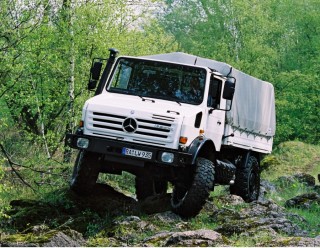
(L): One of the first of the the Unimogs -seen here with rear twin tires and front trailer hitch. (R): Extreme off road capability of the U3000 launched in 2002
Mercedes-Benz says the concept has an impressive, dynamic and extremely expressive “face” corresponding to the future form language of Mercedes-Benz commercial vehicle design. The design concept combines the past and future of the Unimog in an extremely avantgardist way.
“We have taken the Unimog-DNA with its unique concept features to 100 percent into consideration when creating this design concept,” says Bertrand Janssen from the Daimler department for commercial vehicle design.
Yaris Pürsün, Director of the Mercedes-Benz Plant at Wörth and Mercedes-Benz Special Trucks, is visibly enthusiastic about this new interpretation of the Unimog idea by the commercial vehicle designers and the project team responsible. “The result is a complete success. At Mercedes Benz Special Trucks we decided to construct a design concept because we are of the opinion that such a vehicle will act as a bridge between the progressive strength of self-renewal that has distinguished the Unimog programme for 60 years and the future design of the coming generations of products.”
The Concept Design 60 Years Unimog was designed with the intent to show that a great deal of innovation is still possible in the engineering of future Unimog generations.


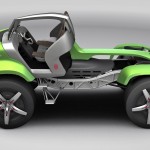

The bonnet lines and mud-guards follow Mercedes-Benz Trucks’ design language. The colour green was chosen for the hulk of a bonnet, since Bertrand Janssen’s team of designers were inspired by the poison dart frog, (what?) which like the Unimog is also extremely mobile both in water and on land. Green was also the colour of the very first Unimog and numerous versions in the future. The coil springs of the Unimog are painted in red, definitely not inspired by Hrithik Roshan’s antics in a hurricane, but to draw attention, as they have been the selling point of the Unimog for years now.
The clearly visible, sweeping lines of the frame have been finished with high-grade trims cut from aluminium blocks. The four same-size wheels make a strong optical impression with their five star alu-rim design. Extremely bling, we say!
Bertrand Janssen emphasises, ” On no account did we work in an atmosphere where our ideas were divorced from reality. Here we have a vehicle which is puristic, but still clearly true to concept – with the claim, that some of its details will turn up in coming product ranges in future. We continued to take up the most important Unimog features which have characterised the vehicle for the last 60 years and which will also characterise it in future – features such as portal axles, coil springs or the frame concept.”
The design concept “60 Years Unimog” is not however a prototype for a new product range.


U 500 Black Edition:
The Unimog does seem to be the favoured child at Mercedes-Benz trucks. Check out the Unimog U 500 Black Edition, from Brabus. An elegant silhouette, the most distinctive features of which were a platform with integral side panels, a gleaming, futuristic-looking, silver bumper and polished stainless steel roll-over bar and an upswept chrome exhaust pipe reminiscent of a US truck.
On the inside the Unimog Black Edition indulged its driver with 16 features in real carbon, Alcantara leather trim for the roof and A/B-pillars and seats upholstered in finest mastic leather. The footwells were carpeted in soft velour, the pedals on the other hand were finished in aluminium and the steering wheel in black leather. On the inside, too, the Black Edition was a first-class implement carrier: entertainment and information highlights included the COMAND system from the S-Class, which offered a 6.5’ screen, DVD navigation, CD changer and a specially developed compass function.


About Portal Axles:

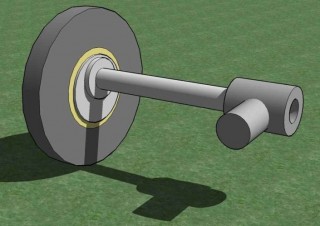
As is obvious from the above images, a portal axle enables to have the axle tube above the centre of the hub. This enables the vehicle to have a higher ground clearance.
More here
Factory Yamaha rider Ben Spies has extended his contract till the end of the year 2012. His original contract was to expire this year. Yamaha have been keen to utilize the services of Spies in the development of the 2012 MotoGP challenger which will be of 1000cc capacity. Jorge Lorenzo who is also contracted to Yamaha till the end of 2012 has no experience with 1000cc machine racing since he emerged from the 125cc and 250cc classes, both of which were 2 stroke as well. Spies on the other hand has come from Superbikes having ridden both in the AMA series and in World Superbike series where he became World Champion convincingly in his rookie season itself. Superbikes run 1000cc engines though they are heavier than GP machines. But the working knowledge of how 1000cc engines behave is very important from the point of view of a racer. The engine power out put and lap time differences between GP racing and Superbike racing have been closing dramatically and that makes Spies valuable for Yamaha for 2012.
Daniel Pedrosa has complained that whatever the FIM has done with Marco Simoncelli after the infamous incident at Le Mans that saw him put Pedrosa out of the race with a fractured clavicle, is too little and too late. Due to that crash and the injury sustained in it, Pedrosa has not only missed scoring at Le Mans but also has had to give the Catalunyan and British GPs a miss. This has put him out of the contention for the world championship this year. That is indeed a pity because Pedrosa looked like the only rider to match the blisteringly fast Casey Stoner this season.
Even a die hard optimist like good old Bernie Ecclestone is slowly veering around to the view that the F1 GP of Bahrain is unlikely this year, given the fact that the ruling family is still facing problems from Shiite protesters who want democracy. Even though emergency is supposedly lifted there are reports constantly of skirmishes between the police and the protesters often culminating in the lobbing of tear gas shells and firing of rubber bullets. Given this situation the F1 community has been reluctant to go to the island kingdom and now it seems that a consensus is emerging about not having the GP of Bahrain this year. That means that the Indian GP will be held as it was originally scheduled, on the 30th of October, 2011.
The FIA President, Jean Todt has claimed that the manufacturers in Formula1 are divided over the new engine formula set to kick in 2013. Cosworth, Mercedes and Ferrari do not want the implementation of the four cylinder 1600cc turbo charged engine formula (at least not yet) while Renault apparently has threatened to quit if the formula is not implemented by 2013. Todt claims that he is in talks with the manufacturers to save the situation. Whatever the case, the glory days of F1 are over and the days of exotic beauties with unrestricted engine configurations and sizes is now firmly in the past. F1 in the politically correct world is shooting itself repeatedly in its feet and therefore it is only a matter of time before it falls.
Atul Auto, the Rajkot based manufacturer of three wheelers both in the passenger and in the load segments is now looking to expand its portfolio. According to Wheelsunplugged.com, Atul Auto is also looking at the creation of a quadricycle platform for load carrying. Ever since Tata came into the three wheeler space with four wheeled vehicles, there has been an attempt on the part of all three wheelers to go the four wheeled way by modifying their three wheeler platforms into quadricycle platforms. Atul Auto is still considering plans and has no concrete projections for now. Atul Auto has also expressed interest in picking up the Government’s stake of 95% in Scooters India Limited.
While BMW and Audi have a range of vehicles in the cross over category, Mercedes has no models that correspond with those of the other two directly. Mercedes has the M Class and the GL class of vehicles that roughly correspond to BMW and Audi models. While the M Class falls somewhere near the BMW X5 the GL class falls near the Audi Q7. Mercedes has been working on its new M Class vehicle and the wraps are off and the vehicle is therefore everyone to see, even though it is yet to me introduced in the Indian market. Even the staunchest of the M Class fans will find it difficult to point out the difference between the new and the existing M Class vehicles. But that has been the approach of the Sindelfingen based manufacturer. Evolution for sometime and then when the evolution process is over, get into the revolution mode.
Picture Courtesy: indianautosblog.com

The production of Audi’s BMW X1 challenger, the Q3 is go in Europe. The car is now being produced in Spain. BMW’s X1 has done surprisingly well in the Indian market, though for its price (and sometimes for less) there have been other vehicles that have offered more space, power and value. Audi has taken note of the success of the X1 and will be bringing in the new Q3 the smallest in the Q series to India. BMW has the X1, X3 and the X5 and Audi’s challengers to the same are the Q3, Q5 and Q7. The latter two are already on sale in India and therefore it is logical to assume that the Q3 will eventually make it to India. The Auto Expo in Jan, 2012 is likely to the scene of the launch. The Q3 like the Q5 lacks in the street presence the locomotive like Q7 has but the Q5 sells quite well and so should the Q3.
Picture Courtesy: indianautosblog.com
