Maruti Suzuki has put a full stop to the production of the present generation Swift which has been a best seller. After the stocks are cleared from the dealers the car manufacturer will introduce the next generation Swift which is an evolution of the present car. It is bigger, better and if reports are to be believed it is also more fuel efficient. It is expected that the best selling run of the Swift will be continued and bettered by the new incoming model.
Yearly Archives: 2011

Whew. Concept sketches from the Italians, the British, and the Germans do things to the enthusiasts’ physiology, but nothing taxes the brain like concepts from the French. Outlandish, futuristic, quirky, worthy of an extended point and laugh session by the Jezza, James and Richard trio, the Renault FRENDZY is all that, and more.
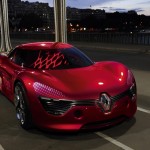
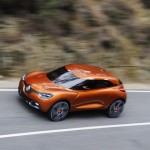
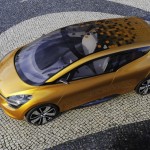
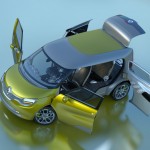
DeZir, Captur, R-SPACE, FRENDZY
It is this writer’s humble opinion that the Renault DeZir (not the DZire) was an easily lovable, lust worthy concept, the Captur a bit less so and the R-SPACE, the most conventional looking of the lot, that is until the doors fly open. The FRENDZY is the fourth concept in a series of designs under the stewardship of Laurens van den Acker, Senior Vice President, Design Renault. The designs are said to be inspired by Renault’s ‘Drive the Change’ motto.


It is the fourth step in Renault’s design strategy based on “the different stages of the human life cycle”. FRENDZY is a commercial business vehicle which can double up perfectly as a comfortable passenger car, it meets the requirements of business users on the one hand and those of families on the other. Exterior Designer Deyan Denkov stresses that the asymmetric body design was very much intentional, and is used to express the twin roles this car is capable of. The driver’s side, there are side windows, no centre pillar ( the B Pillar), but with centre opening doors represents the world of the family.
On the passenger’s side, there’s no glazing and no centre pillar, just one conventional door and one sliding side door which incorporates a 37-inch widescreen display. This is the world of work. The idea of having an exterior display, to act as an advertising medium or to display messages, might seem novel, but it is something that we’ve seen being implemented by young designers world over in various design contests that do not get the kind of exposure this baby from Renault will.

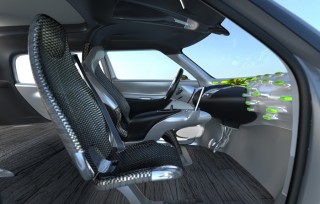
The FRENDZY, being projected as the multi role family car, resorts to a number of tricks to state its intent. The driver, can adapt the vehicle to his or her needs. In ‘work’ mode, the rear-view mirrors sit upright and the interior lighting is green; in ‘family’ mode, the mirrors swivel round to the horizontal position and the interior is bathed in a radiant orange ambience, a subtle reference to the orange Captur which was the wholly family oriented concept from Renault Design. Coloured repeater lights in the headlamps and tail lights provide an external indication of the mode in which FRENDZY is operating.
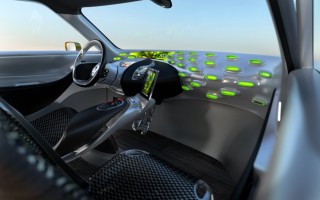
The driver’s side cockpit is designed along the theme of a futuristic ‘work bench’ featuring a structure which appears to be made from molten metal. Green light emanating from the dashboard brings this smooth and organic architecture to life. The lighting, dare we say, is a bit overdone, thanks to the ”nozzles” which Renault claims will be used to plug in various accessories. Modularity, as much of a buzzword in the product design scene, seems to have taken its place here too. The fabric roof adapts itself to the shape of bulky objects, magnetic fixings allow the load to be secured to the floor, and modular stowage systems are a practical bonus for business users. The single-piece rear seat is integrated into the floor, while the front seat folds forward in order to free up space.
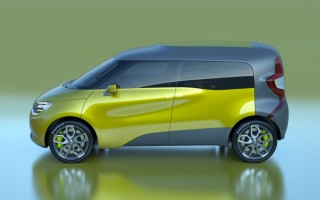

The comfortable passenger seat and, in the rear, a big bench seat give away the FRENDZY’s intention of being a family car too. Depending on their mood of the moment, children can watch a film or play games on the touch-sensitive pad which slides out from the back of the driver’s seat. In addition to this touch pad, there is also special slate integrated into the sliding door, which of course kids can doodle on.


In work mode, the slate can be used for either serious looking formulas or a complicated list of sales figures!
Renault in its press release has projected the concept as an innovative office on wheels, with a BlackBerry® PlayBook™ tablet recently launched by Research In Motion (RIM), plugged in the dash, bearing the heavier share of the burden of living up to the FRENDZY’s ‘office on wheels’ promo line. Being an electric car, very much like the DeZir, the FRENDZY is also bestowed with the capability to produce sounds, both inside and outside, the result of Renault’s collaboration with ICRAM.

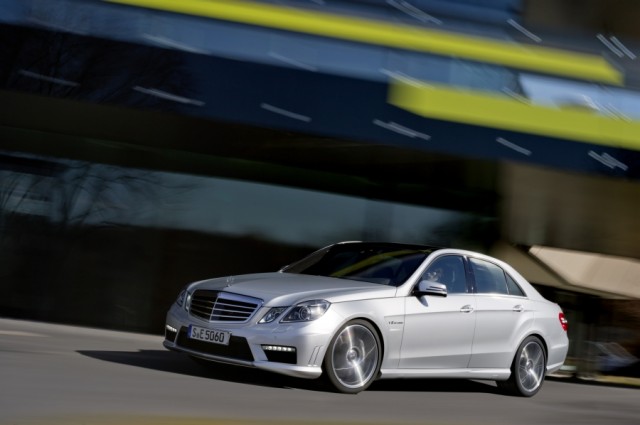
In tune with the “AMG Performance 2015” strategy, the E 63 now comes with the new AMG 5.5 litre V8 BITURBO engine. Although purists will mourn the naturally aspirated 6.3 litre AMG engine that has been replaced by the turbocharged 5.5 litre , a claimed 22% reduction in fuel consumption we think is worth the sacrifice.
The figures for the new engine stand as follows : 386 kW (525 hp) at 5250-5750 rpm with torque of 700 Nm at 1750-5000 rpm, 0-100kph time of 4.3s and an electronically limited 250 kph top speed. Spend another 8306.20 Euros and treat yourself to the AMG Performance Package and you get 410 kW (557 hp) at 5250-5750 rpm and earth shattering 800 Nm at 2000-4500 rpm . The optional package also shaves off a second off the 0-100 kph times. The estate version is marginally slower than the sedan.

Design changes include the new 10 spoke light alloy wheels, wheels, painted titanium grey and with high-sheen rim flanges and the V8 BITURBO badging on the front wings, which again are wider than on its predecessor. The characteristic AMG bodystyling includes the distinctive front apron: the large air intakes with black grilles help with the efficient flow of air through the cooling module positioned behind. The air vents in the front right-hand wheel well liner allow hot air from the additional AMG radiator to escape.


Another highlight comes in the form of the AMG-specific LED daytime driving lights. In conjunction with the optional Intelligent Light System, the E 63 AMG features darkened bi-xenon headlamps. There is also the AMG side sill panels and an AMG sports exhaust system with two sets of twin chrome plated tail pipes. We cannot help but think the BITUBRO badging is more geeky than mechanical. A hyphen that would have visually separated the Turbo from the Bi would have been much appreciated.


The interiors get the AMG treatment too. The AMG Performance steering wheel is flattened at both top and bottom, which Mercedes-Benz claims to facilitate better control of the vehicle. Aluminium shift paddles, perforated leather in the grip areas and 3D design of the airbag cover with its ‘Silver Shadow’ metallic trim element distinguish the steering wheel. The new E-SELECT shift lever with embossed AMG badge on the centre console and the AMG logo that shows three-dimensional full-colour TFT display borrowed from the CLS 63, positioned in the centre of the speedometer when the door is opened, complete the AMG branding.

Driver and front passenger also benefit from independent AMG sports seats, featuring a cross-piping design as well as electric adjustment, seat heating and AMG badges. All seats, armrests and door centre panels are finished in fine leather, and the seat centre panels in perforated leather. The quality of finish of the leather, which is soft to the touch, makes for a particularly pleasant ride experience. Three different appointment colours are available: black, mocha brown/almond beige and reef grey/alpaca grey. Trim elements also boast the highest quality black ash/black piano lacquer finishes.
AMG Performance Studio:
Since 2006, this arm of AMG, based in Affalterbach works towards customizing vehicles to customer specifications. The AMG performance package includes,
- AMG RIDE CONTROL Performance suspension
- AMG light-alloy wheels in a new 10-spoke design, painted in titanium grey with a high-sheen finish, with 255/35 R 19 (front) and 285/30 R 19 (rear) tyres
- AMG rear axle locking differential with 40 percent locking action
- AMG ceramic high-performance composite braking system
- AMG Exterior Carbon package
- AMG Performance steering wheel
- AMG trim elements in carbon fibre/black piano lacquer
- Illuminated AMG door sill panels
- AMG Driver’s package (includes restriction of the top speed to 280 km/h (E 63 AMG Estate) or 300 km/h (E 63 AMG Saloon), participation in a driver training course at the AMG Driving Academy, AMG spoiler lip and electric sunblind for rear window (both for E 63 AMG Saloon only)

‘designo’ for tailor-made individuality
Straight from the press release,
A literally tailor-made individuality can also be achieved courtesy of the comprehensive designo range. Five different designo paint finishes can be combined with nine designo aniline leather appointment options as well as three different trims. Also providing a special look are the two matt paint finishes designo magno cashmere white and designo magno allanite grey.
The single-tone designo aniline leather appointments give the interior of the E 63 AMG a highly exclusive ambience: the AMG sports seats and door centre panels in the chosen leather colour as well as matching piping with contrasting stitching are coordinated with black nappa leather on the door armrests and the centre console cover. Velour floor mats with black designo leather edging, designo metal badges and the black roof lining harmoniously round off the look.
To enhance the high-class appeal of the interior even further, there is also the “Extended designo leather appointments” option. With this, the upper part of the dashboard and the upper door linings are finished in black designo leather. The “Extended designo leather appointments II” option takes things a step further, with fine nappa leather on the lower part of the dashboard, glove compartment lid, door base frames, map pockets on the doors and the side bolsters of the centre console.
Complementing the overall look perfectly are three trims, comprising designo natural curly maple wood, designo natural bamboo wood and designo black piano lacquer, as well as a designo Alcantara® roof lining available in three colours.

Transmission
A major contribution to the car’s exemplary consumption figures is also made by the AMG SPEEDSHIFT MCT 7-speed sports transmission. In place of a conventional torque converter, this uses a compact wet start-up clutch. The E 63 AMG also features a stop/start function as standard: this is active in the Controlled Efficiency (“C”) transmission mode and switches the eight-cylinder engine off when the vehicle comes to a standstill. The stop/start function can be activated or deactivated using the ECO button on the centre console. When in transmission mode “C”, the vehicle will always start up in second gear. The system will also change gears noticeably early and avoid high engine speeds. Demand-driven delivery of fuel and a generator management system with braking energy recuperation during deceleration add further to the economic use of fuel. For the enthusiast, the transmission modes “S” (Sport), “S+” (Sport plus) and “M” (Manual) with shorter response times, higher engine speeds and more spontaneous gear changes demonstrate the full potential of the new AMG V8 biturbo engine. In all three transmission modes, not only is the stop/start function deactivated but, at full load, the engine management system partially suppresses the cylinders. This carefully managed interruption to ignition and injection results in faster gear changes and an emotive acoustic effect. The automatic double-declutching function in reverse gear provides the perfect complement.
The E 63 AMG features the AMG RIDE CONTROL sports suspension with a specially designed front axle: the track has been widened by 56 millimetres compared with the E 500, and includes independent wheel carriers, for increased negative camber at the front, giving clear benefits in terms of grip when driving fast through bends.
As you would expect from a Merc, the Active and Passive Safety features runs quite long, let’s just say, as long as sanity prevails, or tries to, the occupants should live through to see the next generation of E Class roll out.
Fiat India has confirmed that it is working on a car that is smaller than the Punto and that this car will have nearly 85% of localization to keep costs down when it is introduced into the market. The year 2012 is likely to see the introduction of this vehicle which is being developed exclusively for India in the Fiat headquarters at Turin, Italy. Fiat is also considering bringing another car through the CBU route and the media is guessing that this is going to be the Sedici which shares its underpinnings with the Suzuki SX4. However this is purely in the realm of speculation (the Sedici being the CBU import that is).
Motoroids.com has carried a piece of news that Honda has unveiled 110cc concept Vision which will replace the Dio/Lead which is exported from India to the UK. This could mean that the Dio in India too could be replaced with the new scooter which features 14 inch wheels. Here are the pictures but do go to motoroids.com for more information about the scooter.
Picture Courtesy: Motoroids.com


Force Motors’ Force One SUV is due for launch in the coming few weeks. As the launch draws nearer the camouflage is also peeling of more. Here is a close up picture of sorts that Indian Autos Blog.com has posted.
Picture Courtesy: Indian Autos Blog.com

Tata Nano has started going to different countries. It first went to Sri Lanka where it unfortunately seems to have started life as a taxi cab but the next country that it has gone to Nepal, has seen people rush to buy it as a personal car. It seems that the future of the little Nano is bright. It deserves such a future.
Picture Courtesy: Indian Autos Blog.com

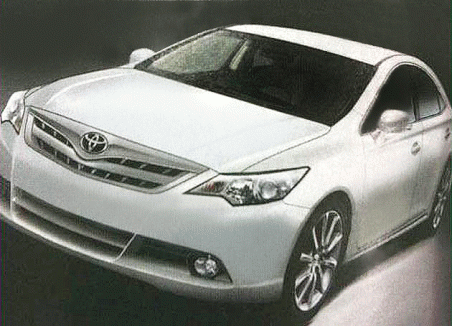
Toyota has given its Camry model car a face lift which is in line with how the Corolla Altis looks. As is usually the case with Toyota the looks of the car are unremarkable. This car is being touted as the 2012 Camry and one can expect people to flock to Toyota showrooms to buy this as people do with Toyota products.
Picture Courtesy: Autocar India.com
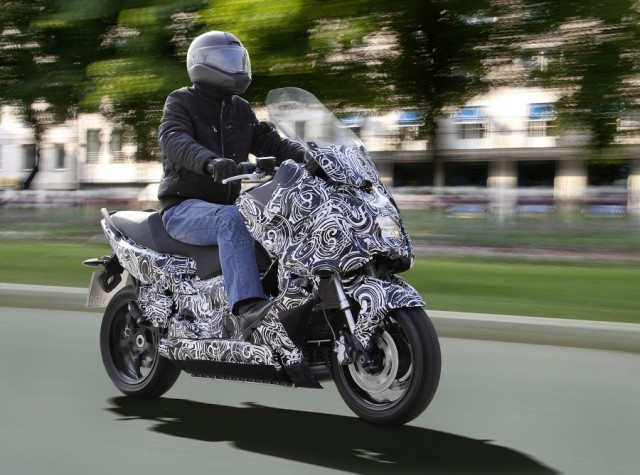
We aren’t particularly fond of electric vehicles, but this one has a BMW badge on it, and BMW claims this one has a much better range and 0-60 kph performance figures comparable to that of a scooter with a 600cc internal combustion engine. This correspondent is wondering if our Government could be convinced to offer a fat subsidy to import one of these. I guess it won’t be as good a buy as the mean green Ninja 650R, but with the claimed 0-60 figures, and coupled with an external audio track, ala what Brabus did for Tesla, maybe we could just live with it. Anyway, here’s the news, straight from the press release.
Since it was conceived as a future-oriented vehicle for commuting between urban areas and the city centre, therefore attracting funding from the German Federal Ministry of Transport, Building and Urban Development, there were two main requirements for its development: dynamic figures comparable to those of a maxi scooter with a combustion engine and a high range in realistic conditions of use.
The concept vehicle BMW E-Scooter provides the necessary sustained output and maximum speed for safe and reliable overtaking on urban motorways and also when carrying two people. It is also easily capable of managing hill starts on steep slopes with a pillion passenger.
The development study also has the necessary maximum output to be able to achieve acceleration figures within the important 0 – 60 km/h range, which are at the level of current maxi scooters powered by a 600 cc combustion engine. The high storage capacity of the battery allows a daily driving range of over 100 kilometres. In this way, the BMW E-Scooter concept vehicle provides a long-term, zero-emissions urban and suburban travel option which is suitable for everyday use.
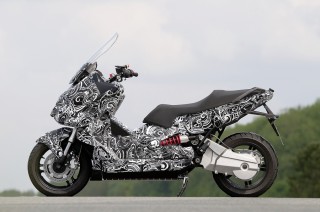

Frame
Unlike existing maxi scooters with combustion engines, the concept vehicle does not have a main frame. Instead, the aluminium battery casing — which also contains the electronic system required for battery cell monitoring —takes over the function of the frame. The steering head support is connected to it, as is the rear frame and the left-hand mounted single swing arm with directly hinged, horizontally installed shock absorber.
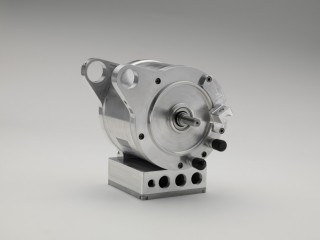
Electric machine, power electronics and charging device.
Due to its high output, the BMW Motorrad development study has no hub motor with direct drive or planetary gearbox. Instead, the high-performance electric machine is mounted behind the battery casing. The secondary drive consists of a toothed belt from the electric machine to the belt pulley mounted coaxially on the swinging fork pivot with drive pinion. From here, power transmission occurs via roller chain to the rear wheel. When the E-Scooter is decelerated in trailing throttle or when braking, the energy released is recuperated, thereby increasing the vehicle’s range by between 10 and 20 per cent depending on driving profile.
The electrical components required for the electric drive are installed on the top of the battery casing. The external battery electronics system permanently collects and monitors data such as the temperature and voltage of the battery cells, both during travel and while charging. The power electronics acts as a control system and controls the electric machine. The charging device includes a charge cable which allows the battery to be recharged at a conventional household power socket. In addition to the other components like an ISO insulation monitor, high-voltage indicator and a high-voltage distributor, a DC-DC converter is included. It is required to change high voltage to low voltage power to supply the 12 volt vehicle supply and especially for the control units.


Cooling system
During travel, the electric machine and power electronics are liquid-cooled, as is the charging device during charging. An electric coolant pump ensures coolant circulation through the radiator. While a coolant is commonly used for the battery in electrically powered cars, the E-Scooter concept vehicle uses an air cooling system in order to save space.
Safety
BMW Motorrad is one of the very few motorcycle manufacturers to be able to draw on its own experience and expertise in the automobile field in the development of electrically powered vehicles. Synergies are derived from the development of the BMW E-Scooter concept vehicle not just in the ready availability of technical components but also in the area of high voltage engineering and the associated safety requirements. Here for the first time, standards established by the leading automobile manufacturers relating to high voltage safety (> 60 volt) and functional reliability are being applied to a two-wheel vehicle with electric drive.
Mercedes-Benz makes a brave claim that the only rival for the new Actros would be its predecessor. All versions of the new Actros are uncompromisingly designed for long-distance transport. It now covers all long-distance applications, whereas previously this domain was served by two truck series, namely the Actros and the Axor.

The Actros’ modular system with a choice of seven different cabs is groundbreaking. The cabs have a width of 2.3 or 2.5 metres, four roof variants and, a maximum length of 2.3 metres. A flat cab floor was previously only for exclusive flagship models but the new Actros has five variants featuring a flat floor.

The GigaSpace cab has a volume of 11.6 cubic metres, a flat floor, 2.13 metres of headroom and more than 900 litres of stowage space. The cockpit area and the living are are visually distinguished by the use of different colours and gerometric form. The functional area of the cockpit is finished in practical anthracite whilst the rear, ceiling and area around the co‑driver’s seat are appointed in a light almond beige colour. High-quality surfaces, the luxurious driver’s seat with optional massage function (from 2012), beds offering the comfort of home, a multifunction steering wheel, informative and attractive instruments, and asymmetrical roof stowage boxes are just some of the many aspects developed specifically for the new Actros.
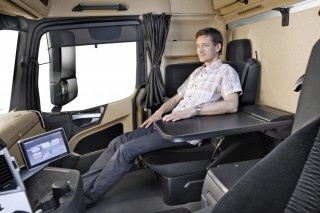
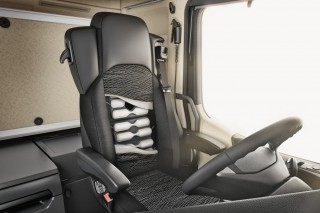
Unique features include the new, optionally available SoloStar Concept for the new Actros, which creates an all-new calm zone and ensures maximum recuperation. This comfortable relaxation area on the co-driver’s side is shaped like a corner sofa unit and is set back against the rear wall.

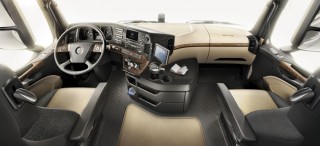
Mercedes Benz says the unmistakable design of the new Mercedes-Benz Actros is as exceptional as the truck as a whole and its look, developed specifically for a long-distance truck, is powerful, masculine and dynamic. The objectives for the design team was simple, rid the Actros of all its straight lines and flat surfaces. Having worked toward the same, the curves along with contrasting concave and convex lines lend the new Actros it’s own unique character.
This fluidic ( it’s not trademarked, is it?) merging of different surfaces, especially visible between the front section and the side flanks is what Mercedes-Benz designers are calling the “flow”. The bumper, corner panelling and entrance form a single unit. Fluid lines are a hallmark feature of the new Actros – which is why designers often talk about “flow”.
Much of the development work was focussed on aerodynamics. The new Actros spent some 2600 hours in the wind tunnel – never before has a truck been developed and tested so intensively in a wind tunnel. Its aerodynamic design is one of major factors behind the reduction in fuel consumption compared to its already highly economical predecessor.


Regarding the powertrain, here’s the info straight from the Press Release.
The all-new heavy-duty engines for the new Actros likewise set standards. From the outset, the new BlueEfficiency Power engine generation offers compliance with Euro VI. The first member of the new engine family is the Mercedes-Benz OM 471 six-cylinder in-line unit developing 310 kW (421 hp) to 375 kW (510 hp) with a torque of 2100 to 2500 Nm. A high torque, even at engine speeds below 1000 rpm, and almost peak output at 1400 rpm make for excellent driveability.
Four valves per cylinder control the two overhead camshafts. These are “composite” or “assembled” camshafts – a first for engines of this size. Another premiere arrives in the shape of the common-rail injection system with X-PULSE pressure booster. The maximum pressure in the rail, around 900 bar, is boosted to up to 2100 bar in the injectors and can be fully varied on the engine map. Charging is performed courtesy of a turbocharger with an asymmetric turbine housing, which improves response. The engine brake, a charged decompression brake, is designed to deliver maximum efficiency. This three-stage brake achieves a maximum braking power of 400 kW.
To meet the stringent requirements imposed by the Euro VI emissions standard, Mercedes-Benz has developed a complex emission-control system consisting of SCR technology with AdBlue injection without compressed air, cooled exhaust gas recirculation (EGR) and a particulate filter. Factors behind the engine’s outstanding economy include its exceptional robustness and longevity as well as maintenance intervals of up to 150,000 kilometres.
In all models, the power is sent to the wheels through a third-generation Mercedes PowerShift fully-automated transmission featuring highly sensitive shift sensors for even faster and more precise response. Rear axles with longer ratios reduce the engine speed and, therefore, fuel consumption.
Long before production started, the new Actros experienced the Arctic Circle in winter and the searing heat of Spain’s Sierra Nevada in summer. It negotiated all kinds of roads in Turkey and got a taste of desert sand in South Africa. Mercedes-Benz proudly claims to have clocked more than 20 million miles over the past five years of testing, and a recent 10000 km trial run, over regular east-west transport operations on the Rotterdam – Stettin – Rotterdam route, has given the Actros a couple of more reasons to ahem.. stand tall.
- 4.5 percent cut in fuel consumption combined with ultra-clean Euro VI emissions standard
- 7.6 percent less fuel consumption for new Euro V truck
- Absolute fuel consumption for the new Actros between 25.1 and 25.9 l per 100 km
Now if only we could lay our hands on one of these. We might even seriously consider dressing up for the occasion!