Yearly Archives: 2011

Production at Tata Motors’ Sanand plant has resumed after a temporary suspension for about a fortnight. This was done for maintenance and to rationalise and align inventory.

Tata Motors has issued a statement that the month is witnessing very encouraging response to consumer-oriented marketing efforts, resulting in increasing inquiries and footfalls at the company’s showrooms.

In the latest Euro NCAP crash test, the BMW X3 achieved the highest rating of 5 stars. The second-generation Sports Activity Vehicle earned its top marks in this challenging test for new vehicles thanks to its comprehensive range of standard safety equipment and effective occupant protection in various types of collision.

Achieving the best rating in the Euro NCAP crash test is proof of the very high level of the safety concept developed for the BMW X models. The new BMW X3 boasts an extremely stable body structure, and the forces exerted on the vehicle in a collision are deflected along precisely defined load paths and absorbed by generous deformation zones. Consequently, the passenger cell fulfils its function as a survival space even in serious collisions. Standard safety equipment inside the new BMW X3 includes front, side and curtain head airbags that protect both the driver and the passengers from injury. Also standard are belt latch tensioners and belt force limiters for the front seats and ISOFIX systems in the rear for attaching child seats, as well as the option of deactivating the front passenger airbag. The restraint systems are controlled by the central safety electronics, which take into account the type and severity of an accident to trigger the most effective protective features in each case.

In their evaluation of the crash test results, the assessors concluded that the new BMW X3 provides a high degree of occupant safety in all seats. Its stable passenger cell provides comprehensive injury protection in a front-end collision for both the driver and the passengers, regardless of a person’s size and the position of their seat. Here the Sports Activity Vehicle was awarded outstanding ratings for the protection of children aged around three years or 18 months in the relevant-sized child seats. For its side impact protection, the BMW X3 likewise achieved the maximum available points.

The new BMW X3 earned an outstanding rating for its active safety features as well. The Sports Activity Vehicle comes as standard with the Dynamic Stability Control system (DSC), which is linked to BMW xDrive intelligent all-wheel drive. Thanks to its wide-ranging functions, including Braking Assistant, Cornering Brake Control and the traction mode DTC (Dynamic Traction Control), Dynamic Stability Control ensures easily controllable and secure handling even in challenging driving situations. Further standard features on the BMW X3 include a Tyre Defect Indicator that warns the driver in good time of a loss of pressure in any individual wheel.

Daimler AG and Rolls-Royce Holdings plc have obtained the approval of all the relevant regulatory authorities for the acquisition of Tognum AG. This step paves the way for Daimler and Rolls-Royce to conclude the takeover of the Friedrichshafen-based engine and drive system specialist Tognum through their joint venture, Engine Holding GmbH. The settlement will be completed within the next eight bank working days. This means that the Tognum shareholders who tendered their shares before the extended offer period ended on June 20, 2011 will receive settlement within the next two weeks.

As of August 22, 2011, Engine Holding GmbH had secured approximately 96.78% of the Tognum shares. Tognum shareholders who have not yet accepted the takeover offer can tender their shares for purchase by Engine Holding GmbH at the offer price of €26 until midnight on November 10, 2011.

Through the acquisition of Tognum, Daimler and Rolls-Royce plan to create a leading supplier of complete industrial engine systems. The joint venture company will offer a broad range of products, services, and solutions worldwide.

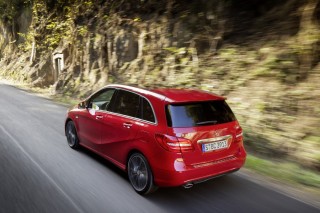
Mercedes-Benz B-Class B 200 CDI in IndiaMercedes-Benz B-Class B 200 CDI in India : Rear

“No model change in the history of Mercedes-Benz has ever seen so many new developments introduced in one fell swoop,” stresses Dr. Thomas Weber, Member of the Board of Management responsible for Group Research and Head of Development, Mercedes-Benz Cars. “Future B-Class customers will benefit from this quantum leap in terms of exemplary low fuel consumption and CO2 emissions combined with driving pleasure, plenty of space and the highest standard of safety that has ever been available in this class.”
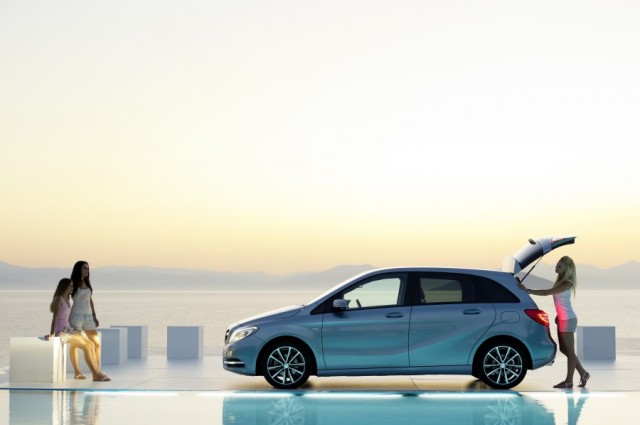
Mercedes-Benz new B-Class

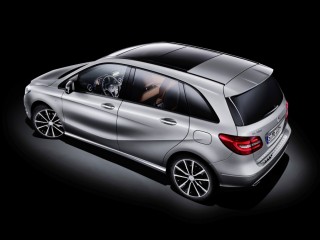
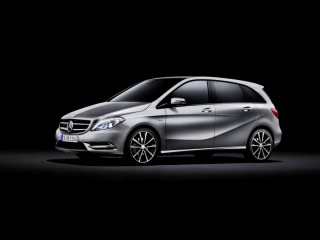
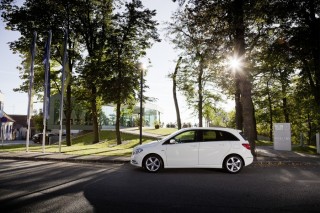
Mercedes-Benz brings the new B-Class on stage at the Frankfurt Motor Show. Mercedes-Benz projects the new B-Class as a typical Mercedes sports tourer, offering plenty of space combined with impressive dynamic performance. The characteristic lines of the exterior design indicate both of these attributes: front and rear sport a width-emphasizing design, with a wide, prominent grille and headlamps extending along the sides at the front while the rear end features a wide rear window, two-piece tail lights with horizontally offset meander and a large tailgate with low loading sill.

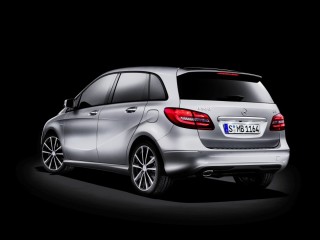
Mercedes-Benz new B-ClassMercedes-Benz new B-Class

The bonnet flows seamlessly into the A-pillar and the roof line descends sleekly to the roof spoiler. The roof features a swage line which lends the vehicle a longer appearance. The pronounced wheel arches offset by dynamic feature lines under the beltline are a sporty interpretation of the current design line from Mercedes-Benz. The bottom edge of the body features dynamic side skirts which add a light touch to the vehicle’s appearance.
Mercedes-Benz new B-ClassMercedes-Benz new B-Class

Four equipment packages (Chrome, Sports, Exclusive and Night package) enable individualisation according to personal tastes. In the interior, the large, three-dimensional trim covering the entire dashboard first strikes the eye. It is available in four variants, covering a broad spectrum from modern through sporty to classic. Mercedes-Benz also claims that many features only found in higher segments of cars have been made available in the compact Benz.The dashboard is optionally available in ARTICO man-made leather finish and features stitching, for example. In the interior, the large, three-dimensional trim covering the entire dashboard first strikes the eye.
Mercedes-Benz B-Class India B 200 CDI and 180 CDIMercedes-Benz B-Class India B 200 CDI and 180 CDI Boot Space

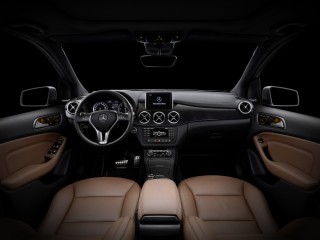
The three large round vents in the middle and their uniquely designed cruciform nozzles add a sporty attribute to the interior’s ’emotional design idiom’ as Mercedes-Benz puts it. The display, which is available in two sizes (5.8- and 7-inch) appears to hover over the vents. With its stylish design – the trim frame with galvanised finish contrasting with the piano black of the front panel – and slender lines, the colour display (TFT) is a highly attractive feature in the cockpit.

The 3-spoke steering wheel, which always incorporates a silver chrome insert in the middle spoke, the instrument cluster with four analogue round dials and suspended pointers in 6 o’clock position and the seats with contrasting stitching underscore the sporty character.
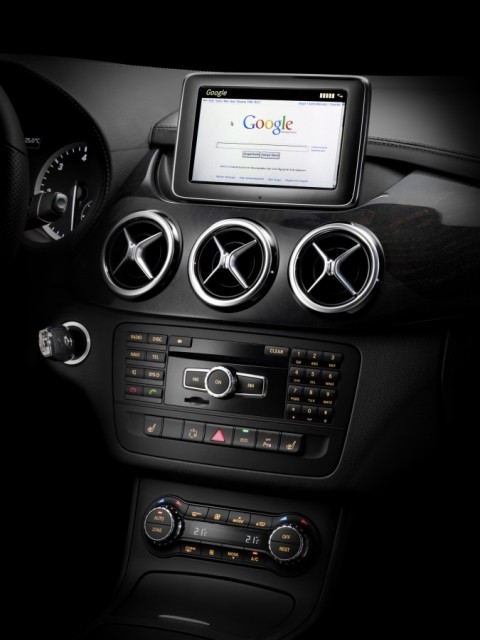
Mercedes-Benz new B-Class Interior: Cruciform Nozzles, 5.8- and 7-inch TFT DisplayMercedes-Benz new B-Class : 3-Spoke Steering Wheel

Mercedes-Benz new B-Class Interior

Powertrain

The new four-cylinder petrol engines (internal designation M270) mark the launch of a completely new engine series. The combustion process is based on the third-generation Mercedes-Benz direct injection system which was introduced last year with the BlueDIRECT V6 and V8 engines. Its use in the B-Class marks this technology’s debut in the compact segment. The new four-cylinder engines have been designed for both transverse and longitudinal installation. In the new B-Class they are initially available with a displacement of 1.6 litres, as the B 180 rated at 90 kW (122 hp) and the B 200 with an output of 115 kW (156 hp). Their maximum torque of 200 and 250 Nm respectively is available from an engine speed of 1250 rpm.
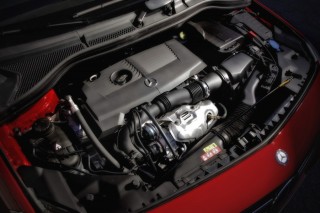
Mercedes Benz B Class India B 180 CDIMercedes Benz B Class India B 200 Mercedes Benz B Class India B 180 CDI

The new four-cylinder diesel engine is a further development of the OM651 deployed in the C- to the S-Class, a common rail direct-injection engine of the third generation. With its displacement scaled down to 1.8 litres various other optimzations, this is the first time that the compression-ignition engine has been mounted transversely in a Mercedes-Benz car. The B 180 CDI generates 109hp, while the B 200 CDI has an output of 136 hp. The maximum torque of 250 / 300 Nm is available from 1400 / 1600 rpm.

Another Mercedes-Benz premiere is the new 7G-DCT dual clutch transmission in the B-Class. This transmission is extremely compact, extremely variable with regard to adaptation of the engine speed thanks to seven gears, features an electric oil pump for start/stop capability, shifts gear without any interruptions in tractive power and combines the comfort of an automatic with the efficiency of a manual transmission.

The new manual transmission designed along similarly compact lines as a three-shaft transmission is a close relative of the DCT. Extremely easy gear shifting, low shift forces, low internal friction and a low weight are among its most important characteristics.

Safety

The PRE-SAFE®preventive occupant protection system which features in the B-Class is available for the first time in this vehicle category. This represents a further step in the ongoing democratisation of this innovation, which was premiered in the S-Class in 2002. Core features of PRE-SAFE®are reversible belt tensioning, the closing of side windows and sliding sunroof in case of critical lateral dynamics and adjustment of the fully electric front passenger seat with memory function to an ideal position for maximum effectiveness of the restraint systems. PRE-SAFE®is always activated in response to critical longitudinal and lateral dynamics and may also be triggered upon intervention by certain assistance functions.

The scope of restraint facilities takes special account of the B-Class’ use as a family car. Great importance has been attached to the safety of the rear occupants. Belt tensioners, belt-force limiters and belt height adjusters come as standard on the outer seats. Rear sidebags are optionally available. Integrated child seats and automatic child seat recognition are available as in the predecessor. Driver and co-driver are provided with new pelvis bags which are able to cover the pelvis and the entire upper part of the body. For head protection, a windowbag is fitted as standard.

The modular “Energy Space” concept means that the new B-Class is already designed to accommodate versions with an alternative drive: appropriate interfaces in the body shell enable the main floor panel to be modified and a step to be produced for the versions with alternative drive. An underfloor compartment covering part of the area under the rear bench seat offers space for alternative energy accumulators.

Mercedes-Benz B-Class India B 180 CDI

Ferrari the ultimate name in sports cars is soon launching the open top version of its 458 car.  This will come to India via the Shreyans Group who are the official importers and representatives of Ferrari and Ducati in India.  We are attaching the press release from Maranello and the pics of the gorgeous open top Ferrari 458 Spider, for your eyes only.

Ferrari’s official press release
The new Ferrari 458 Spider:
the world’s first mid-rear engined berlinetta
equipped with a retractable hard top debuts at the
Frankfurt Motor Show
Maranello, 23rd August 2011 – The new 458 Spider joins the 458 Italia, widening the
range of Ferrari’s mid-rear engined V8s and offering the same uncompromising
technological solutions, handling and performance in a refined open-top
configuration. It is equipped with a Ferrari patented, fully retractable hard top, a world
first for a sports car with this lay-out.
The 458 Spider is powered by Ferrari’s naturally-aspirated, direct-injection 4.5 litre V8
which was nominated as the 2011 International Engine of the Year for its engineering
excellence in terms of driveability, performance, economy and refinement. The power is
transferred to the road by Ferrari’s class-leading dual-clutch F1 paddle-shift
transmission through the sophisticated E-Diff, itself integrated with the F1-Trac
traction control and high-performance ABS for maximum handling dynamics.
Certain of the car’s features, such as its accelerator pedal mapping and the damping of
the multilink suspension, have been calibrated to guarantee maximum sportiness and
absolute driving pleasure with the top down, in line with Maranello’s exclusive spider
tradition. Even the engine soundtrack has been honed to ensure that the car’s
occupants are completely captivated by the drop-top driving experience.
Entirely in aluminium, the hard-top solution adopted for the 458 Spider offers a
number of advantages over the traditional folding soft-top, including a reduction of 25
kg in weight and a deployment time of just 14 seconds. Fully integrated into the styling
of the car, the hard-top was engineered to fit neatly ahead of the engine bay without
compromising aerodynamics or the performance of the car. The small space needed to
house the roof enables the designers to include a generous rear bench for luggage
behind the seats.
The rear of the car is characterised by innovative forms with the buttresses designed to
optimise the flow of air to the engine intakes and the clutch and gearbox oil radiators.
For maximum comfort whilst driving top down the 458 Spider features a generouslysized
adjustable electric wind stop. The design was perfected to slow and diffuse the air
in the cockpit, enabling normal conversation to be held even at speeds over 200 km/h.

Official Pictures

The Ferrari 458 Italia loses the roof, gains 50 kg and we assume loses none of its handling abilities to debut at the Frankfurt Motor Show as the Ferrari 458 Spider.

Ferrari 458 Spider

The 458 Spider features a retractable aluminium roof at is 25kg lighter than the conventional folding soft top. This is the first time that Ferrari has fitted a retractable folding roof to a mid engined berlinetta, a two seater coupe-ish car. Fully integrated into the styling of the car, the hard-top was engineered to fit neatly ahead of the engine bay without compromising aerodynamics or the performance of the car. The roof mechanism does not eat into the space behind the seats meant for luggage.

The buttresses at the rear have been designed to look good and also optimise the flow of air to the engine intakes and the clutch and gearbox oil radiators. The 458 Spider features a large adjustable electric wind stop. The design was perfected to slow and diffuse the air in the cockpit, making sure you do not have to scream to be heard at speeds over 200 km/h.

Leave the screaming to Ferrari’s naturally-aspirated, direct-injection 4.5 litre V8 which was nominated as the 2011 International Engine of the Year for its engineering excellence in terms of driveability, performance, economy and refinement. The power is transferred to the road by Ferrari’sdual-clutch F1 paddle-shift transmission through the sophisticated E-Diff, itself integrated with the F1-Trac traction control and high-performance ABS for maximum handling dynamics.

This video from Ferrari shows the retracting mechanism of the roof.

We are extremely sad to announce that one of the partners of Riot Engine has passed away after an illness.  We express our solidarity with the family of the departed soul and pray that God gives them the strength to cope with the loss.

BMW M5

In auto Markets around the world, people are increasingly shifting to diesel cars due to spiralling fuel prices and increased efficiency. It was only a matter of time before one of the manufacturers considered making a diesel version of a performance car.

It looks like that has happened with BMW announcing a diesel version of their famed M5. It is also being suggested that this car, for the first time, will feature three turbos.

Gone are the days when petrol was looked at as the fuel for performace and diesel as noisy, clumsy and slow. The tremendous advancements in diesel engine technology seems to have given the manufacturers the required confidence to develop a diesel performance car.

At a press conference in Beijing, Volvo Car Corporation today announced a new global brand strategy – “Designed Around You” – as an important part of the brand’s global revitalization plan. The management team from Volvo Car China also presented the progress of the China Growth Strategy including a sales improvement of 36 per cent for the first half of 2011. The strategy points out the direction of Volvo’s future brand development, and the key word is human.

“It summarizes our approach to understanding people, giving them a luxury experience that is a little more human-oriented – while at the same time linking firmly to our heritage of building safe and dependable cars.”, said Richard Monturo, Vice President Global Marketing, Volvo Car Corporation, “We are the most human-centric car brand in the industry. And we need to communicate that to our customers.”

The new brand direction will be further demonstrated at the Frankfurt Motorshow in mid-September.

Now you can get your ‘hatchback with class leading interior space’ in a new colour and a borrowed face! Tata Motors has launched the new Vista which should be available in showrooms from the 1st of September 2011.

The new Tata Vista comes with a new front chrome grill, complemented with a new triple barreled head lamp, and is draped in what Tata Motors calls ‘Summer Sparkle’ color. A mirror polished garnishing below the rear windshield is an addition.

The interiors come with soft feel plastics on the dash and door pads. The steering wheel now has audio controls. The 2 DIN ICE system offers connectivity via USB, AUX and Bluetooth. The Blue 5 technology by Tata helps pair upto 5 phones, the effectiveness of which we will not comment upon until we’ve tested it ourselves.

The ORVMs and the HVAC controls are electrically operated now. Tilt-adjustable steering wheel and height adjustable driver’s seat with lumbar support and a 60:40 flip and fold rear seat complete the interior. The new Swift, WagonR, Liva and the Beat have tilt adjustable steering but not height adjustable seats, whereas the Figo has height adjustable seats but not adjustable steering.

The car will be powered by the 1.3 litre common rail direct injection Quadrajet diesel engine and 1.4 litre MPFi Safire petrol engine with variable valve timing technology. The diesel engine delivers 75PS of max power at 4000 RPM, while the petrol engine delivers max power of 90PS at 6000RPM. The new Tata Vista supposedly delivers a mileage of 22.3 kmpl for diesel and 16.7 kmpl for petrol.

The other major addition is the Clutch-to-Start feature which ensures that one cannot crank the engine unless the clutch is fully pressed, hence there is no risk of re-crank if engine is on. Clutch operation is smoother and requires lesser effort, braking efficiency is boosted by 15%, steering is lighter and more responsive and gear shift is improved.

Four top of the line safety & security features like ABS with EBD, dual airbags, crumple zones and side intrusion beams complete safety of the passengers. Features like engine immobilizer and remote keyless entry complete its sedan like experience.

This is something you are bound to hear a lot from Tata Motors, since the new Vista is being projected as Tata’s premium hatchback that comes closest to offering a sedan like experience.

The Tata Vista will come in 4 trim levels- LS/ GLS (base version), LX/ GLX, VX/ GVX and ZX/ GZX (top-end version) and will be offered in 6 colors, Summer Sparkle, Porcelain White, Arctic Silver, Spice Red, Brilliant Blue and Cavern Grey.

The new Tata Vista, starts from Rs. 3.88 lakhs (ex-showroom Delhi) for the Safire petrol range and from Rs. 4.79 lakhs for the Quadrajet diesel range (ex-showroom, Delhi).