 Eighteen years ago at the Misano circuit in Italy a seemingly innocuous crash took away not just racing motorcycles but also mobility of a great racer who goes by the name of Wayne Rainey. Racers like Rainey are a different breed of people, tenacious and perhaps even pugnacious to the core and possessing a mental toughness that other ordinary people simply do not possess. Till that fateful day eighteen years ago, Wayne Rainey’s life was mainly glory but from then on it has been one of guts and more glory but of a different nature. Lesser mortals would have called time on racing, gone away into some corner and maybe even wallowed in large doses of self-pity. Not so with Rainey, who was racing wheel chairs in hospital corridors when he felt well enough to do so, which was not very many days after his life wrecking crash. But the irrepressible person that he is, Rainey was backing in the racing paddock next season, managing a Marlboro and Yamaha backed 250cc racing team comprising of riders Tetsuya Harada and the KR-Jr or Kenny Roberts Jr. while the elder Kenny Roberts was running the 500cc works Yamaha team.

Like it was till the 250cc category was alive (which is the end of the 2009 season) Aprilia were the dominant manufacturer. Yamaha were running a team but it was Yamaha France that was running the team and sponsorship came from the Malaysian company Telkor. Pierre Francesco Chili and Harada rode for the team when Harada actually clinched the World Championship but the team became small the next year due to the withdrawal of Telkor’s sponsorship. Before Valentino Rossi became their favourite son, Wayne Rainey held that position in the hearts of Yamaha. After all he had won three consecutive World Championships for them and was enroute to a fourth when the Misano crash ended his career. After Rainey, it took Valentino Rossi to get Yamaha back to World Championship winning ways. In the middle were the Mick Doohan years where the Australian won five world championships before Valentino Rossi on the Honda NSR 500 first and then the four stroke 990cc Honda RC211V took over the domination which he continued with Yamaha after he defected there.


The 1990s were still not all about being politically correct and therefore Marlboro was openly forking money into motor racing by supporting McLaren and Ferrari in Formula1 and Yamaha Team Roberts in 500cc for which Rainey was riding till the day of his fatal crash and for whom he had won three world titles. Marlboro supported the physically debilitated Rainey by sponsoring the 250cc race team that went now with name of Marlboro Yamaha Team Rainey. While Tetsuya Harada was by all means a superb rider with an incredibly smooth riding style, he was unable to match the dominant pace of Max Biaggi who had defected from the Rothmans Honda 250cc to the Chesterfield Aprilia 250cc team (see all the cigarette brands). The reason for this was that while Yamaha used a reed valve induction system, the Aprilia used a disc valve induction system. While the reed valve system had its advantages it was simply unable to keep up with the sudden bursts of power that the disc valve engined Aprilia was producing and helping Biaggi to escape at the front.

With Wayne Rainey out of the 500cc category, his arch rival Kevin Schwantz who rode for the Lucky Strike Suzuki team (yet another cigarette brand sponsored team) managed to win his one and only 500cc world title and retired from racing citing that with Wayne Rainey not racing he did not have the motivation to race anymore. Concurrently with these developments was the rise of Honda in the hands of Mick Doohan and his hatchet man Jeremy Burgess. The Honda put out more power than the Yamaha thanks to its single crank shaft design that cut down power losses while the Yamaha used a twin crank shaft design that sapped its power a little more. Doohan under the tutelage of Burgess was setting up the Honda engine in such a way that its mid range power was boosted and this helped its driveability. This along with the fact that Yamaha was not able to attract riders of great calibre helped Doohan and Honda runaway with world titles year after year.
At this time King Kenny the man who started the domination of Yamaha in GP racing decided that he needed another kind of challenge and decided to go into race motorcycle manufacturing rather than running the Yamaha team. He then set up his own motorcycle factory at Banbury in England and with the help of the then tiger economy of Malaysia started a project called the KR3. This is a no brainer; KR stood for Kenny Roberts and the 3 was for the three cylinder configuration. The money came from Malaysia first from Modenas and then from Proton and so he ran this motorcycle either as the Modenas KR3 or the Proton KR3 (this experiment inspired multiple world superbike champion Carl Fogerty to start his own venture again with Malaysian money and went by the name of Foggy Petronas and in the process set back the career of Troy Corser temporarily). The premise behind the KR3 was that four cylindered 500cc machines had too much power and quite a bit of it was not tractable so King Kenny thought that a 3 cylinder motorcycle would deliver more power. His engines were built by Tom Walkinshaw Racing but his efforts only produced modest results in the hands of Jean Michel Bayle.
King Kenny’s other interests opened the door for the Marlboro Team Roberts to become Marlboro Team Rainey who wound up the 250cc operations since Yamaha preferred to focus on the premier class alone to get back to word championship winning ways. Rainey managed the team and had a motley crew of riders ranging from Max Biaggi through Carlos Checa to Sete Gibernau. With the world becoming politically correct increasingly and with a ban on cigarette sponsorship looming large Marlboro decided to quit sponsoring the Yamaha team since results were simply not coming in. Rainey ran the team as the manager and tried to get the services of Mick Doohan in order to get Yamaha to winning races without success. Finally he too threw in the towel and left the MotoGP paddock except for the occasional visit now and then.

Yamaha’s total lack of success in the period between the Rainey years and the Rossi years actually throws great light on the talent of the two men. Prior to Rainey the Yamaha torch was carried by not only Kenny Roberts but also by Eddie Lawson who won championships both on the Honda and the Yamaha. Kenny Roberts picked up Wayne Rainey after he saw Rainey capture the AMA Superbike Championship on an evil handling Kawasaki GPz750 that could be tamed only by Rainey while most other riders could barely finish races atop it. Rainey joined the Lucky Strike Yamaha team (no that is not a typo, before Marlboro came on board Lucky Strike sponsored Yamaha briefly) and brought the kind of results that King Kenny wanted. Misano was the scene of Rainey’s first triumph, a podium riding a 250cc Yamaha and unfortunately for him, his family, his fans and the world of motorcycle racing, Misano also proved to be the last time ever that Rainey would ride a motorcycle.

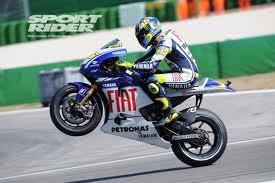
Now eighteen years later the man has returned to the place that holds bitter sweet memories for him. But he spoke like the truly brave man that he is when he said that he had no regrets and that he was quite alright with the way his career ended, when he was ahead and still on the gas. This year the return of Rainey to Misano has eclipsed everything else; Casey Stoner’s exploits aboard the Honda and Rossi’s troubles aboard the Ducati. Rossi had been the inheritor of Rainey’s legacy at Yamaha thanks to an unlikely coup that was pulled off by Lin Jarvis and Masao Furusawa. Yamaha seemed again like a manufacturer who was a worthy champion. It was Rossi’s winning ways on the Yamaha that brought Rainey back to the pit garage of the team on the odd occasion. He was once at Mugello with a beaming smile on his face and almost every time that the series went to Laguna Seca. Laguna Seca is actually what it is due to the efforts of Rainey, who spurred Marlboro and Yamaha to make it a venue for premier class motorcycle GP racing. If Misano has been bitter sweet to Rainey, it has till now been mainly bitter to Rossi with the exception of that one victory on board the M1. The circuit was of the racing calender for a long time until it made a comeback with new asphalt and a new anti clockwise direction. The irony of Misano for Rossi is that he lives less than 15 kms from the place in Tavulia. This is the real Rossi neighbourhood, but success has eluded Rossi consistently except for that one remarkable victory on the Yamaha M1. His travails on board the Ducati do not suggest an end to his bitter memories anytime soon. Maybe it is time to change the brew for Rossi. ‘Oive had too many p(o)ints of bitter ma(y)te, how but some fresh l(o)ime and sugar eh’.


