The Nano from Tata has had a baptism by fire, literally. However, if the last two months are anything to go by the Nano seems to be regaining lost ground. It has sold in excess of 8,000 units in February and March, 2011. That is good considering the fact that in November of 2010 it sold a mere 500 plus units. But if you take the larger picture of the car market, the Maruti Alto which is costlier than the Nano has sold more than 30,000 cars per month in the same two months. It is obvious Nano still has a long way to the top.
Yearly Archives: 2011
Sports car maker Maserati of Italy, now owned by FIAT is coming to India today. It will have dealerships in New Delhi and Mumbai for now but it is expected that the company will set up dealerships in other cities in a phased manner. It is believed that the first model that will be on sale will be the Quatro Porte and will be followed by others. All cars will most likely come in as completely built units, so one can expect prices to be in crores of rupees.
Bentley has been in India for a while now. Internationally, the old Continental GT has been replaced by a new one and that is now coming to India. Needless to say it will continue to stay in the stratosphere. The specs of the car will follow shortly.
Rajiv Bajaj has been quoted as saying that by the end of this year the popular Pulsar and Discover models will be all new. The internet has been abuzz with the news that a new Pulsar 250 is in the final stages of testing. Some reported that it will be a parallel twin and others say that it will be a single cylinder unit with features and specs comparable to the Honda CBR 250R but will come at even more affordable price. Let us wait and see.
The 250cc segment is where some action is taking place in the bike market. The Ninja 250R came first followed by the CBR 250R very recently. Suzuki India has said that it will launch the GW 250 parallel twin during the festive season this year and speculation is rife that Yamaha will also release a 250cc motorcycle based on the FZ series around the same time. Mahindra will release its Mojo (300 cc) towards the end of the year and come next year Garware Motors in collaboration with Hyosung will launch the GT 250. An earlier model of this bike was sold by Kinetic Motors with whom Hyosung had collaboration. It was then called the Comet.
In the recent past Tata Motors, Hyundai India have either expressed an intent to increase prices or have increased prices. Now Maruti Suzuki is increasing its prices. There will be an increase upto Rs. 9,000 on all models that the company makes.

Back in the day when Mel Gibson was announcing his presence with the now cult flick, the king of the road for many a year was the Kawasaki Z1000. The 80s changed all that. Enter Yamahas V-Max. With drag racing gaining popularity, the fortuitous history of the V-Max is now part of folklore. The piano maker just went heavy metal, with a vengeance. Move over Van Halen. The other V is tapping at your doorstep.
Little did Aaraki-san (Project leader of the V-Max back in 1984, a design which underwent little changes in 20 years of production!) know that witnessing a bridge race on the Mississippi where adrenaline junkies went hell for rubber down a straight stretch that one day he would be able to not just fulfil his aim of building the ultimate straight line rocket but also see it last and outlast a lot of its competitors and still go strong for a second coming.

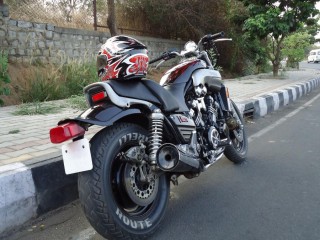
We visit the power cruiser that started the bruiser trend. I used to think the Z1000 handled like a dragon in heat, that notion changed after attempting a 60mph sharpish corner on the V-Max. There is something about these old missiles, point and shoot. Dont turn, just hang on and enjoy the ride. More on that later!
The design team led by Araki-san spent a month in isolation with a goal in mind. To create a machine whos only aim was to decimate anything in a straight line. To say that that goal was achieved is an understatement, just try out-accelerating one on any of the current plastic litres and watch how a 20 year old all metal, sorry, all mental muscle hauls its 300kgs alongside your plastic ass inline 4. Making you feel like a little child who’s just been taught that papa has speed, and muscle too. Cant argue much with that.

Yamaha at the time of The Max wasn’t setting award winning sales pitches and their Venture Royal was a capable bike but it was no Goldwing. What do you do? Take that formidable engine, tweak it to a 130hp, give it a 110 Nm of torque to go with a shorter than cruiser standard wheelbase (1590 mm) and for good measure, add something called V-Boost. Sounds good, V-Boost, works fine too. Little too fine. It takes a carefully practised throttle hand to both not lay down burnt rubber everywhere, or to lay it down anyway. A system which essentially opens butterfly valves in the intake manifold from 5000 rpm on to match the speeds sent by the ignition system (read by a black box which sends a computed signal to a servo motor which then pulls the wire opening the valves..) has been responsible for revolutionising the concept of motorcycling. Big, Heavy, Fast, Unsafe, much like the sports bikes of its time, but also, as comfortable as a motorcycle can get, unlike the sports bikes of its time. The only thing stopping you from a 100 mile sojourn at the drop of a hat was the crazily thirsty mill. Thank god gentlemens agreements weren’t in existence back in the 80s!

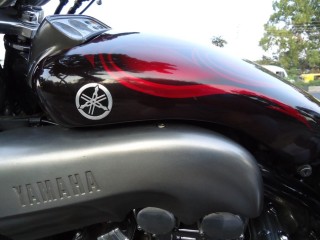
So we hop on to the 1st gen V-Max, partly due to nostalgia, partly to sample how different it is from its current counterpart. The faux scoops still look the part, and the bike still has what it takes to scare someone shitless, but there is something charming about the 1st gen V-Max, perhaps its the all metal look with little plastic where needed, perhaps its that round headlight which barely lit up the road for the speeds it was capable of, perhaps it was more muscle and testosterone than the current offering, or perhaps we are taking nostalgia too far.
Turn the key and flick the kill switch and you hear the distinctive drone of the fuel pump, take note, it’s a warning sign for things to come for those unprepared or those underestimating the power of the V-Max. Thumb the starter and the giant 1200cc V-4 comes to life with a pitter patter that growls to remind you of its thirst for speed and gasoline. No potato-potato this, sample some of the many videos on youtube to hear the din it generates with the right exhaust!

So you plonk it to first and feel your arms ache as you turn it out onto the road because you’ve just gotten off from a much lighter sports bike and onto this behemoth. The weight ceases to be an issue soon enough as it is rock stable with the best C of G I have experienced on a motorcycle. You accelerate, 2000rpm, 3000, 4000, ok, this is nice, smooth, comfortable, they should make more bikes like this, then 5000, 6000, 7000, 8000..beam me up scotty! They SHOULD make more bikes like this! Gut wrenching is an often abused term which one bandies around but it fits the Max to the bill and one is thankful to the step seat which holds the now scared backside in place whilst hauling its tankish frame forward at a rate which would send shivers down a Blackbirds spine! It also helps that the bars allow for a bit of forward movement to HOLD ON DOROTHY! Kansas and a lot of other states just went bye bye.
You shift into second and stay in the power band and release again, same result, third, same story, then you brake, and this is where we tell you a little secret. The V-Max doesn’t like to slow down (to go with hating to corner), while we can live with that, it is certainly amusing to have a motorcycle with this kind of crazy acceleration which neither stops at will, nor carves a corner. So you plan to move near a drag strip. But wait, one doesn’t have to unleash it perennially, should you choose to potter about town at a decent clip, the V-Max is a very manageable motorcycle, with tonnes of charisma (halt at a stop light and look around to know what I mean) and immense road presence. And if the ignorant point out and say “Look ma, Harley!”, just twist the throttle and play with the clutch, what happens next to go with the smoking rubber will ensure you clear any doubts that this is a devil blessed V-4, and not just a cruiser.

When riding a V-Max you will make a lot of friends at the fuel stations, partly because it gives you about 8 kms to the litre, and partly because you have to perform a little magicians trick to get to the fuel tank. Smile as you see the amazed looks of those around as you slide the stand, get off the bike, go around to the back unhook the lock under the seat with your thumbs to flip open the step and then get to where the fuel cap is. I have lost count of the number of guys who peeped into the abyss(?) under the seat trying to find pandoras box where there is storage just about enough for papers, a pair of gloves, and of course the fuel tank.
All in all its a heady rush, a feeling of general bemusement, an exhilarating drama enfolding right in front of your eyes everytime you whip the throttle open yet offering one of the most comfortable rides possible when going slow. Just don’t keep it in the powerband at high speed and approach a corner wanting to slide those pegs at full lean because humans generally cannot wrestle and beat a blue whale. You may live to tell the tale, but the wet seat will tell its own story.

In todays age of motorcycles factory fitted with too much plastic, ABS, Traction control, drive modes etc, one wonders where to place the 1st gen V-Max. No where on earth fits it right because it has lived its life and done its job. If there is a motorcycle heaven out there for bikes which share these characteristics, you will find the Kawasaki Z1000 and Yamaha V-Max playing Thor and Hercules to the other also-rans.
Road test review written by Mad Max aka Mayur Mukherjee
The Tata Nano is one that has been attracting negative publicity from conception to inception and beyond. When the Nano project was announced as the Rs. One Lakh car project, skeptics sneered, environmentalists wailed and said that there would be too many Nanos on the road and that all of them would add to greater pollution levels, good Samaritans cried hoarse about how it would add to traffic problems, competitors mulled that it would be unsafe and more such blahs. The Nano survived all that and made it to the factory floor from the design board. Then a fresh set of problems in the form of Mamata Banerjee and the Trinamool Congress cropped up at Singur where Tata Motors intended to manufacture the Nano. Fights between farmers and police and the delay of the project made Tata look for other places to manufacture the Nano. So it went from the east of the country to the west after checking out the south and settled on Sanand in Gujarat. In the meantime to ensure that customer interest did not die down, Tata made the Nano at its Pant Nagar facility in Uttarakhand in limited numbers (it could only make it in limited numbers since there was no capacity there) and delivered cars to those who had paid the full cost of the car as booking amount. Even though the project had shot past the original figure of One Lakh Rupees, Tata Motors under direction from Ratan Tata himself offered the Nano at Rs. One Lakh ex factory for the no frills version.
Meanwhile Tata Motors diligently constructed their plant at Sanand at great speed and towards the last quarter of 2010 were able to clear out all bookings since by then the Sanand plant had gone on stream and also because many bookings were cancelled. But the Nanos problems were far from over and a new set cropped up. A few Nanos began combusting spontaneously. A couple combusted when being driven home from the showroom while others did so while being parked. Tata carried out an audit and also investigated into the cause of the fires and determined that there was nothing wrong with the design or manufacture and this happened due to the unauthorized fitting of remote locking. The top end Nano, the LX comes with mechanical central locking only and there is no provision for remote locking. The Nano sales nose dived again and only started picking up towards March and April of this year before a slowing down in car buying once again brought down sales numbers.
So, all the initial fears of greater pollution, traffic jams etc have proved to be unfounded since Tata Motors has only managed to sell 10,000 units of the cars for just one month and even sold as little as 505 units for one month. Compare that to the sales of the Alto from Maruti that comfortably sells over 25,000 units per month. Though those fears have been put to rest (those of pollution, traffic jams), new ones about the safety of the car have emerged. Previously people thought that the Nano would not protect its occupants in the event of a crash, but that was forgotten and new fears about being cremated alive in a Nano came to the forefront. In all this many magazines have tested the car, some even took it to Khardungla and came back to tell a happy story, one that said that the car was reliable and wonderful to drive.
At Riot Engine, we decided to check out for ourselves what the Nano was about. It was convenient that the wife of one of our staffers decided to go for the Nano and lo and behold we had a Nano to test and here is the road test. We are abstaining from giving marks or stars or any other form of scoring since those things tend to be too subjective and sometimes the same tester awards different number of marks/points/stars when asked to do so after sometime. Therefore we will only tell the story as it was experienced by us and leave out the other things to you the reader to decide. We are of the belief that the prospective purchaser of any vehicle has to road test that vehicle before making a decision for or against and not go by what the general talk surrounding a product is.

Let us start with the looks of the car. It is now quite old, it has been seen for more than three years, even though Nanos are only just beginning to find their way on to the roads. We find it a cutesy car and when the owner posted pictures of the car on Facebook, her friends, especially those abroad went ooh, wow and aaww. Everyone found it very cute. The colour of the car is Lunar Silver and the car is an LX version that comes with all bells and whistles. Now before you think too much let us tell you what the bells and whistles are. Body coloured bumpers and door handles, HVAC, mechanical central locking, fog lamps –front and rear, power windows for the front doors and that is about it. There is no power steering, and before you say, it is such a small car why does one need a power steering let us humbly submit to you that the steering is very heavy when the car is stationary and one does feel the crying need for a power assisted steering when maneuvering in small or congested spaces.

Coming to the engine of the car, it is a petrol which displaces 621 cc and produces 33 PS of power. Now don’t snicker because we too did the same and regretted later. The husband of the lady who owns the Nano owns a Kawasaki Ninja 250R which produces the same amount of power so the power output was a subject of banter till driving pointed to the obverse of what was thought. But before we get to that let us put things in perspective. The Maruti 800 in its carbureted form did not put out more than 37 PS but more importantly the diesel engine of the very heavy Ambassador only produced 35 PS and many Indians were quite satisfied with it. When you crank the engine into starting, two things strike you. First, the idle seems a little imbalanced and second it sounds like a diesel Piaggio Ape or a diesel rear engine auto from Bajaj. This has mainly to do with the location of the engine at the rear and in the interest of heat dissipation too much sound insulation has been avoided. Also the short exhaust pipe contributes in a big way to this perception.

The gear box is quite alright and gears fall into place without too much effort and the torquey engine ensures that the Nano with a weight of upto 500kgs even starts on inclines without too much effort (the incline is upward and not downward). Tata Motors says that the car should be driven upto speeds of 15 kph, 25 kph, 40 kph and 60 kph in first, second, third and fourth gears respectively for the first 1000 kilometres. The Nano has four forward gears and one reverse gear. The big and easy to read speedo meter in the centre of the car also has a digital odometer and all the other tell tale warning lights except a tachometer. The car moves off quite smoothly and changing gears is a breeze. The car can be driven in fourth gear with a 500kg passenger complement at speeds of 35 to 40 kmph comfortably. In all gears the car pulls effortlessly and driving in traffic is a breeze. The brakes though only drums all around are adequate and handle their job reasonably well.

The suspension of the car is quite alright for intra-city driving. It is not too soft or too stiff. The location of the engine at the rear is responsible for this. However driving over speed breakers can be a novel experience if you are driving the Nano for the first time. We are generally used to having weight on the front wheels, something that the Nano doesn’t have. So one will have to change their approach to speed breakers coming in more slowly than one would in other cars and exiting a little faster than when in front engine cars. The suspension keeps the occupants of the car happy and doesn’t bottom out even with a full load of heavy passengers. The steering is quite precise and the car responds well and moves in the direction that it is pointed towards. The wheels are really small but surprisingly the Nano has huge ground clearance that is more than that of the Alto, the Santro and almost in the league of SUVs. The high centre of gravity of the car means that adventurous driving is best avoided since the car reacts alarmingly to sudden steering inputs or sudden direction changes. Remember the Sumo? This is something like that. The car has understeer and one has to be careful with approach speeds for corners; come in too fast, you probably won’t turn fully or you could topple. The Nano is strictly for commuting and nothing else.
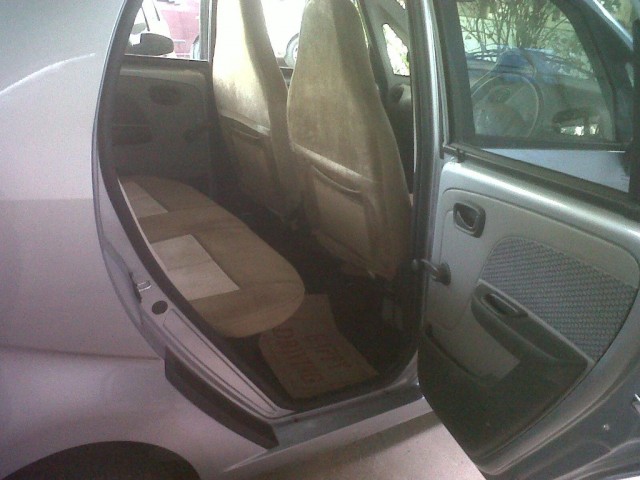
The Nano’s greatest asset has to be its space. For a car so small it comfortably seats 4 XXL adults and 5 typically sized Indians. There is no doubt that the Nano is a family car. The only thing missing is the boot space, there is none of it. The seats are nice and high and ingress and egress is most convenient with the doors opening nicely and wide. Great car for those who suffer from back problems, knee aches or have long legs. Women wearing skirts can exit gracefully without wondering if something is showing. Storage space is restricted to the two scoops in the dash board on either sides of the central console, one in front of the passenger and the other in front of the driver. There is also small little place to hold very small things next to the gear lever. The buttons for power windows are awkwardly placed in front of the gear lever and one has to bend substantially to get to them. The rear of the car (the hatch that is) cannot be opened at all. The access to the engine is by removing the rear seat. The car that was tested was also fitted with a basic JVC stereo system by the owner and despite having only two speakers, the small size of the cabin made for good acoustics. The single wiper on the front windscreen does its job quite effectively. But what is most surprising is the air conditioner. The air conditioner chilled the car within minutes in the summer heat when the car was parked in the sun for more than two hours in 42 degrees Celsius heat. Given the size of the engine the efficiency of air conditioning is nothing short of amazing. Cars with bigger engines do not cool as well and as fast. What is even more heartening is that the loss of power due to running the air conditioner is not very discernable in the city. The head lights are good with a good beam spread as are the fog lamps. But the fog lamps were only used once for testing since they can create problems for oncoming traffic in the absence of a fog.

The owner of this Nano is very proud of her car. She says she has no regrets buying it and that she would only want a power steering on it and no other changes. She finds it compact and says that the car draws a lot of attention, something that we found to be true while we were testing the car. Some people even wanted to know if the stories and negative publicity around the car were true. The car was mainly tested in the city and not too many high speed runs were attempted owing to the fact that the car is still brand new. Just to check top speed one high speed run with a complement of three passengers was done and the clock showed the car doing 110kmh. Needless to say there will be an error in it. The fuel efficiency figure that we got (using the full tank to full tank method) was 14kmpl and car is still very new. The owner also confirmed a similar figure.

All in all we found that the Nano is comfortable car even though it is inexpensive. It does not appear to be cheap or badly put together even though the plastics inside are not top notch and the seats in the front have head restraints integrated into the seat itself for cost cutting reasons. The Tata dealer who sold this car informed us that most of the buyers of the Nano were preferring the top end version of the car i.e is the LX variant and that most of the buyers were using this as their second or third car. Women customers outnumber men was what the dealer said. Now if only Tata can sell this car properly, it would be nice, for the car while not being spectacular in anything, is a competent all rounder which deserves better numbers than it is doing.